

Lazy, typed string splitting helpers for Python, backed by Rust.




isplit scans a string once and yields pieces as soon as separators are found.
It is useful for tokenizer-style code where callers want to consume tokens
lazily instead of allocating the whole split result up front.
The iterator implementation is backed by a small PyO3 Rust extension when available, with the original pure-Python implementation kept as a fallback.
Installation
python -m pip install isplit-rs
The PyPI distribution is named isplit-rs, while the Python package is imported
as isplit.
Quick start
from isplit import irsplit, isplit

list(isplit("A+B+C+D", "+"))
# ["A", "B", "C", "D"]

list(isplit("AAA,,BBB", ",,"))
# ["AAA", "BBB"]

list(irsplit("A+B+C+D", "+"))
# ["D", "C", "B", "A"]
Or consume pieces lazily:
from isplit import isplit

for token in isplit("AAA,BBB,CCC", ","):
    print(token)
Why isplit?
| Feature | What it gives you |
|---|---|
| Lazy iteration | Consume split pieces one at a time |
| Forward and reverse splits | Use isplit or irsplit depending on scan direction |
| Rust acceleration | Use the PyO3 extension when available |
| Pure-Python fallback | Keep imports working even without the extension |
| Typed package | Ship a py.typed marker for type checkers |
Performance
isplit is designed for lazy, partial consumption. When you need every piece
as a list, CPython's built-in str.split is usually the best choice. When you
only need the first few pieces from a larger string, isplit can stop before
splitting the rest of the input.
One local CPython 3.12 / macOS arm64 run, extracting only the first field with the first separator at index 8:
| Input size | split(",")[0] |
split(",", 1)[0] |
partition(",")[0] |
next(isplit(...)) |
|---|---|---|---|---|
| ~1 MB | 1774.0 us | 14.6 us | 16.2 us | 0.3 us |
| ~100 KB | 140.7 us | 1.9 us | 2.0 us | 0.3 us |
| ~10 KB | 13.4 us | 0.8 us | 0.6 us | 0.3 us |
| ~1 KB | 1.8 us | 0.4 us | 0.3 us | 0.3 us |
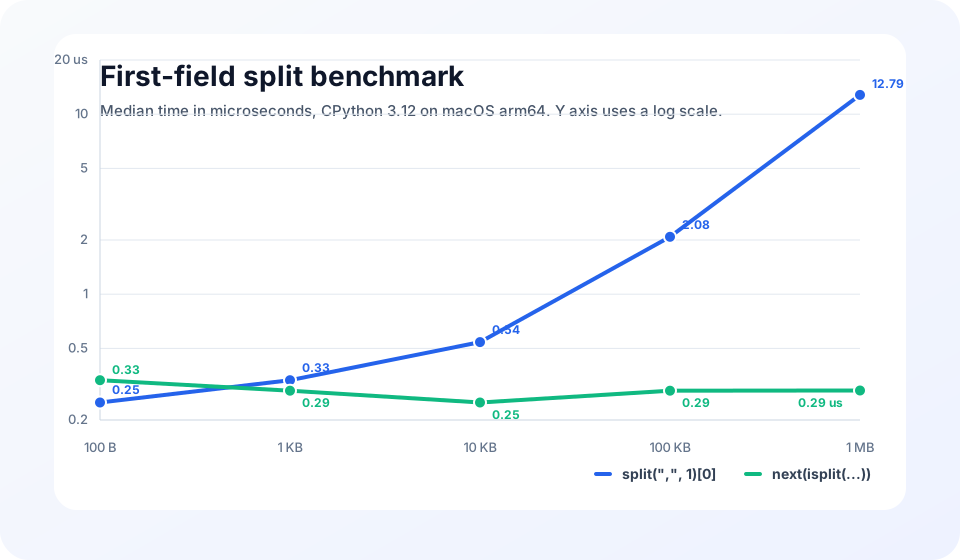
In other words, isplit helps most when it avoids unnecessary work. For small
strings, the difference is tiny; for larger strings, avoiding a full split can
matter.
Run the benchmark locally:
uv run python scripts/benchmark_split.py
API
isplit(text: str, sep: str) -> Iterator[str]
irsplit(text: str, sep: str) -> Iterator[str]
isplit(text, sep)yields pieces from left to right.irsplit(text, sep)yields pieces from right to left.
Both functions follow str.split semantics for non-empty separators and raise
ValueError when sep is empty.
Verify Rust acceleration
Installed wheels include the native Rust extension. To check that your environment is using it:
python - <<'PY'
import isplit._rust as rust

print(rust.__file__)
print(list(rust.isplit("A+B+C", "+")))
PY
The printed path should point to a compiled extension such as
isplit/_rust.abi3.so on Linux/macOS or isplit/_rust.pyd on Windows.
1 maintainer

Metadata
1 maintainer
Release files for isplit-rs 0.3.0
For a detailed explanation of source distributions (sdists) and built distributions (wheels), please see the package formats documentation.
Source distribution (sdist)
| File | Size | Uploaded | Provenance | Actions |
|---|---|---|---|---|
| isplit_rs-0.3.0.tar.gz | 13.4 kB | With provenance | Details for isplit_rs-0.3.0.tar.gz |
Built distributions (wheels)
| File | Interpreter | ABI | Platform | Actions Reset |
|---|---|---|---|---|
| isplit_rs-0.3.0-cp39-abi3-win_amd64.whl | CPython 3.9 | abi3 | Windows x86-64 | Details for isplit_rs-0.3.0-cp39-abi3-win_amd64.whl |
| isplit_rs-0.3.0-cp39-abi3-manylinux_2_28_x86_64.whl | CPython 3.9 | abi3 | Linux glibc 2.28+ x86-64 | Details for isplit_rs-0.3.0-cp39-abi3-manylinux_2_28_x86_64.whl |
| isplit_rs-0.3.0-cp39-abi3-macosx_11_0_arm64.whl | CPython 3.9 | abi3 | macOS 11.0+ ARM64 | Details for isplit_rs-0.3.0-cp39-abi3-macosx_11_0_arm64.whl |
Total release size: 637.8 kB
Release files / isplit_rs-0.3.0.tar.gz
| Download URL | isplit_rs-0.3.0.tar.gz |
|---|---|
| Size | 13.4 kB |
| Tags | Source |
|
SHA-256 checksum How to use checksums |
e7f10b7e97700e3b412f85776735a8f4d968a79d1e92e16ac0b14de259967edd
|
|
BLAKE2b-256 checksum How to use checksums |
ef9440b3e892ecda9123575cd18e09054816fb534feca7f069a08773e1d4667d
|
| Upload date | |
|
Uploaded using Trusted Publishing? What is trusted publishing? |
Yes |
| Uploaded via |
twine/7.0.0 CPython/3.13.14
|
Provenance
Provenance describes where a file came from. On PyPI, provenance is shared via attestations, which provide a verifiable record of the build or publishing details. View details, limitations and caveats.


PyPI Publish Attestation
PyPI verified that this artifact, at this checksum, originated from the publisher listed below.
Signed by GitHub Actions, verified by PyPI on Sep 15, 2026.
Transparency logRelease files / isplit_rs-0.3.0-cp39-abi3-win_amd64.whl
| Download URL | isplit_rs-0.3.0-cp39-abi3-win_amd64.whl |
|---|---|
| Size | 127.8 kB |
| Tags | CPython 3.9 Windows x86-64 abi3 |
|
SHA-256 checksum How to use checksums |
0b45c8a824e6ed0cfadda2a556398ed6b33253c891fcccd82f60064af33a4a65
|
|
BLAKE2b-256 checksum How to use checksums |
74a123ce7ad3d7cd980de2f15b3c430ca14398376a2b8d290d9de52c51dabe8f
|
| Upload date | |
|
Uploaded using Trusted Publishing? What is trusted publishing? |
Yes |
| Uploaded via |
twine/7.0.0 CPython/3.13.14
|
Provenance
Provenance describes where a file came from. On PyPI, provenance is shared via attestations, which provide a verifiable record of the build or publishing details. View details, limitations and caveats.
PyPI Publish Attestation
PyPI verified that this artifact, at this checksum, originated from the publisher listed below.
Signed by GitHub Actions, verified by PyPI on Sep 15, 2026.
Transparency logRelease files / isplit_rs-0.3.0-cp39-abi3-manylinux_2_28_x86_64.whl
| Download URL | isplit_rs-0.3.0-cp39-abi3-manylinux_2_28_x86_64.whl |
|---|---|
| Size | 267.0 kB |
| Tags | CPython 3.9 Linux glibc 2.28+ x86-64 abi3 |
|
SHA-256 checksum How to use checksums |
c4575ee4a693ee57dadaeb50723a3c585697f7bb14ab24ea74e25221b1a49478
|
|
BLAKE2b-256 checksum How to use checksums |
601ec902e58e838e099b6754b1d15f5a55526af00e78ae49d8541122035fa1b0
|
| Upload date | |
|
Uploaded using Trusted Publishing? What is trusted publishing? |
Yes |
| Uploaded via |
twine/7.0.0 CPython/3.13.14
|
Provenance
Provenance describes where a file came from. On PyPI, provenance is shared via attestations, which provide a verifiable record of the build or publishing details. View details, limitations and caveats.
PyPI Publish Attestation
PyPI verified that this artifact, at this checksum, originated from the publisher listed below.
Signed by GitHub Actions, verified by PyPI on Sep 15, 2026.
Transparency logRelease files / isplit_rs-0.3.0-cp39-abi3-macosx_11_0_arm64.whl
| Download URL | isplit_rs-0.3.0-cp39-abi3-macosx_11_0_arm64.whl |
|---|---|
| Size | 229.7 kB |
| Tags | CPython 3.9 abi3 macOS 11.0+ ARM64 |
|
SHA-256 checksum How to use checksums |
c0ae83e0737cec21a6d6372be06e2d79d4135aae9c76427100ca4952a40e8486
|
|
BLAKE2b-256 checksum How to use checksums |
118a6e4dfce11c0e88814a9bf2a968c31f6317c0ad05d27f6c1f54f66fc8d8b3
|
| Upload date | |
|
Uploaded using Trusted Publishing? What is trusted publishing? |
Yes |
| Uploaded via |
twine/7.0.0 CPython/3.13.14
|
Provenance
Provenance describes where a file came from. On PyPI, provenance is shared via attestations, which provide a verifiable record of the build or publishing details. View details, limitations and caveats.
PyPI Publish Attestation
PyPI verified that this artifact, at this checksum, originated from the publisher listed below.
Signed by GitHub Actions, verified by PyPI on Sep 15, 2026.
Transparency logSecurity for isplit-rs 0.3.0
Provenance
Provenance describes where a file came from. On PyPI, provenance is shared via attestations, which provide a verifiable record of the build or publishing details. View details, limitations and caveats.
Full provenance
All 4 files in this release have been uploaded with provenance metadata.
Attestation for isplit_rs-0.3.0.tar.gz
PyPI Publish Attestation
PyPI verified that this artifact, at this checksum, originated from the publisher listed below.
Signed by GitHub Actions, verified by PyPI on Sep 15, 2026.
Transparency logA note on package security
PyPI is a repository for distributing packages, not a service for auditing them. While third-party security researchers and our staff do their best to detect and remove malicious packages, PyPI cannot guarantee the quality, security or suitability of any given package.
To learn more about protecting yourself from malicious actors, visit our package security documentation.














