

itasca-mcp





itasca>model new ;now, with LLM.
itasca-mcp connects AI agents to ITASCA's geomechanics simulation software — PFC, FLAC, 3DEC, MPoint, and MassFlow — through the Model Context Protocol. Browse documentation, run simulations, and execute code, all through natural conversation.
itasca>model solve ;LLM solves.

Tools (10)
5 documentation tools — browse and search the selected engine's commands, Python API, and reference docs. No bridge required.
5 execution tools — interactive REPL, task submission, progress monitoring, interruption, and history. Requires bridge.
Example Prompts
- "Run a biaxial compression test on a dense specimen and plot the stress–strain curve"
- "Build a slope model in FLAC3D and find the factor of safety"
- "Model a tunnel excavation in jointed rock with 3DEC and check block displacements around the opening"
- "Simulate a landslide runout with MPoint and report the final deposit profile"
- "The simulation is still running — check the current unbalanced force without stopping it"
- "What's different about the
zonecommands between FLAC 7.0 and 9.0?"
First-time Setup
Prerequisites
- An ITASCA engine installed — PFC, FLAC, 3DEC, MPoint, or MassFlow. 9.0+ recommended; PFC 6.0 / 7.0, FLAC 7.0, and 3DEC 7.0 are also supported.
- uv installed (for
uvx) - An AI agent — Claude Code, Codex CLI, Gemini CLI, or any MCP-capable client
Agentic Setup (Recommended)
Copy this to your AI agent and let it self-configure:
Fetch and follow this bootstrap guide end-to-end:
https://raw.githubusercontent.com/yusong652/itasca-mcp/main/docs/agentic/itasca-mcp-bootstrap.md
Manual Setup
1. Register the MCP server with your agent.
Most agents register it with a single command:
# Claude Code
claude mcp add itasca-mcp -- uvx itasca-mcp

# Codex / Codex-cli
codex mcp add itasca-mcp -- uvx itasca-mcp

# Gemini CLI
gemini mcp add itasca-mcp uvx itasca-mcp
Or fill in the MCP config file manually:
{
  "mcpServers": {
    "itasca-mcp": {
      "command": "uvx",
      "args": ["itasca-mcp"]
    }
  }
}
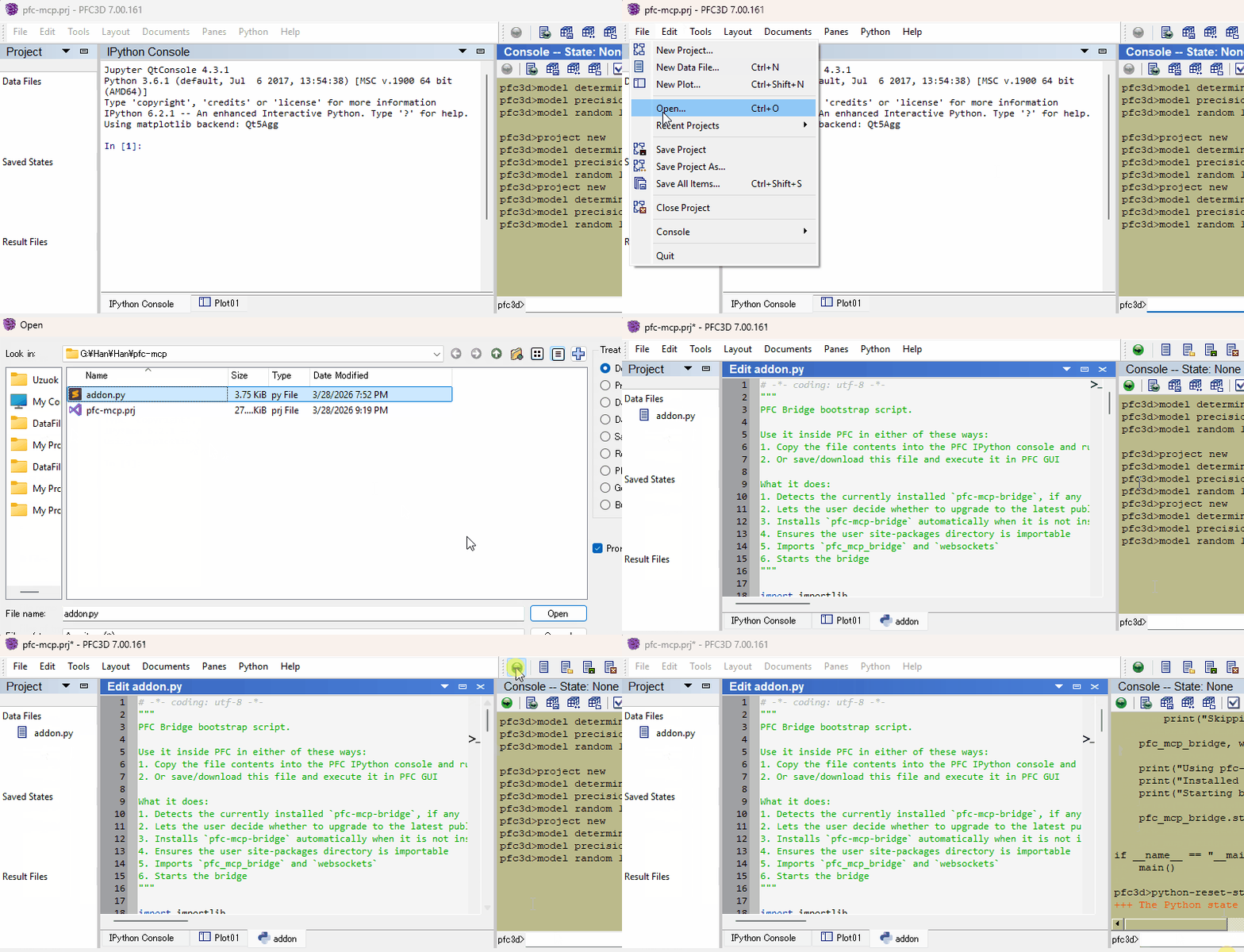
2. Start the bridge from inside the ITASCA engine:
Download addon.py, then use either of these two flows inside the engine GUI (PFC, FLAC, 3DEC, ...):
- Copy the file contents into the engine's IPython console and run them
- Or download the file and execute it in the engine GUI
Verify
Restart your AI agent and ask it to call itasca_execute_code to verify the connection.
Daily Startup
Once first-time setup is done, each new engine session only needs the bridge re-started — run this in the engine's IPython console and you're back online:
import itasca_mcp_bridge
itasca_mcp_bridge.start()
start() checks PyPI for a newer bridge release and self-upgrades before starting. The MCP client config persists.
Features
- Multi-engine corpus - command, Python API, and reference docs for PFC, FLAC, 3DEC, MPoint, and MassFlow, selected via the required
softwareparameter - Multi-version support - command docs across engine versions (PFC: 6.0/7.0/9.0, FLAC: 7.0/9.0, 3DEC: 7.0/9.0) via the
versionparameter - Hierarchical documentation browsing - agents navigate the engine command tree to discover capabilities and boundaries, reducing hallucinated commands
- Enhanced plot documentation - plot items reference docs supplementing the official documentation
- Live REPL alongside running tasks - execute code while a simulation is running: check model state and intermediate results without stopping the task; also useful for quick iteration before writing a full script
- Task lifecycle management - submit long-running simulations, monitor progress, interrupt running tasks, and browse task history
- Agent-started bridge - an AI agent can start the bridge itself through the engine's
console.exe - Multi-client compatible - works with Claude Code, Codex CLI, Gemini CLI, GitHub Copilot CLI, OpenCode, toyoura-nagisa, and other MCP clients
Troubleshooting
See Troubleshooting in the bootstrap guide.
Development
See Developer Guide: Install and Run from Source.

Contributing
PRs and issues are welcome! See CONTRIBUTING.md for where changes land and how the documentation corpus is structured, and the Developer Guide for the source install.
License
MIT - see LICENSE.
1 maintainer

Release files for itasca-mcp 0.9.0
For a detailed explanation of source distributions (sdists) and built distributions (wheels), please see the package formats documentation.
Source distribution (sdist)
| File | Size | Uploaded | |
|---|---|---|---|
| itasca_mcp-0.9.0.tar.gz | 1.7 MB | Details |
Built distribution (wheel)
| File | Interpreter | ABI | Platform | Reset |
|---|---|---|---|---|
| itasca_mcp-0.9.0-py3-none-any.whl | Python 3 | none | any | Details |
Total release size: 3.9 MB
Release files / itasca_mcp-0.9.0.tar.gz
| Download URL | itasca_mcp-0.9.0.tar.gz |
|---|---|
| Size | 1.7 MB |
| Tags | Source |
|
SHA-256 checksum How to use checksums |
c3ce346ff63da8d0404e78e723be8581f10037928525b86cdae2583b75a7398c
|
|
BLAKE2b-256 checksum How to use checksums |
49a715f67ef015eaf700c0a4c6e3e41bbfed35671c3e732d7191d1a7cabfebcc
|
| Upload date | |
|
Uploaded using Trusted Publishing? What is trusted publishing? |
Yes |
| Uploaded via |
twine/7.0.0 CPython/3.13.14
|
Provenance
Provenance describes where a file came from. On PyPI, provenance is shared via attestations, which provide a verifiable record of the build or publishing details. View details, limitations and caveats.


PyPI Publish Attestation
PyPI verified that this artifact, at this checksum, originated from the publisher listed below.
Signed by GitHub Actions, verified by PyPI on Sep 19, 2026.
Transparency logRelease files / itasca_mcp-0.9.0-py3-none-any.whl
| Download URL | itasca_mcp-0.9.0-py3-none-any.whl |
|---|---|
| Size | 2.2 MB |
| Tags | Python 3 |
|
SHA-256 checksum How to use checksums |
411eb78e729b9312503817730847efc10dbe3c10d97e8608e0e1d5fd2dbc6b0e
|
|
BLAKE2b-256 checksum How to use checksums |
f573bdfa45e65f17025a3c50e648d3c563822a577ec35cba22bfc16945fbe0ff
|
| Upload date | |
|
Uploaded using Trusted Publishing? What is trusted publishing? |
Yes |
| Uploaded via |
twine/7.0.0 CPython/3.13.14
|
Provenance
Provenance describes where a file came from. On PyPI, provenance is shared via attestations, which provide a verifiable record of the build or publishing details. View details, limitations and caveats.
PyPI Publish Attestation
PyPI verified that this artifact, at this checksum, originated from the publisher listed below.
Signed by GitHub Actions, verified by PyPI on Sep 19, 2026.
Transparency log













