
Janus
Jev says it's 100% sure. Is it? On 500 Banking77 examples it is right 95.8% of the time. On 500 Web of Science abstracts, 76.7%.
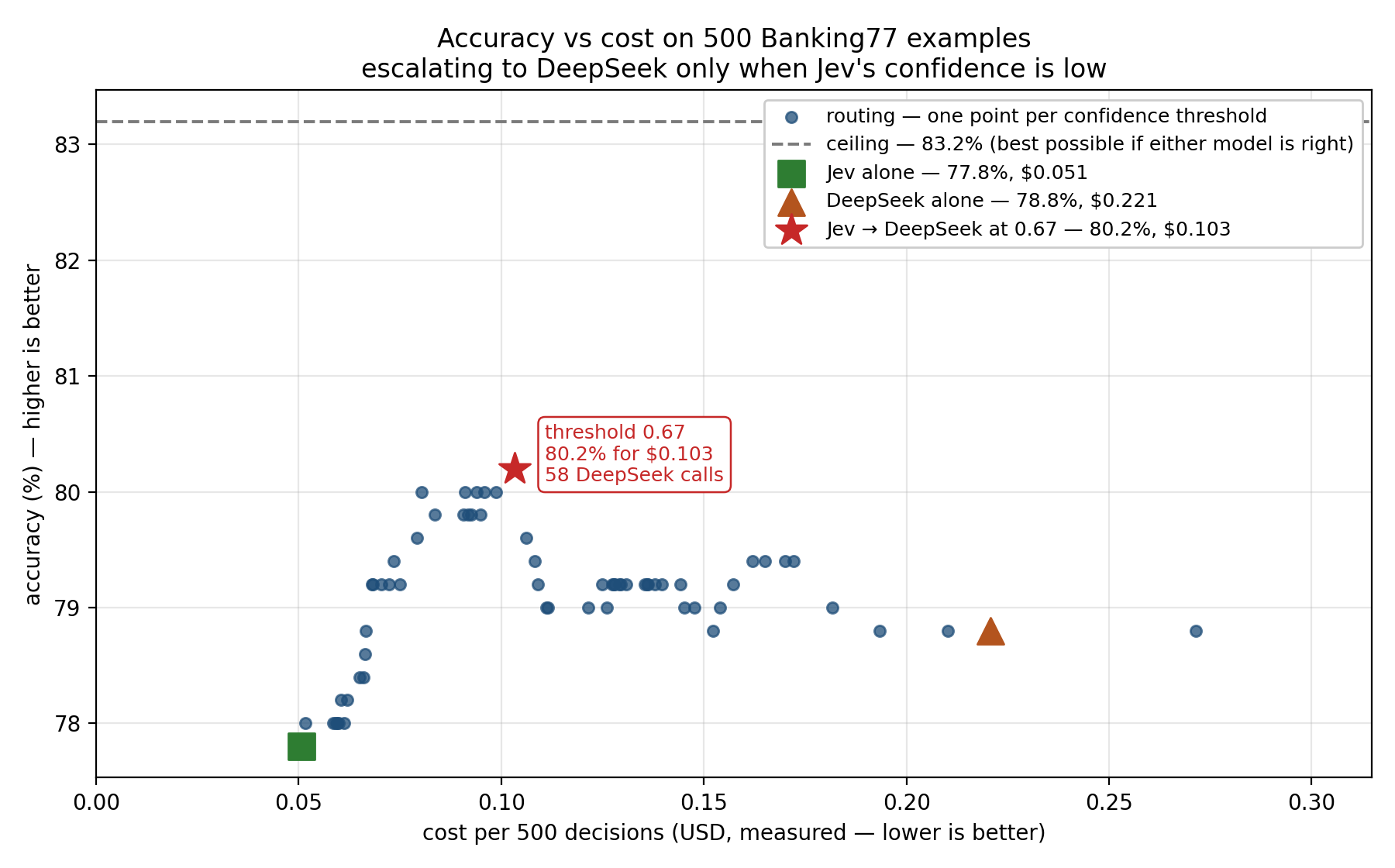
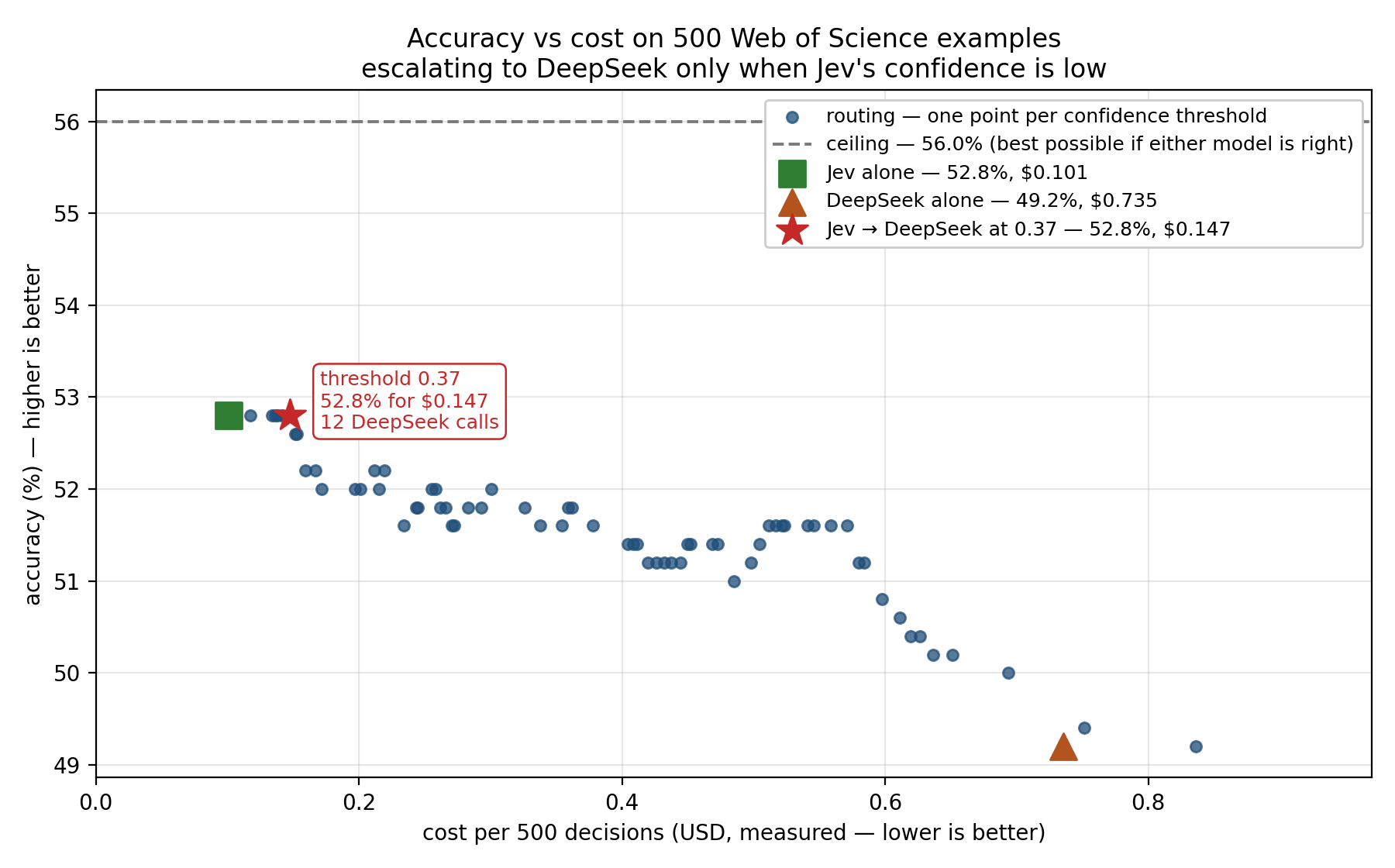
Routing on that signal reaches 80.2% at $0.1033 per 500 decisions on Banking77, against 78.8% at $0.2207 for DeepSeek V4-Pro alone. On Web of Science the same routing ties Jev alone — 52.8% either way — for 46% more money.
Two datasets, opposite outcomes. None of the routing parameters measured on the first held on the second — not the optimal threshold, not the sign of the accuracy gap between the two models, not the size or the accuracy of the saturated confidence level, and not whether routing paid for itself at all.
TL;DR
Banking77 — 500 examples, 77 intent classes:
- Jev alone: 77.8% accuracy at $0.0507 / 500 decisions.
- DeepSeek alone: 78.8% accuracy at $0.2207 / 500 decisions.
- Jev → DeepSeek at 0.67: 80.2% accuracy at $0.1033 / 500 decisions, with DeepSeek called on 11.6% of requests.
Web of Science — 500 abstracts, 145 subject classes:
- Jev alone: 52.8% accuracy at $0.1006 / 500 decisions.
- DeepSeek alone: 49.2% accuracy at $0.7355 / 500 decisions.
- Jev → DeepSeek at 0.37: 52.8% accuracy at $0.1474 / 500 decisions, with DeepSeek called on 2.4% of requests — the same accuracy as Jev alone, for more money.
Jump to the second dataset · what transfers between them
This repository measures the calibration of TypeSafe's Jev decision model and evaluates confidence-based routing: a Jev → fallback cascade that escalates only what Jev is unsure about. It answers one question: at what confidence level can Jev decide on its own, rather than paying a larger model, for a given accuracy target?
The protocol was frozen before any result was looked at
(commit 2384a6b). The dataset, the raw results and the
analysis code are all in this repository.
Quickstart
Five minutes, on your own data. Janus ships no default threshold: it measures one.
1. Install
pip install "janus-decide[typesafe,deepseek]"
The bare package depends only on numpy; each backend is an extra. DeepSeek speaks the
OpenAI protocol, so [deepseek] and [openai] pull the same client.
2. Prepare a labelled JSONL — one object per line, three fields:
{"id": 0, "text": "I lost my card", "gold_label": "lost_or_stolen_card"}
{"id": 1, "text": "when does my card arrive", "gold_label": "card_arrival"}
and a label file naming every class you allow:
{
  "instructions": "Which banking intent does this customer query express?",
  "labels": {
    "lost_or_stolen_card": "The card has been lost or stolen.",
    "card_arrival": "Chasing a card that was already ordered and has not arrived."
  }
}
Start with a few hundred labelled rows; larger samples generally give more stable estimates. Ours were 500.
3. Measure
janus measure \
  --dataset mydata.jsonl --labels mylabels.json \
  --primary typesafe:jev-latest \
  --fallback deepseek:deepseek-v4-pro \
  --out janus.json
Try --sample 20 --seed 1 first: it checks the wiring and the real cost per call
before you spend on the full set. --budget 2.00 stops the run if the projected cost
goes over. An interrupted run resumes by id without re-paying for a completed call.
4. Read the table. This is the real output for the Banking77 data in this repository:
  rule                         thr     cov     acc       cost      p50
  always_primary                 - 100.0%  77.8%     0.0507    296ms
  always_fallback                -   0.0%  78.8%     0.2207   2269ms
  primary_if_confidence_ge    0.67  88.4%  80.2%     0.1033    302ms

VERDICT: ROUTE
  rule      : primary_if_confidence_ge
  threshold : 0.67
  reason    : beats the better single model by +1.4%
  ceiling   : 83.2% (this pair of models, not the task)
The full sweep is written to the measurement report.
Three columns decide it. acc — routing is more accurate here than either model on its own. cost — it costs less than half of the fallback alone. p50 — the median decision still answers in about 300 ms, because most requests never escalate; the fallback alone takes 2.3 seconds. If you are building anything interactive, that last column matters before the other two.
measure can also conclude DO NOT ROUTE, which is what it does on the second
dataset in this repository: no threshold beat the better single model, so the policy
runs that model alone rather than paying for an escalation that buys nothing.
5. Route from Python
from janus import Router, question_from_json, resolve

question = question_from_json("mylabels.json")
router = Router.from_file(
    "janus.json",
    primary=resolve("typesafe:jev-1.13.0"),     # the resolved version, not the alias
    fallback=resolve("deepseek:deepseek-v4-pro"),
)

decision = router.decide(input="I lost my card", question=question)
decision.label       # "lost_or_stolen_card"
decision.source      # "primary" | "fallback"
decision.escalated   # False
decision.cost_usd    # from real tokens; None when the rate is unknown
Pin the resolved version here rather than an alias: an alias moves when a release
ships, and a threshold measured on one version does not transfer to the next. Aliases
are fine in janus measure, which records whatever the API actually answered.
When the models do change under you, janus check says so, and Router raises
instead of quietly applying a threshold measured on something else. janus explain
shows why one input escalated and another did not.
Results — Banking77
500 examples from the Banking77 test split, 77 intent labels, one call per example.
| Strategy | Accuracy | Cost / 500 | DeepSeek calls |
|---|---|---|---|
| Jev only | 77.8% | $0.0507 | 0 |
| DeepSeek V4-Pro only | 78.8% | $0.2207 | 500 |
| Cascade @ 0.67 | 80.2% | $0.1033 | 58 (11.6%) |
| Oracle | 83.2% | — | — |
What this means: On this dataset, confidence-based routing improves accuracy over either model alone while reducing DeepSeek usage; the disagreements where DeepSeek is correct are concentrated at lower Jev confidence levels.
The cascade keeps Jev's answer when its confidence reaches the threshold and escalates otherwise. Its cost always includes Jev on all 500 requests — the confidence has to be obtained before anything can be routed on it — plus DeepSeek on the escalated fraction. Both figures are measured per row, not estimated from a list price: the DeepSeek side accounts for the cache hit/miss split and the hourly rate in force at the time of each call.
The oracle counts an example as correct when either model got it right. It is the ceiling of this cascade, not of the task.
Second dataset: Web of Science
Same pipeline, same metrics, same guard rails, same pre-registered targets. Only the dataset changes: 500 abstracts from the WOS-46985 corpus, 145 subject classes across 7 parent domains, against Banking77's 77 intent classes.
| Strategy | Accuracy | Cost / 500 | DeepSeek calls |
|---|---|---|---|
| Jev only | 52.8% | $0.1006 | 0 |
| DeepSeek V4-Pro only | 49.2% | $0.7355 | 500 |
| Cascade @ 0.37 | 52.8% | $0.1474 | 12 (2.4%) |
| Oracle | 56.0% | — | — |
The cascade loses on this dataset. It reaches 52.8%, which is exactly what Jev alone reaches, and it costs $0.1474 against $0.1006 — 46% more for the same accuracy. This is not a neutral outcome: paying more for no gain is a worse operating point than not routing at all. On Banking77 the same rule gained 1.4 points for roughly half the cost of the fallback. Without measuring on your own data, you cannot tell which of the two situations you are in.
The threshold was not chosen by hand on either dataset. It falls out of the sweep over every observed confidence level, and 0.37 is simply where accuracy peaks here.
Pre-registered targets
| Target | Status | Best threshold reached |
|---|---|---|
| 90% | unattainable | 0.37 → 52.8% (−37.2 points) |
| 95% | unattainable | 0.37 → 52.8% (−42.2 points) |
| 98% | unattainable | 0.37 → 52.8% (−45.2 points) |
The targets were fixed before any frontier run and are not revised. On Banking77 they were already out of reach because the fallback itself reached only 78.8%; here the fallback reaches 49.2%.
Calibration
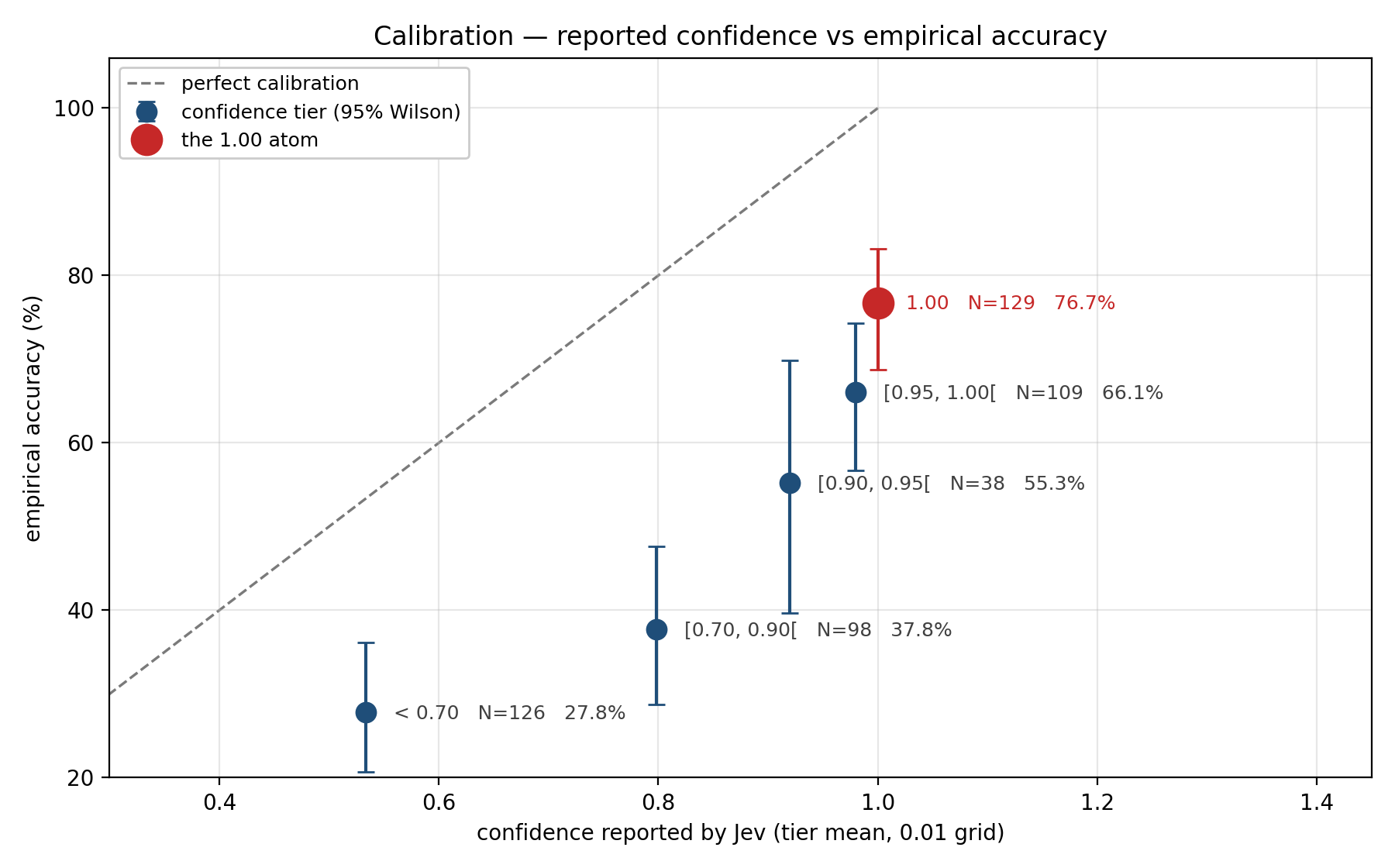
Every tier again sits below the diagonal. The saturated level holds 25.8% of the traffic at 76.7% accuracy, where on Banking77 it held 47.6% at 95.8%.
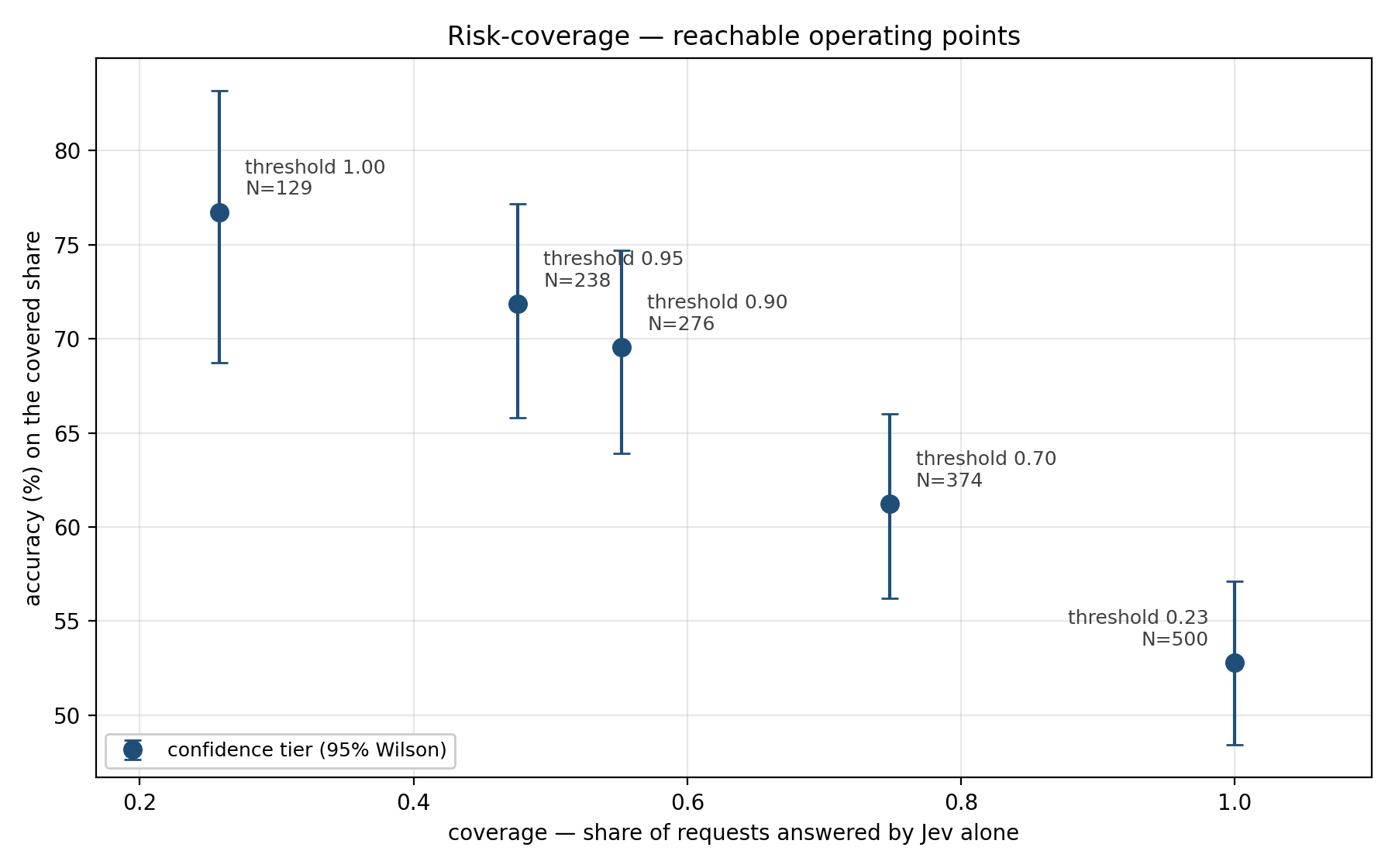
Over the 371 rows outside the saturated level, the paired bootstrap separates none of
the four statistics — all three differences against confidence span zero, where on
Banking77 two of them excluded it.
| Statistic | AUROC | Difference vs confidence (95% CI) |
|---|---|---|
confidence |
0.690 | — |
entropy_norm |
0.697 | −0.008 [−0.023, +0.006] |
margin_top2 |
0.681 | +0.009 [−0.000, +0.018] |
ratio_top2 |
0.677 | +0.013 [−0.001, +0.025] |
Ground truth on this dataset is weaker, and it matters here
This reservation carries as much weight as the result above. The WOS categories come from publication metadata, not from an annotator who read each abstract, and the taxonomy is hierarchical, so many classes are near-synonyms inside one parent domain.
Of the 220 errors both models make, 57.3% stay inside the gold's own parent domain. The most frequent shared (gold → prediction) pairs are defensible answers rather than plain mistakes:
6  biochemistry/Southern blotting   → biochemistry/Molecular biology
4  biochemistry/Northern blotting   → biochemistry/Molecular biology
4  ECE/Electric motor               → ECE/Control engineering
3  Medical/Polycythemia Vera        → Medical/Cancer
2  Psychology/Person perception     → Psychology/Social cognition
Southern blotting is molecular biology; polycythemia vera is a blood cancer. The
52.8% accuracy and the 56.0% oracle may reflect the weakness of the labels as much as
the difficulty of the task, and this repository does not separate the two. The
Banking77 numbers carry the same caveat in milder form, and data/README.md states
both in full.
Cost of the run
$0.8361 in total — $0.7355 for DeepSeek and $0.1006 for Jev. The cache hit rate fell to 92.1% from Banking77's 97.9%, since the variable part of the prompt grew from a few words to a full abstract; billing the input without separating cache hits from misses would have read $1.9964 instead.
What transfers between the two datasets
Every routing parameter measured on Banking77 came out differently on Web of Science.
| Banking77 | Web of Science | |
|---|---|---|
| classes | 77 | 145 |
| accuracy, Jev | 77.8% | 52.8% |
| accuracy, DeepSeek | 78.8% | 49.2% |
| gap, Jev − DeepSeek | −1.0 pt (frontier ahead) | +3.6 pt (Jev ahead) |
| oracle | 83.2% | 56.0% |
| share of traffic at the 1.00 level | 47.6% | 25.8% |
| accuracy at the 1.00 level | 95.8% | 76.7% |
| optimal threshold | 0.67 | 0.37 |
| accuracy at that threshold | 80.2% | 52.8% |
| escalated at that threshold | 11.6% | 2.4% |
| cost at that threshold | $0.1033 | $0.1474 |
| best single model | 78.8% | 52.8% |
| cascade beats it? | yes, +1.4 pt | no, +0.0 pt |
derived statistics vs confidence |
two intervals excluded zero | all three span zero |
The sign of the accuracy gap between the two models reverses. The optimal threshold moves from 0.67 to 0.37. The saturated confidence level halves in size and loses 19 points of accuracy. The cascade goes from beating the better single model to matching it at higher cost. Each of these is a quantity a practitioner would need in order to deploy routing, and none of them could have been read off the first dataset.
METHOD.md recorded, before any of this was run, that a threshold far from 0.67 would be a result rather than a failure, and that a negative result publishes as a positive one does.
Calibration — Banking77
confidence is not a probability of being right. It is a statistic derived from
the shape of the probability distribution, and measuring what it actually predicts
is the point of this repository.
On these 500 examples, every tier sits below the diagonal: reported confidence runs ahead of measured accuracy at every level, the 1.00 atom included. That is an observation about this dataset and this model version, not a property established for other tasks.
The scale is discrete. Measured on the raw HTTP body, before any SDK parsing:
across 1,540 probability values, none falls off a 0.01 grid, and confidence has
the same granularity as probabilities. Nothing is representable between 0.99 and
1.00. On the full run, 44 values out of 38,500 sit up to one double ULP off the
grid, which is float arithmetic, not extra resolution.
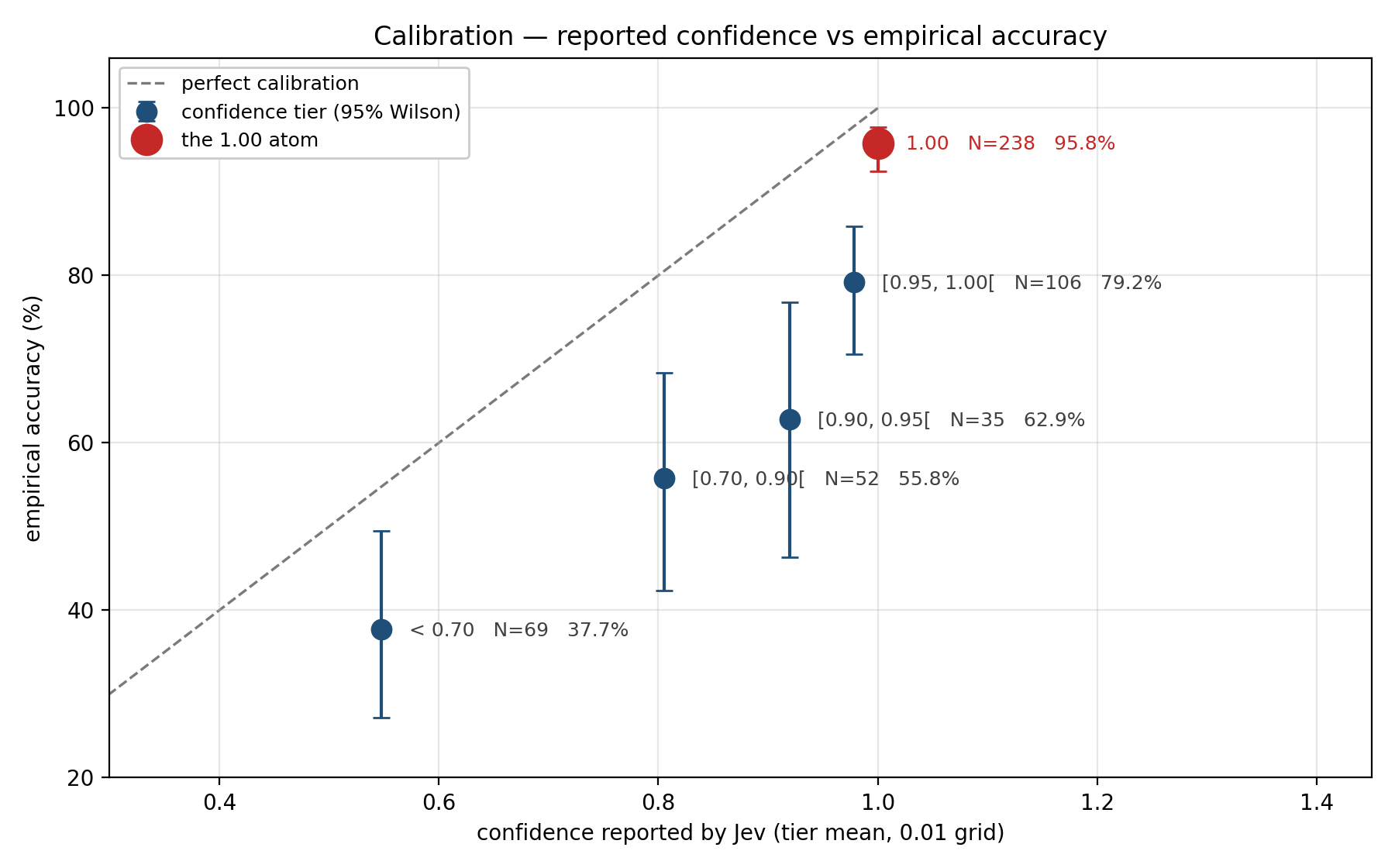
Accuracy per observed confidence level (63 distinct levels; the four largest):
| Confidence | N | Correct | Accuracy | 95% Wilson |
|---|---|---|---|---|
| 1.00 | 238 | 228 | 95.8% | [92.4%, 97.7%] |
| 0.99 | 46 | 37 | 80.4% | [66.8%, 89.3%] |
| 0.98 | 24 | 19 | 79.2% | [59.5%, 90.8%] |
| 0.97 | 18 | 14 | 77.8% | [54.8%, 91.0%] |
The 1.00 level carries 47.6% of the traffic at 95.8% accuracy. Accuracy drops to 80.4% at the very next representable level. 58 of the 63 levels hold fewer than 10 observations each, together 32.4% of the mass, so no single row below the top few supports a conclusion on its own.
ECE and Brier
Added after the results were published, as descriptive figures only. They change no threshold, no decision and no conclusion; the protocol stays frozen. Both are computed on Jev's output — the fallback exposes no distribution, so neither is defined for it.
| Banking77 | Web of Science | |
|---|---|---|
| mean reported confidence | 90.7% | 83.2% |
| empirical accuracy | 77.8% | 52.8% |
| gap | +12.9 points | +30.4 points |
| ECE, per observed level | 0.1568 [0.1418, 0.2000] | 0.3217 [0.2989, 0.3729] |
| ECE, 10 equal-width bins | 0.1302 [0.1015, 0.1636] | 0.3047 [0.2676, 0.3469] |
| multiclass Brier | 0.3518 [0.2947, 0.4102] | 0.7491 [0.6790, 0.8178] |
ECE is reported per observed confidence level as the primary figure, since the
variable is discrete on a 0.01 grid and fixed-width bins would merge levels the API
distinguishes; the conventional ten-bin variant is given for comparison with
published numbers. Brier is the multiclass form, summed over all classes against the
one-hot target, ranging 0 to 2, and computed on the raw probabilities without
renormalisation. Intervals are percentile bootstrap over examples, 10,000 draws,
seed 1729. Definitions in docs/METHOD.md.
On Web of Science the label caveat above weighs on these two figures more than on
accuracy: an abstract whose gold is Southern blotting and which receives most of
its mass on Molecular biology counts as a full error in the Brier score.
No tested derived statistic improves on confidence. Three alternatives computed from
the raw distribution — margin_top2, entropy_norm, ratio_top2 — were compared
by AUROC over the 262 rows outside the 1.00 level, which is the only region where
they are not constant by construction. Paired bootstrap, 10,000 iterations,
seed 1729:
| Statistic | AUROC | Difference vs confidence (95% CI) |
|---|---|---|
confidence |
0.706 | — |
entropy_norm |
0.705 | +0.002 [−0.012, +0.015] |
margin_top2 |
0.695 | +0.011 [+0.001, +0.021] |
ratio_top2 |
0.691 | +0.015 [+0.003, +0.028] |
The data show no improvement of the alternative statistics over confidence. The
bootstrap intervals exclude zero for the margin_top2 and ratio_top2 differences,
but the observed differences are small. The alternatives were not pre-registered with
a minimum margin to beat, so this is an absence of improvement, not a reversal.
Agreement between the two models — Banking77
| Count | Share | |
|---|---|---|
| Both correct | 367 | 73.4% |
| Both wrong, same prediction | 75 | 15.0% |
| Both wrong, different predictions | 9 | 1.8% |
| Jev correct, DeepSeek wrong | 22 | 4.4% |
| DeepSeek correct, Jev wrong | 27 | 5.4% |
Among the 49 disagreements, 74.1% of those DeepSeek wins fall below confidence 0.70, against 59.1% of those Jev wins. That concentration is what the routing rule exploits: DeepSeek-correct disagreements are disproportionately concentrated in the low-confidence tail.
On the 238 examples where Jev returned confidence = 1.00, DeepSeek produced the identical prediction in 238 out of 238 cases.
The package
The measurement above is the reason this package exists and the reason for its
central constraint: Janus ships no default threshold. Router refuses to run
without a policy measured on your own data, because neither 0.67 nor 0.37 meant
anything outside the dataset it came from.
pip install janus-decide
Measure a policy on your own labelled data, then run it:
janus measure \
  --dataset mydata.jsonl \
  --labels  mylabels.json \
  --primary typesafe:jev-latest \
  --fallback deepseek:deepseek-v4-pro \
  --out janus.json
measure writes the report every time, keeps the raw JSONL next to the policy so
it stays auditable, resumes by id if it is interrupted, and refuses to resume a
file whose statement has changed. It can also conclude do not route, which is
what it does on Web of Science, and then the policy runs the better single model
instead of paying for an escalation that buys nothing.
from janus import Router

router = Router.from_file("janus.json", primary=..., fallback=...)
decision = router.decide(input="I lost my card", question=question)

decision.label       # "lost_or_stolen_card"
decision.source      # "primary" | "fallback"
decision.escalated   # False
decision.cost_usd    # measured from real tokens, None when the rate is unknown
Two more commands: janus check says whether the models still answer with the
versions the policy was measured on, and janus explain shows why one input
escalated and another did not.
$ janus explain janus.json --input "I lost my card"

Primary: jev-1.13.0
Prediction: lost_or_stolen_card
Confidence: 0.61

Threshold: 0.67
Decision: ESCALATE

Fallback: deepseek-v4-pro
Final label: lost_or_stolen_card
Source: fallback
confidence and distribution are None when a provider exposes neither, and a
cost is None rather than 0.0 when the rate for the returned model is unknown —
an unknown must not disappear into a sum.
Limitations
Two datasets, 500 examples each, both in English. Banking77 intent classification and Web of Science subject classification. Nothing here establishes behaviour on other tasks, other languages or other label sets. Two datasets show that the parameters do not transfer between these two; they do not establish how they behave on a third.
Neither threshold is a constant of the mechanism. 0.67 is where accuracy peaks on Banking77, 0.37 on Web of Science. Both are observations about their own 500 examples. A threshold must be re-derived on any new workload, never copied from here.
Whether routing pays is itself dataset-dependent. It gained 1.4 points for about half the cost of the fallback on Banking77, and gained nothing for 46% more than Jev alone on Web of Science. Both outcomes came out of the identical pipeline.
The pre-registered targets are unreachable on both datasets. 90%, 95% and 98% were fixed before any frontier run. DeepSeek V4-Pro alone reaches 78.8% on Banking77 and 49.2% on Web of Science, so all three were beyond the fallback itself, whatever the routing rule. That is a design fault in the protocol — the targets were set with no known upper bound — and it is reported rather than corrected. The targets are not revised.
The oracle belongs to this pair of models, not to the dataset. On 84 of the 500 Banking77 examples and 220 of the 500 Web of Science abstracts, neither model has the right answer, capping the cascade at 83.2% and 56.0% respectively. A different fallback could recover some of those; the ceilings would move.
Common errors fall mostly between semantically adjacent classes on both
datasets. On Banking77, 47 distinct (gold, prediction) pairs across 84 errors:
order_physical_card to get_physical_card, card_delivery_estimate to
card_arrival. On Web of Science, 57.3% of the 220 shared errors stay inside the
parent domain of the gold label, with pairs like Southern blotting to
Molecular biology that are defensible answers. How much of this is label
ambiguity rather than model error has not been established on either dataset, and
this repository does not attempt to. It weighs heavier on Web of Science, whose
labels come from publication metadata rather than per-document annotation.
The frontier baseline is DeepSeek V4-Pro. Claude Opus 5 is announced for v2; the provider interface is in place and the protocol is frozen, so it is a run to launch, not a rewrite. An attempt on Gemini 3.8 Flash was abandoned — its free tier allows 20 requests a day, which would make 500 examples take 25 days — and its partial data is excluded.
No reproducibility claim for the frontier side. temperature has been removed
from the API generation used by the Anthropic backend and returns a 400; DeepSeek and
Gemini both return an alias rather than a resolved version, unlike Jev's
jev-1.13.0. Two runs of the same file may differ.
Reproduction
Total cost of a full reproduction: ~$1.11 — $0.2714 for Banking77 ($0.0507 Jev, $0.2207 DeepSeek) and $0.8361 for Web of Science ($0.1006 Jev, $0.7355 DeepSeek).
pip install typesafe-sdk openai numpy matplotlib

cat > .env <<'EOF'
TYPESAFE_API_KEY=...
DEEPSEEK_API_KEY=...
EOF

python experiments/probe.py            # one call, prints the raw response

# Banking77
python experiments/prepare_data.py                                       # rebuilds the dataset
python experiments/run_jev.py      --task banking77                      # 500 calls, ~$0.051
python experiments/run_frontier.py --task banking77 --provider deepseek  # 500 calls, ~$0.221
python experiments/analyze.py      --task banking77
python experiments/cascade.py      --task banking77

# Web of Science
python experiments/prepare_data_wos.py                                   # downloads ~60 MB
python experiments/run_jev.py      --task wos                            # 500 calls, ~$0.101
python experiments/run_frontier.py --task wos --provider deepseek        # 500 calls, ~$0.736
python experiments/analyze.py      --task wos
python experiments/cascade.py      --task wos
The runners take --task; no dataset is hard-coded in them.
Both runners write one line at a time, resume on the ids already present, and refuse
to resume when an existing line carries a different prompt_hash — two prompt
versions can never share a file.
Both datasets are committed with their hashes, so a re-download that drifts is detectable:
sha256(banking77 test.csv)    d12d6e3bc4c3103966ae786dc435913c0c563dfa328f5a3646d0e62cfeeb474d
sha256(banking77_500.jsonl)   33547bc2c3453057fbeb50cc5cb68da32c6da3c1b79b5deae47567c20fcf0bb6
sha256(WOS archive)           b787d484bff88b0dcdb3fa291d06ec9d2f025dc2a67ce1045d0c688cd96ccf8a
sha256(wos_500.jsonl)         23954a60f8ac255bdff021f006aa625b9d8742723d8afe5d53110ebe74fc131c
analyze.py and cascade.py never call an API. They read results/raw/ and compute.
Layout
src/janus/               the package: Router, measure, policy, providers, CLI
experiments/             the measurement this package is built on, unchanged
  probe.py               one call, prints the raw unparsed response
  tasks.py               task registry: name -> labels module + data file
  labels.py              Banking77, 77 labels, id -> name -> description
  labels_wos.py          Web of Science, 145 classes, plus each parent domain
  prepare_data*.py       build the frozen datasets
  run_jev.py             Jev on a task's 500 -> JSONL
  run_frontier.py        a frontier backend on a task's 500 -> JSONL
  providers.py           frontier backends behind one interface
  analyze.py             calibration, risk-coverage, figures
  cascade.py             cascade simulation, zero API calls
tests/                   the package's invariants, including that it still
                         reproduces the published numbers from the raw JSONL
data/                    frozen datasets + provenance
results/raw/             raw JSONL, one line per example
results/figures/         figures, regenerated by analyze.py and cascade.py
docs/METHOD.md           protocol, measured constraints, related work
Both figures are produced from the committed raw results by the scripts above. None is redrawn by hand.
Related work
Verified on 2026-09-17 against the repositories themselves. This rests on a name search on GitHub, so it is not exhaustive, and no claim of the form "nobody has done X" is drawn from it.
Several open-source reimplementations of the decision pattern appeared after Jev shipped on 2026-09-15. They differ in whether they expose calibration at all, and whether they publish measurements against real ground truth — the two come apart in practice.
- genai-craft/openvons carries the fullest calibration surface: temperature, isotonic, and ECE / Brier / NLL / macro-F1.
- bnsd55/openjev reports a fitted temperature and ECE before and after (0.0870 → 0.0773 at T = 1.7178) on 72 field-level decisions.
- TheoLeeCJ/openjev publishes balanced accuracy on WANLI (256 rows) and on an authored set (144 rows), without calibration metrics.
- kw2828/OpenJev states outright that its scores are uncalibrated, and works on synthetic data.
- aigodsend9-boop/specter-decision-engine is a framework with no trained model bundled, exposing temperature via NLL, isotonic via PAV, and Brier / NLL / ECE with bootstrap.
- grishahq/decisionbridge adapts existing LLMs into decision functions with temperature calibration; its bundled evaluation is described by its own README as a small, English-only, AI-authored synthetic pilot.
- dbobo4/local-llm-probabilistic-decision-engine scores candidates directly and warns that calibration must be measured separately on representative labelled data.
- hamakyo/jev-starter targets the closest programme to this one — decision contracts, thresholds, fallbacks, and a Jev → fallback cascade on a labelled dataset. Its issue #5 specifies ECE, Brier, threshold sweeps and coverage-versus-risk. At the time of checking those metrics are presented as planned rather than published.
Agent-side integrations exist as well, including browser-use/jev-ultrafast, which publishes task-timing measurements and notes itself that they are not a general reliability benchmark.
TypeSafe publishes its own workflow evals, whose method is set out under How we evaluate → Assume the harness is correct. Their reference labels are, in their words, "generated via an average of the responses of GPT-6 Astra and Claude Fable 5.1, both at high thinking", and they state that they "assume that the code is correct, and measure against the current smartest large models" rather than optimising for a ground-truth classification. TypeSafe's reference methodology evaluates agreement with its reference models, whereas Janus evaluates predictions against human-labelled ground truth. These answer different questions and neither substitutes for the other.
Jev is also available on Vercel's AI Gateway
as typesafe-ai/jev, announced on 16 September 2026, the day after Jev shipped.
Our contribution is an empirical evaluation of confidence-based selective automation on a real ground-truth dataset, rather than another implementation of the decision layer itself.
Full survey, with what was and was not verified: docs/METHOD.md.
License
MIT — see LICENSE.
Banking77 is distributed under CC BY 4.0; see data/README.md for
provenance and citation.
1 maintainer

Release files for janus-decide 0.1.0
For a detailed explanation of source distributions (sdists) and built distributions (wheels), please see the package formats documentation.
Source distribution (sdist)
| File | Size | Uploaded | |
|---|---|---|---|
| janus_decide-0.1.0.tar.gz | 49.1 kB | Details |
Built distribution (wheel)
| File | Interpreter | ABI | Platform | Reset |
|---|---|---|---|---|
| janus_decide-0.1.0-py3-none-any.whl | Python 3 | none | any | Details |
Total release size: 94.0 kB
Release files / janus_decide-0.1.0.tar.gz
| Download URL | janus_decide-0.1.0.tar.gz |
|---|---|
| Size | 49.1 kB |
| Tags | Source |
|
SHA-256 checksum How to use checksums |
1378891e115b509722874210e1395604557314f4c3e3169c390e3480b9518a41
|
|
BLAKE2b-256 checksum How to use checksums |
93670a8775cb4384aefe87d7fb480cc10f83f0b28f8296134e5a22b325501777
|
| Upload date | |
|
Uploaded using Trusted Publishing? What is trusted publishing? |
No |
| Uploaded via |
twine/7.0.0 CPython/3.14.3
|
Release files / janus_decide-0.1.0-py3-none-any.whl
| Download URL | janus_decide-0.1.0-py3-none-any.whl |
|---|---|
| Size | 45.0 kB |
| Tags | Python 3 |
|
SHA-256 checksum How to use checksums |
044d223db80e367fd9f8f3a5a42822725b5c3bb4076e0c21f76115b11ec881f2
|
|
BLAKE2b-256 checksum How to use checksums |
786de20b3edc352ebdd8f73a3f786a3d62765e64c10667414cbfe45c92f6d4e0
|
| Upload date | |
|
Uploaded using Trusted Publishing? What is trusted publishing? |
No |
| Uploaded via |
twine/7.0.0 CPython/3.14.3
|














