Describe an agent in a few lines of Python. It reads the web, runs code, works a browser,
remembers what it was told, and picks up where it left off after kill -9.






Three agents on one mesh, live in the JarvisCore Desk: a scout reads official docs on the live web, an analyst compares,
a writer delivers the brief with its sources.
A real run, idle time trimmed (MP4). The Desk ships with
JarvisCore Agents, opening soon; the team is 30 lines of Python.
class Scout(AutoAgent):
    role = "scout"
    capabilities = ["web_research"]
    default_kernel_role = "researcher"
    system_prompt = "You find primary sources on the live web, read them, and cite every fact."

class Analyst(AutoAgent):
    role = "analyst"
    capabilities = ["analysis"]
    default_kernel_role = "communicator"
    system_prompt = "You compare options strictly on the evidence."

class Writer(AutoAgent):
    role = "writer"
    capabilities = ["writing"]
    default_kernel_role = "communicator"
    system_prompt = "You write short, decisive briefs for engineering leads, citing sources."

results = await mesh.workflow("vector-db-brief", [
    {"agent": "scout",   "task": "Gather the facts this request turns on, from official docs: ..."},
    {"agent": "analyst", "task": "Compare the options on the scout's evidence.", "depends_on": [0]},
    {"agent": "writer",  "task": "Write a decision brief of at most eight lines.", "depends_on": [1]},
])
JarvisCore is a Python runtime for agents that do work, not just talk. You give an agent a role and a prompt; the runtime gives it tools, a loop that checks itself, memory, credentials and durable state, and hands you back an answer you can verify.
- Agents act. Every turn is one real tool call: search and read the web, run Python in a sandbox, drive a browser, draft and deliver.
- Answers come with their evidence. You get the answer, the data behind it, what each tool actually saw, and an honest status: an agent that could not finish says so, and why.
- Work survives. Finished steps survive a crash, agents remember across runs, credentials never enter a prompt, and a person approves anything irreversible.
What people build with it
Read a whole website
One goal_oriented agent opens the catalogue, walks every page, computes the figures
with code and saves a report: 32 books, 2 pages, every figure correct.
browse_a_whole_site.py · real time 1m 56s ·
needs jarviscore-framework[browser] and BROWSER_ENABLED=true.
Watch it run in a terminal

Compute, never estimate
Revenue and quarter-on-quarter growth for four regions from a 400-row CSV, computed by
code the agent writes and runs in a sandbox. Every figure matches a hand-written check.
analyst_that_computes.py · real time 54s.
Watch it run in a terminal

Remember across runs
Tell it once. A new process, given nothing, still knows. Kept facts live in
.jarviscore/memory/, with nothing to install; point it at Athena for semantic memory
shared across machines. agent_that_remembers.py.
Watch it run in a terminal

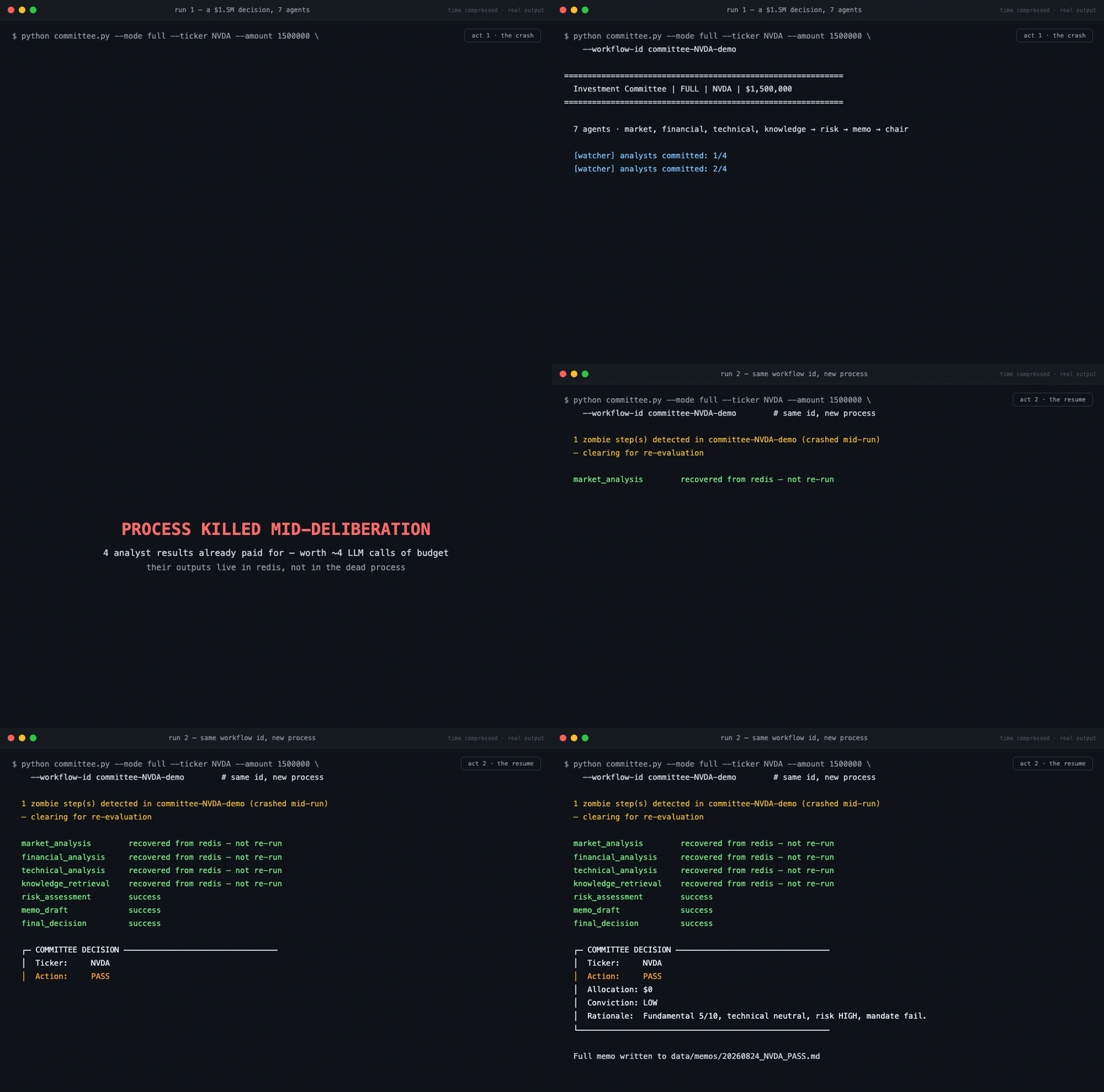
Survive kill -9
Kill the process mid-workflow and run the same command again: finished steps come back
from Redis, and only the unfinished work runs.
survives_a_crash.py · needs REDIS_URL.
Watch it run in a terminal

More, end to end
| Demo | What it shows |
|---|---|
| Research team, in a terminal | The same kind of team without the Desk: a scout and an analyst, one workflow, a cited brief. Recording. |
| Investment committee | Seven agents deliberate a $1.5M position on live market data; the process is killed mid-deliberation and finishes without re-running the analysts. Recording. |
| Four-process research mesh | Four agents in four processes find each other over SWIM, claim steps from a shared ledger, and deliver to Slack through the credential vault. Reproduce with examples/demo_synthesizer.py and demo_node_1/2/3.py. |
| Launch film | The story of JarvisCore Agents, in four minutes. |
How it works
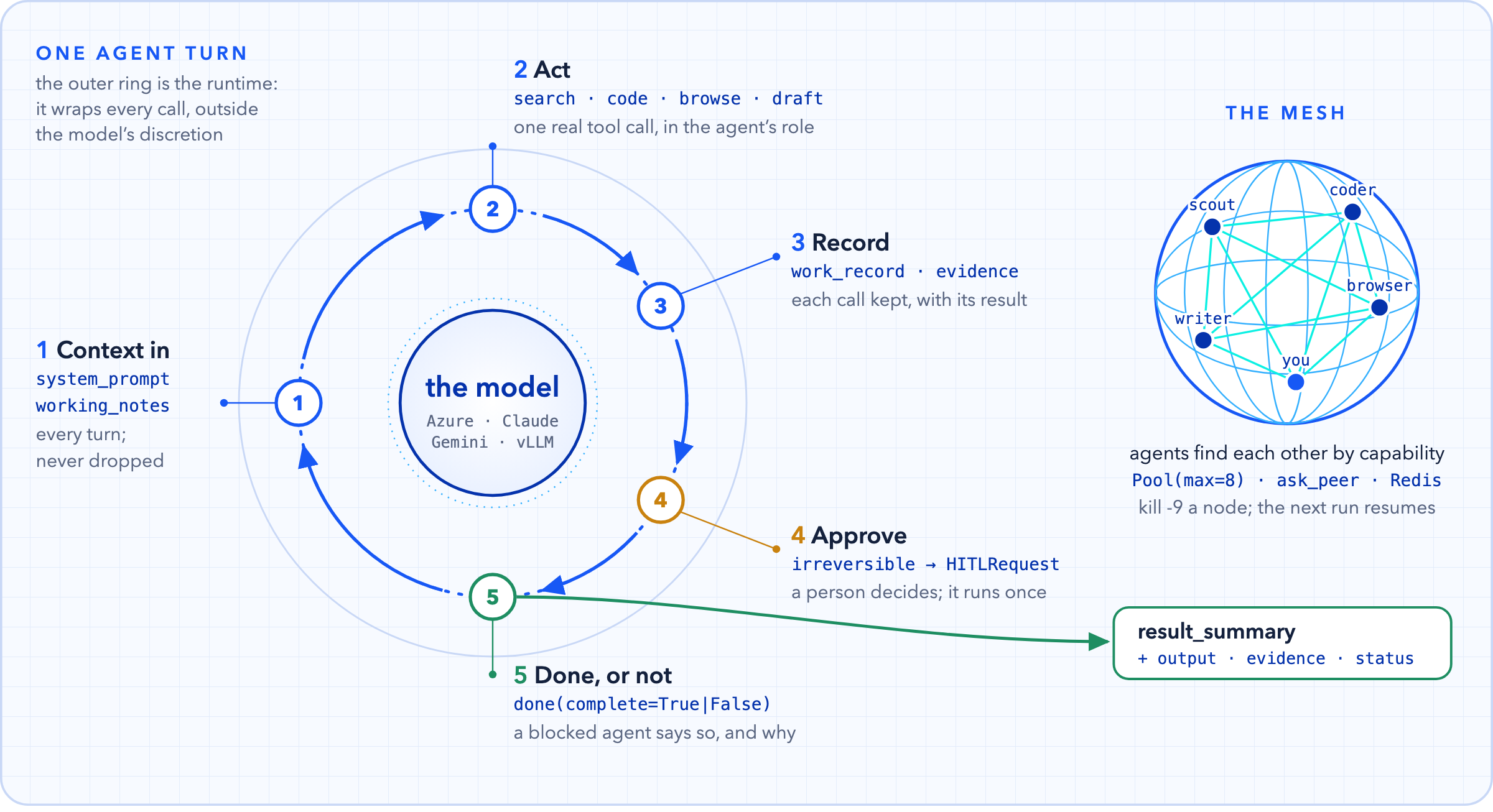
An agent's work is a loop around the model, and everything outside the model is the runtime's job, not the prompt's:
- Context in. The system prompt, the agent's own working notes (never dropped, even when the context is full) and facts recalled from earlier runs.
- Act. One real tool call per turn, in the role the task needs: researcher,
coder, browser or communicator. Credentials are placed at the call by Nexus, and
only for agents that declare
requires_auth = True. - Record. Every call and its result are kept, so the answer can cite them and you can check them.
- Approve. An action marked irreversible waits for a person, then runs once.
- Done, or not. The agent finishes with
complete=True, or says what stopped it.
Agents find each other on the mesh by capability, one agent can run as a pool of workers, and every workflow step is saved in Redis as it finishes.
Start in two minutes
pip install jarviscore-framework
Add one model key to .env (AZURE_API_KEY, CLAUDE_API_KEY, GEMINI_API_KEY or
LLM_ENDPOINT), check it with jarviscore check --validate-llm, and run:
import asyncio
from jarviscore import AutoAgent, Mesh


class Researcher(AutoAgent):
    role = "researcher"
    capabilities = ["research"]
    system_prompt = "You find primary sources, read them, and cite every fact."


async def main():
    mesh = Mesh()
    mesh.add(Researcher)
    await mesh.start()
    result = await mesh.run_task(
        agent="researcher",
        task="What changed in the EU AI Act's final text for open-source models?",
    )
    print(result["result_summary"])  # the answer
    print(result["evidence"])        # what the tools actually saw
    await mesh.stop()

asyncio.run(main())
No database, no broker, no Docker. Add what you need as you go:
| Install | Adds |
|---|---|
jarviscore-framework[browser] then playwright install chromium |
A browser agent that reads whole sites and fills forms |
jarviscore-framework[redis] with REDIS_URL |
Durable workflows, crash recovery, several processes sharing work |
jarviscore-framework[p2p] |
Agents on several machines finding each other over SWIM |
jarviscore-framework[rag] |
Local vector search over your documents |
jarviscore-framework[full] |
Everything |
Prefer to write the logic yourself? A CustomAgent is plain Python in
execute_task(), on the same mesh as everything else.
What you can count on
| Promise | What the runtime does |
|---|---|
| An honest status | An agent that could not do the task returns failure with its own reason, never a success with empty figures. |
| Evidence you can check | result["evidence"] holds each cited tool's input and output. A receipt the agent did not earn is refused. |
| Work that survives | Finished workflow steps are recovered from Redis after a crash, not re-run and not re-billed. Long steps continue across execution epochs. |
| Memory that lasts | Facts an agent keeps are recalled in later runs, keyed to its role, and kept apart per tenant with memory_scope_field. |
| Credentials out of reach | Tokens are placed at the call by Nexus, only for agents that declare requires_auth. They never appear in prompts, generated code or traces. |
| A person in the loop | Irreversible actions wait for an approval through Mesh.resolve_hitl(), then run exactly once. |
| Scale without rewrites | Pool(max=8) turns one agent into several workers, and every model call is paced to the provider's real limits. Verifying 196 claims took 9.4 minutes with pools, against 202 with fixed workers. |
| Integrations without wiring | Typed atoms for CRMs, payments, messaging, storage and more, with auth injected at runtime. See what your installed version ships with jarviscore atom list. |
Go further
| Guide | What it covers |
|---|---|
| Getting started | Install, first agent, first multi-agent workflow |
| AutoAgent · CustomAgent | The two ways to write an agent |
| Workflows · Goals | Steps you know in advance, and goals that plan their own |
| Browser · People in the loop | Reading and acting on real sites, with approvals |
| Memory · Nexus | What agents keep, and how they reach your accounts |
| Production · Configuration | Pools, pacing, Redis, sandboxes and every setting |
| Changelog | What changed, release by release |
Community
Every other week we debug real agents live in office hours on Discord. If JarvisCore saves you time, a ⭐ helps other developers find it.
License
Apache 2.0. See LICENSE. You can build and sell products with it; there is no revenue or user threshold that requires a commercial agreement. Separately licensed enterprise modules have their own terms; see JarvisCore Enterprise.
Building with JarvisCore? An optional Built with JarvisCore credit on your About page or docs is appreciated; the trademark policy applies.


Release files for jarviscore-framework 2.2.0
For a detailed explanation of source distributions (sdists) and built distributions (wheels), please see the package formats documentation.
Source distribution (sdist)
| File | Size | Uploaded | Provenance | |
|---|---|---|---|---|
| jarviscore_framework-2.2.0.tar.gz | 1.4 MB | With provenance | Details |
Built distribution (wheel)
| File | Interpreter | ABI | Platform | Reset |
|---|---|---|---|---|
| jarviscore_framework-2.2.0-py3-none-any.whl | Python 3 | none | any | Details |
Total release size: 4.2 MB
Release files / jarviscore_framework-2.2.0.tar.gz
| Download URL | jarviscore_framework-2.2.0.tar.gz |
|---|---|
| Size | 1.4 MB |
| Tags | Source |
|
SHA-256 checksum How to use checksums |
974664f50ff4af40b2f9e239d65a67d22a5ca24ee963515a7ece7444c64c8c6a
|
|
BLAKE2b-256 checksum How to use checksums |
65ab82dce58e27b9012aff4b9be27e0067ca4975e3577cbe00ae3c7f62d4401d
|
| Upload date | |
|
Uploaded using Trusted Publishing? What is trusted publishing? |
Yes |
| Uploaded via |
twine/7.0.0 CPython/3.13.16
|
Provenance
Provenance describes where a file came from. On PyPI, provenance is shared via attestations, which provide a verifiable record of the build or publishing details. View details, limitations and caveats.


PyPI Publish Attestation
PyPI verified that this artifact, at this checksum, originated from the publisher listed below.
Signed by GitHub Actions, verified by PyPI on Oct 22, 2026.
Transparency logRelease files / jarviscore_framework-2.2.0-py3-none-any.whl
| Download URL | jarviscore_framework-2.2.0-py3-none-any.whl |
|---|---|
| Size | 2.8 MB |
| Tags | Python 3 |
|
SHA-256 checksum How to use checksums |
9e50cb538905052ae6222897a8f328c6ff4777046bad56fbf363507a12f6ad18
|
|
BLAKE2b-256 checksum How to use checksums |
b69b7a4b36c78ab841853a253341de71c05cb7ca24f3f902cfc59f275a74b1da
|
| Upload date | |
|
Uploaded using Trusted Publishing? What is trusted publishing? |
Yes |
| Uploaded via |
twine/7.0.0 CPython/3.13.16
|
Provenance
Provenance describes where a file came from. On PyPI, provenance is shared via attestations, which provide a verifiable record of the build or publishing details. View details, limitations and caveats.
PyPI Publish Attestation
PyPI verified that this artifact, at this checksum, originated from the publisher listed below.
Signed by GitHub Actions, verified by PyPI on Oct 22, 2026.
Transparency logSecurity for jarviscore-framework 2.2.0
Provenance
Provenance describes where a file came from. On PyPI, provenance is shared via attestations, which provide a verifiable record of the build or publishing details. View details, limitations and caveats.
Full provenance
All 2 files in this release have been uploaded with provenance metadata.
Attestation for jarviscore_framework-2.2.0.tar.gz
PyPI Publish Attestation
PyPI verified that this artifact, at this checksum, originated from the publisher listed below.
Signed by GitHub Actions, verified by PyPI on Oct 22, 2026.
Transparency logA note on package security
PyPI is a repository for distributing packages, not a service for auditing them. While third-party security researchers and our staff do their best to detect and remove malicious packages, PyPI cannot guarantee the quality, security or suitability of any given package.