
JaxGCRL





Installation | Quick Start | Environments | Baselines | Citation
Accelerating Goal-Conditioned RL Algorithms and Research
We provide blazingly fast goal-conditioned environments based on MJX and BRAX for quick experimentation with goal-conditioned self-supervised reinforcement learning.
- Blazingly Fast Training - Train 10 million environment steps in 10 minutes on a single GPU, up to $22\times$ faster than prior implementations.
- Comprehensive Benchmarking - Includes 10+ diverse environments and multiple pre-implemented baselines for out-of-the-box evaluation.
- Modular Implementation - Designed for clarity and scalability, allowing for easy modification of algorithms.
Installation 📂
Editable Install (Recommended)
After cloning the repository, run one of the following commands.
With GPU on Linux:
pip install -e . -f https://storage.googleapis.com/jax-releases/jax_releases.html
With CPU on Mac:
export SDKROOT="$(xcrun --show-sdk-path)" # may be needed to build brax dependencies
pip install -e .
PyPI
The package is also available on PyPI:
pip install jaxgcrl -f https://storage.googleapis.com/jax-releases/jax_releases.html
Quick Start 🚀
To verify the installation, run a test experiment:
jaxgcrl crl --env ant
The jaxgcrl command is equivalent to invoking python run.py with the same arguments
[!NOTE]
If you haven't yet configuredwandb, you may be prompted to log in.
See scripts/train.sh for an example config.
A description of the available agents can be generated with jaxgcrl --help.
Available configs can be listed with jaxgcrl {crl,ppo,sac,td3} --help.
Common flags you may want to change include:
- env=...: replace "ant" with any environment name. See
jaxgcrl/utils/env.pyfor a list of available environments. - Removing --log_wandb: omits logging, if you don't want to use a wandb account.
- --total_env_steps: shorter or longer runs.
- --num_envs: based on how many environments your GPU memory allows.
- --contrastive_loss_fn, --energy_fn, --h_dim, --n_hidden, etc.: algorithmic and architectural changes.
Environment Interaction
Environments can be controlled with the reset and step functions. These methods return a state object, which is a dataclass containing the following fields:
state.pipeline_state: current, internal state of the environment
state.obs: current observation
state.done: flag indicating if the agent reached the goal
state.metrics: agent performance metrics
state.info: additional info
The following code demonstrates how to interact with the environment:
import jax
from utils.env import create_env

key = jax.random.PRNGKey(0)

# Initialize the environment
env = create_env('ant')

# Use JIT compilation to make environment's reset and step functions execute faster
jit_env_reset = jax.jit(env.reset)
jit_env_step = jax.jit(env.step)

NUM_STEPS = 1000

# Reset the environment and obtain the initial state
state = jit_env_reset(key)

# Simulate the environment for a fixed number of steps
for _ in range(NUM_STEPS):
    # Generate a random action
    key, key_act = jax.random.split(key, 2)
    random_action = jax.random.uniform(key_act, shape=(8,), minval=-1, maxval=1)

    # Perform an environment step with the generated action
    state = jit_env_step(state, random_action)
Wandb support 📈
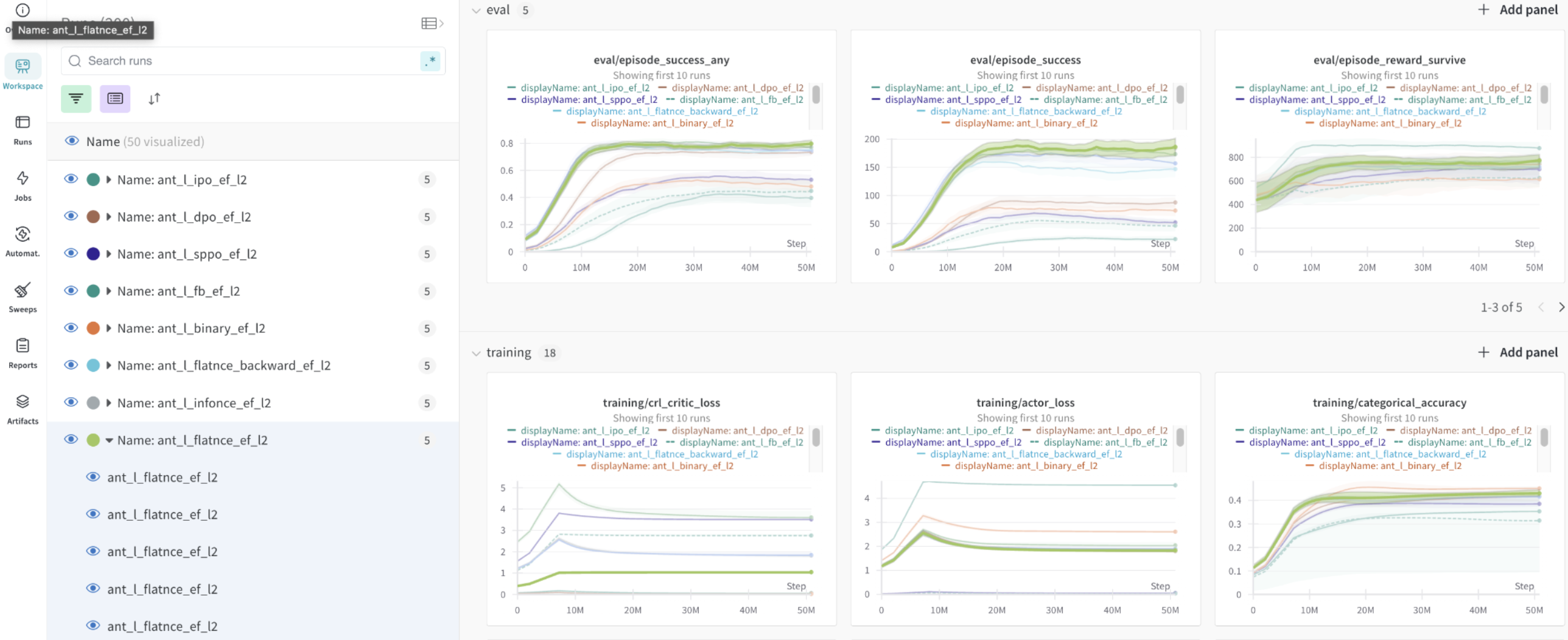
We strongly recommend using Wandb for tracking and visualizing results (Wandb support). Enable Wandb logging with the --log_wandb flag. The following flags are also available to organize experiments:
--project_name--group_name--exp_name
The --log_wandb flag logs metrics to Wandb. By default, metrics are logged to a CSV.
- Run example
sweep:
wandb sweep --project example_sweep ./scripts/sweep.yml
- Then run
wandb agentwith :
wandb agent <previous_command_output>
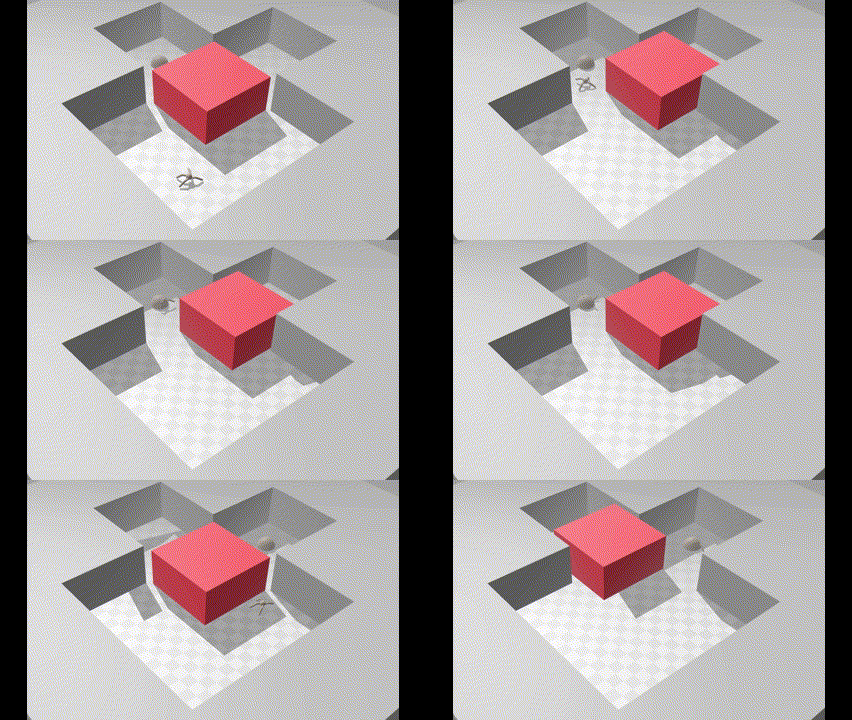
We also render videos of the learned policies as wandb artifacts.
Environments 🌎
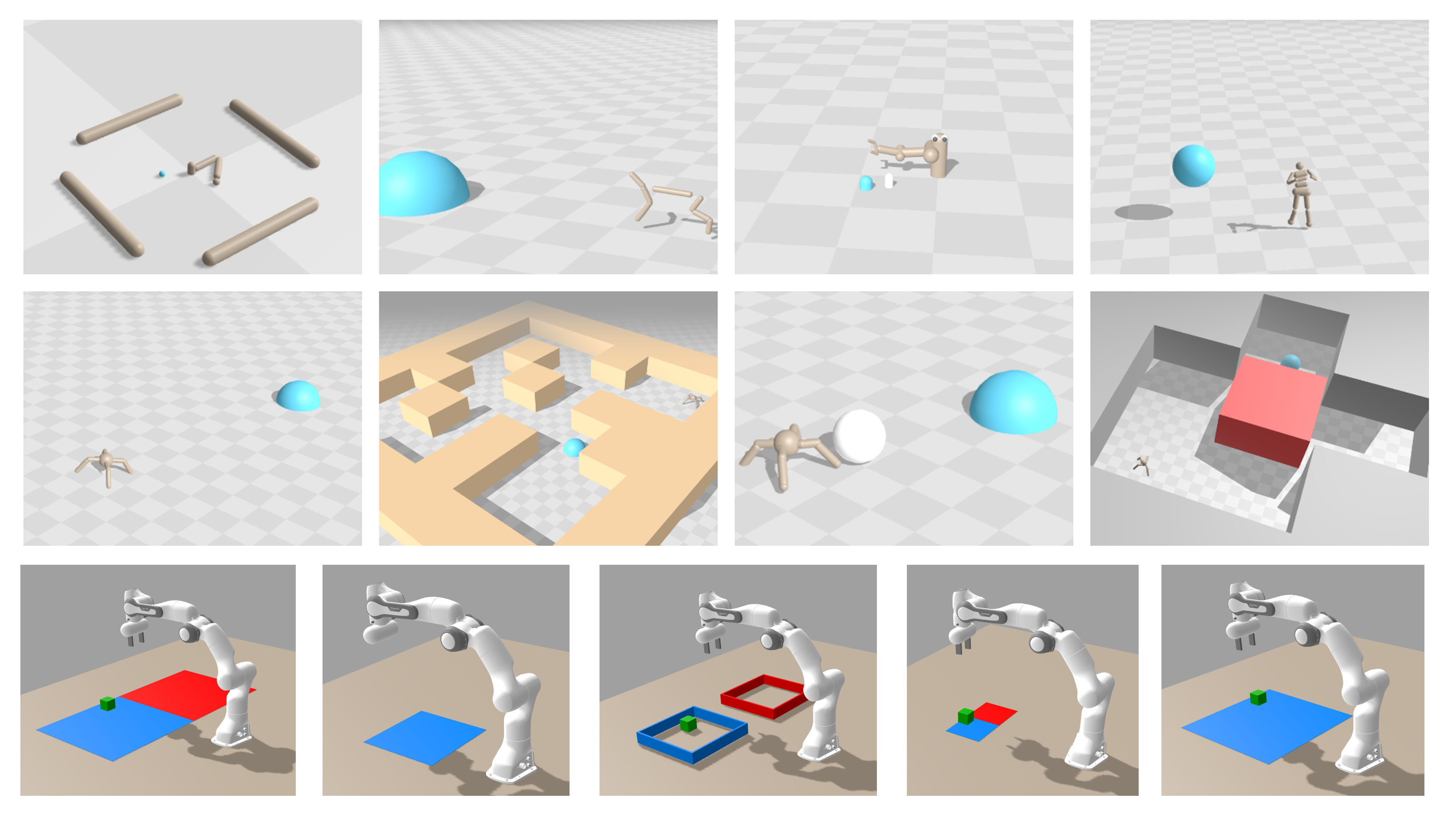
We currently support a variety of continuous control environments:
- Locomotion: Half-Cheetah, Ant, Humanoid
- Locomotion + task: AntMaze, AntBall (AntSoccer), AntPush, HumanoidMaze
- Simple arm: Reacher, Pusher, Pusher 2-object
- Manipulation: Reach, Grasp, Push (easy/hard), Binpick (easy/hard)
| Environment | Env name | Code |
|---|---|---|
| Reacher | reacher |
link |
| Half Cheetah | cheetah |
link |
| Pusher | pusher_easy pusher_hard |
link |
| Ant | ant |
link |
| Ant Maze | ant_u_maze ant_big_maze ant_hardest_maze |
link |
| Ant Soccer | ant_ball |
link |
| Ant Push | ant_push |
link |
| Humanoid | humanoid |
link |
| Humanoid Maze | humanoid_u_maze humanoid_big_maze humanoid_hardest_maze |
link |
| Arm Reach | arm_reach |
link |
| Arm Grasp | arm_grasp |
link |
| Arm Push | arm_push_easy arm_push_hard |
link |
| Arm Binpick | arm_binpick_easy arm_binpick_hard |
link |
To add new environments: add an XML to envs/assets, add a python environment file in envs, and register the environment name in utils.py.
Baselines 🤖
We currently support following algorithms:
| Algorithm | How to run | Code |
|---|---|---|
| CRL | python run.py crl ... |
link |
| PPO | python run.py ppo ... |
link |
| SAC | python run.py sac ... |
link |
| SAC + HER | python run.py sac ... --use_her |
link |
| TD3 | python run.py td3 ... |
link |
| TD3 + HER | python run.py td3 ... --use_her |
link |
Code Structure 📝
The core structure of the codebase is as follows:
run.py: Takes the name of an agent and runs with the specified configs.
agents/
├── agents/
│   ├── crl/
│   │   ├── crl.py CRL algorithm
│   │   ├── losses.py contrastive losses and energy functions
│   │   └── networks.py CRL network architectures
│   ├── ppo/
│   │   └── ppo.py PPO algorithm
│   ├── sac/
│   │   ├── sac.py SAC algorithm
│   │   └── networks.py SAC network architectures
│   └── td3/
│       ├── td3.py TD3 algorithm
│       ├── losses.py TD3 loss functions
│       └── networks.py TD3 network architectures
├── utils/
│   ├── config.py Base run configs
│   ├── env.py Logic for rendering and environment initialization
│   ├── replay_buffer.py: Contains replay buffer, including logic for state, action, and goal sampling for training.
│   └── evaluator.py: Runs evaluation and collects metrics.
├── envs/
│   ├── ant.py, humanoid.py, ...: Most environments are here.
│   ├── assets: Contains XMLs for environments.
│   └── manipulation: Contains all manipulation environments.
└── scripts/train.sh: Modify to choose environment and hyperparameters.
The architecture can be adjusted in networks.py.
Contributing 🏗️
Help us build JaxGCRL into the best possible tool for the GCRL community. Reach out and start contributing or just add an Issue/PR!
- Add Franka robot arm environments. [Done by SimpleGeometry]
- Get around 70% success rate on Ant Big Maze task. [Done by RajGhugare19]
- Add more complex versions of Ant Sokoban.
- Integrate environments:
- Overcooked
- Hanabi
- Rubik's cube
- Sokoban
To run tests (make sure you have access to a GPU):
python -m pytest
Citing JaxGCRL 📜
If you use JaxGCRL in your work, please cite us as follows:@inproceedings{bortkiewicz2025accelerating,
author = {Bortkiewicz, Micha\l{} and Pa\l{}ucki, W\l{}adek and Myers, Vivek and
Dziarmaga, Tadeusz and Arczewski, Tomasz and Kuci\'{n}ski, \L{}ukasz and
Eysenbach, Benjamin},
booktitle = {{International Conference} on {Learning Representations}},
title = {{Accelerating Goal-Conditioned RL Algorithms} and {Research}},
url = {https://arxiv.org/pdf/2408.11052},
year = {2025},
}
Questions ❓
If you have any questions, comments, or suggestions, please reach out to Michał Bortkiewicz (michalbortkiewicz8@gmail.com).
See Also 🙌
There are a number of other libraries which inspired this work, we encourage you to take a look!
JAX-native algorithms:
- Mava: JAX implementations of IPPO and MAPPO, two popular MARL algorithms.
- PureJaxRL: JAX implementation of PPO, and demonstration of end-to-end JAX-based RL training.
- Minimax: JAX implementations of autocurricula baselines for RL.
- JaxIRL: JAX implementation of algorithms for inverse reinforcement learning.
JAX-native environments:
- Gymnax: Implementations of classic RL tasks including classic control, bsuite and MinAtar.
- Jumanji: A diverse set of environments ranging from simple games to NP-hard combinatorial problems.
- Pgx: JAX implementations of classic board games, such as Chess, Go and Shogi.
- Brax: A fully differentiable physics engine written in JAX, features continuous control tasks.
- XLand-MiniGrid: Meta-RL gridworld environments inspired by XLand and MiniGrid.
- Craftax: (Crafter + NetHack) in JAX.
- JaxMARL: Multi-agent RL in Jax.
2 maintainers


Release files for jaxgcrl 0.2.8
For a detailed explanation of source distributions (sdists) and built distributions (wheels), please see the package formats documentation.
Source distribution (sdist)
| File | Size | Uploaded | |
|---|---|---|---|
| jaxgcrl-0.2.8.tar.gz | 5.0 MB | Details |
Built distribution (wheel)
| File | Interpreter | ABI | Platform | Reset |
|---|---|---|---|---|
| jaxgcrl-0.2.8-py3-none-any.whl | Python 3 | none | any | Details |
Total release size: 10.2 MB
Release files / jaxgcrl-0.2.8.tar.gz
| Download URL | jaxgcrl-0.2.8.tar.gz |
|---|---|
| Size | 5.0 MB |
| Tags | Source |
|
SHA-256 checksum How to use checksums |
f996c7b2afc594e48fd8be7f5e26e2de382f81bc398a65dc66cca7a0f5b1634e
|
|
BLAKE2b-256 checksum How to use checksums |
e8b9b9fa6d2b51d4e19c7e7acdb8ee5b35ede1da09698cf84a9daa880f5768b1
|
| Upload date | |
|
Uploaded using Trusted Publishing? What is trusted publishing? |
No |
| Uploaded via |
uv/0.6.9
|
Release files / jaxgcrl-0.2.8-py3-none-any.whl
| Download URL | jaxgcrl-0.2.8-py3-none-any.whl |
|---|---|
| Size | 5.2 MB |
| Tags | Python 3 |
|
SHA-256 checksum How to use checksums |
6de10a6524f2d07aab59216b888d684d6bc0d0727ed3561d49a70240528ed259
|
|
BLAKE2b-256 checksum How to use checksums |
0f1843c83bb81fa7bb836c0bc2d3142121243a4b0915fbd0b11eefd800a678cd
|
| Upload date | |
|
Uploaded using Trusted Publishing? What is trusted publishing? |
No |
| Uploaded via |
uv/0.6.9
|














