



Main:

Develop:


Mission: To make nested sampling faster, easier, and more powerful
What is JAXNS?
JAXNS is a nested-sampling library and probabilistic programming interface built with JAX. It is intended for scientific problems that need Bayesian evidence, weighted posterior samples, or exploration of difficult constrained priors.
JAXNS v3 implements nested sampling as a race tree with dynamic lineage allocation.
JAXNS can:
- Estimate the Bayesian evidence of a model or hypothesis.
- Produce weighted or resampled posterior samples.
- Explore degenerate, multimodal posteriors.
- Model continuous and discrete variables.
- Scale from a laptop to a cluster of thousands of accelerators.
JAXNS v3 is described in Phantom-Conditioned Nested Sampling (Albert, 2026). Read and cite this preprint for the current algorithm, phantom conditioning, and dynamic allocation schemes.
The previous Phantom-Powered Nested Sampling paper is redacted. The original JAXNS paper remains valid as a reference for JAXNS's high performance, but its description of the algorithm is superseded by the v3 paper.
Install
JAXNS requires Python 3.10 or later. Install the default package from PyPI:
pip install jaxns
The distributed runtime has two additional dependencies and is opt-in:
pip install "jaxns[distributed]"
For development, clone the repository and install the test and example extras:
git clone https://www.github.com/JoshuaAlbert/jaxns.git
cd jaxns
pip install -e ".[tests,examples]"
Quick start
Define a model with JAXCTX
Define Bayesian variables with Prior(...).realise(), return a scalar log
likelihood, and pass observations or other runtime data through args.
import jax
from jax import numpy as jnp
from jaxns.priors import Prior
from tensorflow_probability.substrates import jax as tfp

from jaxns.model import Model

tfpd = tfp.distributions


def prior_model(predictor, observations, measurement_uncertainty):
    intercept = Prior(
        tfpd.Normal(loc=0.0, scale=1.0),
        name="intercept",
    ).realise()
    slope = Prior(
        tfpd.Normal(loc=0.0, scale=2.0),
        name="slope",
    ).realise()
    prediction = intercept + slope * predictor
    return jnp.sum(
        tfpd.Normal(
            loc=prediction,
            scale=measurement_uncertainty,
        ).log_prob(observations)
    )


model = Model(prior_model=prior_model)
args = (
    jnp.linspace(0.0, 1.0, 6),
    jnp.asarray([0.15, 0.32, 0.83, 1.08, 1.52, 1.77]),
    jnp.asarray(0.15),
)
model.sanity_check(
    key=jax.random.PRNGKey(1),
    args=args,
)
The model exposes the same explicit args and params on its lower-level
operations, including sample_U, transform_to_X, log_likelihood,
log_prior, and log_joint.
We recommend running model.sanity_check(...) before sampling. Every normal
likelihood evaluation maps NaN log-likelihoods to -inf (zero likelihood),
including NaNs encountered later in local or distributed runs. The sanity
check reads raw model outputs and reports NaNs before this conversion. It also
checks for non-finite prior values, positive-infinite log-likelihoods, and
non-scalar outputs. A sampled check cannot validate every point in the prior.
Change from v2: v2 allowed NaN conversion to be bypassed with allow_nan.
In v3 the conversion is unconditional and that option is removed. Initial
and subsequently allocated root samples are unconditional prior draws, with
one likelihood evaluation each. Zero likelihoods, including mapped NaNs, are
retained without redrawing so their prior mass remains in the evidence.
Declare continuous periodic parameters
Use realise(periodic=True) when the two endpoints of a continuous prior's
base coordinate represent the same physical point. For example, an angular
location can cross the -pi/pi chart seam:
def angular_model(observed_angle, concentration):
    angle = Prior(
        tfpd.Uniform(low=-jnp.pi, high=jnp.pi),
        name="angle",
    ).realise(periodic=True)
    return concentration * jnp.cos(angle - observed_angle)
This is an endpoint-equivalence assertion, not a synonym for a bounded prior. JAXNS keeps canonical samples in the half-open unit cube and draws an independent random chart for every isotropic slice transition, allowing the chain to move across an artificial seam without changing the prior measure. The declaration applies to the complete realised prior; cyclic categorical variables are not supported.
Periodic coordinates currently require isotropic slice directions. Runs begin
with exact isotropic directions, and state.iso_directions() explicitly keeps
or returns a state to that mode. Calling state.fit_gmm_directions(...) for a
periodic model fails because the Euclidean GMM can split a seam-crossing mode;
toroidal GMM geometry is tracked in
issue #276. The
Jones-scalar example demonstrates
a periodic calibration phase together with DTEC, clock, and unknown noise.
Run nested sampling locally
from jaxns.core import NestedSampler

sampler = NestedSampler(
    model=model,
    collect_phantom_samples=True,
)
state = sampler.run(key=jax.random.PRNGKey(6), args=args)
results = state.to_result().trim()

results.summary()
results.plot_diagnostics()
results.plot_cornerplot(variables=["intercept", "slope"])
results.plot_evidence(
    num_samples=4096,
    conditionings=("classic", "phantom"),
    key=jax.random.PRNGKey(3),
    exact_log_Z=-0.274366,
)

# Reuse the same retained clusters with a shorter conditioning prefix.
prefix_evidence = results.sample_evidence(
    num_samples=4096,
    phantom_conditioning=True,
    num_phantoms=1,
    key=jax.random.PRNGKey(4),
)

# Classic expectation summaries remain on results.log_Z_mean/log_Z_uncert.
# This separate ensemble provides the Monte Carlo summaries.
classic_evidence = results.sample_evidence(4096, key=jax.random.PRNGKey(5))

# Resampling returns an equally weighted posterior with integration methods.
posterior = results.resample(1000, key=jax.random.PRNGKey(7))
mean_slope = posterior.integrate_fn_over_posterior(lambda x: x["slope"])
Phantom collection and evidence conditioning are separate choices. The
runner retains every intermediate state from each chain when collection is
enabled: num_slices - 1 phantoms, with the final transition reserved for the
classic replacement. This policy also applies to explicitly supplied samplers.
At evidence time, num_phantoms=None uses every retained state; an explicit
value uses that many states from the same start prefix without rerunning nested
sampling. Retaining more states increases result/checkpoint memory, while a
shorter evidence prefix is physically sliced before JAX compilation so its
unused suffix adds no MC-kernel work.
Classic conditioning is the default for Monte Carlo evidence. Set
phantom_conditioning=True to use retained phantoms. See the
API migration note for the removed v2 names and
the model-independent constrained-sampler interface.
A fixed-seed CPU run of the example above produces this summary:
--------
Termination Conditions:
Small remaining evidence
--------
likelihood evals: 50435
classic samples: 818
phantom samples: 1516
likelihood evals / sample: 61.7
--------
logZ (classic expected)=-0.38 +- 0.28
max(logL)=5.31
H=4.74
posterior ESS (Kish)=109.5
likelihood evals / posterior ESS: 460.8
--------
intercept: mean +- std.dev. | MAP est. | max(L) est.
intercept: 0.09 +- 0.11 | 0.1 | 0.09
--------
slope: mean +- std.dev. | MAP est. | max(L) est.
slope: 1.69 +- 0.17 | 1.69 | 1.71
--------
| Nested-sampling diagnostics | Posterior corner plot |
|---|---|
 |
 |

The plots show the posterior geometry, sampler diagnostics, and both evidence conditioning modes. Across 30 independent runs, phantom conditioning was calibrated against the analytic evidence and reduced RMSE from 0.297 to 0.232.
Custom stopping goals, resumable checkpoints, posterior resampling, and advanced sampler options are covered in the documentation and examples.
Scale out
For expensive likelihoods, JAXNS can use a dynamic pool of CPU, GPU, and TPU workers across one machine or a trusted cluster. Workers can join, leave, or recover without restarting the scientific run.
See the executable run-pattern design for setup, configuration, recovery, and checkpoint examples.
Documentation and support
Read the JAXNS documentation and the repository examples. Likelihood and prior-model calculations must use JAX-compatible operations.
For scientific questions, use the GitHub discussion forum. Bug reports and contributions are welcome through GitHub issues and pull requests.
Change Log
26 Aug, 2026 -- JAXNS 3.0.0. Major paper-driven core and public API update:
- Added race-tree nested sampling with dynamic lineage allocation, a Python user-goal loop, JIT-compiled depth epochs, and continuation-batched likelihood evaluation across replacement chains.
- Added opt-in, hourly full-state checkpoints with automatic local and distributed resume, atomic manifest publication, and corruption detection.
- Made model data and parameters explicit through JAXCTX
argsandparams, and made scientific state and result objects immutable pytree dataclasses. - Added plateau-correct shrinkage and bounded final Monte Carlo evidence draws, with explicit classic or phantom conditioning using retained early-chain phantom states.
- Added explicit state-owned GMM slice-direction fitting and transparent finite or explicitly unlimited sample-buffer growth.
- Added reversible random-chart slice sampling for continuous periodic prior
coordinates declared with JAXCTX
realise(periodic=True); isotropic directions are required until toroidal GMM geometry is available. - Added an opt-in asynchronous worker runtime and
jaxns-clifor local IPC or trusted-network multi-node TCP pools with dynamic registration, restartable heartbeat leases, worker-only likelihood execution, scalar logical-thread dispatch, and device-local continuation batching. - Removed v2-only APIs, including evidence maximisation. Public v3 classes are imported from their defining modules.
3 Aug, 2025 -- JAXNS 2.6.9 released. Fix sdist, and TFP dependency.
7 Dec, 2024 -- JAXNS 2.6.7 released. Fix pip dependencies install.
13 Nov, 2024 -- JAXNS 2.6.6 released. Minor improvements to plotting.
9 Nov, 2024 -- JAXNS 2.6.5 released. Added gradient guided nested sampling. Removed num_parallel_workers in favour
devices.
4 Nov, 2024 -- JAXNS 2.6.4 released. Resolved bias when using phantom points.
1 Oct, 2024 -- JAXNS 2.6.3 released. Enable pytrees in context.
25 Sep, 2024 -- JAXNS 2.6.2 released. Fixed some important (not so edge) cases. Made faster. Handle no seed scenarios.
24 Sep, 2024 -- JAXNS 2.6.1 released. Sharded parallel JAXNS. Rewrite of internals to support sharded parallelisation.
20 Aug, 2024 -- JAXNS 2.6.0 released. Removed haiku dependency. Implemented our own
context. jaxns.framework.context.convert_external_params enables interfacing with any external NN libary.
24 Jul, 2024 -- JAXNS 2.5.3 released. Replacing framework U-space with W-space. Maintained external API in U space.
23 Jul, 2024 -- JAXNS 2.5.2 released. Added explicit density prior. Sped up parametrisation. Scan associative implemented.
27 May, 2024 -- JAXS 2.5.1 released. Fixed minor accuracy degradation introduced in 2.4.13.
15 May, 2024 -- JAXNS 2.5.0 released. Added ability to handle non-JAX likelihoods, e.g. if you have a simulation framework with python bindings you can now use it for likelihoods in JAXNS. Small performance improvements.
22 Apr, 2024 -- JAXNS 2.4.13 released. Fixes bug where slice sampling not invariant to monotonic transforms of likelihood.
20 Mar, 2024 -- JAXNS 2.4.12 released. Minor bug fixes, and readability improvements. Added Empirical special prior.
5 Mar, 2024 -- JAXNS 2.4.11/b released. Add random_init to parametrised variables. Enable special priors to be
parametrised.
23 Feb, 2024 -- JAXNS 2.4.10 released. Hotfix for import error.
21 Feb, 2024 -- JAXNS 2.4.9 released. Minor improvements to some priors, and bug fixes.
31 Jan, 2024 -- JAXNS 2.4.8 released. Improved global optimisation performance using gradient slicing. Improved evidence maximisation.
25 Jan, 2024 -- JAXNS 2.4.6/7 released. Added logging. Use L-BFGS for Evidence Maximisation M-step. Fix bug in finetune.
24 Jan, 2024 -- JAXNS 2.4.5 released. Gradient based finetuning global optimisation using L-BFGS. Added ability to simulate prior models without bulding model (for data generation.)
15 Jan, 2024 -- JAXNS 2.4.4 released. Fix performance issue for larger max_samples. Fixed bug in termination
conditions. Improved parallel performance.
10 Jan, 2024 -- JAXNS 2.4.2/3 released. Another performance boost, and experimental global optimiser.
9 Jan, 2024 -- JAXNS 2.4.1 released. Improve performance slightly for larger max_samples, still a performance issue.
8 Jan, 2024 -- JAXNS 2.4.0 released. Python 3.9+ becomes supported. Migrate parametrised models to stable. All models are now default able to be parametrised, so you can use hk.Parameter anywhere in the model.
21 Dec, 2023 -- JAXNS 2.3.4 released. Correction for ESS and logZ uncert. parameter_estimation mode.
20 Dec, 2023 -- JAXNS 2.3.2/3 released. Improved default parameters. difficult_model mode. Improve plotting.
18 Dec, 2023 -- JAXNS 2.3.1 released. Paper open science release. Default parameters from paper.
11 Dec, 2023 -- JAXNS 2.3.0 released. Release of Phantom-Powered Nested Sampling algorithm.
5 Oct, 2023 -- JAXNS 2.2.6 released. Minor update to evidence maximisation.
3 Oct, 2023 -- JAXNS 2.2.5 released. Parametrised priors, and evidence maximisation added.
24 Sept, 2023 -- JAXNS 2.2.4 released. Add marginalising from saved U samples.
28 July, 2023 -- JAXNS 2.2.3 released. Bug fix for singular priors.
26 June, 2023 -- JAXNS 2.2.1 released. Multi-ellipsoidal sampler added back in. Adaptive refinement disabled, as a bias has been detected in it.
15 June, 2023 -- JAXNS 2.2.0 released. Added support to allow TFP bijectors to defined transformed distributions. Other minor improvements.
15 April, 2023 -- JAXNS 2.1.0 released. pmap used on outer-most loops allowing efficient device-device communication during parallel runs.
8 March, 2023 -- JAXNS 2.0.1 released. Changed how we're doing annotations to support python 3.8 again.
3 January, 2023 -- JAXNS 2.0 released. Complete overhaul of components. New way to build models.
5 August, 2022 -- JAXNS 1.1.1 released. Pytree shaped priors.
2 June, 2022 -- JAXNS 1.1.0 released. Dynamic sampling takes advantage of adaptive refinement. Parallelisation. Bayesian opt and global opt modules.
30 May, 2022 -- JAXNS 1.0.1 released. Improvements to speed, parallelisation, and structure of code.
9 April, 2022 -- JAXNS 1.0.0 released. Parallel sampling, dynamic search, and adaptive refinement. Global optimiser released.
2 Jun, 2021 -- JAXNS 0.0.7 released.
13 May, 2021 -- JAXNS 0.0.6 released.
8 Mar, 2021 -- JAXNS 0.0.5 released.
8 Mar, 2021 -- JAXNS 0.0.4 released.
7 Mar, 2021 -- JAXNS 0.0.3 released.
28 Feb, 2021 -- JAXNS 0.0.2 released.
28 Feb, 2021 -- JAXNS 0.0.1 released.
1 January, 2021 -- Paper submitted
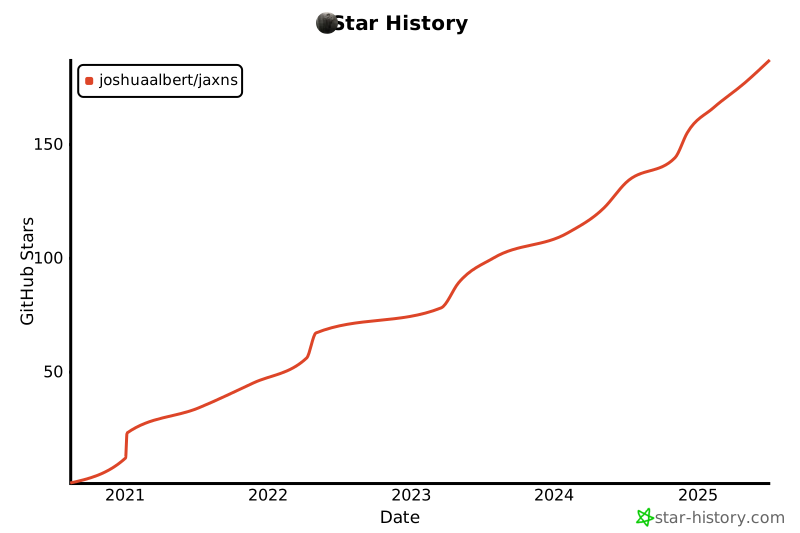
Star History
1 maintainer

Metadata
1 maintainer
Release files for jaxns 3.0.0
For a detailed explanation of source distributions (sdists) and built distributions (wheels), please see the package formats documentation.
Source distribution (sdist)
| File | Size | Uploaded | |
|---|---|---|---|
| jaxns-3.0.0.tar.gz | 193.8 kB | Details |
Built distribution (wheel)
| File | Interpreter | ABI | Platform | Reset |
|---|---|---|---|---|
| jaxns-3.0.0-py3-none-any.whl | Python 3 | none | any | Details |
Total release size: 405.9 kB
Release files / jaxns-3.0.0.tar.gz
| Download URL | jaxns-3.0.0.tar.gz |
|---|---|
| Size | 193.8 kB |
| Tags | Source |
|
SHA-256 checksum How to use checksums |
aeed4432fa2337a4a84530a806eddedd86e6fd0a7491a23073ac2d5228efc74c
|
|
BLAKE2b-256 checksum How to use checksums |
59b7ff493394ba671506f0985b052e41afe07ca7c13b6a891025d44a14757805
|
| Upload date | |
|
Uploaded using Trusted Publishing? What is trusted publishing? |
No |
| Uploaded via |
twine/7.0.0 CPython/3.12.9
|
Release files / jaxns-3.0.0-py3-none-any.whl
| Download URL | jaxns-3.0.0-py3-none-any.whl |
|---|---|
| Size | 212.1 kB |
| Tags | Python 3 |
|
SHA-256 checksum How to use checksums |
a7ba19385bc0acb8a2c2e0c0c22f6896ca40ab18bab647c4f66706a967cb64fd
|
|
BLAKE2b-256 checksum How to use checksums |
0cd62e27f654be384660030ca0ab5c6b6326d140661ceb8ba0ebe7178f49ee14
|
| Upload date | |
|
Uploaded using Trusted Publishing? What is trusted publishing? |
No |
| Uploaded via |
twine/7.0.0 CPython/3.12.9
|














