
JWST observations planning for asteroids.

Project description

Features - Install - Documentation



JWST observation planning and simulation for minor bodies across the Solar
System. You define the target and instrument(s) – jayrock does the rest.
>>> import jayrock
Features
Computation of target ephemeris
Define a solar system target by name and then compute and display its JWST-observable ephemeris for a specified cycle, including visibility windows, magnitude changes, and thermal flux estimates.
>>> achilles = jayrock.Target("achilles") # define target by name or designation
>>> achilles.compute_ephemeris(cycle=6)   # compute ephemeris for JWST Cycle 6
>>> achilles.print_ephemeris()
(588) Achilles: Ephemeris from 2027-07-01 to 2028-06-30
├── Window 1: 2027-07-02 -> 2027-08-10
│   ├── Duration         40 days
│   ├── Vmag             16.18 -> 16.48
│   └── Thermal @ 15um   393.39 -> 308.31 mJy
├── Window 2: 2028-03-02 -> 2028-04-21
│   ├── Duration         51 days
│   ├── Vmag             16.54 -> 16.15
│   └── Thermal @ 15um   279.80 -> 360.74 mJy
└── errRA/errDec in arcsec: 0.027 / 0.005
Modelling of reflectance spectrum and thermal emission
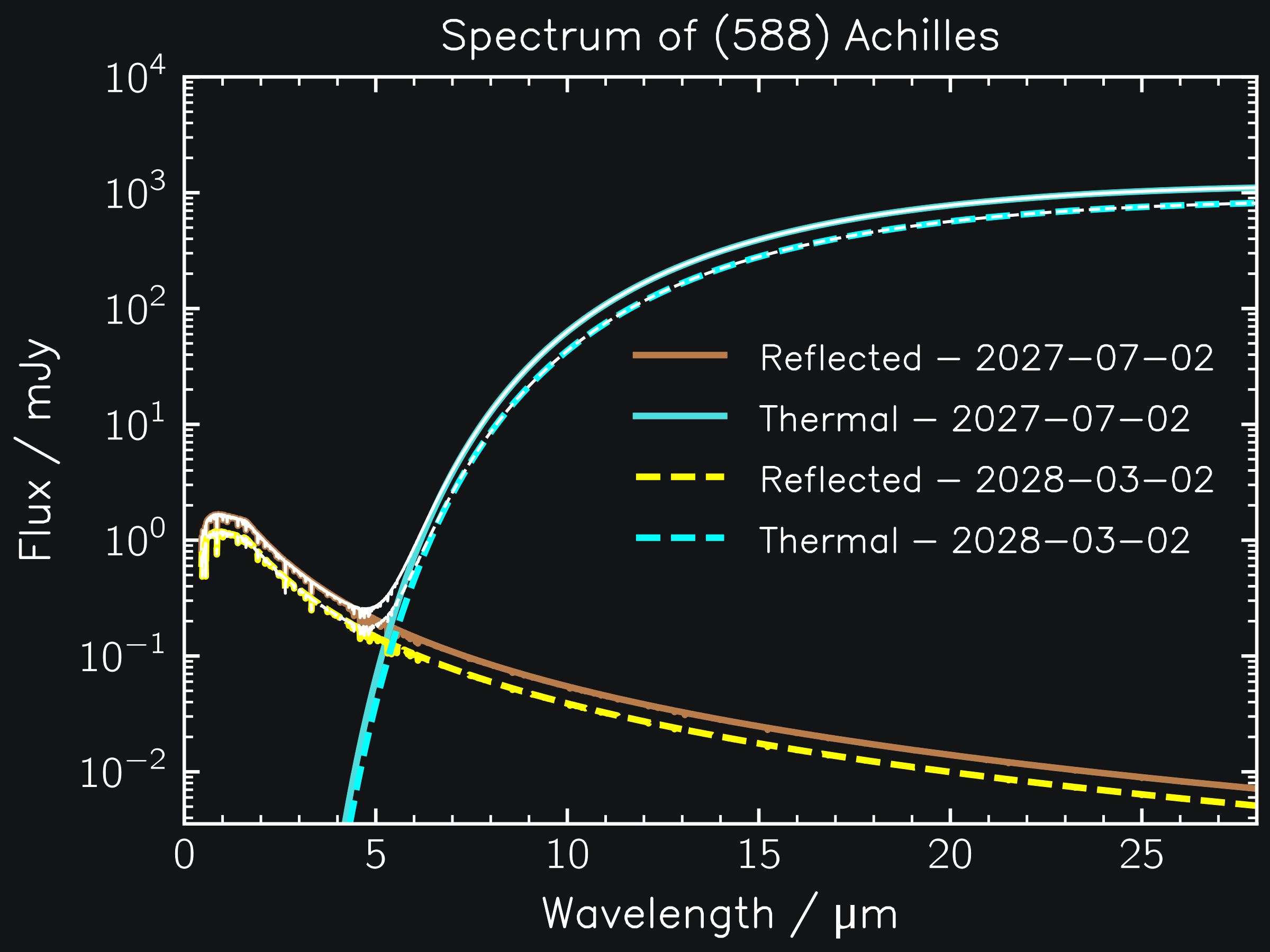
Identify the dates of maximum and minimum thermal emission within the visibility window and then plot the target's modelled reflectance and thermal spectrum for a direct comparison between the two observation dates.
>>> # compare spectra at dates of max/min thermal emission
>>> date_thermal_max = achilles.get_date_obs(at="thermal_max")
>>> date_thermal_min = achilles.get_date_obs(at="thermal_min")
>>> achilles.plot_spectrum(date_obs=[date_thermal_max, date_thermal_min])
Compute instrument configuration to reach SNR target
Configure a JWST instrument and calculate the required exposure time parameters (groups and integrations) to achieve a specified Signal-to-Noise Ratio (SNR) at a particular wavelength.
>>> miri_lrs = jayrock.Instrument('MIRI', mode='LRSSLIT')
>>> miri_lrs.detector.nexp = 2  # 2-pt dither
>>> miri_lrs.detector.readout_pattern = 'fastr1'  # recommended for LRS
>>> # Compute exposure times for SNR target of 300 at 10 micron
>>> miri_lrs.set_snr_target(300, target, date_thermal_min, wave=10)
>>> # -> jayrock defines ngroup and nint for you
Visualise SNR across detector configurations and possible saturation issues
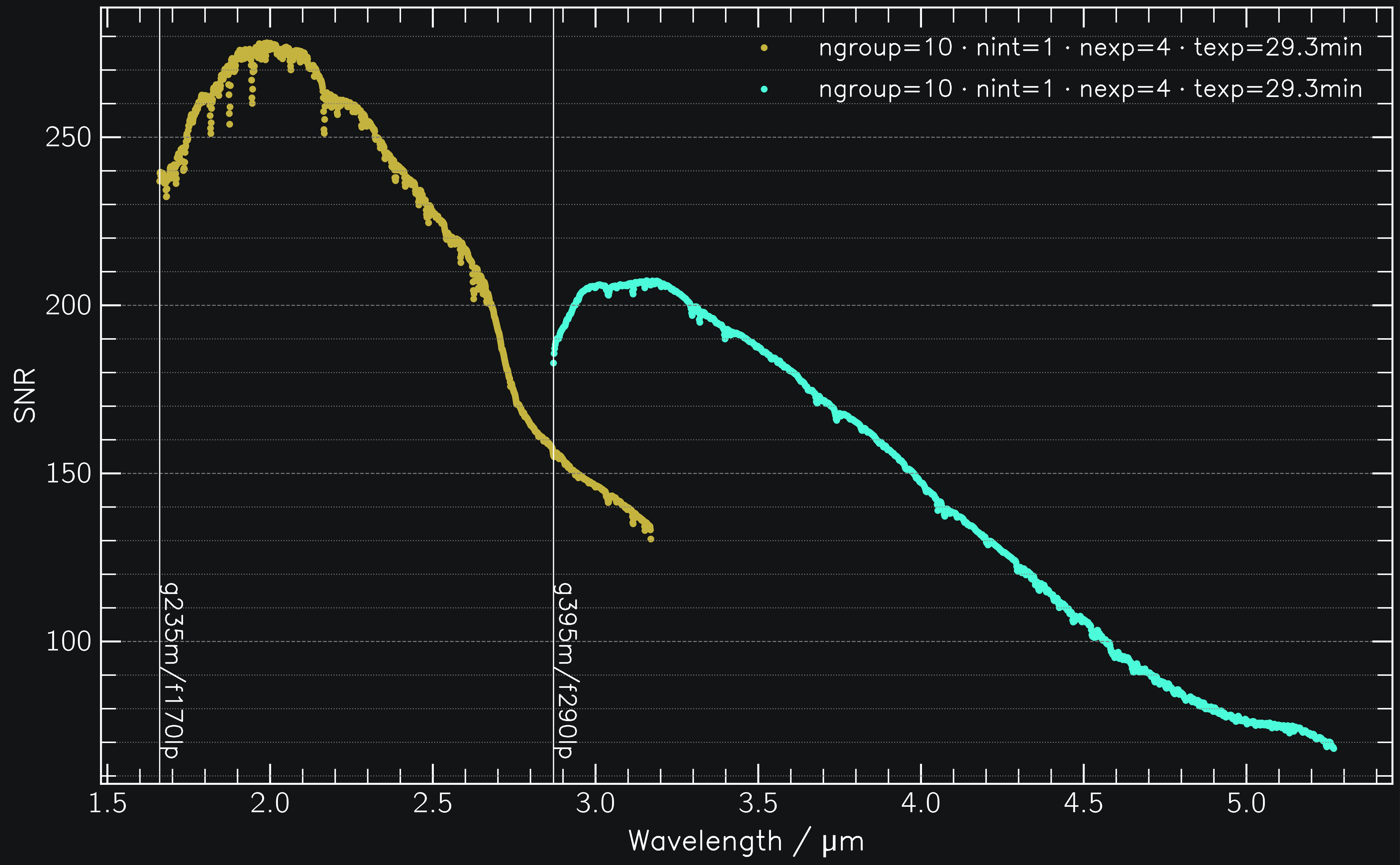
Simulate multiple observations using manually set exposure parameters across different detector configurations (apertures/filters/dispersers). Plot the resulting simulated SNR over the full wavelength range for all defined observations.
# Simulate observation of Achilles on date of minimum Vmag
date_obs = achilles.get_date_obs(at="vmag_min")

observations = []  # list to store observations

inst = jayrock.Instrument("NIRSpec", mode="IFU")

for disp, filt in [("G235M", "F170LP"), ("G395M", "F290LP")]:

    # Set filter and disperser
    inst.disperser = disp
    inst.filter = filt

    # Set ngroup, nint, nexp directly
    inst.detector.ngroup = 10  # number of groups per integration
    inst.detector.nint = 1     # number of integrations per exposure
    inst.detector.nexp = 4     # number of exposures -> number of dithers

    obs = jayrock.observe(achilles, inst, date_obs=date_obs)
    observations.append(obs)

# Plot SNR over wavelength
jayrock.plot_snr(observations)
Install
Install from PyPi using pip:
$ pip install jayrock
The minimum required python version is 3.11. jayrock relies on pandeia, the python engine behind the JWST ETC.
Detailed install instructions for this dependency can be found here.
Documentation
Check out the documentation at jayrock.readthedocs.io.
Release history Release notifications | RSS feed


Download files
Download the file for your platform. If you're not sure which to choose, learn more about installing packages.
Source Distribution
Built Distribution
Filter files by name, interpreter, ABI, and platform.
If you're not sure about the file name format, learn more about wheel file names.
Copy a direct link to the current filters
File details
Details for the file jayrock-0.0.3.tar.gz.
File metadata
- Download URL: jayrock-0.0.3.tar.gz
- Upload date:
- Size: 18.1 kB
- Tags: Source
- Uploaded using Trusted Publishing? No
- Uploaded via: poetry/2.1.1 CPython/3.12.3 Linux/6.5.0-44-generic
File hashes
| Algorithm | Hash digest | |
|---|---|---|
| SHA256 |
7321b485c384f077539ecc4113b2396898aa72354d2cf788a660f90cecfb494a
|
|
| MD5 |
b14eabc362d922b1ad9e6fee435f6ee7
|
|
| BLAKE2b-256 |
ef3f5b65be3c894739dbe70d854db7b994029c921f49de87ddfb650c5ea9a0f3
|
File details
Details for the file jayrock-0.0.3-py3-none-any.whl.
File metadata
- Download URL: jayrock-0.0.3-py3-none-any.whl
- Upload date:
- Size: 19.6 kB
- Tags: Python 3
- Uploaded using Trusted Publishing? No
- Uploaded via: poetry/2.1.1 CPython/3.12.3 Linux/6.5.0-44-generic
File hashes
| Algorithm | Hash digest | |
|---|---|---|
| SHA256 |
f8993a3dfdc087b42fe714a39b4f51f70021f40f33569b09e77e60d5df3b9982
|
|
| MD5 |
7905807d8c7b08dba83cf637c4aa4725
|
|
| BLAKE2b-256 |
f48f2addc4f7eee437c3ec7120b9803900ed6afdfdedcd62bda0446898df0a8a
|






