
jdDesktopEntryEdit
A graphical Program to create and edit Desktop Entries

jdDesktopEntryEdit allows you to create and edit Desktop Entries according to the Freedesktop Specification.
Unlike other Programs, which try to make things easy by implementing only the main parts, the Goal of jdDesktopEntryEdit is to support the full specification.
Install
Flatpak
You can get jdDesktopEntryEdit from Flathub
AUR
Arch Users can get jdDesktopEntryEdit from the AUR
SourceForge
You can get Windows and AppImage Builds from SourceForge
pip
You can install jdDesktopEntryEdit from PyPI using pip:
pip install jdDesktopEntryEdit
Using this Method, it will not include a Desktop Entry or any other Data file, so you need to run jdDesktopEntryEdit from the Command Line. Use this only, when nothing else works.
From source
This is only for experienced Users and someone, who wants to package jdDesktopEntryEdit for a Distro.
jdDesktopEntryEdit should be installed as a Python package.
You can use pip or any other tool that can handle Python packages.
YOu need to have lrelease installed to build the Package.
After that, you should run install-unix-datafiles.py which wil install things like the Desktop Entry or the Icon in the correct place.
It defaults to /usr, but you can change it with the --prefix argument.
It also applies the translation to this files.
You need gettext installed to run install-unix-datafiles.py.
Here's a example of installing jdDesktopEntryEdit into /usr/local:
sudo pip install --prefix /usr/local .
sudo ./install-unix-datafiles.py --prefix /usr/local
Translate
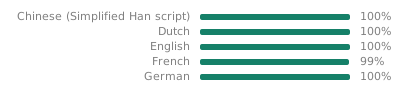
You can help translating jdDesktopEntryEdit on Codeberg Translate
Develop
jdDesktopEntryEdit is written in Python and uses PyQt6 as GUI toolkit. You should have some experience in both.
You can run jdDesktopEntryEdit.pyto start jdDesktopEntryEdit from source and test your local changes.
It ships with a few scripts in the tools directory that you need to develop.
CompileUI.py
This is the most important script. It will take all .ui files in jdDesktopEntryEdit/ui and compiles it to a Python class
and stores it in jdDesktopEntryEdit/ui_compiled. Without running this script first, you can't start jdDesktopEntryEdit.
You need to rerun it every time you changed or added a .ui file.
BuildTranslations.py
This script takes all .ts files and compiles it to .qm files.
The .ts files are containing the translation source and are being used during the translation process.
The .qm contains the compiled translation and are being used by the Program.
You need to compile a .ts file to a .qm file to see the translations in the Program.
UpdateTranslations.py
This regenerates the .ts files. You need to run it, when you changed something in the source code.
The .ts files are contains the line in the source, where the string to translate appears,
so make sure you run it even when you don't changed a translatable string, so the location is correct.
UpdateUnixDataTranslations.py
This regenerates the translation files in deploy/translations. these files contains the translations for the Desktop Entry and the AppStream File.
It uses gettext, as it is hard to translate this using Qt.
These files just exists to integrate the translation with Weblate, because Weblate can't translate the Desktop Entry and the AppStream file.
Make sure you run this when you edited one of these files.
You need to have gettext installed to use it.
UpdateTranslators.py
This uses git to get a list of all Translators and writes it to jdDesktopEntryEdit/data/translators.json.
This is used to display the translators in the About Dialog.
You need git to run this script.
WriteChangelogHtml.py
This read the Changelog from deploy/page.codeberg.JakobDev.jdDesktopEntryEdit.metainfo.xml, converts it to HTML and writes it to jdDesktopEntryEdit/data/changelog.html.
This is used to display the Changelog in the About Dialog.
You need appstream-python to be installed to use this script.
1 maintainer

Metadata
1 maintainer
Release files for jdDesktopEntryEdit 1.8
For a detailed explanation of source distributions (sdists) and built distributions (wheels), please see the package formats documentation.
Source distribution (sdist)
| File | Size | Uploaded | |
|---|---|---|---|
| jddesktopentryedit-1.8.tar.gz | 86.9 kB | Details |
Built distribution (wheel)
| File | Interpreter | ABI | Platform | Reset |
|---|---|---|---|---|
| jddesktopentryedit-1.8-py3-none-any.whl | Python 3 | none | any | Details |
Total release size: 171.0 kB
Release files / jddesktopentryedit-1.8.tar.gz
| Download URL | jddesktopentryedit-1.8.tar.gz |
|---|---|
| Size | 86.9 kB |
| Tags | Source |
|
SHA-256 checksum How to use checksums |
b23e2851b3f4dcc0b53a7a3fce3eb8ac989ed2cbe27ced71f7e96f557639cf0e
|
|
BLAKE2b-256 checksum How to use checksums |
77ea4a219a8d2030abd04d12307d9b2a6edc33c41f767a951ef43cbe2615eb18
|
| Upload date | |
|
Uploaded using Trusted Publishing? What is trusted publishing? |
No |
| Uploaded via |
twine/6.2.0 CPython/3.13.7
|
Release files / jddesktopentryedit-1.8-py3-none-any.whl
| Download URL | jddesktopentryedit-1.8-py3-none-any.whl |
|---|---|
| Size | 84.1 kB |
| Tags | Python 3 |
|
SHA-256 checksum How to use checksums |
afe87c4bc26a7ce1bd866d2616d250f11075f55e70531e1e022416a76ab21392
|
|
BLAKE2b-256 checksum How to use checksums |
c65cf6649e609e90bd61d5b6973bee36d5eb6b99f72840ffd1ee69fbda75ab80
|
| Upload date | |
|
Uploaded using Trusted Publishing? What is trusted publishing? |
No |
| Uploaded via |
twine/6.2.0 CPython/3.13.7
|














