





Quickstart · Usage · How it works · The receipts · Headless · White paper
Autonomous Engineering With Proof
Agents that don’t just act.
They audit · verify · attack · and prove.
Jeffy Loop is an autonomous engineering system built around a simple principle: AI agents shouldn’t just produce work. They should produce evidence that the work is correct. Instead of asking an agent to complete a task and trusting its conclusion, Jeffy creates a continuous Audit → Attack → Verify → Prove loop in which specialized agents inspect the work, challenge it, validate the result, and generate an auditable record of what happened. The goal isn’t simply autonomous code generation; it is autonomous engineering with proof - where every claimed result is accompanied by reproducible evidence that can be independently examined.
Jeffy treats “done” as something that must be demonstrated, not declared. The system is designed to turn autonomous engineering from a conversational interaction into an evidence-producing process: actions leave traces, decisions have provenance, failures are exposed rather than hidden, and successful outcomes produce a durable receipt of what was changed, why it was changed, and how the result was verified.
The proof
Jeffy was run against 132 open-source projects with no connection to this repository, each judged by its own test suite, every run published, failures included.
| Projects tested | Converged | Failed | PRs merged | PRs open | Issues filed |
|---|---|---|---|---|---|
| 132 | 103 | 28 | 24 | 37 | 4 |
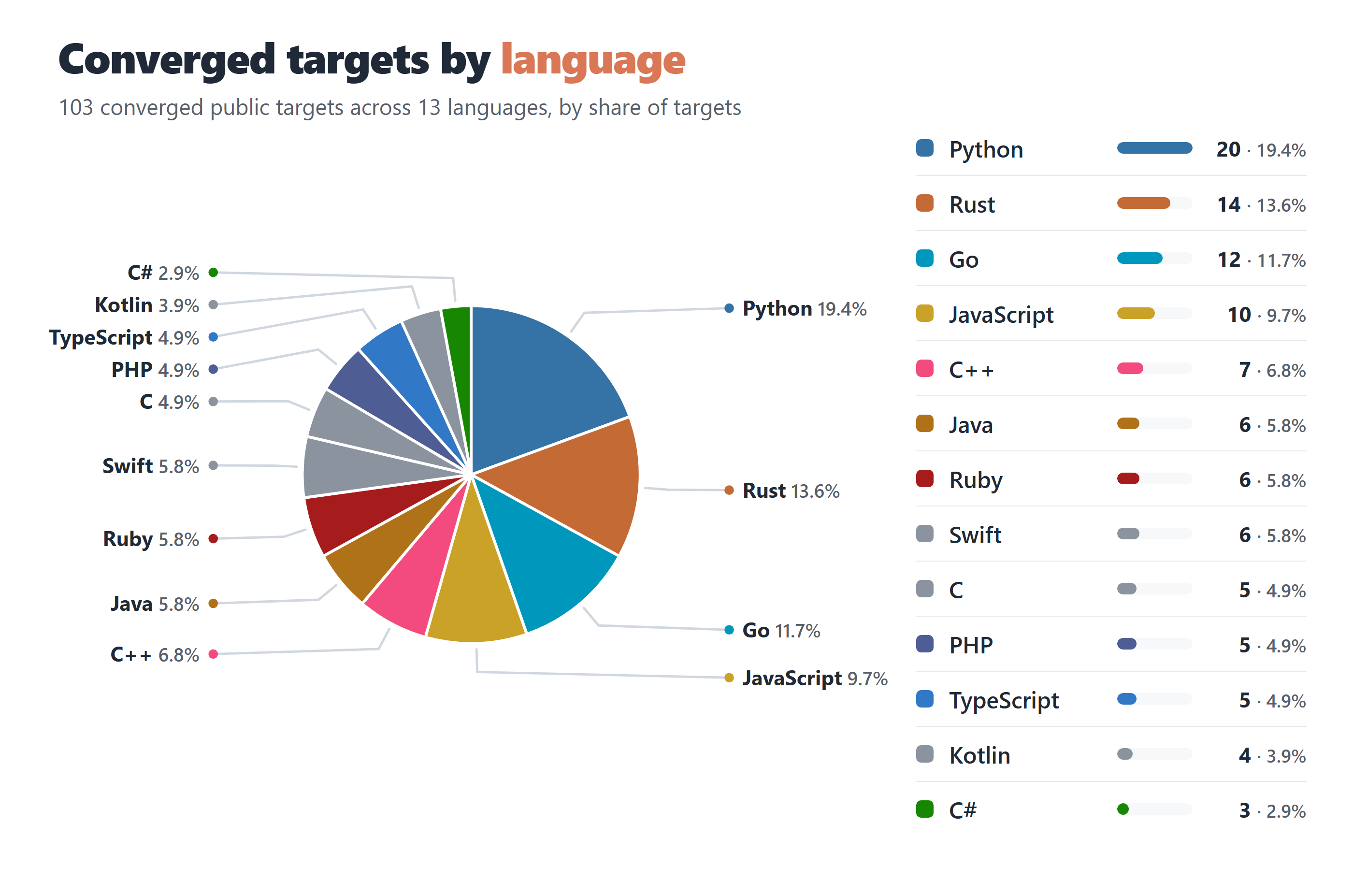
103 projects run to convergence across 13 languages with no language-specific analyzer or ruleset. Derived from the scorecard at render time.
Independent Validation
A merged pull request is the one result Jeffy cannot award itself. It takes an independent maintainer, someone with no stake in this project, to review the patch and accept it into their own codebase. Maintainers across 21 open source projects have done exactly that, including:
- Google, snappy - every release build compressed a 4 GiB input into a stream whose header claimed 0 bytes; merged the morning after filing.
- Apple (2)
- swift-log - a documented no-op setter asserted instead; merged after the maintainer asked for the doc-only form.
- swift-protobuf - the project's own CMake build of
protoc-gen-swifthad not compiled since June; approved and merged the day it was filed.
- Microsoft, mimalloc - the zeroing allocator returned uninitialized memory above the small-size threshold; merged by the author the same day.
- Apache (2)
- commons-text - a
StringMatcheroverload forwarded the buffer end as its start; merged the morning after review. - commons-csv - the record counter's Javadoc said headers were not counted while the constructor's header was; corrected, merged three days after filing.
- commons-text - a
- JetBrains, kotlinx-datetime - deprecation quick-fixes pointed developers at the wrong replacement; merged within two hours.
- Node.js, ada - the URL parser reported
host_endone byte short; merged twelve minutes after filing.
Every project, every patch, and every failure
Quickstart
You need Claude Code, signed in once, and git. The installer handles everything else, including jq.
git clone https://github.com/lenamonj/jeffy-loop.git
cd jeffy-loop
./install.sh        # Windows PowerShell: .\install.ps1
Or, with uv, no clone needed:
uv tool install jeffy-loop
jeffy install
[!NOTE] If PowerShell refuses with "running scripts is disabled on this system", run
powershell -ExecutionPolicy Bypass -File .\install.ps1once.
Open Claude Code in the project you want to improve and type /jeffy 10. It is a slash command inside the session, not a shell command. If you only want the Highs found and fixed, type /jeffy 10 --highs; it stops at the first audit that finds none, so it is usually the faster run (High hunt). When the run ends, start a new session to run it again; the restart is doing real work.
Five guarantees
Each one is enforced by the iteration prompt, the state files, or the Stop hook. How.
- It audits like an engineer, not a linter. A finding exists only when the loop can point at it and prove it with a runnable check.
- It cannot wreck your repo. Every iteration is a local commit, a broken verify is reverted, and nothing is ever pushed.
- "Done" is not the agent's opinion. An adversarial evaluator and a shell gate re-check every declaration.
- It cannot claim what it never looked at. The whole public surface goes on a checklist before any finding is filed.
- Lessons become machinery. A rule learned once binds every later iteration, and the engine itself passes 347 behavioural checks on Linux, Windows and macOS.
Documentation
| Page | What it covers |
|---|---|
| Usage | Flags, rounds and budgets, scoped mode, cancelling, upgrading, uninstalling, and what to know before a first run |
| How it works | The run lifecycle, the five guarantees, the full rule set, what a converged stop looks like, and how the loop improves itself |
| Headless runs | Running budgeted rounds unattended from bash or PowerShell |
| The receipts | Every open-source target with its outcome, the merged patches, the greenfield builds |
| Contributing | The validator and the review bar |
| White paper | For readers new to agent loops: how loops got here, every rule from first principles, and what this method still cannot do |
[!IMPORTANT] Trust model. The engine is one shell script,
skills/jeffy/hooks/stop-hook.sh, plus the small library beside it inskills/jeffy/hooks/lib/, registered as a Claude Code Stop hook. In a session with no live Jeffy state file it exits at once and does nothing. The installer writes two skill folders under~/.claude/skills, one hook entry in~/.claude/settings.json, and, only if you say yes whenjqis missing, ajqinstall through your package manager.
License
MIT
1 maintainer

Release files for jeffy-loop 1.23.0
For a detailed explanation of source distributions (sdists) and built distributions (wheels), please see the package formats documentation.
Source distribution (sdist)
| File | Size | Uploaded | |
|---|---|---|---|
| jeffy_loop-1.23.0.tar.gz | 115.3 kB | Details |
Built distribution (wheel)
| File | Interpreter | ABI | Platform | Reset |
|---|---|---|---|---|
| jeffy_loop-1.23.0-py3-none-any.whl | Python 3 | none | any | Details |
Total release size: 245.1 kB
Release files / jeffy_loop-1.23.0.tar.gz
| Download URL | jeffy_loop-1.23.0.tar.gz |
|---|---|
| Size | 115.3 kB |
| Tags | Source |
|
SHA-256 checksum How to use checksums |
b65fce7593e44d386c4ee6be044408bcaa48e7fe26ede8b18491ebd8240221db
|
|
BLAKE2b-256 checksum How to use checksums |
d38f3b5b7ef493e895178fdec60fe2d701f713bc3d2df1b51e1e0e4a50503cdd
|
| Upload date | |
|
Uploaded using Trusted Publishing? What is trusted publishing? |
Yes |
| Uploaded via |
twine/7.0.0 CPython/3.13.14
|
Provenance
Provenance describes where a file came from. On PyPI, provenance is shared via attestations, which provide a verifiable record of the build or publishing details. View details, limitations and caveats.


PyPI Publish Attestation
PyPI verified that this artifact, at this checksum, originated from the publisher listed below.
Signed by GitHub Actions, verified by PyPI on Sep 7, 2026.
Transparency logRelease files / jeffy_loop-1.23.0-py3-none-any.whl
| Download URL | jeffy_loop-1.23.0-py3-none-any.whl |
|---|---|
| Size | 129.8 kB |
| Tags | Python 3 |
|
SHA-256 checksum How to use checksums |
2f51864102d52d023ca2f5080f5c0fd155016b2919e14c7eb9e6ebbc8025092d
|
|
BLAKE2b-256 checksum How to use checksums |
dcbbdeb98305b7e1f92ab77b1f28f601a1f815f3a8d6c02df2c87d6805e28ee8
|
| Upload date | |
|
Uploaded using Trusted Publishing? What is trusted publishing? |
Yes |
| Uploaded via |
twine/7.0.0 CPython/3.13.14
|
Provenance
Provenance describes where a file came from. On PyPI, provenance is shared via attestations, which provide a verifiable record of the build or publishing details. View details, limitations and caveats.
PyPI Publish Attestation
PyPI verified that this artifact, at this checksum, originated from the publisher listed below.
Signed by GitHub Actions, verified by PyPI on Sep 7, 2026.
Transparency log













