
A Python SDK for Jellyfin.
Verified details
These details have been verified by PyPIProject links
GitHub Statistics
Maintainers

Project description
Jellyfin SDK for Python

A High-level Wrapper for OpenAPI Generated Bindings for Jellyfin API.
Warning: API changes will occur only in the final classes, bindings and legacy don't change
The main goal of this project is to be a wrapper for the API but with high level of abstraction using the power of OpenAPI Specs bindings and good patterns such as Inversion of Control, Method Chaining, JSONPath, and more.
Main unique features:
- Enables targeting a specific Jellyfin server version to ensure compatibility and prevent breaking changes.
- Supports accessing multiple servers, each potentially running different Jellyfin versions.
- Allows reducing the level of abstraction to access advanced or unavailable options through lower-level interfaces.
- Works like AWS CDK Constructs Level, more abstraction, more simple.
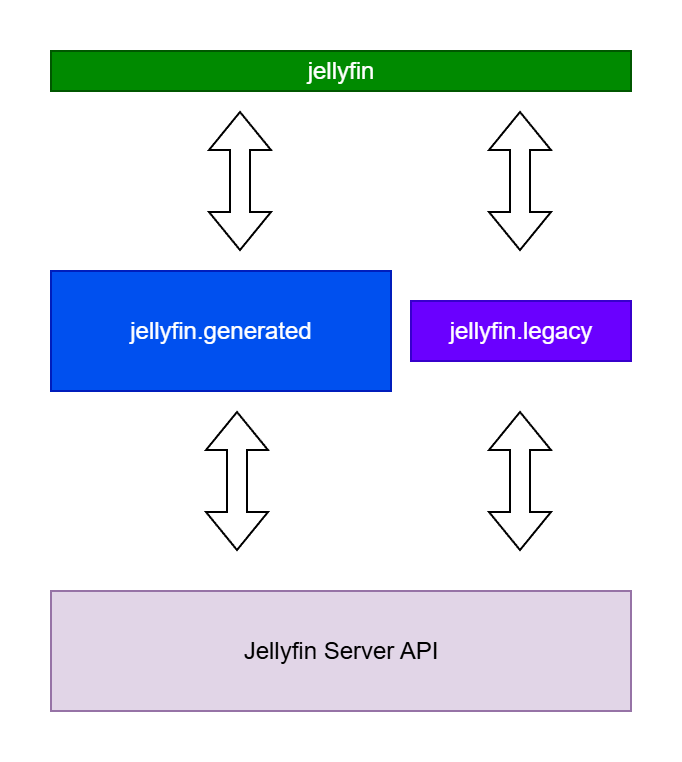
How modules work together
This project is mainly inspired by good python library like these:
Install
pip install jellyfin-sdk
or
uv add jellyfin-sdk
Usage
Drop-in replacement for jellyfin-apiclient-python
This library includes the old legacy client (which is almost unmaintained) to help with migration:
pip uninstall jellyfin-apiclient-python
pip install jellyfin-sdk[legacy]
# change from
from jellyfin_apiclient_python import JellyfinClient
from jellyfin_apiclient_python.api import API

# to this
from jellyfin.legacy import JellyfinClient
from jellyfin.legacy.api import API
List of current problems in legacy project already fixed here:
import jellyfin

jellyfin.api(os.getenv("URL"), os.getenv("API_KEY")).users.libraries

ValueError: User ID is not set. Use the 'of(user_id)' method to set the user context.
import jellyfin

jellyfin.api(os.getenv("URL"), os.getenv("API_KEY")).system.info
import jellyfin
from jellyfin.items import ItemCollection, Item
from jellyfin.generated import PlaylistsApi, BaseItemKind

api = jellyfin.api(os.getenv("URL"), os.getenv("API_KEY"))
api.user = 'justin'
playlist = api.items.search.add('include_item_types', [BaseItemKind.PLAYLIST]).recursive().all.first
playlist

<Item
  name="Editor's Choice",
  original_title=None,
  server_id='REDACTED',
  id=UUID('ec0770d5-bde0-794c-bc1e-c5e8ff0588ca'),
  etag=None,
  source_type=None,
  playlist_item_id=None,
  date_created=None,
  date_last_media_added=None,
  extra_type=None
  ...
]>

# no high level abstraction, let's use bindings for playlist
ItemCollection(Item(
    PlaylistsApi().get_playlist_items(playlist.id, api.user.id)
))
Easy to debug
Debug is a missing peace in every implementation I look at, even the jellyfin team have a hard time to see what happen.
To help to remove the SDK of equation and for code more complex we have a feature to allow show a curl command of every request in the server.
import jellyfin
from jellyfin.items import ItemCollection
from jellyfin.generated import PlaylistsApi, BaseItemKind

api = jellyfin.api(os.getenv("URL"), os.getenv("API_KEY"))
api.debug = True

playlist = api.items.search.add('include_item_types', [BaseItemKind.PLAYLIST]).recursive().all.first
The api.debug enable the client to print all requests in curl in prompt. Never use this in production!
curl '-X' GET \n
    '-H' 'Accept: application/json' \n
    '-H' 'User-Agent: OpenAPI-Generator/10.10/python' \n
    '-H' 'Authorization: MediaBrowser Token="API_KEY"' \n
    URL/Items?recursive=true&includeItemTypes=Playlist
Lots of problems happens in the api server or behavior not in documentation, in this way you have data to open a issue in jellyfin.
Login
import os

os.environ["URL"] = "https://jellyfin.example.com"
os.environ["API_KEY"] = "MY_TOKEN"
Using SDK
import jellyfin

api = jellyfin.api(
    os.getenv("URL"),
    os.getenv("API_KEY")
)

print(
    api.system.info.version,
    api.system.info.server_name
)
Direct with Generated Bindings
from jellyfin.generated.api_10_10 import Configuration, ApiClient, SystemApi

configuration = Configuration(
    host = os.getenv("URL"),
    api_key={'CustomAuthentication': f'Token="{os.getenv("API_KEY")}"'},
    api_key_prefix={'CustomAuthentication': 'MediaBrowser'}
)

client = ApiClient(configuration)
system = SystemApi(client)

print(
    system.get_system_info().version,
    system.get_system_info().server_name
)
It's possible use the proxy direct, this always will point to current stable
# specific
from jellyfin.generated.api_10_10 import Configuration, ApiClient, SystemApi

# current stable
from jellyfin.generated import Configuration, ApiClient, SystemApi

# current unstable
from jellyfin.generated.api_10_11 import BackupApi

# inject from high level abstraction
import jellyfin

api = jellyfin.api(
    os.getenv("URL"),
    os.getenv("API_KEY")
)

# module loader
api.generated

<module 'jellyfin.generated.api_10_10' from '/code/jellyfin-sdk-python/src/jellyfin/generated/api_10_10/__init__.py'>

# injected from bindings
client = api.generated.ApiClient

<class 'jellyfin.generated.api_10_10.api_client.ApiClient'>
Legacy
from jellyfin.legacy import JellyfinClient
client = JellyfinClient()
client.authenticate(
    {"Servers": [{
        "AccessToken": os.getenv("API_KEY"),
        "address": os.getenv("URL")
    }]},
    discover=False
)
system_info = client.jellyfin.get_system_info()

print(
    system_info.get("Version"),
    system_info.get("ServerName")
)
Jellyfin Server API Version
This is important because when a new API version is released, breaking changes can affect the entire project. To avoid this, you can set an API target version, similar to how it's done in Android development:
from jellyfin.api import Version
import jellyfin

# By default will use the lastest stable
jellyfin.api(
    os.getenv("URL"),
    os.getenv("API_KEY")
)

# now let's test the new API (version 10.11) for breaking changes in same endpoint
jellyfin.api(
    os.getenv("URL"),
    os.getenv("API_KEY"),
    Version.V10_11
)

# but str is allow to: 10.10, 10.11 and etc
jellyfin.api(
    os.getenv("URL"),
    os.getenv("API_KEY"),
    '10.11'
)

# let's test a wrong version
jellyfin.api(
    os.getenv("URL"),
    os.getenv("API_KEY"),
    '99'
)

ValueError: Unsupported version: 99. Supported versions are: ['10.10', '10.11']
List all libraries of an user
When using API_KEY some endpoints need the user_id (don't me ask why!), almost all issues with jellyfin is around this.
To help to identify this not-so-much-edge-cases we raise a exception to help with that:
api = jellyfin.api(
    os.getenv("URL"),
    os.getenv("API_KEY")
)

api.users.libraries

ValueError: User ID is not set. Use the 'of(user_id)' method to set the user context.


api.users.of('f674245b84ea4d3ea9cf11').libraries

# works also with the user name
api.users.of('niels').libraries

# when using 'of' the attribute of dataclasses
# user and user_view can be accessed directly
api.users.of('niels').id
List all items
Item can be any object in the server, in fact that's how works, one huge table recursive linked.
api = jellyfin.api(
    os.getenv("URL"),
    os.getenv("API_KEY")
)

api.items.all

# Same command but without shorthand
search = api.items.search
search

<ItemSearch (no filters set)>

search.paginate(1000)

<ItemSearch filters={
  start_index=0,
  limit=1000,
  enable_total_record_count=True
}>

search.recursive()

<ItemSearch filters={
  start_index=0,
  limit=1000,
  enable_total_record_count=True,
  recursive=True
}>
All filter options is available here.
The pagination uses a Iterator:
api = jellyfin.api(
    os.getenv("URL"),
    os.getenv("API_KEY")
)

for item in api.items.search.paginate(100).recursive().all:
    print(item.name)
Let's get the User ID by name or ID
api = jellyfin.api(
    os.getenv("URL"),
    os.getenv("API_KEY")
)

uuid = api.user.by_name('joshua').id

api.user.by_id(uuid).name
Get item by ID
api = jellyfin.api(
    os.getenv("URL"),
    os.getenv("API_KEY")
)

api.items.by_id('ID')
This is just a shorthand for:
api.items.search.add('ids', ['ID']).all.first
Upload a Primary Image for a Item
import jellyfin
from jellyfin.generated import ImageType

api = jellyfin.api(
    os.getenv("URL"),
    os.getenv("API_KEY")
)

api.image.upload_from_url(
    'ID',
    ImageType.PRIMARY,
    'https://upload.wikimedia.org/wikipedia/commons/6/6a/Jellyfin_v10.6.0_movie_detail%2C_web_client.png'
)
Add tags in a collection
Edit item require the user_id, but we make this easy:
api = jellyfin.api(
    os.getenv("URL"),
    os.getenv("API_KEY")
)

item = api.items.edit('ID', 'joshua')
item.tags = ['branding']
item.save()

item = api.items.edit('ID', 'niels')
item.tags = ['rules']
item.save()
If you want to set a global user:
api = jellyfin.api(
    os.getenv("URL"),
    os.getenv("API_KEY")
)
api.user = 'niels'

item = api.items.edit('ID')
item.tags = ['branding']
item.save()

item = api.items.edit('OTHER_ID')
item.tags = ['rules']
item.save()
The user on edit method has precedence over global
Register as a client
If necessary register a client to identify ourselves to the server
api = jellyfin.api(
    os.getenv("URL"),
    os.getenv("API_KEY")
)
api.register_client()

<Api
 url='https://jellyfin.example.com',
 version='10.10',
 auth='Token="***",
       Client="4b8caf670ca1",
       Device="Linux Ubuntu 24.04.3 LTS (noble)",
       DeviceId="a7-17-23-d8-b9-b8",
       Version="24.04.3"'
>
If you need customize the client information:
api.register_client('test')

<Api
 url='https://jellyfin.example.com',
 version='10.10',
 auth='Token="***",
       Client="test",
       Device="Linux Ubuntu 24.04.3 LTS (noble)",
       DeviceId="a7-17-23-d8-b9-b8",
       Version="24.04.3"'
>
For more detail look the docs.
Documentation
- SDK Reference
- Jellyfin API 10.10 (Stable)
- Jellyfin API 10.11 (Release Candidate)
Supported Jellyfin Versions
| SDK Version | Jellyfin API Target |
|---|---|
| 0.1.x | 10.10.x-10.11.x |
Project details
Verified details
These details have been verified by PyPIProject links
GitHub Statistics
Maintainers
Release history Release notifications | RSS feed


Download files
Download the file for your platform. If you're not sure which to choose, learn more about installing packages.
Source Distribution
Built Distribution
Filter files by name, interpreter, ABI, and platform.
If you're not sure about the file name format, learn more about wheel file names.
Copy a direct link to the current filters
File details
Details for the file jellyfin_sdk-0.3.0.tar.gz.
File metadata
- Download URL: jellyfin_sdk-0.3.0.tar.gz
- Upload date:
- Size: 788.7 kB
- Tags: Source
- Uploaded using Trusted Publishing? Yes
- Uploaded via: uv/0.8.15
File hashes
| Algorithm | Hash digest | |
|---|---|---|
| SHA256 |
27b6b16f24017b40dfeebc8bcf3c4ed8614c90ce9f4d17efc305fdfee95d8f6d
|
|
| MD5 |
9ab208113b40537c70d999ce33226144
|
|
| BLAKE2b-256 |
764dcab9593ffa44c9e2175d931c393a453248b00b686c6d7bc8d8ca2c6f8b5c
|
File details
Details for the file jellyfin_sdk-0.3.0-py3-none-any.whl.
File metadata
- Download URL: jellyfin_sdk-0.3.0-py3-none-any.whl
- Upload date:
- Size: 1.7 MB
- Tags: Python 3
- Uploaded using Trusted Publishing? Yes
- Uploaded via: uv/0.8.15
File hashes
| Algorithm | Hash digest | |
|---|---|---|
| SHA256 |
c953360485d025b7bf416933c36f0e407a7b906ff88efda6f6ce3c7716604994
|
|
| MD5 |
8b70d509b8bfdf1118436cb0d95c6998
|
|
| BLAKE2b-256 |
a54b4479fc23de6872b92ac5b92d4fcf30056710dd16cc746e320f12c3abfdc9
|






