
jev-lite
OpenAI-style Python client for TypeSafe Jev (System One).
Jev does not generate text. Send state plus typed questions; get structured
decisions with probabilities. jev-lite is the official TypeSafe HTTP client — sync
and async, same shape as the OpenAI Python SDK. jev-lite@0.0.2 added Dialogflow-style
system entities; jev-lite@0.0.3 adds a privacy filter and a reranker (all
three are previews, below); jev-lite@0.0.4 adds images and Box answers
for Jev 1.14.
pip install jev-lite
# or: uv add jev-lite
Python 3.11+. Set TYPESAFE_API_KEY. Docs: https://docs.typesafe.ai/
Usage
from jev_lite import Choice, Noul, Score, TypeSafe

client = TypeSafe()  # TYPESAFE_API_KEY

result = client.system_one.create(
    state="I was charged twice. Please fix this ASAP.",
    questions={
        "billing": Noul(instructions="Is this ticket about billing?"),
        "tone": Choice(
            instructions="What is the customer's tone?",
            criteria={"calm": None, "frustrated": None, "angry": None},
        ),
        "urgency": Score(
            instructions="How urgent is this ticket?",
            criteria=["can wait", "this week", "today"],
        ),
    },
)

print(result.nouls["billing"].noul)
print(result.choices["tone"].choice)
print(result.scores["urgency"].score)
print(result.elapsed_ms, result.request_id, result.usage)
print(client.models.list())  # GET /v1/models
Async is the same surface with await:
from jev_lite import AsyncTypeSafe, Noul

async with AsyncTypeSafe() as client:
    result = await client.system_one.create(
        state="I was charged twice. Please fix this ASAP.",
        questions={"billing": Noul(instructions="Is this ticket about billing?")},
    )
    models = await client.models.list()
Pin the model with TypeSafe(model="jev-1.13.0") (or TYPESAFE_DEFAULT_MODEL);
jev-latest moves. Prefer one system_one.create with many questions over a
loop of calls. jev-1.14.0 matches 1.13 on the modules below but scores
lower on hard semantic decisions, so the modules stay on 1.13; TypeSafe will
retire 1.13 with 60 days' notice, and the pins move then
(1.14 vs 1.13).
Re-running unchanged questions can replay answers from disk
(pip install "jev-lite[cache]"):
client = TypeSafe(cache="~/.cache/jev") # or a configured diskcache.Cache
Only 200 responses are stored, keyed on the request body (which carries the model id). Leave the cache off when you measure repeat or order stability.
Images and Box (Jev 1.14, experimental)
Put an Image anywhere a value can go: in state, instructions or
criteria. The client uploads it as an asset and adds the
TypeSafe-Danger-Zone-Images header. A Box answer is where a target is,
as edges in fractions of the image; it needs jev-1.14.0.
from pathlib import Path
from jev_lite import Box, Image, Noul, TypeSafe

with TypeSafe(model="jev-1.14.0") as client:
    result = client.system_one.create(
        state={"photo": Image(Path("kitchen.jpg"))},  # PNG/JPEG, sides 280-1568 px
        questions={
            "has_mug": Noul(instructions="Is there a coffee mug in `photo`?"),
            "mug": Box(instructions="the coffee mug in `photo`"),
        },
    )

mug = result.boxes["mug"]
print(mug.box.left, mug.box.top, mug.box.right, mug.box.bottom, mug.confidence)
A Box always returns a box, so gate it on the Noul. An image costs about
2·⌈w/28⌉·⌈h/28⌉ input tokens. Measured limits (targets under ~40 px,
counting past five, text under 7 px) and usage rules:
docs/system-one/use/images.md; the
benchmark is image-questions@v0.0.1.
System entities (preview)
jev_lite.system_entities extracts the 59 Dialogflow ES system entities
(@sys.date-time, @sys.unit-currency, @sys.geo-city, …) and fills
typed slots, in ten languages (en and zh-Hant primary). Code proposes
candidates, Jev jev-1.13.0 decides, code normalizes. Preview: the API
may change within 0.0.x. Same install; no extra dependency.
from datetime import datetime
from zoneinfo import ZoneInfo

from jev_lite import TypeSafe
from jev_lite.system_entities import extract

now = datetime(2026, 10, 1, 16, 0, tzinfo=ZoneInfo("Asia/Taipei"))
with TypeSafe() as client:
    result = extract(client, "Book a table for 4 next Friday at 7pm", ["date-time", "number"], now=now)
for match in result.matches:
    print(match.entity, match.span.text, match.value)  # number 4 …; date-time … 2026-10-09 19:00
Slot filling, async and the value models: API.
Read the known limitations first:
extraction is not a security boundary. On the held-out set
system-entities-cases@v0.0.1 (301 cases, ten languages) it is 99.3% exact
on accepted values; a same-day rerun gave 98.9% on jev-1.13.0 and 99.3% on
jev-1.14.0 (release gates).
Privacy filter and reranker (preview)
jev_lite.privacy_filter and jev_lite.reranker ship in jev-lite@0.0.3
as previews: the APIs may change within 0.0.x. Import them as modules
(from jev_lite.privacy_filter import detect, from jev_lite.reranker import rerank). All numbers pin jev-1.13.0.
Privacy filter: private-span detection. Public multilingual gold (ai4privacy OpenPII, Gretel finance, NVIDIA Nemotron-PII), 300 test texts, exact-span precision / recall:
| Setup | P / R | Over-redaction | Speed |
|---|---|---|---|
| openai/privacy-filter, local GPU | 63.4 / 62.9 | 5.2% | ~20 ms per text |
| openai/privacy-filter proposes, Jev decides | 75.4 / 60.1 | 2.5% | p50 210 ms |
| Jev only, no GPU (broader proposals, per-label cuts) | 68.6 / 60.5 | 2.4% | p50 215 ms |
| Jev only, round-04 default | 80.4 / 57.6 | 1.5% | p50 210 ms |
| Jev only, before the person proposer | 78.3 / 63.6 | 1.6% | p50 209 ms |
Jev only, default detect(client, text), no GPU |
79.3 / 69.2 | 1.6% | p50 ~0.7 s |
Same default on jev-1.14.0 (same-day 1.13: 79.7 / 69.7, 1.6%) |
82.4 / 68.2 | 1.3% | call p50 0.19 s |
The default uses per-label proposers and cuts fitted on dev, and finds
people with system_entities person spans plus a person detect Noul (person
recall 43.9 → 71.9), with an order-stable name boundary. On overlap it
scores 88.9 / 77.6; exact address recall is 0 because the gold splits an
address into components while the filter masks the whole address. It fails
most written robustness bars, so it is a preview. Hosted Jev sees the raw
text before masking. Details:
docs/privacy-filter/.
Reranker: batched evidence Noul over a first-stage pool (balanced batches of at most 30, independent of the caller's order), nDCG@10:
| Bank | First stage | Reranked | Query p50 | Same day, 1.13 → 1.14 |
|---|---|---|---|---|
| SciFact (50 q) | .556 | .638 | 0.30 s | .635 → .634 |
| FiQA (50 q) | .219 | .346 | 0.26 s | .346 → .348 |
| zh, BM25 (50 q) | .526 | .587 | 0.30 s | .603 → .618 |
| zh, E5 (50 q) | .551 | .647 | 0.27 s | .640 → .656 |
| Mr. TyDi ko / ja / ar (30 q each) | .415 / .605 / .529 | .675 / .791 / .754 | 0.23–0.24 s | .687 / .791 / .741 → .675 / .808 / .741 |
A batch score is relative to the other passages in its request, not a
standalone probability. A passage that echoes the relevance criteria can be
lifted into the top 10; rerank(..., check_echo=True) (off by default)
re-checks the top-k and moves such passages down, at about +0.23 s. Details: docs/reranker/.
Tracing
Off by default. Opt in and pick the destination:
from jev_lite import instrument

instrument(endpoint="http://127.0.0.1:4318")  # local Grafana LGTM
Or set OTEL_EXPORTER_OTLP_ENDPOINT and call instrument(), or install your
own TracerProvider first (Logfire, etc.). Spans record prompt, result, and
latency.
Develop
uv sync --dev
uv run ruff check . && uv run pytest
The supported public API is the TypeSafe client. Optional local engines live
under jev_lite.engine (pip install 'jev-lite[ml]'). See
docs/.
Semantic decisions v0.0.2
Dataset semantic-decisions@v0.0.2, versioned separately from the package
(versions).
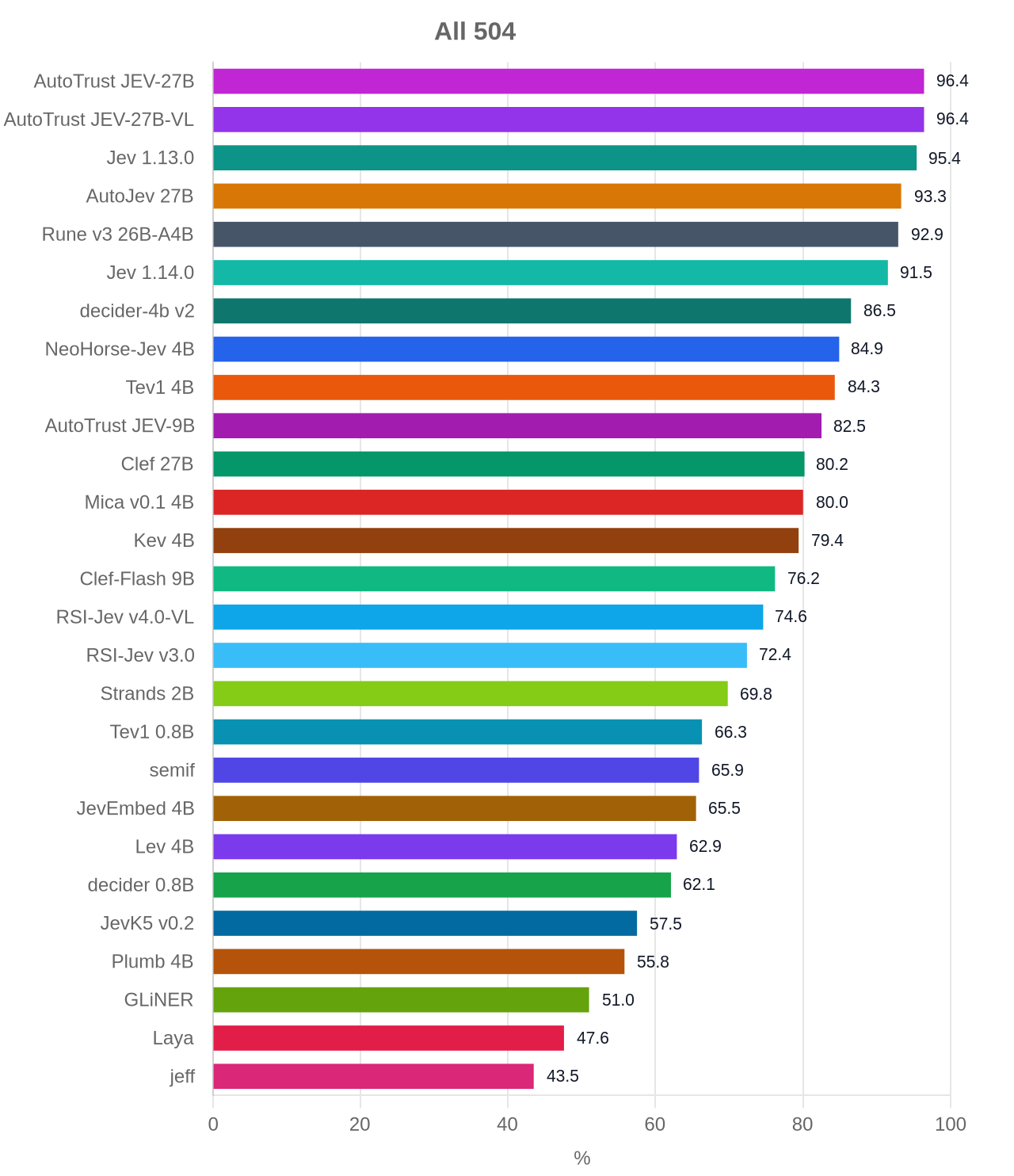
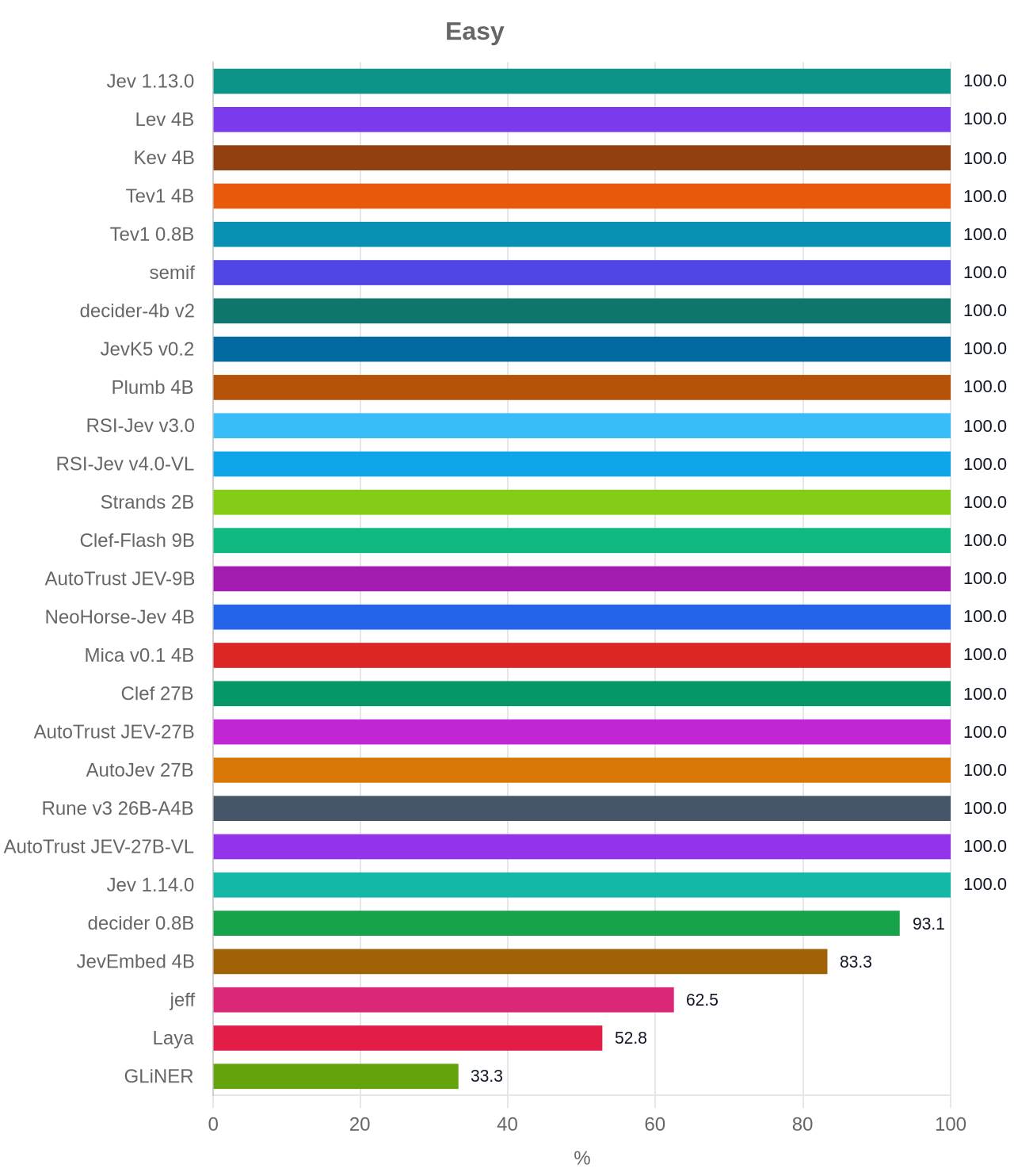
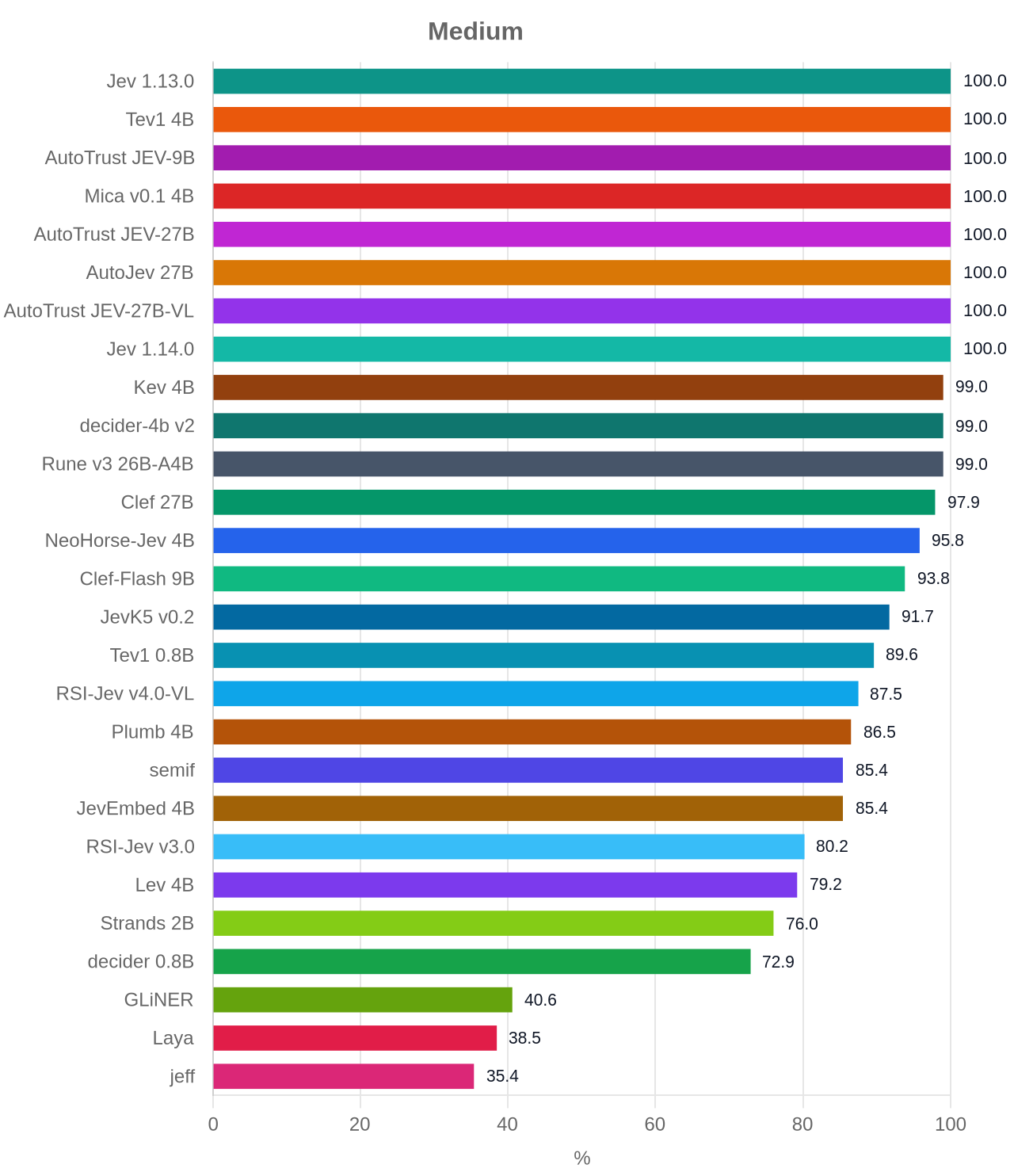
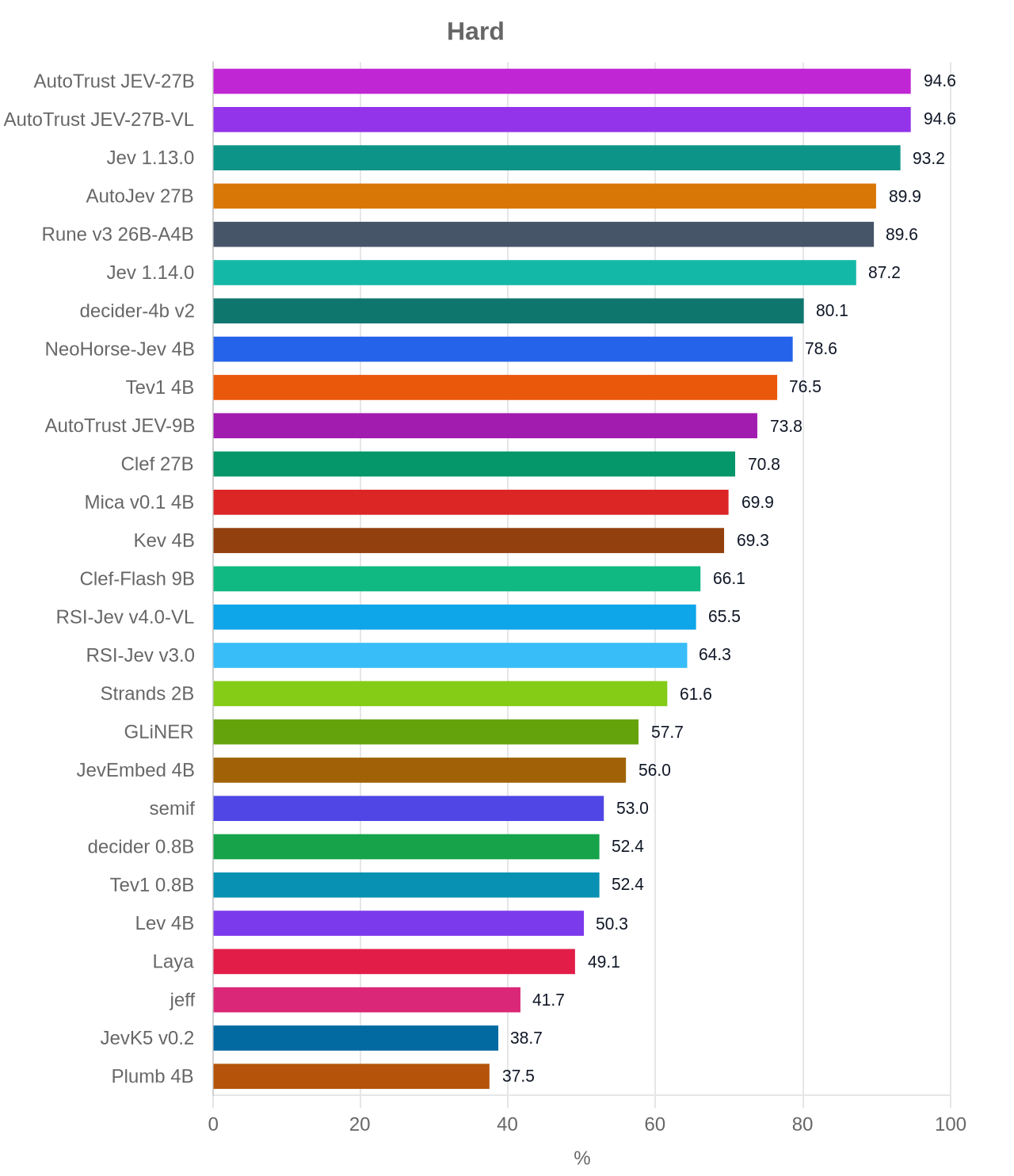
252 frozen zh-Hant rows in 18 families (36 easy, 48 medium, 168 hard), gold derived from visible text. This natural zh-Hant v1 qualified freeze is v0.0.2, and it is the only semantic-decision eval in this repo. Every model answers the same 504 locked requests: each row in canonical and left-rotated option order. Charts are percent correct. The families were seen during development before the freeze, so this is not unseen confirmation.
| Model | Easy /72 | Medium /96 | Hard /336 | All /504 | Hard priority reversals /29 |
|---|---|---|---|---|---|
| AutoTrust JEV-27B | 72 | 96 | 318 | 486 | 28 |
| AutoTrust JEV-27B-VL | 72 | 96 | 318 | 486 | 28 |
Jev jev-1.13.0 |
72 | 96 | 313 | 481 | 28 |
| AutoJev-27B | 72 | 96 | 302 | 470 | 29 |
| Rune v3 26B-A4B | 72 | 95 | 301 | 468 | 24 |
Jev jev-1.14.0 |
72 | 96 | 293 | 461 | 24 |
| decider-4b v2 | 72 | 95 | 269 | 436 | 14 |
| NeoHorse-Jev-4B | 72 | 92 | 264 | 428 | 5 |
| Tev1-4B | 72 | 96 | 257 | 425 | 15 |
| AutoTrust JEV-9B | 72 | 96 | 248 | 416 | 4 |
| Clef 27B | 72 | 94 | 238 | 404 | 4 |
| Mica v0.1 4B | 72 | 96 | 235 | 403 | 7 |
| Kev 4B | 72 | 95 | 233 | 400 | 9 |
| Clef-Flash 9B | 72 | 90 | 222 | 384 | 3 |
| RSI-Jev v4.0-VL 2B | 72 | 84 | 220 | 376 | 0 |
| RSI-Jev v3.0 2B | 72 | 77 | 216 | 365 | 2 |
| Strands Decider 2B | 72 | 73 | 207 | 352 | 1 |
| Tev1-0.8B | 72 | 86 | 176 | 334 | 0 |
| SemIf, Qwen3.5-4B | 72 | 82 | 178 | 332 | 2 |
| JevEmbed Qwen3-Embedding-4B | 60 | 82 | 188 | 330 | 1 |
| Lev 4B | 72 | 76 | 169 | 317 | 1 |
| decider-0.8b | 67 | 70 | 176 | 313 | 1 |
| JevK5 4B v0.2 | 72 | 88 | 130 | 290 | 2 |
| Plumb-4B | 72 | 83 | 126 | 281 | 1 |
| GLiNER2.5-Decide | 24 | 39 | 194 | 257 | 0 |
| Laya multilingual | 38 | 37 | 165 | 240 | 0 |
| jeff (GLiFormer large) | 45 | 34 | 140 | 219 | 0 |
Easy and medium are regression and "insufficient information" controls.
Hard carries the difference: a priority reversal counts only if both ends
of a same-case pair are right in both orders. Always answering B already
scores 194/336 on hard. All 13,608 first attempts (27 models × 504) are
valid, with no errors. Adapters differ, so these are task-level scores, not
weight comparisons. Jev jev-1.14.0 scores 20 fewer than jev-1.13.0, all
on hard (293 vs 313; a repeat gave 462 in all), so keep jev-1.13.0 pinned
for text decisions.
Details and disclosures.
Earlier banks (semantic-decisions@v0.0.1, the controlled slices, r2) are
retired. v0.0.1 survives only at package tag v0.0.1, and none of their
scores is pooled with v0.0.2. No model redistribution is authorized.
License
Apache-2.0
1 maintainer

Metadata
1 maintainer
Release files for jev-lite 0.0.4
For a detailed explanation of source distributions (sdists) and built distributions (wheels), please see the package formats documentation.
Source distribution (sdist)
| File | Size | Uploaded | |
|---|---|---|---|
| jev_lite-0.0.4.tar.gz | 4.2 MB | Details |
Built distribution (wheel)
| File | Interpreter | ABI | Platform | Reset |
|---|---|---|---|---|
| jev_lite-0.0.4-py3-none-any.whl | Python 3 | none | any | Details |
Total release size: 4.5 MB
Release files / jev_lite-0.0.4.tar.gz
| Download URL | jev_lite-0.0.4.tar.gz |
|---|---|
| Size | 4.2 MB |
| Tags | Source |
|
SHA-256 checksum How to use checksums |
06dd02be24bbb4833e3c3362822bb91e6aa5044a5599dc2909249e9e2887669c
|
|
BLAKE2b-256 checksum How to use checksums |
a588eebb5972f218c19b2ed88a9cee2f561c5a12e8fca91e1d1232b6a9cd95ee
|
| Upload date | |
|
Uploaded using Trusted Publishing? What is trusted publishing? |
Yes |
| Uploaded via |
twine/7.0.0 CPython/3.13.14
|
Provenance
Provenance describes where a file came from. On PyPI, provenance is shared via attestations, which provide a verifiable record of the build or publishing details. View details, limitations and caveats.


PyPI Publish Attestation
PyPI verified that this artifact, at this checksum, originated from the publisher listed below.
Signed by GitHub Actions, verified by PyPI on Oct 15, 2026.
Transparency logRelease files / jev_lite-0.0.4-py3-none-any.whl
| Download URL | jev_lite-0.0.4-py3-none-any.whl |
|---|---|
| Size | 354.1 kB |
| Tags | Python 3 |
|
SHA-256 checksum How to use checksums |
67e81f156b7c143ec3e8de0188c0e60a9bf1c872c80b2079dd3d3ce407104702
|
|
BLAKE2b-256 checksum How to use checksums |
c8b47d536c73e93c9b2028600921e839a1b85fd367404603743cc70127f9008c
|
| Upload date | |
|
Uploaded using Trusted Publishing? What is trusted publishing? |
Yes |
| Uploaded via |
twine/7.0.0 CPython/3.13.14
|
Provenance
Provenance describes where a file came from. On PyPI, provenance is shared via attestations, which provide a verifiable record of the build or publishing details. View details, limitations and caveats.
PyPI Publish Attestation
PyPI verified that this artifact, at this checksum, originated from the publisher listed below.
Signed by GitHub Actions, verified by PyPI on Oct 15, 2026.
Transparency log













