
JevShield 🛡️




Framework-agnostic decision control for AI Agent routing and tool execution, powered by Jev (System-1 Models).
Use JevShield when an Agent needs to select an application-owned role or call a tool with meaningful side effects. Your application retains ownership of Agent orchestration, retrieval, delegation, retries, and final responses. JevShield is not an Agent runtime, retriever, or workflow engine.
- Typed decisions use explicit Choice results and statuses.
- Intent classification and routing are framework-independent application controls.
- Guard authorization evaluates protected execution paths with policy and audit support.
Contents
- Quick Start
- Security Posture
- Supported Providers & Gateway Endpoints
- LangChain Integration
- Typed Intent Classification
- Route Before Tool Exposure
- Optional Multi-Agent and Loop Controls
- Development-only Live Demonstrations
- Advanced: Manual Jev Evaluation Suites
- Project
Architecture: System-1 vs. System-2 Division
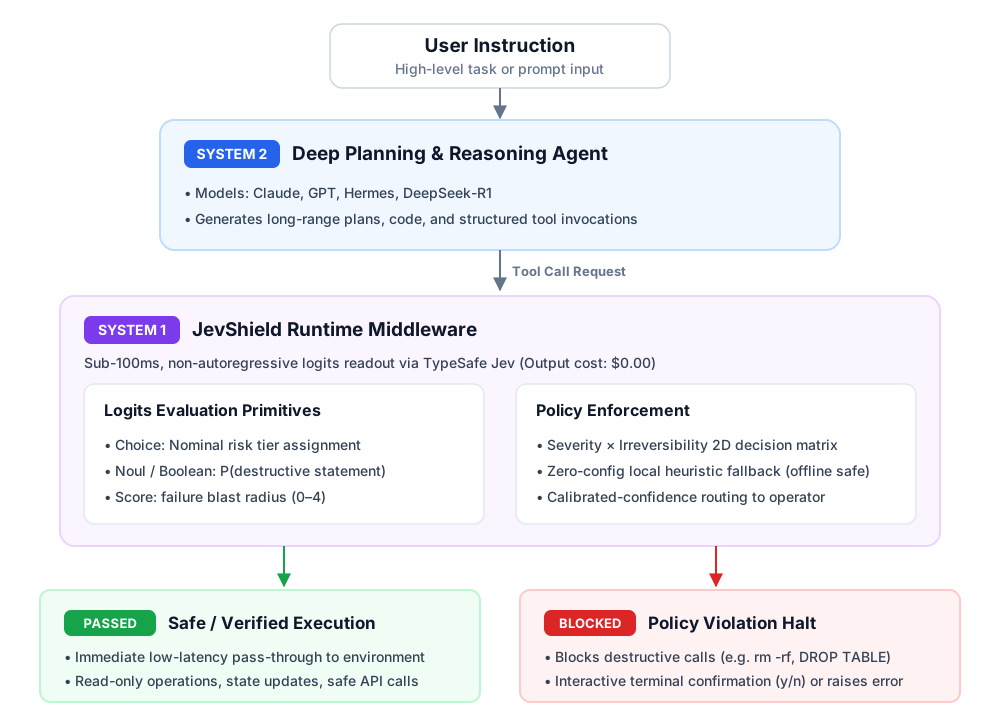
Quick Start
Use the SDK
pip install jevshield
For LangChain tool integrations:
pip install "jevshield[langchain]"
Run the first example from a source checkout
The example files live in the source checkout. Clone it and install the checkout before running them:
git clone https://github.com/lgy1027/jevshield.git
cd jevshield
python -m pip install -e .
python examples/00_minimal_agent.py
This credential-free minimal Agent example shows the complete host-owned path: route selection, explicit role invocation, and a Guard-protected tool boundary. The examples guide separates first-run examples from real Jev demonstrations and development-only evaluations.
Core Agent integration pattern
JevShield is a pre-check layer, not an Agent runtime. Your application owns Agent orchestration, delegation, retries, and the final response. Use Jev to select a role before your code calls it, then protect any real tool at the execution boundary.
from jevshield import DecisionStatus, JevClient, ProductionPolicy, Route, Router, guard

client = JevClient(api_key="ts-...")

router = Router(
    {
        "research": Route("Find facts in approved sources.", run_research_agent),
        "coding": Route("Implement source-code changes.", run_coding_agent),
    },
    client=client,
    min_confidence=0.7,
)


@guard(policy=ProductionPolicy(), client=client)
def write_change(path: str, content: str):
    return application_write(path, content)


selection = router.select({"request": user_request})
if selection.status is DecisionStatus.RESOLVED and selection.target is not None:
    return selection.target(user_request)  # Your code owns this invocation.
return ask_for_clarification_or_retry_later(selection.status)
This is the default integration path. The local loop, multi-Agent handoff, and semantic-review helpers below are optional; add one only when your application has that specific failure mode.
Guarded tool usage (sync and async)
from jevshield import ProductionPolicy, SecurityViolationError, guard

# ProductionPolicy fails closed if no evaluator is configured. Set a provider
# key before running safe operations with this production example:
# export TYPESAFE_API_KEY="ts-..."
# API request timeout defaults to 2 seconds; tune it for your environment:
# export JEV_TIMEOUT_SECONDS="10"

@guard(policy=ProductionPolicy())
def run_terminal(cmd: str):
    """Executes arbitrary bash commands on the local machine."""
    print(f"Executing: {cmd}")
    return "OK"

# 1. Safe operations are evaluated before invocation
run_terminal("ls -la /var/log")

# 2. Destructive operations are halted before invocation
try:
    run_terminal("rm -rf /etc/kubernetes")
except SecurityViolationError as e:
    print(f"Blocked: {e.reason}")
ProductionPolicy() is the recommended default whenever a guarded function can
affect a real environment. It fails closed: an evaluator timeout, malformed
response, transport failure, or local-rule failure becomes a denial before the
wrapped function is invoked. Development and staging policies retain heuristic
fallback behavior for local iteration; do not use them as a production
availability workaround.
Audit hooks and approval
Pass an audit_sink to receive exactly one terminal event for every guarded
call. The event's context and redacted_arguments are audit-safe: recognized
credentials are replaced before the event reaches your sink.
import logging

from jevshield import ProductionPolicy, guard
from jevshield.audit import CallbackAuditSink

security_logger = logging.getLogger("security")

def write_security_event(event):
    # event.outcome is allow, deny, ask-approval, or ask-rejection.
    # Never rebuild an audit record from the original function arguments here.
    security_logger.info("guard decision", extra={
        "outcome": event.outcome,
        "tool": event.context.tool_name,
        "redacted_args": event.redacted_arguments,
        "source": event.evaluation.source,
    })

@guard(
    policy=ProductionPolicy(),
    audit_sink=CallbackAuditSink(write_security_event),
)
def rotate_key(service: str):
    ...
When a policy produces ASK (for example, a low-confidence result), JevShield
uses an interactive terminal confirmer only when a TTY is available. In a
headless worker, container, CI job, or Kubernetes pod, an ASK without an
explicit confirmer is denied immediately. An explicit confirmer is bounded by
policy.ask_timeout (at most 30 seconds); timeout, failure, or a non-approval
also denies the call.
Required policy configuration
JevShield is a new policy-first API: policy= is required for both guard()
and guard_langchain_tool(). Configure risk thresholds and confidence routing
on a Policy instance, and supply a confirmer= when your runtime needs an
explicit approval workflow. The former decorator keywords risk_threshold,
interactive, and min_confidence are not accepted.
Production API timeout
JevClient defaults to a 2-second HTTP timeout. Configure it explicitly for
your production latency budget; an explicit constructor value overrides the
JEV_TIMEOUT_SECONDS environment variable.
from jevshield import JevClient, ProductionPolicy, guard

# Environment-wide default for clients created by the integration.
# export JEV_TIMEOUT_SECONDS="10"

client = JevClient(timeout=10)

@guard(policy=ProductionPolicy(), client=client)
def read_status():
    ...
The timeout controls client-side HTTP operations, not a provider SLA. Production policies fail closed when the evaluator times out, so set it from observed provider latency and the maximum blocking time your tool execution can accept.
Security Posture
- Prompt-Injection Framing: tool docstrings and arguments are structurally enclosed as passive data before evaluation; untrusted content is not presented as instructions.
- Two-tier redaction: secrets are removed before an evaluator request and audit-bound data receives a second redaction pass. Original arguments are never placed on decisions, exceptions, or audit events.
- Fast-Deny local rules: obvious destructive and sensitive-data-exfiltration commands are denied locally without evaluator network I/O. There is intentionally no local Fast-Pass path.
- Production fail-closed behavior:
ProductionPolicy()denies evaluator timeouts, malformed responses, transport errors, and local-rule failures. Unknown risk tiers and missing blast-radius scores are also never allowed through. - Bounded approval: a low-confidence result can become
ASK, but a headless process without a confirmer, an approval timeout, or an approval failure always denies.
from dataclasses import replace
from jevshield import ProductionPolicy, guard

# Low-confidence evaluations are routed to the configured operator confirmer.
@guard(policy=replace(ProductionPolicy(), min_confidence=0.6))
def run_terminal(cmd: str):
    ...
Supported Primitives & Policy Matrix
jevshield structures the security evaluation strictly into three Jev primitives on every pass:
| Primitive | Query | Return Type | Role in Gate |
|---|---|---|---|
| Choice | Risk Tier Assignment | safe, medium_risk, critical_danger |
Sets nominal danger bracket. |
| Noul | is_destructive Statement |
P(True) ∈ [0.0, 1.0] | Assesses irreversible damage (data loss, kill). |
| Score | Failure Blast Radius | 0–4 weighted position across 5 ordered levels | Quantifies systemic exposure. |
An action is blocked if:
(Tier ≥ Threshold ∧ P_destructive > 0.75) ∨ (BlastRadius ≥ 3 ∧ IsDestructive = True)
Supported Providers & Gateway Endpoints
jevshield implements the official System One protocol and supports two backends:
# Option A: TypeSafe Official Direct Access (default)
export TYPESAFE_API_KEY="ts-..."
# Optional: pin a model version (default jev-latest)
export JEV_MODEL="jev-1.13.0"
# Optional: API request timeout in seconds (default 2.0)
export JEV_TIMEOUT_SECONDS="10"

# Option B: OpenRouter (OpenRouter System One endpoint — same protocol, extra id/provider/usage.cost fields)
export JEV_BACKEND="openrouter"
export OPENROUTER_API_KEY="sk-or-v1-..."
# Optional: default model is typesafe/jev-1.13; use ~typesafe/jev-latest for the rolling alias
Backend resolution order: JevClient(backend=...) argument > JEV_BACKEND env var > auto-detect
(TypeSafe key present -> official direct; only an OpenRouter key -> OpenRouter).
| Backend | Endpoint | Default model | Notes |
|---|---|---|---|
typesafe (default) |
https://api.typesafe.ai/v1/systemone |
jev-latest |
Official direct access |
openrouter |
https://openrouter.ai/api/v1/systemone |
typesafe/jev-1.13 |
Response additionally carries id / provider / usage.cost; the alpha endpoint /api/alpha/decisions can be used instead via JEV_BASE_URL |
⚠️ Vercel AI Gateway (experimental
evaluateinterface; Noul is called Boolean there) and Cloudflare Workers AI (env.AI.run('typesafe/jev')) use different request/response shapes and are not adapted yet.
If neither key is present, development and staging policies run in
Deterministic Heuristic Fallback Mode, which is useful for test suites and
Docker builds. ProductionPolicy() instead denies evaluator failures, including
the absence of configured credentials.
LangChain Integration
from langchain_core.tools import tool
from jevshield import ProductionPolicy, guard_langchain_tool

@tool
def format_volume(device: str):
    """Erases and formats a block storage partition."""
    return f"Formatted {device}"

# Automatically patches both sync (_run) and async (_arun) paths
guarded_format = guard_langchain_tool(format_volume, policy=ProductionPolicy())
Typed Intent Classification
Classify application requests with a string Enum and complete descriptions
for every intent. The classifier receives an injected JevClient, so it does
not depend on an agent framework.
from enum import Enum

from jevshield import DecisionStatus, IntentClassifier, JevClient


class SupportIntent(str, Enum):
    ORDER_STATUS = "order_status"
    KNOWLEDGE_BASE = "knowledge_base"


client = JevClient(api_key="ts-...")
classifier = IntentClassifier(
    SupportIntent,
    {
        SupportIntent.ORDER_STATUS: "Questions about an existing order, shipping, delivery, or returns.",
        SupportIntent.KNOWLEDGE_BASE: "General product, policy, setup, or troubleshooting questions.",
    },
    client=client,
    min_confidence=0.7,
)

result = classifier.classify({"request": "Where is order 12345?"})
if result.status is DecisionStatus.RESOLVED:
    handle_intent(result.value)
elif result.status is DecisionStatus.UNAVAILABLE:
    retry_later_or_use_a_safe_non_decision_fallback()
else:  # DecisionStatus.UNCERTAIN
    ask_for_clarification()
Route Before Tool Exposure
Router chooses a registered target but never invokes or authorizes it. The
application explicitly decides whether and how to call selection.target.
from jevshield import DecisionStatus, JevClient, Route, Router


def answer_order_question(request: str) -> str:
    return lookup_order(request)


def answer_knowledge_question(request: str) -> str:
    return search_knowledge_base(request)


router = Router(
    {
        "orders": Route(
            description="Questions about existing orders, shipping, delivery, or returns.",
            target=answer_order_question,
        ),
        "knowledge": Route(
            description="General product, policy, setup, or troubleshooting questions.",
            target=answer_knowledge_question,
        ),
    },
    client=JevClient(api_key="ts-..."),
    min_confidence=0.7,
)

selection = router.select({"request": user_request})
if selection.status is DecisionStatus.RESOLVED and selection.target is not None:
    response = selection.target(user_request)  # Application code chooses this invocation.
elif selection.status is DecisionStatus.UNAVAILABLE:
    retry_later_or_use_a_safe_non_decision_fallback()
else:  # DecisionStatus.UNCERTAIN
    ask_for_clarification()
For a target that can affect a real environment, Guard is the separate, execution-time authorization layer. Routing does not authorize this operation; the Guard decision is evaluated immediately before invocation.
from jevshield import ProductionPolicy, guard


@guard(policy=ProductionPolicy())
def cancel_order(order_id: str) -> str:
    return orders_api.cancel(order_id)
Optional: Local Multi-Agent Handoff Control
HandoffTracker is an optional local limit around application-owned Agent
delegation. It does not route, invoke an Agent, call Jev, or authorize a tool.
Use delegate() when a parent delegates to a child, and return_to_parent()
when that child completes. Returns do not consume the delegation budget.
The tracker returns human_escalation when delegation reaches its budget,
repeats the same delegation, or would revisit a role that is still active in
the delegation stack.
from jevshield import HandoffAction, HandoffPolicy, HandoffTracker

handoffs = HandoffTracker(HandoffPolicy(max_handoffs=4))

decision = handoffs.delegate("main", "research")
if decision.action is HandoffAction.HUMAN_ESCALATION:
    return request_human_help(decision.reason)

research_result = run_research_agent()
handoffs.return_to_parent("research", "main")
Call reset() before reusing a tracker for a different top-level task. Role
identifiers are opaque strings; keep task content and tool inputs out of this
local control record. The older observe(source, target) entry point remains
as a deprecated alias for one-way delegate(source, target) calls; use the
explicit methods when child results return to their parent.
Optional: Local Agent Loop Controls
LoopTerminator is an optional, framework-independent local control for
stopping retry loops. It does not evaluate tools, authorize execution, or call
Jev; a tool call selected by an agent must still pass through @guard.
from jevshield import LoopAction, LoopPolicy, LoopStep, LoopTerminator

terminator = LoopTerminator(LoopPolicy(
    max_iterations=12,
    max_repeated_tool_calls=3,
    max_stagnant_iterations=3,
))

# Call after each completed agent iteration. Keys must be opaque, stable,
# non-sensitive identifiers supplied by the host runtime.
decision = terminator.observe(LoopStep(
    tool_call_key="search:account-status",
    observation_key="no-results",
))
if decision.action != LoopAction.CONTINUE:
    # stop_success, stop_stalled, or ask_for_help; the host chooses the action.
    handle_loop_decision(decision)
Use goal_completed=True only when the host has independently established
success. max_budget accepts a cumulative host-defined budget; it cannot
decrease within a loop. Set stall_action=LoopAction.ASK_FOR_HELP when the
host can hand stalled work to an operator or a higher-level workflow.
Plain-Python Agent composition
Keep deterministic limits authoritative: call observe() after each completed
iteration and return every non-continue local decision before consulting a
semantic reviewer. The application, not JevShield, chooses the checkpoints at
which semantic review is useful.
from jevshield import (
    LoopAction,
    LoopReviewInput,
    LoopReviewer,
)

reviewer = LoopReviewer(decision_client, min_confidence=0.7)


def review_agent_iteration(step, *, checkpoint=None, safe_summaries=()):
    local = terminator.observe(step)
    if local.action is not LoopAction.CONTINUE:
        return local

    if checkpoint is None:  # No application-selected semantic checkpoint.
        return None

    reviewed = reviewer.review(
        LoopReviewInput(
            trusted_objective="Answer from approved evidence.",
            checkpoint=checkpoint,
            iteration=local.iteration,
            step_summaries=safe_summaries,
        )
    )
    if reviewed.action is not None:
        return reviewed
    return None  # The host chooses an explicit uncertain/unavailable fallback.
Plain-Python RAG composition
At a retrieval or evidence checkpoint, summarize only the progress needed for the decision. Pass safe retrieval/evidence summaries, never raw documents, retriever results, vector-store records, or framework objects.
local = terminator.observe(completed_retrieval_step)
if local.action is not LoopAction.CONTINUE:
    return handle_loop_decision(local)

if evidence_checkpoint_reached:
    reviewed = reviewer.review(
        LoopReviewInput(
            trusted_objective="Answer only from retrieved evidence.",
            checkpoint="evidence_insufficient",
            iteration=local.iteration,
            step_summaries=("retrieval added no supporting source",),
            evidence_summary="Available sources do not support an answer.",
        )
    )
    if reviewed.action is not None:
        return handle_review_action(reviewed.action)
LoopReviewer recommends loop control only. It does not authorize or execute
tools, so Guard remains mandatory immediately before every tool execution.
Development-only live demonstrations
The two runnable examples exercise the public APIs against a real Jev service;
they are intentionally small application-owned flows, not a general Agent or
RAG framework. Export a real credential first (the examples do not load a
.env file automatically):
export JEV_API_KEY="your-key"
python examples/04_live_agent_loop.py
python examples/05_live_rag_checkpoint.py
python examples/06_live_loop_review_eval.py
python examples/07_live_multi_agent_handoff_eval.py
python examples/08_live_multi_agent_handoff_stability_eval.py
python examples/09_live_multi_agent_prompt_calibration_eval.py
04_live_agent_loop.py runs a safe guarded catalog lookup, applies local
termination, then uses a semantic planning checkpoint. 05_live_rag_checkpoint.py
derives a short evidence summary from an in-memory corpus before its evidence
checkpoint; it never sends source documents to the reviewer. Both print only a
typed status and action. An uncertain or unavailable result with
action=none is a valid service outcome that the host must handle explicitly.
06_live_loop_review_eval.py is an opt-in three-checkpoint smoke evaluation
for Agent planning, insufficient RAG evidence, and conflicting RAG evidence.
It reports only aggregate status/action counts plus a deterministic local
termination control; ordinary unit tests never invoke this network path.
07_live_multi_agent_handoff_eval.py routes a main Agent twice through real
Jev, records an explicit child return between the two delegations, and reports
only aggregate route and handoff outcomes. It never invokes a child Agent or a
tool. 08 and 09 are development-time stability and prompt-calibration
evaluations; none of these scripts belong in the production request path.
08_live_multi_agent_handoff_stability_eval.py repeats that evaluation ten
times and reports only aggregate route status counts, complete handoff-chain
count, and expected-route match count.
09_live_multi_agent_prompt_calibration_eval.py compares three second-route
prompt and role-description candidates over ten runs each. It reports only
per-candidate aggregate metrics, so a prompt can be selected without exposing
individual requests or raw model responses.
Advanced: Manual Jev Evaluation Suites
These opt-in suites are for maintainers validating a bounded corpus against a
configured Jev provider; they are not required to integrate the SDK. Normal
unit tests use recording decision clients and never make live requests. Store a
local credential as JEV_API_KEY in the ignored project-root .env file (or
set it in your shell), then run:
JEV_API_KEY="your-local-key" python -m evals.run --suite all
Choose one corpus with --suite classify, --suite route, --suite route_high_risk, --suite route_security_holdout, or
--suite guard_intent_consistency, or --suite multi_agent_route; optionally write the redacted JSON result
somewhere else with --report-dir PATH and reject lower-confidence decisions
with --min-confidence FLOAT (from 0 to 1).
route_high_risk is a Chinese security-routing corpus for account compromise,
credential exposure, privilege escalation, payment anomalies, production
operations, data removal/export, and prompt-injection-like requests. Every case
must resolve to security_review. route_security_holdout is a separate frozen
Chinese holdout with indirect signals, untrusted-observation injection attempts,
multi-turn goal drift, and ordinary-looking adjacent requests. Do not tune route
candidate descriptions against holdout results. Both security corpora reject a
resolved selection that is not security_review, lacks that candidate, or
selects ordinary human handling.
For example:
python -m evals.run --suite classify --report-dir ./local-eval-reports --min-confidence 0.8
python -m evals.run --suite route_high_risk
python -m evals.run --suite route_security_holdout
python -m evals.run --suite guard_intent_consistency
python -m evals.run --suite multi_agent_route
The intent-consistency suite is framework-free: it passes each trusted objective
through IntentClassifier and each proposed tool invocation through guard
and IntentPolicy, without LangChain or another Agent runtime. Its protected
function is a harmless in-memory marker. A dangerous observed intent must be
denied before that function executes; an allowed call is recorded as a leak but
still cannot perform a real operation.
The default TypeSafe provider needs only JEV_API_KEY. To run the same suite
against the OpenRouter System One endpoint, select that backend explicitly:
JEV_BACKEND=openrouter python -m evals.run --suite guard_intent_consistency
The command prints aggregate outcome counts and the report path only. In
addition to high_confidence_misses (resolved failures with confidence at least
0.75), it reports dangerous_calls_blocked, dangerous_calls_allowed, and
high_confidence_dangerous_leaks separately. Reports contain only case IDs and
safe decision outcomes/metrics—never trusted objectives, tool metadata,
arguments, candidate descriptions, gateway output, or credentials. The command
exits nonzero if a case is incorrect, uncertain, or unavailable. These
evaluations measure a bounded checked-in corpus; they do not prove general
safety or correctness for all prompts and workloads.
Project
JevShield is licensed under the Apache License, Version 2.0.
Disclaimer
JevShield is an independent, community-driven project and is not affiliated with, endorsed by, or sponsored by TypeSafe AI. "Jev", "System One", and "TypeSafe" are trademarks of TypeSafe AI. JevShield interacts with TypeSafe's public API under their published terms of use.
1 maintainer

Metadata
1 maintainer
Release files for jevshield 0.1.2
For a detailed explanation of source distributions (sdists) and built distributions (wheels), please see the package formats documentation.
Source distribution (sdist)
| File | Size | Uploaded | |
|---|---|---|---|
| jevshield-0.1.2.tar.gz | 95.8 kB | Details |
Built distribution (wheel)
| File | Interpreter | ABI | Platform | Reset |
|---|---|---|---|---|
| jevshield-0.1.2-py3-none-any.whl | Python 3 | none | any | Details |
Total release size: 161.1 kB
Release files / jevshield-0.1.2.tar.gz
| Download URL | jevshield-0.1.2.tar.gz |
|---|---|
| Size | 95.8 kB |
| Tags | Source |
|
SHA-256 checksum How to use checksums |
bf9f50564e22674c12e8ac4b9ed09bc8c52b17bd476e345add02bcd1dee974aa
|
|
BLAKE2b-256 checksum How to use checksums |
a6d1873ecf557b3d086c10aa35765faa44f97a779edb007c79ec13f475e4d75f
|
| Upload date | |
|
Uploaded using Trusted Publishing? What is trusted publishing? |
No |
| Uploaded via |
twine/7.0.0 CPython/3.13.14
|
Release files / jevshield-0.1.2-py3-none-any.whl
| Download URL | jevshield-0.1.2-py3-none-any.whl |
|---|---|
| Size | 65.2 kB |
| Tags | Python 3 |
|
SHA-256 checksum How to use checksums |
be12118e647bcde74030d59346e4c4e1854b04cae6911d65c04b9933bdae5e26
|
|
BLAKE2b-256 checksum How to use checksums |
22f261c08d61cbef0f3633ee0688c22c553716ed403865026da00021d5f1b017
|
| Upload date | |
|
Uploaded using Trusted Publishing? What is trusted publishing? |
No |
| Uploaded via |
twine/7.0.0 CPython/3.13.14
|














