
Jevy Graph

Jevy Graph compiles documents into source-grounded RDF. It discovers atomic relations locally, asks Jev to resolve ambiguous entity boundaries and predicates, verifies every selected claim, and emits Turtle with evidence and provenance.
The compiler is designed for high-recall extraction from ordinary prose, scientific papers, legal text, tables, measurements, and equations. It does not require an ontology or a document-specific schema.
19-second demo
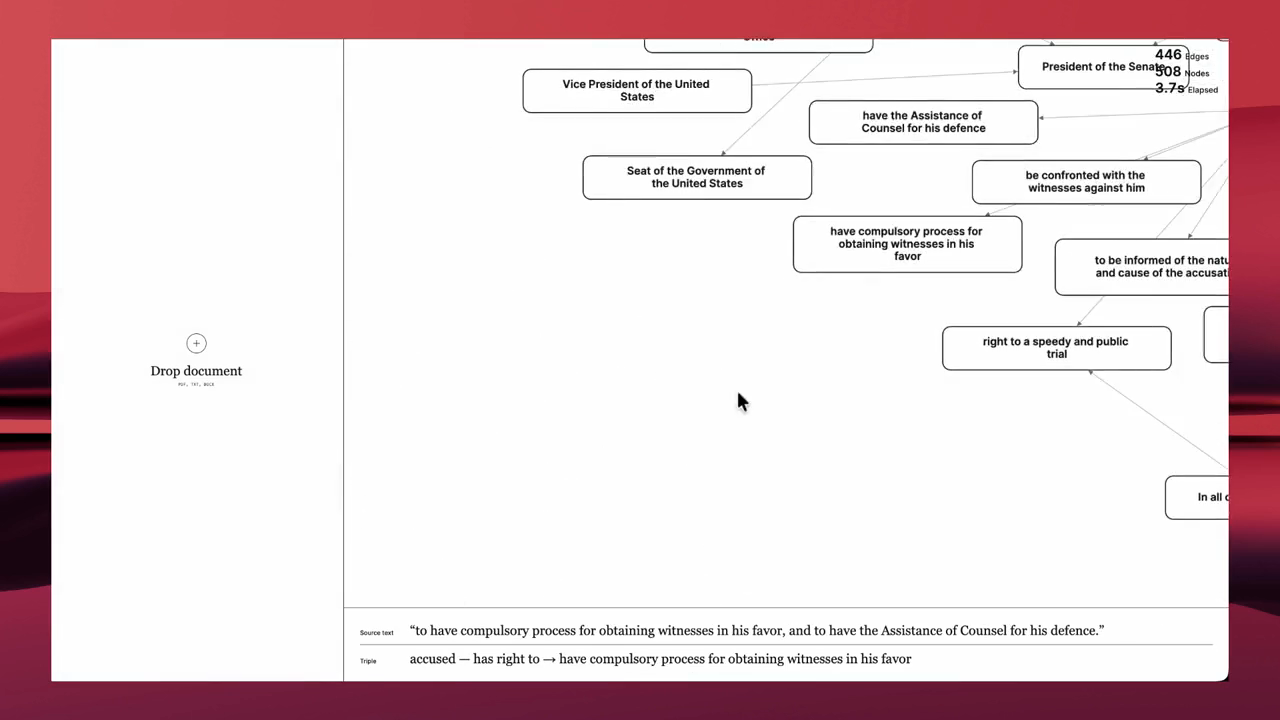
Click the preview for the short version, or watch the full 72-second demo.
Features
- Multiple atomic claims from one sentence, clause, list, or table row
- Normalized entities and stable predicates without external entity linking
- Modality, negation, conditions, sections, pages, and evidence spans preserved
- Jev selection and verification streamed in parallel batches
- RDF statements with calibrated support and entity-quality scores
- CLI, Python API, and a real-time Cytoscape demo
- No runtime Python dependencies
How it works
document
  -> deterministic clause, table, equation, and measurement extraction
  -> bounded subject / predicate / object candidates
  -> Jev candidate selection
  -> Jev support and boundary verification
  -> thresholding and deduplication
  -> source-grounded RDF/Turtle
Jev never invents free-form graph text. It chooses among candidates generated from the document, then independently scores the selected relationship. Frames with one valid interpretation skip the selection call but are still verified.
Quick start
Jevy Graph requires Python 3.11 or newer and a TypeSafe API key.
git clone https://github.com/saivivekvenna/jevy-graph.git
cd jevy-graph
python3 -m venv .venv
source .venv/bin/activate
python -m pip install -e .
cp .env.example .env
Add your key to .env:
TYPESAFE_API_KEY=your-key-here
Compile UTF-8 text to Turtle:
jevy-graph document.txt -o graph.ttl
For a local-only extraction smoke test that does not call Jev:
printf 'Alice founded Acme. Acme is located in Toronto.' \
  | jevy-graph --no-verify
Demo
The demo accepts PDF, DOCX, Markdown, CSV, and plain-text files. Normal uploads stream verified claims as their Jev batches finish. Documents that produce at least 2,000 relation frames use larger compute batches and mount the completed graph once. Selection and verification overlap across batches; every emitted claim still passes both support and entity-boundary checks. Large uploads send fixed candidate fields once per question instead of repeating them in every option. No candidate options are removed by this encoding.
Starting a new upload cancels the previous request. Already running Jev calls may finish, but pending batches stop when the server detects the disconnect. The final API event includes Jev-reported token usage and request/retry counts.
An elapsed timer measures upload through backend completion, excluding final graph layout. Hover over an edge or leaf node to read its source text and triple in the labeled footer without highlighting or hiding the rest of the graph.
jevy-graph-demo
Open http://localhost:8080/demo/. PDF support requires pdftotext, available
from Poppler (brew install poppler on macOS or apt install poppler-utils on
Debian and Ubuntu).
The API key stays on the server and is never sent to the browser.
Python API
import os

from jevy_graph import Thresholds, compile_text
from jevy_graph.jev import JevClient

client = JevClient(os.environ["TYPESAFE_API_KEY"])
result = compile_text(
    "Alice founded Acme.",
    client=client,
    thresholds=Thresholds(support=0.45, entity=0.10, joint=0.70),
)

print(result.turtle)
print(result.accepted)
Omit client for deterministic, unverified extraction.
RDF model
Each accepted positive relationship is emitted as a direct semantic edge and
as an rdf:Statement carrying its provenance:
<urn:jevy:entity:alice-...> <urn:jevy:relation:founded> <urn:jevy:entity:acme-...> .

<urn:jevy:claim:...> a rdf:Statement ;
    rdf:subject <urn:jevy:entity:alice-...> ;
    rdf:predicate <urn:jevy:relation:founded> ;
    rdf:object <urn:jevy:entity:acme-...> ;
    jevy:evidence "Alice founded Acme." ;
    jevy:support "0.950000"^^xsd:decimal ;
    jevy:entityQuality "0.910000"^^xsd:decimal .
Negative claims are reified with jevy:polarity "negative" without asserting
the positive edge. Numeric values are emitted as typed literals when possible.
Scope
The CLI reads UTF-8 text. The demo additionally converts PDF and DOCX uploads. The extractor handles ordinary prose, legal lists, scientific sections, layout-preserving tables, assignments, equations, and measurements.
External knowledge-base linking, ontology alignment, OCR, and scanned PDFs are out of scope. Entity normalization is intentionally conservative unless the document explicitly declares an alias.
Development
python -m unittest discover -s tests -q
Pull requests should include a focused regression test for behavior changes. Keep extraction deterministic and keep API credentials out of fixtures, logs, and commits.
Performance checks
Use a new process to measure a first upload. No graph layout or browser rendering
is included; extraction, Jev processing, and final filtering are timed separately.
The benchmark writes source-grounded claims and metrics to the ignored out/
directory. --live makes paid API calls; without it only extraction is measured.
PYTHONPATH=src python scripts/benchmark.py document.pdf \
  --live --compact --workers 12 --batch-size 48 --output out/benchmark.json
Use --sample 512 for a bounded comparison, or --reference to run selection
for all frames before verification. Frame and candidate hashes allow checking
that an optimization preserves the entire deterministic candidate set.
Measured locally on September 21, 2026 (first upload, Python 3.14):
| Document / configuration | Accepted claims | Compute time | Reported input tokens |
|---|---|---|---|
| Odyssey PDF, original implementation | ~5,150 | ~75.3s | Not recorded |
| Odyssey PDF, pipelined, original question format | 5,164 | 49.1s | 21,417,219 |
| Odyssey PDF, compact fixed fields and paced requests | 5,123 | 45.3s | 19,178,128 |
| Constitution PDF, normal streaming configuration | 449 | 3.84s | 1,221,971 |
All Odyssey configurations used 14,881 frames. The optimized extractor produced identical frame and candidate hashes to the original. The 45.3s run included 23 rate-limit retries, so network conditions and account limits materially affect timing. Model decisions vary between calls: claim counts are a regression signal, not proof of complete coverage or correctness. The full uncompressed and compact runs shared 3,950 exact claims, so matching volumes should not be read as identical outputs. Ten-second processing of the full Odyssey has not been demonstrated with verification preserved.
Privacy and security
The demo binds to 127.0.0.1 by default and is intended for local use. Document
text used in Jev decisions is sent to TypeSafe's API. Review TypeSafe's policies
before processing sensitive material, and add authentication plus upload
hardening before exposing the demo server publicly.
Never commit .env; it is ignored by Git.
License
1 maintainer

Metadata
1 maintainer
Release files for jevy-graph 0.1.0
For a detailed explanation of source distributions (sdists) and built distributions (wheels), please see the package formats documentation.
Source distribution (sdist)
| File | Size | Uploaded | |
|---|---|---|---|
| jevy_graph-0.1.0.tar.gz | 55.6 kB | Details |
Built distribution (wheel)
| File | Interpreter | ABI | Platform | Reset |
|---|---|---|---|---|
| jevy_graph-0.1.0-py3-none-any.whl | Python 3 | none | any | Details |
Total release size: 108.7 kB
Release files / jevy_graph-0.1.0.tar.gz
| Download URL | jevy_graph-0.1.0.tar.gz |
|---|---|
| Size | 55.6 kB |
| Tags | Source |
|
SHA-256 checksum How to use checksums |
557efd3aa899db4bebbf07a8001e3e0ee564b2542dc88de3292a4740523990fe
|
|
BLAKE2b-256 checksum How to use checksums |
ec358833f31edebd7b9303c000eb869fbce1a4a4fb65bda85503169235a211f4
|
| Upload date | |
|
Uploaded using Trusted Publishing? What is trusted publishing? |
Yes |
| Uploaded via |
twine/7.0.0 CPython/3.13.14
|
Provenance
Provenance describes where a file came from. On PyPI, provenance is shared via attestations, which provide a verifiable record of the build or publishing details. View details, limitations and caveats.


PyPI Publish Attestation
PyPI verified that this artifact, at this checksum, originated from the publisher listed below.
Signed by GitHub Actions, verified by PyPI on Sep 22, 2026.
Transparency logRelease files / jevy_graph-0.1.0-py3-none-any.whl
| Download URL | jevy_graph-0.1.0-py3-none-any.whl |
|---|---|
| Size | 53.1 kB |
| Tags | Python 3 |
|
SHA-256 checksum How to use checksums |
cd5870cfe215d4087ebb745a5bdc8b621dab3ff7477f697bbdf589df2615cb17
|
|
BLAKE2b-256 checksum How to use checksums |
c59d58080900cd131a270d46e2ed8937cc7ed1337f002110c2f6df825bdcba11
|
| Upload date | |
|
Uploaded using Trusted Publishing? What is trusted publishing? |
Yes |
| Uploaded via |
twine/7.0.0 CPython/3.13.14
|
Provenance
Provenance describes where a file came from. On PyPI, provenance is shared via attestations, which provide a verifiable record of the build or publishing details. View details, limitations and caveats.
PyPI Publish Attestation
PyPI verified that this artifact, at this checksum, originated from the publisher listed below.
Signed by GitHub Actions, verified by PyPI on Sep 22, 2026.
Transparency log












