
Build multimodal AI services via cloud native technologies · Neural Search · Generative AI · MLOps

Project description


Build multimodal AI services with cloud native technologies





Jina is an MLOps framework to build multimodal AI microservice-based applications written in Python that can communicate via gRPC, HTTP and WebSocket protocols. It allows developers to build and serve services and pipelines while scaling and deploying them to a production while removing the complexity, letting them focus on the logic/algorithmic part, saving valuable time and resources for engineering teams.
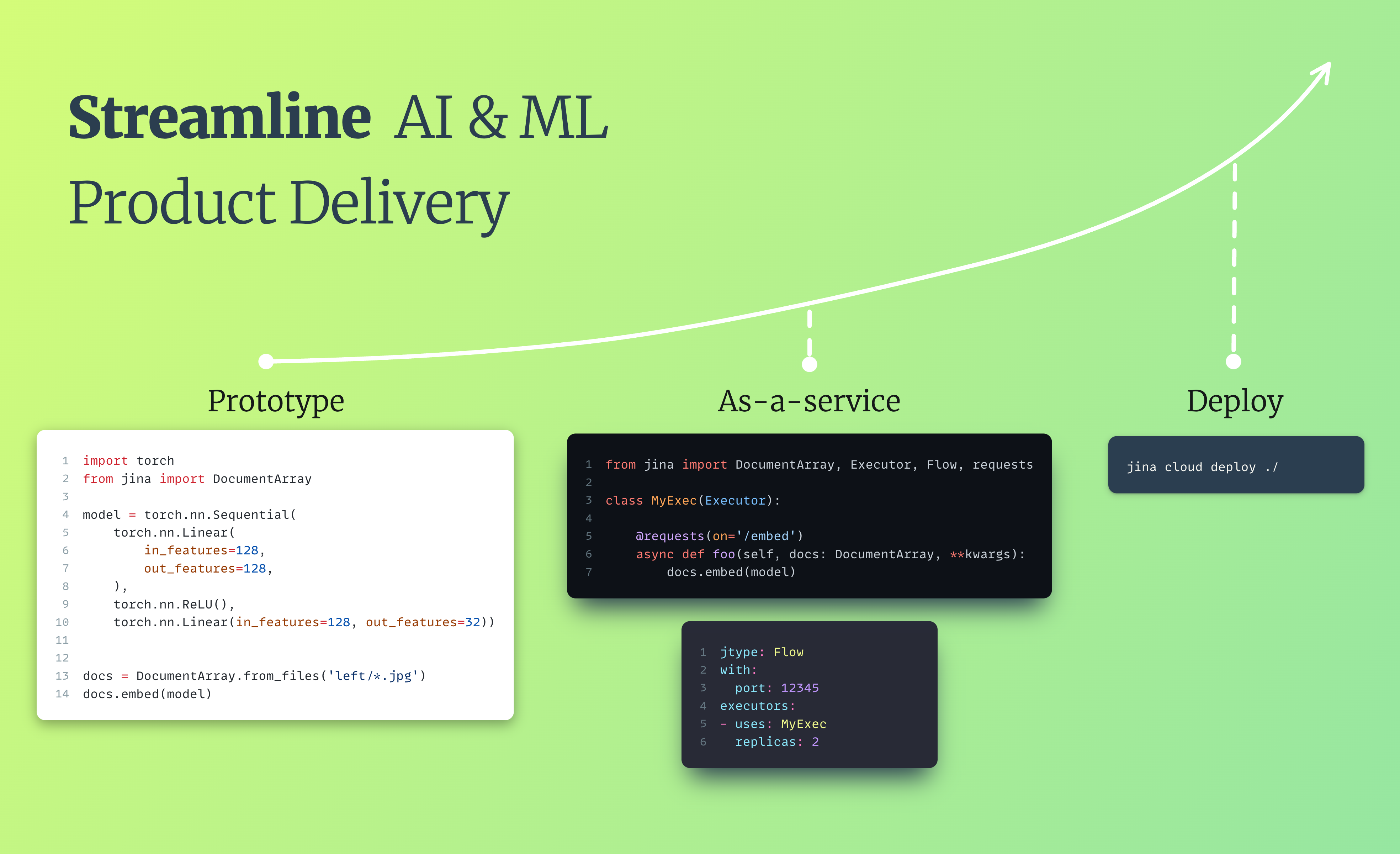
Jina aims to provide a smooth Pythonic experience transitioning from local deployment to deploying to advanced orchestration frameworks such as Docker-Compose, Kubernetes, or Jina AI Cloud. It handles the infrastructure complexity, making advanced solution engineering and cloud-native technologies accessible to every developer.
Build and deploy a gRPC microservice • Build and deploy a pipeline
Applications built with Jina enjoy the following features out of the box:
🌌 Universal
- Build applications that deliver fresh insights from multiple data types such as text, image, audio, video, 3D mesh, PDF with LF's DocArray.
- Support for all mainstream deep learning frameworks.
- Polyglot gateway that supports gRPC, Websockets, HTTP, GraphQL protocols with TLS.
⚡ Performance
- Intuitive design pattern for high-performance microservices.
- Easy scaling: set replicas, sharding in one line.
- Duplex streaming between client and server.
- Async and non-blocking data processing over dynamic flows.
☁️ Cloud native
- Seamless Docker container integration: sharing, exploring, sandboxing, versioning and dependency control via Executor Hub.
- Full observability via OpenTelemetry, Prometheus and Grafana.
- Fast deployment to Kubernetes and Docker Compose.
🍱 Ecosystem
- Improved engineering efficiency thanks to the Jina AI ecosystem, so you can focus on innovating with the data applications you build.
- Free CPU/GPU hosting via Jina AI Cloud.
Jina's value proposition may seem quite similar to that of FastAPI. However, there are several fundamental differences:
Data structure and communication protocols
- FastAPI communication relies on Pydantic and Jina relies on DocArray allowing Jina to support multiple protocols to expose its services.
Advanced orchestration and scaling capabilities
- Jina lets you deploy applications formed from multiple microservices that can be containerized and scaled independently.
- Jina allows you to easily containerize and orchestrate your services, providing concurrency and scalability.
Journey to the cloud
- Jina provides a smooth transition from local development (using DocArray) to local serving using (Jina's orchestration layer) to having production-ready services by using Kubernetes capacity to orchestrate the lifetime of containers.
- By using Jina AI Cloud you have access to scalable and serverless deployments of your applications in one command.

Documentation
Install
pip install jina transformers sentencepiece
Find more install options on Apple Silicon/Windows.
Get Started
Basic Concepts
Jina has four fundamental concepts:
- A Document (from DocArray) is the input/output format in Jina.
- An Executor is a Python class that transforms and processes Documents.
- A Deployment serves a single Executor, while a Flow serves Executors chained into a pipeline.
The full glossary is explained here.
Build AI Services

Let's build a fast, reliable and scalable gRPC-based AI service. In Jina we call this an Executor. Our simple Executor will use Facebook's mBART-50 model to translate French to English. We'll then use a Deployment to serve it.
Note A Deployment serves just one Executor. To combine multiple Executors into a pipeline and serve that, use a Flow.
Note Run the code in Colab to install all dependencies.
Let's implement the service's logic:
translate_executor.py |
|---|
from docarray import DocumentArray
from jina import Executor, requests
from transformers import AutoTokenizer, AutoModelForSeq2SeqLM


class Translator(Executor):
    def __init__(self, **kwargs):
        super().__init__(**kwargs)
        self.tokenizer = AutoTokenizer.from_pretrained(
            "facebook/mbart-large-50-many-to-many-mmt", src_lang="fr_XX"
        )
        self.model = AutoModelForSeq2SeqLM.from_pretrained(
            "facebook/mbart-large-50-many-to-many-mmt"
        )

    @requests
    def translate(self, docs: DocumentArray, **kwargs):
        for doc in docs:
            doc.text = self._translate(doc.text)

    def _translate(self, text):
        encoded_en = self.tokenizer(text, return_tensors="pt")
        generated_tokens = self.model.generate(
            **encoded_en, forced_bos_token_id=self.tokenizer.lang_code_to_id["en_XX"]
        )
        return self.tokenizer.batch_decode(generated_tokens, skip_special_tokens=True)[
            0
        ]
|
Then we deploy it with either the Python API or YAML:
Python API: deployment.py |
YAML: deployment.yml |
|---|---|
from jina import Deployment
from translate_executor import Translator

with Deployment(uses=Translator, timeout_ready=-1) as dep:
    dep.block()
|
jtype: Deployment
with:
  uses: Translator
  py_modules:
    - translate_executor.py # name of the module containing Translator
  timeout_ready: -1
And run the YAML Deployment with the CLI: |
──────────────────────────────────────── 🎉 Deployment is ready to serve! ─────────────────────────────────────────
╭────────────── 🔗 Endpoint ───────────────╮
│  ⛓      Protocol                   GRPC │
│  🏠        Local          0.0.0.0:12345  │
│  🔒      Private      172.28.0.12:12345  │
│  🌍       Public    35.230.97.208:12345  │
╰──────────────────────────────────────────╯
Use Jina Client to make requests to the service:
from docarray import Document
from jina import Client

french_text = Document(
    text='un astronaut est en train de faire une promenade dans un parc'
)

client = Client(port=12345)  # use port from output above
response = client.post(on='/', inputs=[french_text])

print(response[0].text)
an astronaut is walking in a park
Note In a notebook, one cannot use
deployment.block()and then make requests to the client. Please refer to the colab link above for reproducible Jupyter Notebook code snippets.
Build a pipeline
Sometimes you want to chain microservices together into a pipeline. That's where a Flow comes in.
A Flow is a DAG pipeline, composed of a set of steps, It orchestrates a set of Executors and a Gateway to offer an end-to-end service.
Note If you just want to serve a single Executor, you can use a Deployment.
For instance, let's combine our French translation service with a Stable Diffusion image generation service from Jina AI's Executor Hub. Chaining these services together into a Flow will give us a multilingual image generation service.
Build the Flow with either Python or YAML:
Python API: flow.py |
YAML: flow.yml |
|---|---|
from jina import Flow

flow = (
    Flow()
    .add(uses=Translator, timeout_ready=-1)
    .add(
        uses='jinaai://jina-ai/TextToImage',
        timeout_ready=-1,
        install_requirements=True,
    )
)  # use the Executor from Executor hub

with flow:
    flow.block()
|
jtype: Flow
executors:
  - uses: Translator
    timeout_ready: -1
    py_modules:
      - translate_executor.py
  - uses: jinaai://jina-ai/TextToImage
    timeout_ready: -1
    install_requirements: true
Then run the YAML Flow with the CLI: |
─────────────────────────────────────────── 🎉 Flow is ready to serve! ────────────────────────────────────────────
╭────────────── 🔗 Endpoint ───────────────╮
│  ⛓      Protocol                   GRPC  │
│  🏠        Local          0.0.0.0:12345  │
│  🔒      Private      172.28.0.12:12345  │
│  🌍       Public    35.240.201.66:12345  │
╰──────────────────────────────────────────╯
Then, use Jina Client to make requests to the Flow:
from jina import Client, Document

client = Client(port=12345)  # use port from output above

french_text = Document(
    text='un astronaut est en train de faire une promenade dans un parc'
)

response = client.post(on='/', inputs=[french_text])

response[0].display()

You can also deploy a Flow to JCloud.
First, turn the flow.yml file into a JCloud-compatible YAML by specifying resource requirements and using containerized Hub Executors.
Then, use jina cloud deploy command to deploy to the cloud:
wget https://raw.githubusercontent.com/jina-ai/jina/master/.github/getting-started/jcloud-flow.yml
jina cloud deploy jcloud-flow.yml
⚠️ Caution: Make sure to delete/clean up the Flow once you are done with this tutorial to save resources and credits.
Read more about deploying Flows to JCloud.
Check the getting-started project source code.

Why not just use standard Python to build that microservice and pipeline? Jina accelerates time to market of your application by making it more scalable and cloud-native. Jina also handles the infrastructure complexity in production and other Day-2 operations so that you can focus on the data application itself.
Easy scalability and concurrency
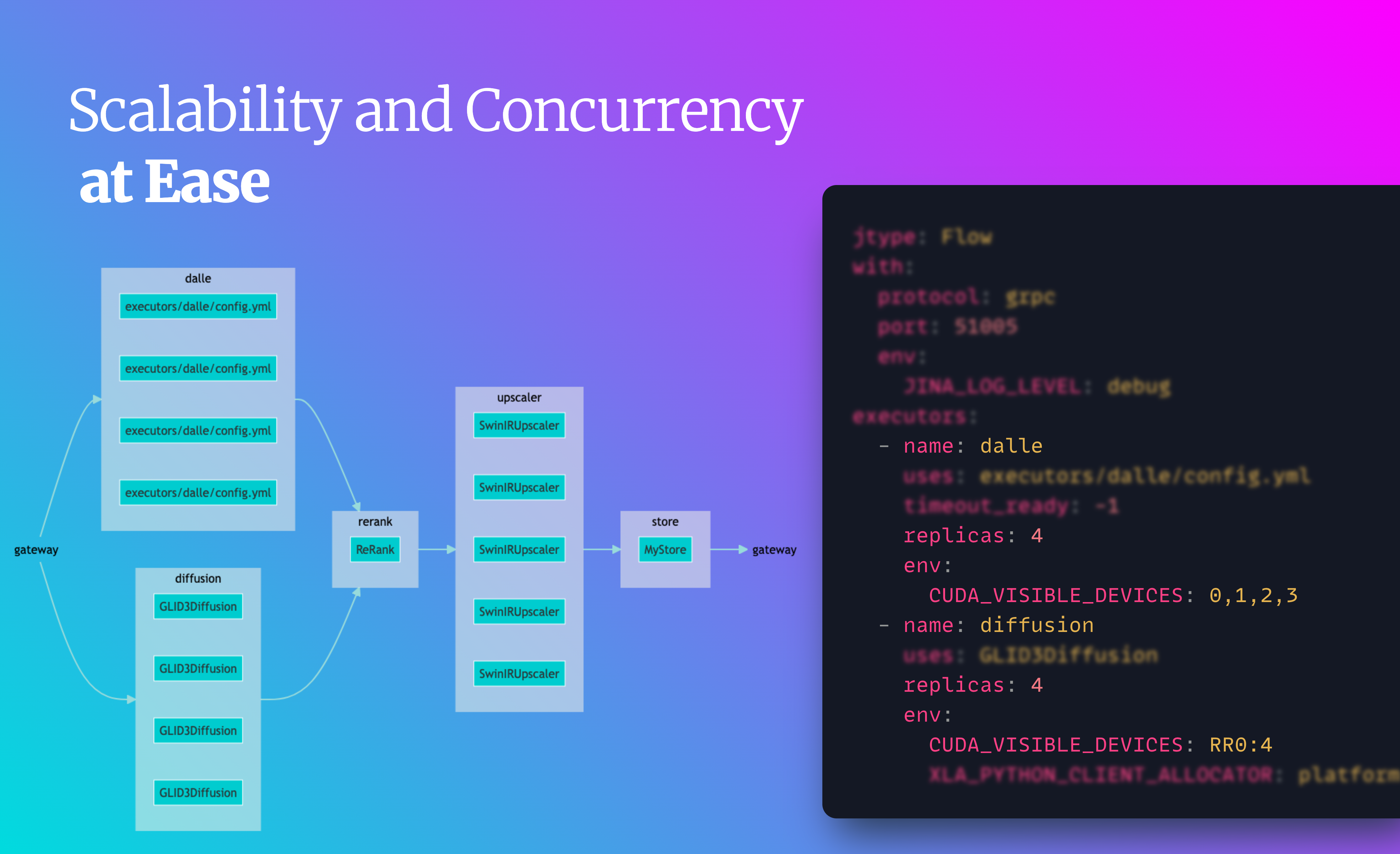
Jina comes with scalability features out of the box like replicas, shards and dynamic batching. This lets you easily increase your application's throughput.
Let's scale a Stable Diffusion Executor deployment with replicas and dynamic batching:
- Create two replicas, with a GPU assigned for each.
- Enable dynamic batching to process incoming parallel requests together with the same model inference.
| Normal Deployment | Scaled Deployment |
|---|---|
jtype: Deployment
with:
  timeout_ready: -1
  uses: jinaai://jina-ai/TextToImage
  install_requirements: true
|
jtype: Deployment
with:
  timeout_ready: -1
  uses: jinaai://jina-ai/TextToImage
  install_requirements: true
  env:
   CUDA_VISIBLE_DEVICES: RR
  replicas: 2
  uses_dynamic_batching: # configure dynamic batching
    /default:
      preferred_batch_size: 10
      timeout: 200
|
Assuming your machine has two GPUs, using the scaled deployment YAML will give better throughput compared to the normal deployment.
These features apply to both Deployment YAML and Flow YAML. Thanks to the YAML syntax, you can inject deployment configurations regardless of Executor code.
Seamless container integration
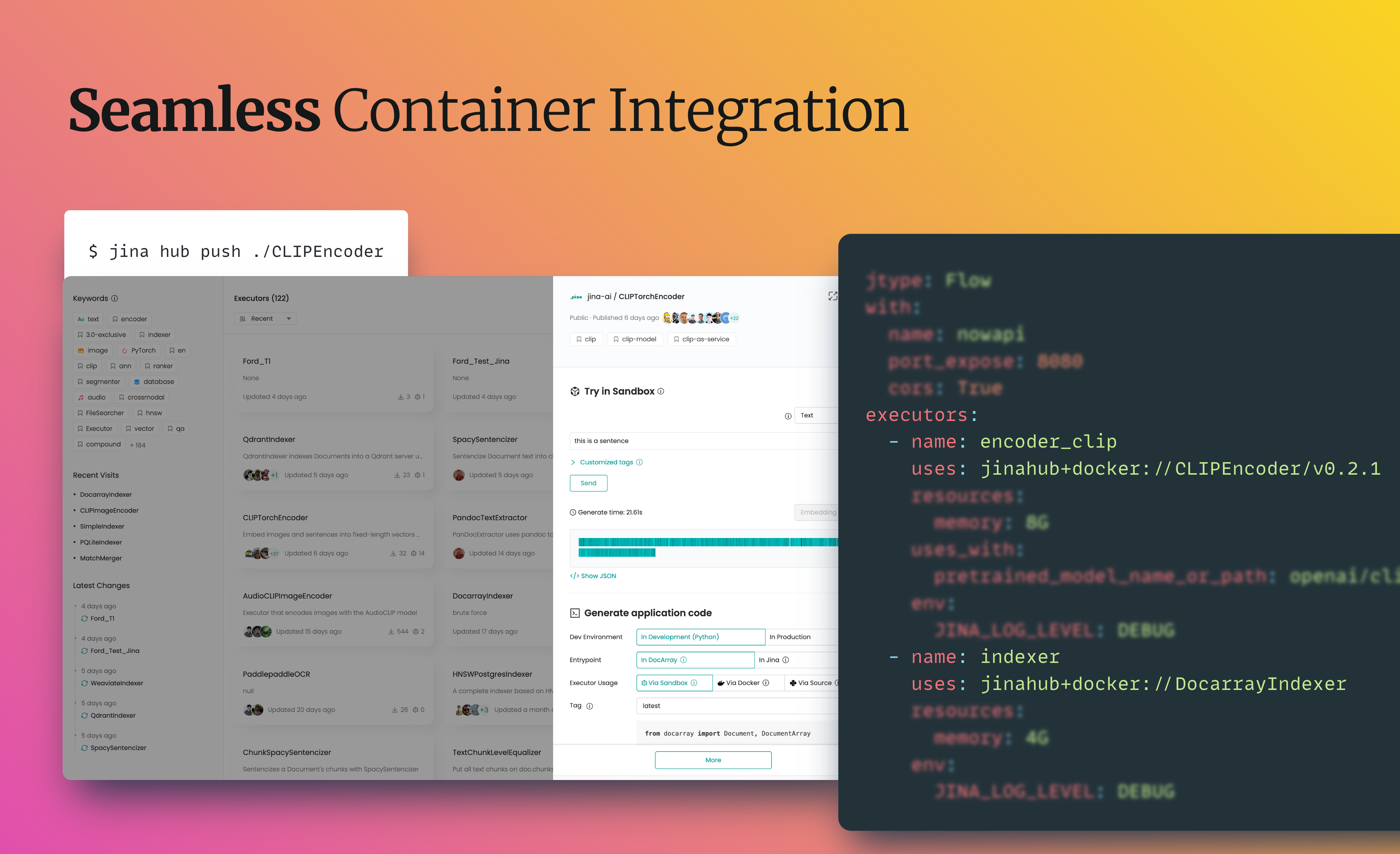
Use Executor Hub to share your Executors or use public/private Executors, with no need to worry about dependencies.
To create an Executor:
jina hub new
To push it to Executor Hub:
jina hub push .
To use a Hub Executor in your Flow:
| Docker container | Sandbox | Source | |
|---|---|---|---|
| YAML | uses: jinaai+docker://<username>/MyExecutor |
uses: jinaai+sandbox://<username>/MyExecutor |
uses: jinaai://<username>/MyExecutor |
| Python | .add(uses='jinaai+docker://<username>/MyExecutor') |
.add(uses='jinaai+sandbox://<username>/MyExecutor') |
.add(uses='jinaai://<username>/MyExecutor') |
Executor Hub manages everything on the backend:
- Automated builds on the cloud
- Store, deploy, and deliver Executors cost-efficiently;
- Automatically resolve version conflicts and dependencies;
- Instant delivery of any Executor via Sandbox without pulling anything to local.

Get on the fast lane to cloud-native
Using Kubernetes with Jina is easy:
jina export kubernetes flow.yml ./my-k8s
kubectl apply -R -f my-k8s
And so is Docker Compose:
jina export docker-compose flow.yml docker-compose.yml
docker-compose up
Note You can also export Deployment YAML to Kubernetes and Docker Compose.
Likewise, tracing and monitoring with OpenTelemetry is straightforward:
from docarray import DocumentArray
from jina import Executor, requests


class Encoder(Executor):
    @requests
    def encode(self, docs: DocumentArray, **kwargs):
        with self.tracer.start_as_current_span(
            'encode', context=tracing_context
        ) as span:
            with self.monitor(
                'preprocessing_seconds', 'Time preprocessing the requests'
            ):
                docs.tensors = preprocessing(docs)
            with self.monitor(
                'model_inference_seconds', 'Time doing inference the requests'
            ):
                docs.embedding = model_inference(docs.tensors)
You can integrate Jaeger or any other distributed tracing tools to collect and visualize request-level and application level service operation attributes. This helps you analyze request-response lifecycle, application behavior and performance.
To use Grafana, download this JSON and import it into Grafana:

To trace requests with Jaeger:

What cloud-native technology is still challenging to you? Tell us and we'll handle the complexity and make it easy for you.
Support
- Join our Slack community and chat with other community members about ideas.
- Join our Engineering All Hands meet-up to discuss your use case and learn Jina's new features.
- When? The second Tuesday of every month
- Where? Zoom (see our public events calendar/.ical) and live stream on YouTube
- Subscribe to the latest video tutorials on our YouTube channel
Join Us
Jina is backed by Jina AI and licensed under Apache-2.0.
Release history Release notifications | RSS feed


Download files
Download the file for your platform. If you're not sure which to choose, learn more about installing packages.
Source Distributions
Built Distributions
Filter files by name, interpreter, ABI, and platform.
If you're not sure about the file name format, learn more about wheel file names.
Copy a direct link to the current filters
File details
Details for the file jina-3.15.1-cp311-cp311-manylinux_2_5_x86_64.manylinux1_x86_64.manylinux_2_17_x86_64.manylinux2014_x86_64.whl.
File metadata
- Download URL: jina-3.15.1-cp311-cp311-manylinux_2_5_x86_64.manylinux1_x86_64.manylinux_2_17_x86_64.manylinux2014_x86_64.whl
- Upload date:
- Size: 7.7 MB
- Tags: CPython 3.11, manylinux: glibc 2.17+ x86-64, manylinux: glibc 2.5+ x86-64
- Uploaded using Trusted Publishing? No
- Uploaded via: twine/4.0.2 CPython/3.7.16
File hashes
| Algorithm | Hash digest | |
|---|---|---|
| SHA256 |
a471c76ec0f6b534356c1bf20b52d593c063c991e5128900af5572cb485d17c5
|
|
| MD5 |
063479141526bdcf17d8a6bc53dec956
|
|
| BLAKE2b-256 |
2d6434f20aec914ac403e7165a5bd068c21427a2950e557afe362a5bd01ce30f
|
File details
Details for the file jina-3.15.1-cp311-cp311-macosx_11_0_arm64.whl.
File metadata
- Download URL: jina-3.15.1-cp311-cp311-macosx_11_0_arm64.whl
- Upload date:
- Size: 8.7 MB
- Tags: CPython 3.11, macOS 11.0+ ARM64
- Uploaded using Trusted Publishing? No
- Uploaded via: twine/4.0.2 CPython/3.7.16
File hashes
| Algorithm | Hash digest | |
|---|---|---|
| SHA256 |
fa3b1ce11742e6520ba8e2f61f1eb1de520c8593006f6f53f34b9895c271f415
|
|
| MD5 |
e0813eef58fff9ac03f381eec94f4693
|
|
| BLAKE2b-256 |
003d835e56f097eeb559a6635ffc25869d1499832e47cdedfe837a0dd9b76366
|
File details
Details for the file jina-3.15.1-cp311-cp311-macosx_10_9_x86_64.whl.
File metadata
- Download URL: jina-3.15.1-cp311-cp311-macosx_10_9_x86_64.whl
- Upload date:
- Size: 8.7 MB
- Tags: CPython 3.11, macOS 10.9+ x86-64
- Uploaded using Trusted Publishing? No
- Uploaded via: twine/4.0.2 CPython/3.7.16
File hashes
| Algorithm | Hash digest | |
|---|---|---|
| SHA256 |
a6a39cdac4e1e6012552a18183be98e02f05e274959694c3e782b96ceb89fcdc
|
|
| MD5 |
5d23ebfb64698ddd0e6ab7835e043657
|
|
| BLAKE2b-256 |
0aa4cbca5c4bfb19b07214f4161cff1c223bc92445a96eb4c84a3a57831b4c72
|
File details
Details for the file jina-3.15.1-cp310-cp310-manylinux_2_5_x86_64.manylinux1_x86_64.manylinux_2_17_x86_64.manylinux2014_x86_64.whl.
File metadata
- Download URL: jina-3.15.1-cp310-cp310-manylinux_2_5_x86_64.manylinux1_x86_64.manylinux_2_17_x86_64.manylinux2014_x86_64.whl
- Upload date:
- Size: 7.7 MB
- Tags: CPython 3.10, manylinux: glibc 2.17+ x86-64, manylinux: glibc 2.5+ x86-64
- Uploaded using Trusted Publishing? No
- Uploaded via: twine/4.0.2 CPython/3.7.16
File hashes
| Algorithm | Hash digest | |
|---|---|---|
| SHA256 |
128c883a2b5cc96cb00ae2e258e8d2156a2dc7f66764d860641d7b16daed703b
|
|
| MD5 |
d9956e680bef00ac62f2c4098bba7e98
|
|
| BLAKE2b-256 |
8afe69073e6f5b1863e115b942794e08bdf887ba07c61f2d2c9bf3840da16171
|
File details
Details for the file jina-3.15.1-cp310-cp310-macosx_11_0_arm64.whl.
File metadata
- Download URL: jina-3.15.1-cp310-cp310-macosx_11_0_arm64.whl
- Upload date:
- Size: 8.7 MB
- Tags: CPython 3.10, macOS 11.0+ ARM64
- Uploaded using Trusted Publishing? No
- Uploaded via: twine/4.0.2 CPython/3.7.16
File hashes
| Algorithm | Hash digest | |
|---|---|---|
| SHA256 |
9215a2a9082e030c0a5049f73dd1a39ee09fc9f91f8e823863e609ce3eb1141e
|
|
| MD5 |
8bf95376e56ff0a09f17435aea69d30f
|
|
| BLAKE2b-256 |
69e8810d3996cc4d920f98c78abc867ea4f69971ccb0731401a8cb5117b8458e
|
File details
Details for the file jina-3.15.1-cp310-cp310-macosx_10_9_x86_64.whl.
File metadata
- Download URL: jina-3.15.1-cp310-cp310-macosx_10_9_x86_64.whl
- Upload date:
- Size: 8.7 MB
- Tags: CPython 3.10, macOS 10.9+ x86-64
- Uploaded using Trusted Publishing? No
- Uploaded via: twine/4.0.2 CPython/3.7.16
File hashes
| Algorithm | Hash digest | |
|---|---|---|
| SHA256 |
efc4bbc5b10c5d77dafac1dcf1efd208994ef9ab741e3ac89e9340670b3a2be3
|
|
| MD5 |
3956d9e7e7ad9ea0d5690752819c7c57
|
|
| BLAKE2b-256 |
3bdb977112b417d17a04e7b0fa0d29d6fb4838dd1cfb0f2e6cd2af71b0ba72c5
|
File details
Details for the file jina-3.15.1-cp39-cp39-manylinux_2_5_x86_64.manylinux1_x86_64.manylinux_2_17_x86_64.manylinux2014_x86_64.whl.
File metadata
- Download URL: jina-3.15.1-cp39-cp39-manylinux_2_5_x86_64.manylinux1_x86_64.manylinux_2_17_x86_64.manylinux2014_x86_64.whl
- Upload date:
- Size: 7.7 MB
- Tags: CPython 3.9, manylinux: glibc 2.17+ x86-64, manylinux: glibc 2.5+ x86-64
- Uploaded using Trusted Publishing? No
- Uploaded via: twine/4.0.2 CPython/3.7.16
File hashes
| Algorithm | Hash digest | |
|---|---|---|
| SHA256 |
8107a28e395a339bc3d7de36bc53d49cbd88444de39ee1b68834437f2d0ffbf9
|
|
| MD5 |
36f599128ea605729aadcdd9b2dd4a1e
|
|
| BLAKE2b-256 |
9c50febbfcbaa83336e2967e6808c09da9afb0a9feef831643291ab024036144
|
File details
Details for the file jina-3.15.1-cp39-cp39-macosx_11_0_arm64.whl.
File metadata
- Download URL: jina-3.15.1-cp39-cp39-macosx_11_0_arm64.whl
- Upload date:
- Size: 8.7 MB
- Tags: CPython 3.9, macOS 11.0+ ARM64
- Uploaded using Trusted Publishing? No
- Uploaded via: twine/4.0.2 CPython/3.7.16
File hashes
| Algorithm | Hash digest | |
|---|---|---|
| SHA256 |
a8f074db2a12b07376cc4fe5e094950bf0a2337581ab61e59af87143d750797d
|
|
| MD5 |
a0d1d895913785c30d62f6cb70bfbe26
|
|
| BLAKE2b-256 |
fd9f7920ba5abd59a6cd0d2facc8d8910757c1444d5df3f44c6e4827b94fec1b
|
File details
Details for the file jina-3.15.1-cp39-cp39-macosx_10_9_x86_64.whl.
File metadata
- Download URL: jina-3.15.1-cp39-cp39-macosx_10_9_x86_64.whl
- Upload date:
- Size: 8.7 MB
- Tags: CPython 3.9, macOS 10.9+ x86-64
- Uploaded using Trusted Publishing? No
- Uploaded via: twine/4.0.2 CPython/3.7.16
File hashes
| Algorithm | Hash digest | |
|---|---|---|
| SHA256 |
42de2f4b901e9a2ef31cc6d581ff325787496b006be11ebd3aff335a625aefa1
|
|
| MD5 |
c330f814ee374a6f401036db17dd4059
|
|
| BLAKE2b-256 |
cab59d69ecd53a2d252dc13970ffe3db1cbc57038d39ac3380fdee206cc76db5
|
File details
Details for the file jina-3.15.1-cp38-cp38-manylinux_2_5_x86_64.manylinux1_x86_64.manylinux_2_17_x86_64.manylinux2014_x86_64.whl.
File metadata
- Download URL: jina-3.15.1-cp38-cp38-manylinux_2_5_x86_64.manylinux1_x86_64.manylinux_2_17_x86_64.manylinux2014_x86_64.whl
- Upload date:
- Size: 7.7 MB
- Tags: CPython 3.8, manylinux: glibc 2.17+ x86-64, manylinux: glibc 2.5+ x86-64
- Uploaded using Trusted Publishing? No
- Uploaded via: twine/4.0.2 CPython/3.7.16
File hashes
| Algorithm | Hash digest | |
|---|---|---|
| SHA256 |
8ab57e70a5ff68e6428769164d4bd3f8f842b1521c16ea5abad91fecc69f50b4
|
|
| MD5 |
45199688efce95a8e694dfc1ac00b687
|
|
| BLAKE2b-256 |
2a9f28bb646d327848ce1d00e88b1b673495c9ffd82a433e7922c8d5b0098cc9
|
File details
Details for the file jina-3.15.1-cp38-cp38-macosx_11_0_arm64.whl.
File metadata
- Download URL: jina-3.15.1-cp38-cp38-macosx_11_0_arm64.whl
- Upload date:
- Size: 8.7 MB
- Tags: CPython 3.8, macOS 11.0+ ARM64
- Uploaded using Trusted Publishing? No
- Uploaded via: twine/4.0.2 CPython/3.7.16
File hashes
| Algorithm | Hash digest | |
|---|---|---|
| SHA256 |
72b1c8f1b03aef65d561f1d1089af4740563d2ed27fb023062887bf14303a445
|
|
| MD5 |
b5c0ca019f0fd4be0809063d2f2c6e5b
|
|
| BLAKE2b-256 |
fae9a768823780e5ad7e822cccc5eaafafd12166dc78b06641c827cad3c69275
|
File details
Details for the file jina-3.15.1-cp38-cp38-macosx_10_9_x86_64.whl.
File metadata
- Download URL: jina-3.15.1-cp38-cp38-macosx_10_9_x86_64.whl
- Upload date:
- Size: 8.7 MB
- Tags: CPython 3.8, macOS 10.9+ x86-64
- Uploaded using Trusted Publishing? No
- Uploaded via: twine/4.0.2 CPython/3.7.16
File hashes
| Algorithm | Hash digest | |
|---|---|---|
| SHA256 |
d53a5f6fdc96a51bcd977ae2929f32620b3cbd976d32b29b23e6ff2136f5fb1c
|
|
| MD5 |
a4be0aeda691a7d18e62a618c04aec21
|
|
| BLAKE2b-256 |
1c17ff679eeeaeb901a6783a873a52719be7c2f7187dd4c11b84c082792aec69
|
File details
Details for the file jina-3.15.1-cp37-cp37m-macosx_10_9_x86_64.whl.
File metadata
- Download URL: jina-3.15.1-cp37-cp37m-macosx_10_9_x86_64.whl
- Upload date:
- Size: 8.7 MB
- Tags: CPython 3.7m, macOS 10.9+ x86-64
- Uploaded using Trusted Publishing? No
- Uploaded via: twine/4.0.2 CPython/3.7.16
File hashes
| Algorithm | Hash digest | |
|---|---|---|
| SHA256 |
49f436338b7150539b945ab703820c15eb77caf4b86fbc0debd26e71baa7e31e
|
|
| MD5 |
4573d9546724d4f8fa8cc54ccd69c485
|
|
| BLAKE2b-256 |
018e18056c85a96112e00ed878111758bf485b178e477f4b73cac4476641e4ec
|






