
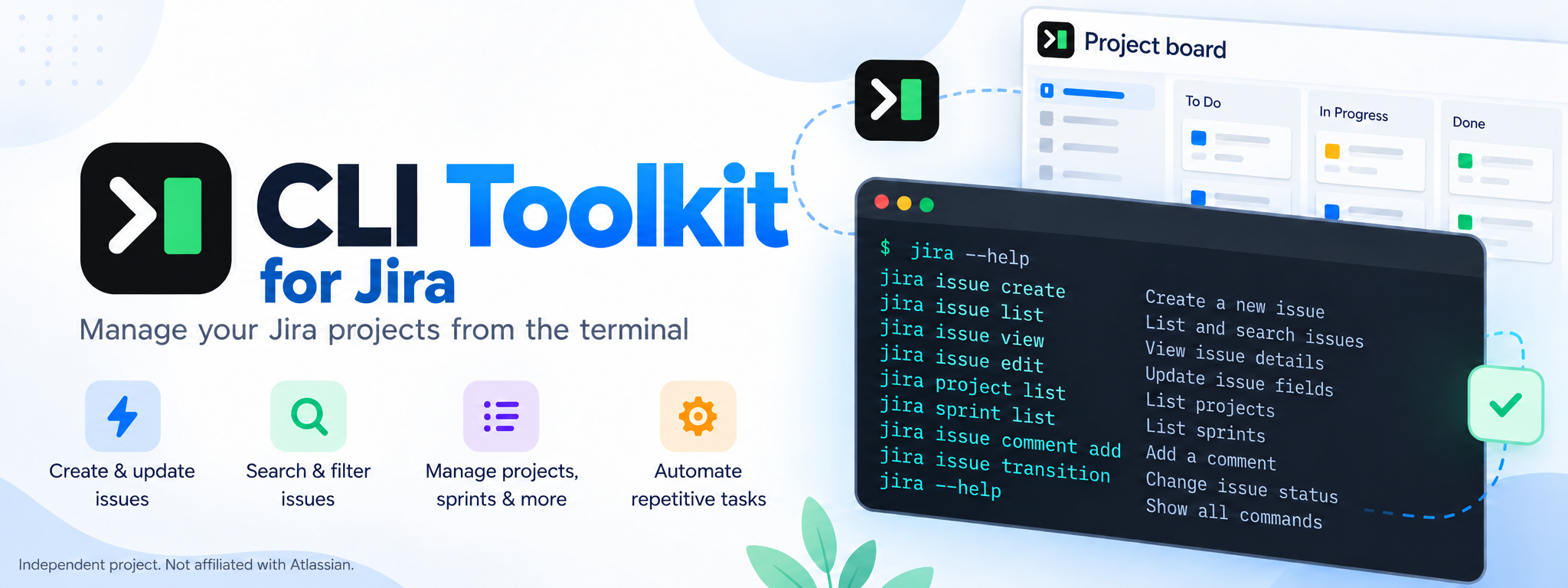







CLI Toolkit for Jira
Independent terminal tools for Jira Cloud, using the jira command. Find issues, create and edit work, manage sprints, and automate repeatable workflows using your existing account and project permissions.
Independent project. Not affiliated with, endorsed by, or sponsored by Atlassian. Jira is a trademark of Atlassian.
Website · Command reference · Latest release · Migration guides
Get started
Install the latest stable native binary. The installers verify release checksums and run version/help checks before installing. No Python runtime, administrator access, or Jira credentials are needed for native installation.
macOS
curl -fsSL https://raw.githubusercontent.com/User17745/jira-cli-toolkit/main/scripts/install.sh | bash
export PATH="$HOME/.local/bin:$PATH"
macOS 15+, Apple Silicon or Intel. Installs to ~/.local/bin/jira.
Or with Homebrew, which also handles upgrades:
brew install user17745/tap/jira-cli-toolkit
brew upgrade jira-cli-toolkit
Linux
curl -fsSL https://raw.githubusercontent.com/User17745/jira-cli-toolkit/main/scripts/install.sh | bash
export PATH="$HOME/.local/bin:$PATH"
Linux x86_64, glibc 2.39+ (for example Ubuntu 24.04+). Installs to ~/.local/bin/jira. curl and sha256sum or shasum are required. Homebrew on Linux x86_64 works too (brew install user17745/tap/jira-cli-toolkit). On older systems, musl or unsupported native architectures, use the Python package instead: pipx install jira-cli-toolkit.
Windows
Run in PowerShell:
irm https://raw.githubusercontent.com/User17745/jira-cli-toolkit/main/scripts/install.ps1 | iex
Windows 10+ x86_64, PowerShell 5.1+. Installs to %LOCALAPPDATA%\JiraCLI\bin\jira.exe and adds that directory to your user PATH. Open a new terminal if needed.
Prefer manual installation? Open the latest release and choose a matching binary or Python wheel. The installation guide explains verification and pipx/uv/Python installation. From 2.5.1 the Python package is also on PyPI as jira-cli-toolkit: pipx install jira-cli-toolkit, then pipx upgrade jira-cli-toolkit. Installations made before 2.5.1 are tracked as jsup; switch once with pipx uninstall jsup and pipx install jira-cli-toolkit (configuration and saved credentials are kept).
Already installed? Use the migration guide. Installers refuse to replace existing CLI commands or managed shims. Custom paths and pinned versions are documented in installer options.
Connect your account
jira --version
jira auth login --profile work
jira context use --project ENG
jira issue list --open
Replace ENG with your project key. Guided login explains how to create an Atlassian API token, hides token input, validates your identity, and helps you select a project.
Everyday workflows
| Do this | Run this |
|---|---|
| Find unfinished work | jira issue list -p ENG --open |
| Run your own JQL | jira issue list --jql 'assignee = currentUser()' |
| Inspect an issue | jira issue view ENG-42 |
| Create an issue | jira issue create -p ENG --type Bug --summary "Fix login" |
| Edit an issue | jira issue edit ENG-42 --summary "Fix keyboard navigation" |
| Discover transitions | jira issue transitions ENG-42 |
| Change its state | jira issue transition ENG-42 --to "In Progress" |
| Add a comment | jira issue comment add ENG-42 -m "Review started" |
| List boards and sprints | jira board list -p ENG · jira sprint list --board 123 |
| Inspect project fields | jira project fields -p ENG --type Bug |
Issue types, fields, transitions and board operations follow your project’s metadata and permissions. The CLI also supports assignment, relationships, attachments, comment maintenance, components, templates, CSV and shell completion. Explore the full reference.
Help works without credentials or a network connection:
jira --help
jira help issue create
jira issue comment --help
Authentication and profiles
- Native credentials: tokens use macOS Keychain, Windows Credential Manager, or a supported Linux wallet. Preferences at
~/.config/jsup/config.jsonhold profile references, not tokens. - Multiple contexts: use
profile list/use,--profile NAME, andcontext use --project KEYto choose an account and project. - Scoped tokens: guided login supports
--scopedand cloud-ID discovery. Tokens inherit account permissions and must have the scopes needed for each operation. - Explicit alternatives: scripts can supply a complete environment identity. POSIX
--storage fileis a separate mode-0600 plaintext opt-in, never an automatic fallback. - Recovery: API tokens cannot refresh automatically. Replace an invalid/revoked/expired token with
auth login; the CLI never replays a write automatically after recovery.
Native stores can require interactive approval. Linux wallets are interactive-only; scripted macOS access suppresses approval dialogs and fails with recovery instructions if approval is needed. Read the authentication details.
Automation and agents
jira issue list -p ENG --open --json --no-input
jira issue list -p ENG --open --csv --columns key,summary,status
jira issue create --template callback --var name=Example --var issue="Login failed"
jira completion zsh
JSON preserves API field structures, CSV supports selected columns, and --no-input makes missing input explicit. Destructive commands still need --yes in scripts. Runtime errors are structured on stdout for grouped commands; diagnostics and usage errors use stderr. Exit codes: 0 success/help, 1 API/network failure, 2 input/config/file errors, 130 interruption.
Templates are declarative JSON with declared variables, not executable hooks. The example callback template has explicit defaults that must fit your project; ordinary creation adds no support-specific fields. Read scripting and template details.
Any REST endpoint, without a token in the command
jira api calls any Jira Cloud REST path with your saved profile, so agents and scripts can use endpoints that have no convenience command. --spec looks the endpoint up in Atlassian's official OpenAPI documents first, without contacting your site.
jira api /rest/api/3/issue -X POST --spec              # permissions, scopes, body schema
jira api /rest/api/3/issue -X POST --data @issue.json  # then call it
jira api /rest/api/3/project/search --query maxResults=20
jira api /rest/agile/1.0/board/12/sprint --profile work | jq '.values[].name'
Response bodies go to stdout exactly as Jira returns them; failures are a JSON object on stderr. Requests stay on your site: no absolute URLs, no redirects, and auth headers can't be overridden. Writes are never retried. For unattended agents, approve keychain access once and give the agent a least-privilege account. Read the API, discovery and agent setup guide.
Explicit updates and releases
jira update --info
jira update --check
jira update --yes
Standalone updates select a compatible GitHub Release binary, verify its manifest/hash/size, validate version/help, and retain a .previous backup. Windows completes replacement through a separate helper. Config and credentials stay untouched; ordinary commands never auto-update.
For pipx/uv/Python installations, update gives instructions for the owning manager. Public downloads need no Jira token; an optional GitHub token can increase API rate limits. Update, verification and rollback details.
Releases contain wheel/sdist, macOS arm64/x86_64, Linux x86_64 and Windows x86_64 binaries, manifest and checksums. Current native OS requirements are listed above and in the manifest. Independent attestation verification, signing and notarization remain release-hardening work.
Migrating from old commands
jira is the primary command from v2.1. Python-package installations retain jsup and jira-cli-toolkit throughout v2.x. Invoking either prints a startup notice on stderr; JSON stdout and internal completion/update protocols stay intact. Native installers supply the jira executable.
| Earlier command | Current command |
|---|---|
jsup open -p ENG |
jira issue list -p ENG --open |
jsup issue-show ENG-42 |
jira issue view ENG-42 |
jsup issue-move ENG-42 --to Done |
jira issue transition ENG-42 --to Done |
Read the installation/credential migration guide and the complete developer command migration. Existing migrated profiles need no second credential migration when updating from v2.0.
Development
python -m venv .venv
.venv/bin/python -m pip install -e .
.venv/bin/python -m unittest discover -s tests -v
On Windows use .venv\Scripts\python. Tests use local fixtures and mocked Jira calls; they do not need credentials or change issues.
The landing page uses React, TypeScript, Vite, Tailwind and shadcn/ui:
cd web
npm ci
npm run dev
npm run build
npm test
Website development and browser checks · Installer development · Release acceptance
Scope and next steps
The current release supports standard Jira Cloud issues and applicable Software boards/sprints, and any Jira Cloud REST endpoint through jira api, including Service Management. Service Management convenience commands and Data Center remain future work. Required-field discovery cannot describe every app-specific workflow validator; Jira remains authoritative.
Original project code is licensed under AGPL-3.0-only. See completed milestones and remaining work.
Independent project and intellectual property notice
CLI Toolkit for Jira is independently developed and maintained. It is not affiliated with, sponsored by, endorsed by, or otherwise associated with Atlassian or any of its affiliated business entities. It is not an official Jira product.
References to Jira and Atlassian, including the jira command name, identify the external service and describe compatibility and usage. They do not claim ownership of those names or imply an official relationship. Jira and Atlassian are trademarks of Atlassian.
No infringement of third-party trademarks, copyrights, patents, or other intellectual property rights is intended. This statement does not establish that a particular use is non-infringing or replace any permission that may be required.
License
Copyright © 2026 Abhishek Aggarwal. Original project code is licensed under the GNU Affero General Public License, version 3 only (AGPL-3.0-only). You may redistribute and modify it under that license. It is provided without warranty, including any implied warranty of merchantability or fitness for a particular purpose. See LICENSE for the complete terms and NOTICE for the project notice.
Third-party components and assets retain their own copyright notices and applicable license terms; preserve those notices when redistributing them. This does not remove applicable AGPL obligations for covered combined works. The project license does not grant rights to third-party trademarks. Website third-party notices are included separately.
1 maintainer

Metadata
1 maintainer
Release files for jira-cli-toolkit 2.5.2
For a detailed explanation of source distributions (sdists) and built distributions (wheels), please see the package formats documentation.
Source distribution (sdist)
| File | Size | Uploaded | |
|---|---|---|---|
| jira_cli_toolkit-2.5.2.tar.gz | 1.7 MB | Details |
Built distribution (wheel)
| File | Interpreter | ABI | Platform | Reset |
|---|---|---|---|---|
| jira_cli_toolkit-2.5.2-py3-none-any.whl | Python 3 | none | any | Details |
Total release size: 1.8 MB
Release files / jira_cli_toolkit-2.5.2.tar.gz
| Download URL | jira_cli_toolkit-2.5.2.tar.gz |
|---|---|
| Size | 1.7 MB |
| Tags | Source |
|
SHA-256 checksum How to use checksums |
307a91348a779034e91c24a330f3e5a0dfdf503c3fd0f66c46c888f05fd093a6
|
|
BLAKE2b-256 checksum How to use checksums |
72c813fb13972d13da0c7411f4fba6373dee5fd46acdb59e52725f53824103b2
|
| Upload date | |
|
Uploaded using Trusted Publishing? What is trusted publishing? |
Yes |
| Uploaded via |
twine/7.0.0 CPython/3.13.14
|
Provenance
Provenance describes where a file came from. On PyPI, provenance is shared via attestations, which provide a verifiable record of the build or publishing details. View details, limitations and caveats.


PyPI Publish Attestation
PyPI verified that this artifact, at this checksum, originated from the publisher listed below.
Signed by GitHub Actions, verified by PyPI on Oct 8, 2026.
Transparency logRelease files / jira_cli_toolkit-2.5.2-py3-none-any.whl
| Download URL | jira_cli_toolkit-2.5.2-py3-none-any.whl |
|---|---|
| Size | 73.8 kB |
| Tags | Python 3 |
|
SHA-256 checksum How to use checksums |
0eadfd43658eb12245a5f2a301128f9c6ae520b9b34c3aa89ff870a2599a5f56
|
|
BLAKE2b-256 checksum How to use checksums |
73c9fd9d201e7c4627feca5f2629aa3a9e13f8602ffda5520830017f46ff0995
|
| Upload date | |
|
Uploaded using Trusted Publishing? What is trusted publishing? |
Yes |
| Uploaded via |
twine/7.0.0 CPython/3.13.14
|
Provenance
Provenance describes where a file came from. On PyPI, provenance is shared via attestations, which provide a verifiable record of the build or publishing details. View details, limitations and caveats.
PyPI Publish Attestation
PyPI verified that this artifact, at this checksum, originated from the publisher listed below.
Signed by GitHub Actions, verified by PyPI on Oct 8, 2026.
Transparency log













