
jobd







A self-hostable, GPU-aware job broker for your own machines — with native MCP/agent integration.
Like task-spooler or pueue, but across all your machines — and VRAM-aware.
Demo recorded on jobd v0.5.30; output on later versions may differ.
You have a couple of boxes with GPUs — a workstation, a server, maybe a laptop — wired together over Tailscale or a LAN. You want to fire off training runs, data pipelines, and long batch jobs from anywhere, have them land on whichever machine actually has the VRAM free, survive across sessions, and get preempted cleanly when something more important shows up. You don't have a cloud, a Kubernetes cluster, or a Slurm install, and you don't want one.
jobd is that missing piece: a lightweight, single-process broker that turns a handful of personal machines into a single queue — and an LLM agent can drive it directly.
# from any machine on your tailnet:
job submit --project myproj --gpu --vram-required 16 --wait -- python train.py
# → routed to whichever worker has ≥16 GB VRAM free, streamed back to your terminal
VRAM routing tracks one GPU per host: the worker reports free memory on GPU index 0 only.
Why it exists
Most schedulers assume a datacenter. The lightweight ones that don't (a bare nohup, a tmux session, an ssh-and-pray script) give you nothing: no queue, no VRAM-aware routing, no preemption, no record of what ran where. jobd fills the gap between "ssh in and run it" and "stand up Slurm":
- VRAM-fit routing. The broker matches each job against live worker capacity (free VRAM / RAM / CPUs, capability tags, arch/OS) and dispatches to a worker that actually fits — instead of you guessing which box is free. One GPU per host is tracked (GPU index 0).
- Preempt + checkpoint window. A higher-priority job can preempt a running one: the worker sends
SIGTERM, the workload gets a grace window, thenSIGKILL. jobd gives each job a per-jobJOBD_CHECKPOINT_DIRto write into during that window; saving the checkpoint is the workload's job. A preempted job ends in the terminalpreemptedstate and is not re-run automatically — to resume, you submit a new job pointed at the old checkpoint. (See docs/preemption.md.) - Survives sessions. Submit, close your laptop, check back tomorrow. Jobs live in the broker, not your shell.
- Agent-native. Ships a first-class MCP server so an LLM agent (Claude Code, etc.) can submit, monitor, and babysit jobs as tool calls.
- Yours. One broker process you run on a machine you own. No accounts, no telemetry, no per-GPU-hour billing; the broker and worker talk only to each other and to your clients. The optional self-update scripts do go online to fetch releases:
scripts/update-worker.sh(whichjob fleet addinstalls on a timer) installs from PyPI, andscripts/deploy-broker.shqueries the GitHub API and pulls the image from GHCR. - Loopback by default, tailnet-only beyond it. The broker binds
127.0.0.1unless you setJOBD_HOST. A request from any address that is neither loopback nor in Tailscale's CGNAT range (100.64.0.0/10) gets a403(JOBD_DISABLE_TAILNET_ACL=1turns that check off).
Why not just use…?
| Tool | What it gives you | Why jobd instead |
|---|---|---|
nohup / tmux / ssh-and-pray |
Runs a command on one box | No queue, no VRAM-aware routing, no preemption, no record of what ran where |
| task-spooler | A real job queue — on a single machine | jobd queues across all your machines and routes by live VRAM/CPU fit |
| Pueue | A mature single-machine command queue daemon | Pueue's own README declares distributed execution out of scope — jobd is that missing layer, plus GPU awareness |
| HyperQueue | Multi-machine task scheduling with HPC roots, single binary | HQ counts GPUs but doesn't track VRAM, and has no preemption/checkpoint contract or agent interface |
| Slurm | Datacenter-grade scheduling | Heavy to stand up and operate for 2–3 personal boxes; jobd is one process + a poller per host |
| SkyPilot / dstack | Provision and run on clouds + your own machines | SkyPilot's "existing machines" mode installs a Kubernetes cluster (k3s) on your boxes; dstack wants Docker + passwordless sudo on every host. jobd is one process + a poller — no containers, no sudo, no K8s |
| Modal | Serverless GPU compute on Modal's cloud | Cloud-only: it runs on Modal's machines, not yours |
| Ray | A distributed-compute framework; Ray Jobs also runs any shell command on a Ray cluster | You first stand up and run a Ray cluster; jobd is one broker process + a poller per host, with live VRAM-fit routing and a checkpoint window on preemption |
Closest in spirit are Pueue and task-spooler (single-machine by design) and HyperQueue (multi-machine, HPC-shaped). jobd's niche is the 2–5-GPU homelab: multi-machine live VRAM-fit routing (one GPU per host tracked) + preempt/checkpoint window + a native MCP interface — a combination we haven't found in the tools above — with nothing heavier than a Python process per host.
Architecture
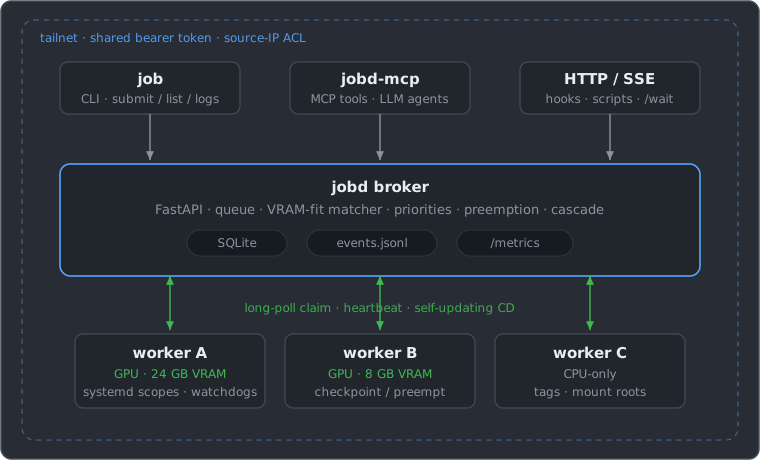
Diagram source (mermaid)
flowchart TD
    CLI["job CLI"]:::client --> B
    MCP["jobd-mcp<br/>MCP tools"]:::client --> B
    API["HTTP · SSE"]:::client --> B
    B["<b>jobd broker</b> — FastAPI<br/>queue · matcher · priorities · SQLite"]:::broker
    B <-->|poll · dispatch| WA["worker A<br/>24 GB GPU"]:::worker
    B <-->|poll · dispatch| WB["worker B<br/>8 GB GPU"]:::worker
    B <-->|poll · dispatch| WC["worker C<br/>CPU-only"]:::worker
    classDef client fill:#1f2937,stroke:#4b5563,color:#e5e7eb;
    classDef broker fill:#0e7490,stroke:#155e75,color:#ecfeff;
    classDef worker fill:#14532d,stroke:#166534,color:#dcfce7;
Workers poll the broker (pull model — no inbound connection to a worker); the broker matches each job against live capacity and hands it back on the poll. One broker process, one poller per host.
- Broker — a FastAPI + SQLite service. Holds the queue, runs the matcher, resolves per-project priorities and defaults, exposes a small HTTP API and an SSE stream. Single source of truth.
- Workers — lightweight polling agents, one per host. Each advertises live capacity via heartbeat, claims jobs it can run, executes them (
shell=False: the argv you submit is run as-is, not through a shell — exceptjob submit --stdinand the MCPjobd_submittool, which take a command string and run it asbash -c <string>), streams logs back, and honors preemption signals. - Clients — the
jobCLI, thejobd-mcpMCP server, or anything that speaks the HTTP API.
Install
pip install jobd               # broker + CLI
pip install "jobd[mcp]"        # adds the MCP server
pip install "jobd[worker]"     # adds the worker daemon (jobd-worker)
Requires Python ≥ 3.11. Everything ships in the one jobd package: the broker (jobd), the CLI (job), the MCP server (jobd-mcp), and the worker (jobd-worker). The worker's extra runtime deps (psutil, nvidia-ml-py) live behind the [worker] extra since they're only needed on machines that actually run jobs. scripts/install-worker.sh sets a worker up under ~/jobd-worker with its own venv and a generated config.
Quickstart (single host)
# 1. start the broker (binds 127.0.0.1:8765 by default)
JOBD_ALLOW_NO_AUTH=1 jobd          # no-auth is fine for a loopback-only broker

# 2. in another shell, install + start a worker pointed at it
pip install "jobd[worker]"
JOBD_URL=http://127.0.0.1:8765 JOBD_WORKER_HOST=local jobd-worker

# 3. submit a job and wait for it
job submit --project demo --wait -- echo hello
job list
job logs <id>
For a real multi-host deployment (Docker broker + systemd workers, Tailscale binding, shared auth token), see docs/security.md and the templates in docker-compose.yml and scripts/. Adding a worker to a running fleet is one command:
job fleet add user@newbox      # ssh in, install pinned to the broker's version,
                               # wire systemd units + the self-update timer,
                               # verify it registers. `job fleet status` shows drift.
Day-2 operations (health, draining a worker, upgrades, token rotation, backups) are in docs/runbook.md.
Supported platforms
Python 3.11+ everywhere.
| Component | Linux | macOS | Windows |
|---|---|---|---|
Broker (jobd) |
✅ | ☑️ | ☑️ (WSL recommended) |
CLI (job) / MCP (jobd-mcp) |
✅ | ☑️ | ☑️ |
Worker (jobd-worker) |
✅ full | ⚠️ degraded | untested |
✅ = CI-tested on Linux (Ubuntu), with limits: CI has no GPU runner, so the NVIDIA/VRAM paths are tested only against mocks, and the tests that need a systemd --user scope skip on GitHub's runners. ☑️ = pure-Python and expected to work, but not exercised by CI — please file an issue if something is broken there.
The worker runs its best on Linux with a systemd user instance: memory caps, process reaping, and preemption use systemd-run --user scopes and cgroups. On non-systemd hosts the worker still executes jobs, but silently drops those guarantees — fine for a single trusted box, not for hard resource isolation. GPU features need NVIDIA + nvidia-ml-py. The broker, CLI, and MCP server are pure-Python and portable.
CLI
job submit -p PROJ [--gpu] [--vram-required N] [--needs TAG]... [--count N | --sweep K=v1,v2]... [--wait] -- CMD...
job list [--state STATE] [--project P] [--array A<id>]   # queue + recent jobs
job status ID | A<id> [--watch]             # one job, or an array's aggregate
job logs ID [-n BYTES]                      # tail captured output
job wait ID                                 # block until terminal
job cancel ID  /  job preempt ID            # stop a job
job adopt --pid N -p PROJ [--gpu]           # register a process you already started (Linux)
job workers                                 # fleet snapshot + health
job projects list | set NAME PRI | nudge NAME DELTA
job audit [--project P] [--since 24h]       # event history
job adopt makes a process started outside jobd (nohup, tmux) visible to the broker: it holds a slot and its VRAM until it exits, and nothing is launched. Its exit code is unknowable, so it ends orphaned, never completed — see docs/adoption.md.
job submit --explain dry-runs the resolution (priority, profile, project defaults, host pin) and prints the effective config without enqueuing anything.
Job arrays
Submit N jobs from one template with --count N. Each member is a normal job — it routes, runs, preempts, and checkpoints independently — and {i} in the command is replaced by the member's 0-based index:
job submit -p train --count 8 -- python train.py --fold {i}
# → Submitted array A42: 8 jobs (ids 42..49)

job list --array A42         # the members, with their index annotations
job status A42               # aggregate: state tally + per-member rollup
The array is identified as A<id> (the first member's job id). job status A42 exits non-zero if any member ended in a non-completed terminal state, so it composes with shell &&.
For a grid search, use --sweep KEY=v1,v2,v3 (repeatable) instead of --count. The broker fans out the cartesian product of all axes, substituting {KEY} per member; {i} (the flat member index) is also available:
job submit -p train --sweep lr=0.1,0.01 --sweep seed=1,2,3 \
  -- python train.py --lr {lr} --seed {seed} --out run-{i}
# → Submitted array A50: 6 jobs (ids 50..55)   # 2 × 3 = 6 members
--sweep and --count are mutually exclusive, the product is capped at 1000 members, and i is reserved as an axis key. Substitution is a literal {key} replace (not str.format), so JSON literals and shell braces in the command pass through untouched.
Coming from pueue or task-spooler?
Most verbs map directly — what changes is that the queue spans every machine you own. The last row is only a rough equivalent: jobd has no named groups with their own parallelism limit.
| You ran… | With jobd |
|---|---|
tsp <cmd> / pueue add -- <cmd> |
job submit -p <project> -- <cmd> |
tsp -w / pueue follow <id> |
job logs -f <id> (or job wait <id>) — streams, exits with the job's own exit code |
tsp / pueue status |
job list |
pueue log <id> |
job logs <id> |
commands piped to simple_gpu_scheduler |
... | job submit -p <project> --stdin — one job per line, fleet-wide |
pueue kill <id> |
job cancel <id> |
pueue group / parallelism limits |
approximately: projects + priorities (projects.yaml); per-worker slots via JOBD_WORKER_MAX_CONCURRENT_JOBS |
What you gain on top: jobs route to whichever machine actually has the VRAM/CPU free, live in the broker rather than in one machine's shell, can be preempted with a checkpoint window instead of killed, and are drivable by an LLM agent over MCP. What you lose: there is no pause/resume, stash, or edit of a queued job (cancel and resubmit instead), and if a worker dies mid-job, a running job not marked idempotent ends orphaned rather than being re-run. A one-machine deployment (broker + one worker on the same host) otherwise behaves like a network-reachable pueue.
MCP / agent integration
jobd ships an MCP server (jobd-mcp) exposing the queue as nine tools — jobd_submit, jobd_status, jobd_logs, jobd_list, jobd_cancel, jobd_preempt, jobd_events, jobd_workers, jobd_worker_delete. docs/agent-cookbook.md is the worked tour: fire-and-babysit polling, surviving preemption with checkpoints, sweeps, and asking the broker why a job won't schedule.
One-liner for Claude Code:
claude mcp add jobd --env JOBD_URL=http://127.0.0.1:8765 --env JOBD_API_TOKEN=<your-token> -- jobd-mcp
Or point any other MCP client at it:
{
  "mcpServers": {
    "jobd": {
      "command": "jobd-mcp",
      "env": {
        "JOBD_URL": "http://127.0.0.1:8765",
        "JOBD_API_TOKEN": "<your-token>"
      }
    }
  }
}
JOBD_API_TOKEN must match the broker's token, or every call returns 401. Omit it only when the broker runs with JOBD_ALLOW_NO_AUTH=1.
Now an agent can "run this overnight," check on it next session, and route GPU work through the broker instead of colliding on a shared card. The examples/claude-code-hooks/ directory has optional Claude Code hooks that nudge (or hard-block) an agent toward submitting heavy commands through jobd — including a VRAM-aware GPU guard with # NO_GPU / # CONCURRENT_OK / # VRAM=NGB override markers.
Configuration
Three optional YAML files under JOBD_CONFIG_DIR (default /app/config, the Docker image's path — set it when you run from pip). Example files live in this repo's config/ directory; they are not included in the pip package, and docker-compose.yml mounts them into the container:
projects.yaml— per-project base priority and submit defaults (preemptibility, wall/idle timeouts, host pins, capability requirements). Entries may also declareroots:so a job typed with an unregistered run label is priced by the project whose directory it runs in. See docs/projects-yaml.md for the full resolution model and docs/events.md for the event catalog.profiles.yaml— named resource bundles (--profile gpu-train-large) the matcher uses to size a job.classifier.yaml— rules that auto-suggest a profile from the command string.
All three are optional; with none present, every job runs at the global default priority.
Everything else is environment variables — the complete JOBD_* catalog (broker, worker, CLI/MCP, and the vars provided to workloads) lives in docs/configuration.md, and a CI test keeps it in lockstep with the source in both directions.
Concurrency (multislotting)
By default each worker runs one job at a time (JOBD_WORKER_MAX_CONCURRENT_JOBS=1). Raise it to let a worker bin-pack several jobs that fit side by side:
JOBD_WORKER_MAX_CONCURRENT_JOBS=3 jobd-worker
The matcher is resource-aware, so this is not blind N-up oversubscription. Each in-flight job reserves its vram_gb / ram_gb / cpus footprint, and the worker's heartbeat advertises only what's left. For VRAM, NVML's free figure already counts memory a running job has allocated, so only the not-yet-allocated part of the reservations is subtracted: free_vram = nvml_free − max(0, Σ in-flight vram_gb − VRAM held by this worker's jobs), where nvml_free is GPU index 0 only. RAM and CPUs subtract the full reservations. The broker won't place a job that doesn't fit the remaining headroom. The practical payoff: a CPU-only job and a GPU job run at the same time — the CPU job reserves 0 VRAM, so it never blocks the GPU slot, and vice-versa. Two GPU jobs co-run only if both fit live VRAM: before starting a job it was handed, the worker re-reads free VRAM and refuses the job if it no longer fits. A job whose command contains the literal marker # CONCURRENT_OK skips that last check — use it when you know the requested VRAM is overstated.
job workers reports each worker's slot usage — running jobs out of max_concurrent — alongside the live resource ad:
// job workers
{ "host": "desktop", "state": "online", "running": 2, "max_concurrent": 3,
  "free_vram_gb": 9.1, "idle_cpus": 6, ... }
Set the limit per worker from its environment (systemd unit, shell, or worker.yaml env) — it's a worker-local knob, not a broker setting.
Retention
By default jobd keeps every job record and .log file forever — history is never lost. On a long-running broker, opt into pruning:
JOBD_JOB_RETENTION_DAYS=30 jobd # delete terminal jobs + their logs after 30 days
The sweeper deletes jobs in a terminal state whose finished_at is older than the horizon, unlinks their per-job .log, and emits a jobs_pruned event. Freed SQLite pages are reused under WAL, so the DB file stays bounded without a global-locking VACUUM. The default (0) keeps everything; pruning old terminal parents is safe for any still-pending dependents.
Security
The broker has no TCP-layer auth beyond a shared bearer token, so it is meant to run on a trusted network (loopback or a Tailscale tailnet), never on a public interface. Three stacked controls:
- Interface binding — set
JOBD_HOSTto127.0.0.1(the default) or a Tailscale CGNAT address (100.64.0.0/10), not0.0.0.0. The broker itself does not enforce this: it starts on any bind address, and only warns (or refuses) when a non-loopback bind is combined with no-auth. The only check on the bind value is a CI lint (tests/test_deploy_lint.py) on the shipped Docker deployment; control 2 is what holds at runtime. - Source-IP check (runtime) — whatever the bind, the broker answers
403to any request whose source address is neither loopback nor in100.64.0.0/10(src/jobd/auth.py).JOBD_DISABLE_TAILNET_ACL=1turns this off. - Bearer token — set
JOBD_API_TOKEN(≥32 random bytes) on every broker/worker/CLI/MCP host. The broker refuses to start without it unless you explicitly setJOBD_ALLOW_NO_AUTH=1.JOBD_ALLOW_NO_AUTH=1is for a loopback-only broker (JOBD_HOST=127.0.0.1) — for local dev/tests. Combined with a non-loopbackJOBD_HOSTit exposes an unauthenticated RCE endpoint to your whole tailnet; the broker logs a startup warning if you do this. Don't.
Three endpoints are exempt from the source-IP check and the token — /livez, /readyz and /metrics answer with no bearer token and no source-IP check, because a generic HTTP monitor cannot send a token. /metrics is the one that matters: it publishes the broker version, job counts by state, and every worker's hostname and version. No commands, cwd, env or project names — but it does fingerprint the fleet. That is why, for these three, the JOBD_HOST bind above is load-bearing rather than defence-in-depth: port-forward the broker and you publish that inventory. Full table: Unauthenticated surface.
Full threat model, env-var reference, and token rotation: docs/security.md.
License
MIT — see LICENSE.
1 maintainer

Release files for jobd 0.5.51
For a detailed explanation of source distributions (sdists) and built distributions (wheels), please see the package formats documentation.
Source distribution (sdist)
| File | Size | Uploaded | |
|---|---|---|---|
| jobd-0.5.51.tar.gz | 881.0 kB | Details |
Built distribution (wheel)
| File | Interpreter | ABI | Platform | Reset |
|---|---|---|---|---|
| jobd-0.5.51-py3-none-any.whl | Python 3 | none | any | Details |
Total release size: 1.1 MB
Release files / jobd-0.5.51.tar.gz
| Download URL | jobd-0.5.51.tar.gz |
|---|---|
| Size | 881.0 kB |
| Tags | Source |
|
SHA-256 checksum How to use checksums |
6051a2a0560ec2a825aae7252313948648616cbef4ff85023594435da9d67210
|
|
BLAKE2b-256 checksum How to use checksums |
af161dc2dbaea120f65413a86802a1662499377d3c7a8f3d0de52fa0b8169974
|
| Upload date | |
|
Uploaded using Trusted Publishing? What is trusted publishing? |
Yes |
| Uploaded via |
twine/7.0.0 CPython/3.13.14
|
Provenance
Provenance describes where a file came from. On PyPI, provenance is shared via attestations, which provide a verifiable record of the build or publishing details. View details, limitations and caveats.


PyPI Publish Attestation
PyPI verified that this artifact, at this checksum, originated from the publisher listed below.
Signed by GitHub Actions, verified by PyPI on Sep 26, 2026.
Transparency logRelease files / jobd-0.5.51-py3-none-any.whl
| Download URL | jobd-0.5.51-py3-none-any.whl |
|---|---|
| Size | 242.4 kB |
| Tags | Python 3 |
|
SHA-256 checksum How to use checksums |
0b75f8d145bb2782f7bce8d471c6c22f6094a7d6eb285e9c1e82d9298a702a5b
|
|
BLAKE2b-256 checksum How to use checksums |
3ea1b5b73f7067895efdfcb032b1ef3cfb96a194553dc6b49e504a069b489086
|
| Upload date | |
|
Uploaded using Trusted Publishing? What is trusted publishing? |
Yes |
| Uploaded via |
twine/7.0.0 CPython/3.13.14
|
Provenance
Provenance describes where a file came from. On PyPI, provenance is shared via attestations, which provide a verifiable record of the build or publishing details. View details, limitations and caveats.
PyPI Publish Attestation
PyPI verified that this artifact, at this checksum, originated from the publisher listed below.
Signed by GitHub Actions, verified by PyPI on Sep 26, 2026.
Transparency log













