
job-posting-structure
This repository provides the jobstruct python package, which implements methods for extracting structured informaton from job postings as described in:
Mark Howison, William O. Ensor, Suraj Maharjan, Rahil Parikh, Srinivasan H. Sengamedu, Paul Daniels, Amber Gaither, Carrie Yeats, Chandan K. Reddy, Justine S. Hastings. 2024. Extracting Structured Labor Market Information from Job Postings with Generative AI. Digital Government: Research and Practice, in press. doi:10.1145/3674847
Abstract: Labor market information is an important input to labor, workforce, education, and macroeconomic policy. However, granular and real-time data on labor market trends are lacking; publicly available data from survey samples are released with significant lags and miss critical information such as skills and benefits. We use generative Artificial Intelligence to automatically extract structured labor market information from unstructured online job postings for the entire U.S. labor market. To demonstrate our methodology, we construct a sample of 6,800 job postings stratified by 68 major occupational groups, extract structured information on educational requirements, remote-work flexibility, full-time availability, and benefits, and show how these job characteristics vary across occupations. As a validation, we compare frequencies of educational requirements by occupation from our sample to survey data and find no statistically significant difference. Finally, we discuss the scalability to collections of millions of job postings. Our results establish the feasibility of measuring labor market trends at scale from online job postings thanks to advances in generative AI techniques. Improved access to such insights at scale and in real-time could transform the ability of policy leaders, including federal and state agencies and education providers, to make data-informed decisions that better support the American workforce.
Copyright Amazon.com, Inc. or its affiliates. All Rights Reserved.
Copyright National Association of State Workforce Agencies. All Rights Reserved.
Licensed under Creative Commons Attribution-NonCommercial-ShareAlike 4.0 International.
Overview
Job postings are challenging to use as a data source for labor market information because of the variation in how they are written. Generative AI models excel at summarizing the kind of variation in language, formatting, and conventions found in job postings. This package provides Generative AI methods for extracting structured information from job postings, which we studied in the paper cited above. Using an example job posting for a software engineer, you can view an example of the original job description and the resulting structured information extracted by the package.
Organization
The package is organized into three main classes:
- SkillsTaxonomyAI provides a GenAI method for enriching an existing skills taxonomy, which defaults to a basic taxonomy derived from the O*NET® Database. It requires a subscription to the Amazon Bedrock service for access to GenAI foundation models (Claude 3 Haiku by default).
- JobStructAI provides GenAI methods for extracting structured information from job description text, optionally using a SkillsTaxonomy object to identify skills. It also requires a Bedrock subscription.
- JobStructHTML provides a basic, deterministic method for extracting information from an HTML-formatted job posting using HTML tags and conventions for typical section names. It requires no subscriptions and can be run offline.
It also provides a command-line interface to the SkillsTaxonomyAI and JobStructAI classes.
Prompt Architecture
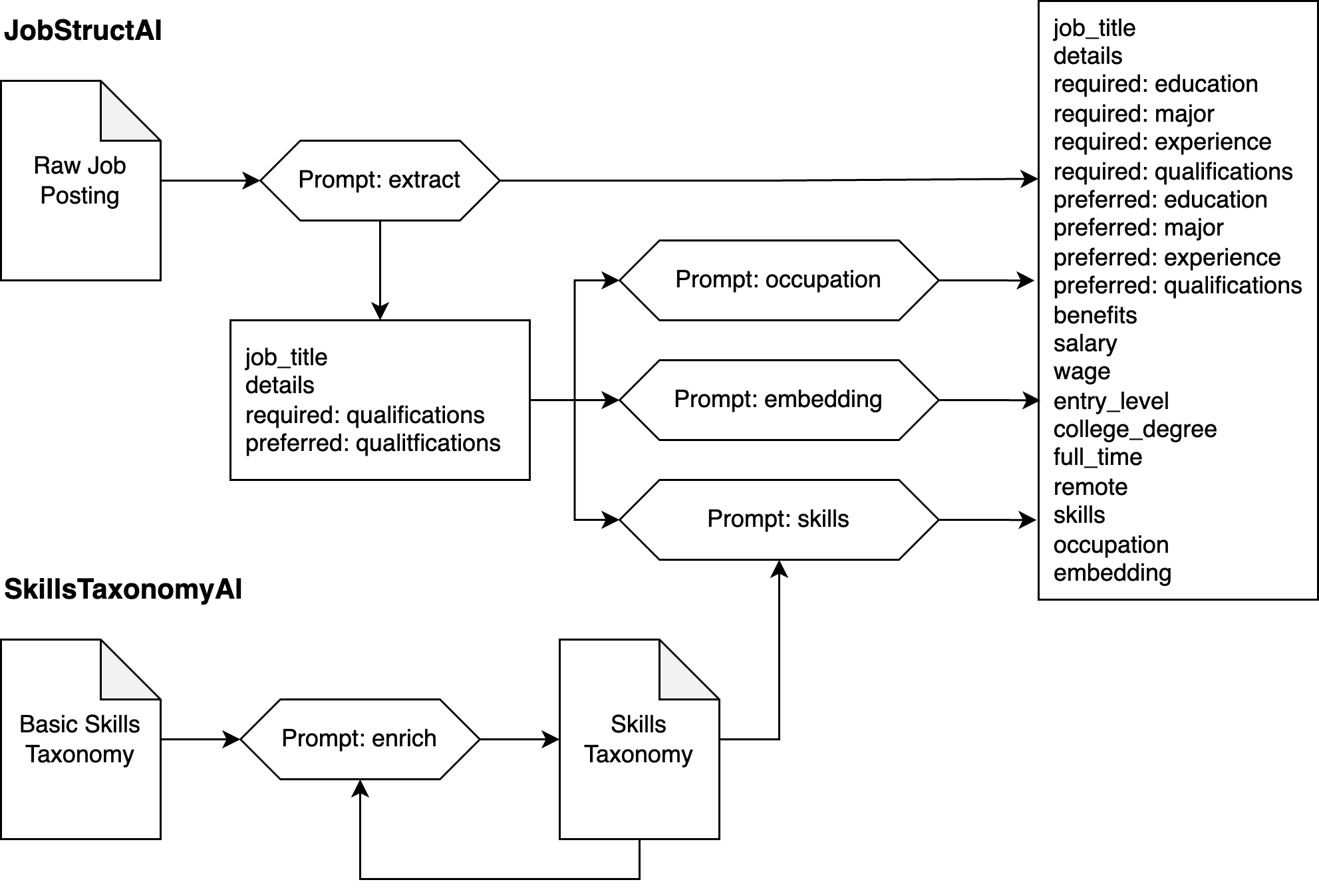
The SkillsTaxonomyAI class uses a single prompt enrich, which can be called iteratively to expand the child nodes of the skills taxonomy, starting from a basic taxonomy.
The JobStructAI class uses the extract prompt for an initial extraction of structured information from the job posting. It concatenates the job_title, details, required:qualifications, and preferred:qualifications fields into a cleaned job description, which can be optionally run through the occupation, embedding, and skills prompts to add those corresponding fields. The skills prompt additionally requires a SkillsTaxonomyAI object as input.
API Examples
SkillsTaxonomyAI class
The SkillsTaxonomyAI class can be initialized without any parameters, which will load a basic skills taxonomy included in the package.
from jobstruct import SkillsTaxonomyAI
skills = SkillsTaxonomyAI()
You can also start from a custom skills taxonomy in JSON format (see src/jobstruct/data/onet_taxonomy.json for an example):
skills = SkillsTaxonomyAI("mySkillsTaxonomy.json")
Once initialized, the skills taxonomy can be enriched using generative AI queries against a Bedrock client with:
import boto3
client = boto3.client("bedrock-runtime")
skills.enrich(client)
JobStructAI class
Initialize a JobStructAI object from a text filename, a text string, an HTML filename, or an HTML string, along with a Bedrock client and (optionally) a skills taxonomy:
from jobstruct import JobStructAI

with open("myJobPosting.txt") as f:
    text = f.read()
j = JobStructAI(text, client, skills)

j = JobStructAI.from_file("myJobPosting.txt", client, skills)

with open("myJobPosting.html") as f:
    html = f.read()
j = JobStructAI.from_html(html, client, skills)

j = JobStructAI.from_html_file("myJobPosting.html", client, skills)
The extracted information can be accessed as object attributes or can be exported to a dictionary with:
j.to_dict()
The schema is:
job_title: str
details: List[str]
required:
    education: str
    major: List[str]
    experience: int
    qualifications: List[str]
preferred:
    education: str
    major: List[str]
    experience: int
    qualifications: List[str]
benefits: List[str]
salary: List[float]
wage: List[float]
entry_level: bool
college_degree: bool
full_time: bool
remote: bool
skills: List[str]
occupation: List[str]
embedding: List[float]
JobStructHTML class
Initialize a JobStructHTML object from a filename, an HTML string, or an existing BeautifulSoup object that contains parsed HTML:
from jobstruct import JobStructHTML

j = JobStructHTML.from_file("myJobPosting.html")

with open("myJobPosting.html") as f:
    html = f.read()
j = JobStructHTML.from_string(html)

soup = BeautifulSoup(html, "html.parser")
j = JobStructHTML.from_soup(soup)
The object contains attributes for each segment parsed from the job posting:
- description
- benefits
- qualitifications
- responsibilities
- requirements
- eeo (Equal Employment Opportunity)
- other
Command-line examples
The jobstruct command provides access to the SkillsTaxonomyAI and JobStructAI classes through the subcommands:
jobstruct enrich -h
jobstruct extract -h
Create an enriched skills taxonomy from the included basic taxonomy with:
jobstruct enrich -o mySkillsTaxonomy.json
Extract structured information from a text or HTML job posting file with:
jobstruct extract --skills mySkillsTaxonomy.json -o myJobPosting.json myJobPosting.txt
jobstruct extract --skills mySkillsTaxonomy.json -o myJobPosting.json myJobPosting.html
Authors
- Mark Howison
- William O. Ensor
- Suraj Maharjan
- Rahil Parikh
- Srinivasan H. Sengamedu
- Paul Daniels
- Amber Gaither
- Carrie Yeats
- Chandan K. Reddy
- Justine S. Hastings
- Nikhil Abhyankar
Citations and Credits
Includes information from O*NET OnLine Help: The Database by the U.S. Department of Labor, Employment and Training Administration (USDOL/ETA). Used under the CC BY 4.0 license.
1 maintainer

Metadata
1 maintainer
Release files for jobstruct 0.1.1
For a detailed explanation of source distributions (sdists) and built distributions (wheels), please see the package formats documentation.
Source distribution (sdist)
| File | Size | Uploaded | |
|---|---|---|---|
| jobstruct-0.1.1.tar.gz | 25.3 kB | Details |
Built distribution (wheel)
| File | Interpreter | ABI | Platform | Reset |
|---|---|---|---|---|
| jobstruct-0.1.1-py3-none-any.whl | Python 3 | none | any | Details |
Total release size: 52.2 kB
Release files / jobstruct-0.1.1.tar.gz
| Download URL | jobstruct-0.1.1.tar.gz |
|---|---|
| Size | 25.3 kB |
| Tags | Source |
|
SHA-256 checksum How to use checksums |
a3d48972a559c3959ad17ccc329361bd1f7241ea7ab06a63359c6bc1cccfb1c8
|
|
BLAKE2b-256 checksum How to use checksums |
f91f64fe5bb0086a279755e6f8b029652a0d213bcf61404d968db8415423cbcf
|
| Upload date | |
|
Uploaded using Trusted Publishing? What is trusted publishing? |
No |
| Uploaded via |
twine/5.1.1 CPython/3.11.6
|
Release files / jobstruct-0.1.1-py3-none-any.whl
| Download URL | jobstruct-0.1.1-py3-none-any.whl |
|---|---|
| Size | 26.9 kB |
| Tags | Python 3 |
|
SHA-256 checksum How to use checksums |
15152356c13c8cfc2b8a45314990b3a99cd1491ceccd4174ea1c654f15afc175
|
|
BLAKE2b-256 checksum How to use checksums |
378b882eaa1683e4361ab9c12fcaf96ca66451c76cd62d5d90632c4252675cc0
|
| Upload date | |
|
Uploaded using Trusted Publishing? What is trusted publishing? |
No |
| Uploaded via |
twine/5.1.1 CPython/3.11.6
|














