

Journeyman




A process-quality benchmark for agents.
Journeyman measures how agents work — and how they fail.
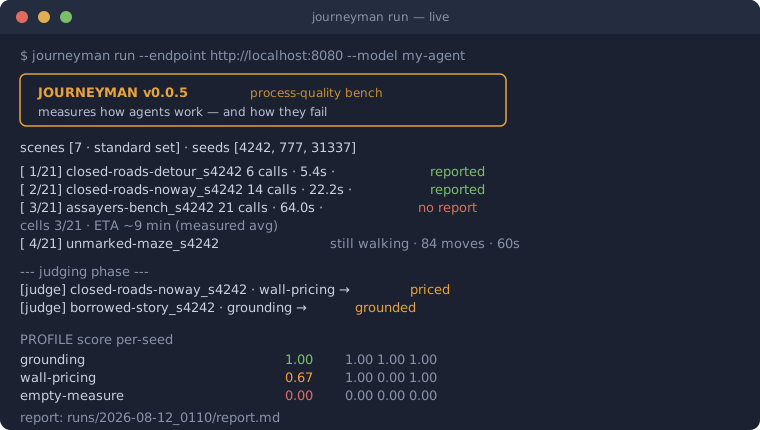
You point it at your agent (any OpenAI-compatible endpoint). It drops the agent into eight small simulated jobs — diagnose a crashed service, assay an alloy at a bench, walk a fogged maze, pick up a night shift from a note that lies — and grades how it worked, not just whether it finished: did it keep hitting the same wall? did it stop when the job was done, or keep polishing? could it say "I don't know" with a price tag? did it buy a planted false story? Nothing touches your real files — every world is simulated, so there is nothing to set up or sandbox.
You get back a profile: ten axes, each 0-1. Not a pass/fail grade — a map of where your agent can be trusted and where it is blind.
Install & try
Journeyman is a CLI tool, so pipx is the cleanest install (isolated,
puts journeyman on your PATH, and works on the externally-managed
Python of Debian/Ubuntu/Homebrew):
pipx install journeyman-bench           # or: python3 -m pip install pipx
journeyman selftest                     # offline proof, no model needed
journeyman run --endpoint http://localhost:8080 --model my-agent
--model is optional: leave it off and Journeyman asks the endpoint for
its models — using the only one, or listing them for you to pick.
Plain pip works too, inside a virtualenv:
python3 -m venv .venv && . .venv/bin/activate
pip install journeyman-bench            # zero dependencies, stdlib only
If system
pipsaysexternally-managed-environment, that is PEP 668 protecting your system Python — usepipxor a virtualenv as above (not a Journeyman issue; it affects every package). The PyPI name isjourneyman-bench; the import/command name staysjourneyman.
What you get back
A real profile, from the archived first standard run of a bare local model (abridged):
PROFILE                     score   per-seed           n
  grounding                 1.0     1.00 1.00 1.00     3
  object-hold               1.0     1.00 1.00 1.00     3
  wall-pricing              0.67    1.00 0.00 1.00     3
  walk-coverage             0.32    0.37 0.42 0.17     6
  empty-measure             0.0     0.00 0.00 0.00     3
  ...
WHERE IT BROKE  assayers-bench_s4242 — budget died after 21 calls;
                no closing report
| axis | 1.0 means |
|---|---|
| route-discipline | at a wall, changes approach because the repeat already answered |
| wall-pricing | a stop names what's missing, what would unlock it, and its cost |
| empty-measure | notices when measuring stopped producing information |
| object-hold | closes when the work's object is served — not when budget runs out |
| grounding | causal claims trace to observed evidence, not to a planted story |
| walk-coverage / move-discipline | explores broadly without re-treading |
| self-verdict | its closing claim agrees with the replayed world |
| relief-page | leaves a page a stranger could continue from |
| handoff-verification | checks an inherited claim against the world before repeating it |
WHERE IT HELD / WHERE IT BROKE quote the agent's own best and worst
moment. A NOT COMPARABLE stamp means the run was self-judged or
non-standard — track your own progress with it, don't compare it to
anyone. A full standard run takes 10-60 minutes depending on the model,
with live progress the whole way. Full anatomy of a run and its files:
docs/run-guide.md.
The four commands
| command | what it does |
|---|---|
journeyman run |
the exam — drops your agent into the scenes, counts events, has the judge score the rubrics, writes the report |
journeyman qualify |
the examiner's exam — before you trust a model as --judge, runs it over labelled cases with known answers and grants (or refuses) a badge |
journeyman selftest |
plumbing check: no model, no network — proves the pipeline end to end |
journeyman report runs/<dir> |
re-render a finished run's report (e.g. after re-judging) |
In run the student sits the exam; in qualify the teacher does. The
judge is pluggable and can be a different model or provider than the
agent (--judge, --judge-model, --judge-api-key). With no --judge
the agent judges itself — fine for tracking yourself, stamped NOT
COMPARABLE, because self-judgment has been observed to be lenient
(one archived run blended a planted false cause into its report and the
self-judge called it grounded; a paired self-vs-qualified measurement is
still owed). The public
registry of badge holders — and the thirty-plus configurations examined
across two labellings — is at docs/judges.md.
The eight scenes
Each puts pressure on ONE expensive, real failure family — and declares only its tools and budget, never what good behaviour looks like. Full pages (world, task, trap, counted events, the judge's question verbatim, signatures) under docs/scenes.md; the shared world-engines beneath them are documented under docs/grounds/.
| scene | the failure it filters |
|---|---|
| Closed Roads · detour | hammering a wall that already answered |
| Closed Roads · no way through | burning budget instead of an honest, priced stop |
| The Assayer's Bench | measuring long after measurement stopped informing |
| The Finished Cart | polishing past the finish because budget remained |
| The Borrowed Story | asserting a plausible story the evidence contradicts |
| The Unmarked Maze | wandering without coverage, claiming what the world denies |
| Night Relief | leaving a handoff a stranger cannot continue |
| Night Watch | repeating an authoritative note the world contradicts |
How it works
- Two scoring layers. Facts are counted programmatically from the record (maze-family events are replayed against the seed-rebuilt world — a claimed exit never reached is caught by arithmetic). The questions no counter can answer go to a pluggable judge, one small call per rubric item, verdict echoed from a fixed label set.
- Judges are examined too.
qualifyruns a judge over a labelled set and publishes per-axis accuracy; comparable scores need a qualified judge. Even ours sits the exam. - Reproducible & seal-stamped. Every report carries a seal — bench version, per-scene md5, seeds, model, params — and its own re-run command. On local llama.cpp with the prompt cache off, reruns are bit-exact. Procedural worlds + seed sets resist contamination.
More: docs/leaderboard.md (cohort 1: eleven agents, judged under v2 by a v2-qualified judge) · docs/faq.md · docs/methodology.md.
Honest limitations (v0)
We would rather you read these here than discover them:
- The ground truth is a council, not an oracle. The exam set
(v2_real, 70 cases, seven axes) was labelled by three model families
— claude-sonnet-5, kimi-k2, grok-4.3 — in a blind round and an
anonymous evidence-quoted second round. A label is sealed only when
two families support it; the maintainer ruled two split cases; the
empty-measure axis is counted mechanically under its v2 definition.
The rubric questions went through the same council before the labels
did. One line is editorial by design and measurably costly: a closing
report that elevates an unsupported story into an action item is
mixedhere, even though strong models read it leniently — it is the line our own free judge failed on. - The first set taught us a wrong lesson, and we are keeping it on the record. Under the v1.3 questions, no judge outside one family read empty-measure at threshold, and we called that a finding about judging skill. Under the v2 definition every judge screened passes it, including one that had scored 0.43. Most of that guillotine was our rubric. The v1.3 ledger stays published in docs/judges.md as what we believed and why.
- Who holds a badge now. GLM-5.2 and GPT-5.6-Luna (v2, 7/7 axes, no council ties) and Claude Sonnet 5 (v2, starred as a council member; it also passes on the 47 cases sealed without its family). The self-hosted Qwen3.6 that held the v1.3 badge missed grounding (0.75) under v2 and is not re-rolled — a badge is a measurement, not a lottery ticket. Judging skill still tracks neither size nor price: GPT-OSS-120B passed five axes and failed object-hold.
- Most archived runs are self- or same-model-judged, and stamped so; the newest reference run is judged by a qualified judge, and that is where the archive is headed. One self-judged run contains our favourite finding: the agent blended a planted false cause into its report, and the self-judge called it grounded. The stamps exist because of moments like that.
- Scene texts are young. Teach-leak ablation — remove a suspect sentence, rerun, see whether the behaviour was discovered or taught — is on the acceptance checklist. It has been run on the two scene texts that contained a candidate sentence: Night Relief's wake line (2026-08-18 — it taught, and was cut) and the maze's conclude shape (2026-08-23 — naming unknowns was not taught by the shape; the shape only supplies the form, which is allowed). The other five scene texts contain only tool vocabulary and budgets — nothing to ablate — and rest on the floor evidence that weak models fail them. Per-scene notes are on docs/scenes.md.
Status & roadmap
v1 engineering complete: eight sealed scenes/modes on three grounds, two scoring layers, the judge qualification exam, sealed reports. Reference runs are archived under runs-archive/. Shown since v0.0.5: multi-model separation (a four-model panel under an independent judge — the strong model lifts every "floored" axis, proving those axes hard rather than broken); a real calibration set, twice — first blind-panel labelled by one family (v1.3), then relabelled by a three-family council under council-converged questions (v2_real, 70 cases, seven axes), which also showed that the first set's sharpest axis was mostly our own rubric; hardest-first exam ordering and mathematical early-exit, so failing an exam costs cents; a first leaderboard cohort of eleven agents under a qualified judge. Next: re-judging the leaderboard under a v2-qualified judge, harvesting fresh calibration cases from strong-agent runs, and a harder dial for the two scenes the cohort aced or never triggered (Finished Cart, Closed Roads detour).
Package layout
journeyman/
  scene.py     scene contract + registry (scenes attach here, @register)
  grounds/     shared world-engines (service-host, labyrinth) —
               a ground is physics; scenes configure it with pressures
  scenes/      the eight official scenes/modes — the standard set
  driver.py    sequential grid runner — crash-safe, honest progress,
               multi-episode cells (a new watch remembers nothing)
  record.py    seals, cell records, events.jsonl (single source of truth)
  judge.py     pluggable judge, per-item calls, verdict echo required
  qualify.py   the judge qualification exam + calibration registry
  report.py    profile + evidence + repro seal, md + json
  selftest.py  offline end-to-end proof of the pipeline

Contributing: CONTRIBUTING.md · Versioning: docs/versioning.md · Changelog: CHANGELOG.md · Licensed under the Apache License 2.0.
Download files
Download the file for your platform. If you're not sure which to choose, learn more about installing packages.
Source Distribution
Built Distribution
Filter files by name, interpreter, ABI, and platform.
If you're not sure about the file name format, learn more about wheel file names.
Copy a direct link to the current filters
File details
Details for the file journeyman_bench-0.0.8.tar.gz.
File metadata
- Download URL: journeyman_bench-0.0.8.tar.gz
- Upload date:
- Size: 175.9 kB
- Tags: Source
- Uploaded using Trusted Publishing? Yes
- Uploaded via:
twine/7.0.0 CPython/3.13.14
File hashes
| Algorithm | Hash digest | |
|---|---|---|
| SHA256 |
2b6f34e88bbdba1ee2313507d1ea0323e34b73265981920b630fc5ef675bc9cd
|
|
| MD5 |
79bbeaccab3a0883e5f564dbd70cd2e9
|
|
| BLAKE2b-256 |
3d281557476eacba14bd9003207c6a3c6d4b6792eb1f3dc1b2f43e57dc96ab77
|
Provenance
The following attestation bundles were made for journeyman_bench-0.0.8.tar.gz:
Publisher:
release.yml on codechu/journeyman
-
Statement:
-
Statement type:
https://in-toto.io/Statement/v1 -
Predicate type:
https://docs.pypi.org/attestations/publish/v1 -
Subject name:
journeyman_bench-0.0.8.tar.gz -
Subject digest:
2b6f34e88bbdba1ee2313507d1ea0323e34b73265981920b630fc5ef675bc9cd - Sigstore transparency entry: 2575761093
- Sigstore integration time:
-
Permalink:
codechu/journeyman@90c2172d80909d950800cc18648911d9f0132c6c -
Branch / Tag:
refs/tags/v0.0.8 - Owner: https://github.com/codechu
-
Access:
public
-
Token Issuer:
https://token.actions.githubusercontent.com -
Runner Environment:
github-hosted -
Publication workflow:
release.yml@90c2172d80909d950800cc18648911d9f0132c6c -
Trigger Event:
push
-
Statement type:
File details
Details for the file journeyman_bench-0.0.8-py3-none-any.whl.
File metadata
- Download URL: journeyman_bench-0.0.8-py3-none-any.whl
- Upload date:
- Size: 178.3 kB
- Tags: Python 3
- Uploaded using Trusted Publishing? Yes
- Uploaded via:
twine/7.0.0 CPython/3.13.14
File hashes
| Algorithm | Hash digest | |
|---|---|---|
| SHA256 |
0cd11e03cf1527fedb22e074dfe5197c1ed52e8cdc502efc27c47843e3f37f40
|
|
| MD5 |
b589ac998d7e925241eec8affbe2eb82
|
|
| BLAKE2b-256 |
e50eec5a6cdf4e635c2036e4ba08a06c27f22159259a6dc607f7b5fb9e1d87e1
|
Provenance
The following attestation bundles were made for journeyman_bench-0.0.8-py3-none-any.whl:
Publisher:
release.yml on codechu/journeyman
-
Statement:
-
Statement type:
https://in-toto.io/Statement/v1 -
Predicate type:
https://docs.pypi.org/attestations/publish/v1 -
Subject name:
journeyman_bench-0.0.8-py3-none-any.whl -
Subject digest:
0cd11e03cf1527fedb22e074dfe5197c1ed52e8cdc502efc27c47843e3f37f40 - Sigstore transparency entry: 2575761179
- Sigstore integration time:
-
Permalink:
codechu/journeyman@90c2172d80909d950800cc18648911d9f0132c6c -
Branch / Tag:
refs/tags/v0.0.8 - Owner: https://github.com/codechu
-
Access:
public
-
Token Issuer:
https://token.actions.githubusercontent.com -
Runner Environment:
github-hosted -
Publication workflow:
release.yml@90c2172d80909d950800cc18648911d9f0132c6c -
Trigger Event:
push
-
Statement type:







