
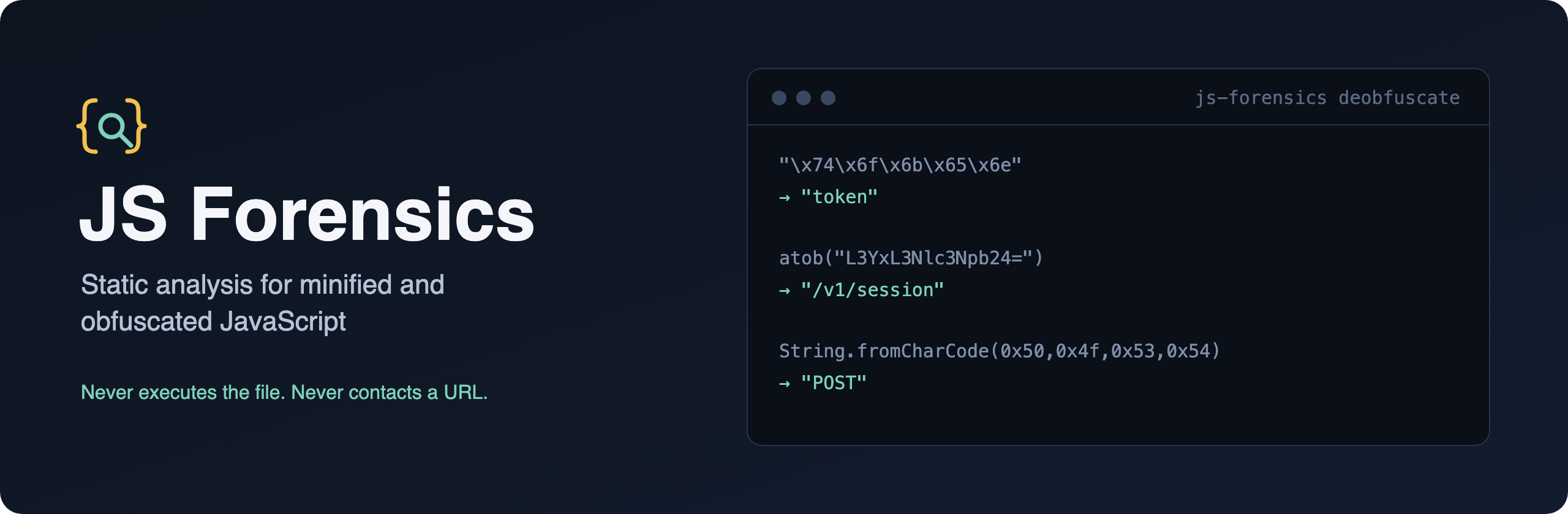
JS Forensics
JS Forensics is a static-analysis toolkit for JavaScript that is minified, obfuscated, or simply unfamiliar. It parses a file, reports what is in it, and applies a small set of safe, traceable clean-up transformations.
It never executes the file it analyzes and never contacts a URL it finds.
Status: v0.1.0, alpha. The analyses are heuristic and the transformations are deliberately conservative. See Known limitations before relying on a result.
What it does
- Parses modern JavaScript with tree-sitter and reports syntax errors with line and column.
- Counts functions, declarations, identifiers, literals, calls, loops, and conditionals from the syntax tree.
- Detects twelve documented obfuscation indicators and shows the evidence for each one.
- Extracts string literals and sorts them into URLs, domains, API paths, HTTP header names, cookie strings, HTML, JSON, and everything else.
- Decodes escape-heavy literals and constant
String.fromCharCode,String.fromCodePoint, andatobcalls without running them. - Folds constant expressions such as
"a" + "b",0x3e8 * 0x3c, and!0. - Reports hex-style (
_0x1a2b) and very short identifier names. - Lists references to browser APIs (cookies, storage, network, canvas, WebGL, audio, WebRTC) and whether each is read, written, called, or constructed.
- Lists potential network endpoints with the HTTP method when the source determines it.
- Writes a terminal summary, JSON, or a standalone HTML report.
Installation
Python 3.10 to 3.14 is supported.
$ pip install js-forensics
$ js-forensics --version
js-forensics 0.1.0
To install from source instead:
$ git clone https://github.com/stackadnan/js-forensics.git
$ cd js-forensics
$ python -m venv .venv && source .venv/bin/activate
$ pip install .
The Quick start examples use examples/sample.js from the repository.
Quick start
The repository ships a small obfuscated file to try things on.
$ js-forensics analyze examples/sample.js
$ js-forensics analyze examples/sample.js --format json --output report.json
$ js-forensics strings examples/sample.js
$ js-forensics endpoints examples/sample.js
$ js-forensics deobfuscate examples/sample.js --output-dir output/
$ js-forensics report examples/sample.js --format html --output report.html
analyze prints a summary. Part of the output for the sample:
Obfuscation indicators (heuristic score 45/100)
The score adds fixed weights for the indicators below. It is not a probability and not a verdict on
what the code does.
[+15] Escape-encoded string literals
    -  4 of 8 string literals spell printable ASCII text with \x or \u escapes.
    1:109  Escape-encoded literal.  "\x74\x6f\x6b\x65\x6e"
[+15] Hex-style identifier names
    -  6 of 6 declared names look like _0x1a2b.
[+10] Decoder calls with constant arguments
    1:167  atob call with constant arguments.  atob("L3YxL3Nlc3Npb24=")
[+5] Minified layout

Decoded values
Technique            At     Value
escape-sequences     1:14   https://api.example.com
escape-sequences     1:109  token
atob                 1:167  /v1/session
String.fromCharCode  1:271  POST

Browser APIs referenced
API    Category  Usage  Count  Confidence  First at
fetch  network   call   1      high        1:335

Potential network endpoints
Method   URL                      Source               Resolved  At
UNKNOWN  /v1/session              constant-expression  static    1:167
UNKNOWN  https://api.example.com  string-literal       static    1:14

Unresolved call  At     Reason
fetch            1:335  the URL argument is not a static string
deobfuscate turns the one-line sample into this, and records every change in
output/transformations.json:
var _0x3e1f=["https://api.example.com","token"];
function _0x2b7c(_0x1d){
  var _0x4a="/v1/session";
  if(true){
    return _0x3e1f[0x0]+_0x4a+"?"+_0x3e1f[0x1]+"="+_0x1d
  }
  return false
}
var _0x51="POST",_0x77=60000;
fetch(_0x2b7c("abc"),{method:_0x51,keepalive:!![]});
setTimeout(function(){
  console["log"]("done",_0x77)
},1000);
The names stay as they were and the array lookups are not inlined. That is the current boundary of what the tool does, not an oversight.
Commands
| Command | Purpose |
|---|---|
analyze FILE |
Summary of everything below. --format text|json. |
strings FILE |
String and template literals with categories. --category filters. |
endpoints FILE |
Potential network endpoints, domains, and request calls whose URL is dynamic. |
deobfuscate FILE |
Run the transformation pipeline. Writes to --output-dir (default js-forensics-output/). |
report FILE |
Standalone report. --format html|json; --transformations adds the pipeline history. |
Options shared by the analysis commands: --output/-o, --tolerant (analyze
a file despite syntax errors and mark the results as partial), --no-redact,
and --max-bytes (default 2 MiB).
Exit codes: 0 success, 2 invalid command line, 3 input file missing,
unreadable, too large, or not UTF-8, 4 JavaScript syntax error, 5 output
could not be written. 1 is an unexpected internal error.
docs/usage.md is the full reference, including the counting rules and every indicator's threshold. docs/output-schema.md describes the JSON.
Supported analysis techniques
| Area | How it works |
|---|---|
| Statistics | Counts of syntax-node types. No regular expressions over source text. |
| Obfuscation indicators | Twelve structural rules with fixed thresholds and weights. The score is the capped sum of the weights that triggered. |
| String classification | Pattern heuristics. One category per string; ambiguous strings stay other. |
| Static decoding | Reimplementations of JavaScript string escapes, String.fromCharCode, String.fromCodePoint, and atob, applied only to constant arguments. |
| Constant folding | A static evaluator for strings, numbers, and booleans covering arithmetic, bitwise, comparison of same-typed values, !, and string concatenation. |
| Browser APIs | A catalogue of global names and member chains, plus a few distinctive method names matched with lower confidence. |
| Endpoints | Arguments of fetch, XMLHttpRequest.open, WebSocket, EventSource, navigator.sendBeacon, axios, and $.ajax/$.get/$.post, plus URL-like string literals and constant expressions. |
Deobfuscation pipeline
Four stages run in order, each on the output of the one before:
format-statementsputs each statement on its own line. It only changes whitespace between statements.simplify-string-escapesrewrites"\x68\x69"as"hi".decode-static-callsreplaces decoder calls on constants with the string they return.fold-constantsreplaces constant operator expressions with their value.
Transformations edit exact source ranges; the program is not regenerated from
its syntax tree, so untouched code stays byte-for-byte as it was. After every
stage the result is parsed again, and a stage whose output does not parse is
discarded and reported as reverted. Each stage's output is saved under
stages/ so you can diff them.
An expression that cannot be resolved safely is left unchanged. Decoder calls
and all-constant expressions that were skipped are listed with the reason, for
example 1 / 0 ("/ by zero yields Infinity or NaN").
Security boundaries
Every input is treated as hostile.
- The analyzed file is read and parsed. It is never evaluated, imported, or passed to a JavaScript runtime.
- No network access happens. URLs are extracted as text and nothing is resolved or fetched. The test suite fails if a socket is opened.
- The original file is never modified. Outputs go to a separate path and a write that would land on the input is refused.
- Input size is limited (2 MiB by default), nesting depth is bounded in the evaluator, and a transformation that would grow a file more than fourfold is reverted.
- HTML reports contain no script, carry a
default-src 'none'Content-Security-Policy, and escape all text taken from the file. Extracted URLs are shown as text, not links. - Terminal and HTML output escape control characters, so a file cannot inject ANSI sequences or bidirectional overrides into what you read.
- Likely credentials (JWTs, common API-key formats, bearer tokens, URL
passwords, secret-looking query parameters and cookie values, and literals
assigned to names like
passwordorapiKey) are masked in reports. This is pattern matching and will miss some.--no-redactturns it off. The deobfuscated JavaScript itself is never redacted. - A finding describes source text. "References
document.cookie" does not mean a cookie was read, and a listed endpoint does not mean a request is made.
Known limitations
- No data-flow analysis. Values are resolved only where they are constant at
the point of use, so string-array lookups (
_0x1f2a(0x1b)), strings built across statements, and values held in variables are not recovered. - No renaming, no dead-code removal, and no control-flow unflattening.
- Code inside
eval,Function, and string timers is not analyzed. - Constant folding skips anything that needs type coercion beyond
string-plus-number, such as
"5" * 2,[] + [],+"3", logical and conditional operators, and string comparison with<. - Template literals are extracted but never rewritten.
- The formatter adds line breaks between statements only. Long expressions and comma sequences stay on one line.
- Decoder calls are resolved on the assumption that
Stringandatobare the built-ins. They are skipped when the file declares or assigns those names or useswith, but runtime monkey-patching cannot be seen. - Identifier counts are by name and ignore scope.
- The parser is tree-sitter's JavaScript grammar. It also accepts JSX and does not report every early error an engine would. TypeScript is not supported.
- Only UTF-8 input is accepted.
- Memory use is high. On the development machine, a full analysis with transformations of 1 MB of dense minified source took about 9 seconds and peaked near 370 MB. This is why the default input limit is 2 MiB.
Contributing
See CONTRIBUTING.md for setup, the checks to run, and the rules for adding detectors and transformations. docs/architecture.md explains how the code is laid out.
License
MIT. See LICENSE.
Security problems should be reported privately; see SECURITY.md.
1 maintainer

Metadata
1 maintainer
Release files for js-forensics 0.1.0
For a detailed explanation of source distributions (sdists) and built distributions (wheels), please see the package formats documentation.
Source distribution (sdist)
| File | Size | Uploaded | |
|---|---|---|---|
| js_forensics-0.1.0.tar.gz | 397.5 kB | Details |
Built distribution (wheel)
| File | Interpreter | ABI | Platform | Reset |
|---|---|---|---|---|
| js_forensics-0.1.0-py3-none-any.whl | Python 3 | none | any | Details |
Total release size: 469.1 kB
Release files / js_forensics-0.1.0.tar.gz
| Download URL | js_forensics-0.1.0.tar.gz |
|---|---|
| Size | 397.5 kB |
| Tags | Source |
|
SHA-256 checksum How to use checksums |
58ac91a93ae09166a29b41708e5ccd3ee93dae53f24f12ae4cfd947480983547
|
|
BLAKE2b-256 checksum How to use checksums |
343eba789df05abd8d43cec09212fb437e3a52239bfd7591815d7968d06e197d
|
| Upload date | |
|
Uploaded using Trusted Publishing? What is trusted publishing? |
Yes |
| Uploaded via |
twine/7.0.0 CPython/3.13.14
|
Provenance
Provenance describes where a file came from. On PyPI, provenance is shared via attestations, which provide a verifiable record of the build or publishing details. View details, limitations and caveats.


PyPI Publish Attestation
PyPI verified that this artifact, at this checksum, originated from the publisher listed below.
Signed by GitHub Actions, verified by PyPI on Oct 13, 2026.
Transparency logRelease files / js_forensics-0.1.0-py3-none-any.whl
| Download URL | js_forensics-0.1.0-py3-none-any.whl |
|---|---|
| Size | 71.6 kB |
| Tags | Python 3 |
|
SHA-256 checksum How to use checksums |
d684731e5876dfcf33c349153da3eba155fff8bd0f6207d3672c5649801eb6c9
|
|
BLAKE2b-256 checksum How to use checksums |
75de2e6371535460b2f2a79ea5f0df88be9f2c875ebe342a6b236a92254c6995
|
| Upload date | |
|
Uploaded using Trusted Publishing? What is trusted publishing? |
Yes |
| Uploaded via |
twine/7.0.0 CPython/3.13.14
|
Provenance
Provenance describes where a file came from. On PyPI, provenance is shared via attestations, which provide a verifiable record of the build or publishing details. View details, limitations and caveats.
PyPI Publish Attestation
PyPI verified that this artifact, at this checksum, originated from the publisher listed below.
Signed by GitHub Actions, verified by PyPI on Oct 13, 2026.
Transparency log












