
A package to repair broken json strings
Verified details
These details have been verified by PyPIProject links
GitHub Statistics
Maintainers

Project description






English | 中文
This simple package can be used to fix an invalid json string. To know all cases in which this package will work, check out the unit test.

Think about sponsoring this library!
This library is free for everyone and it's maintained and developed as a side project so, if you find this library useful for your work, consider becoming a sponsor via this link: https://github.com/sponsors/mangiucugna
Premium sponsors
- Icana-AI Makers of CallCoach, the world's best Call Centre AI Coach. Visit https://www.icana.ai/
- mjharte
Demo
If you are unsure if this library will fix your specific problem, or simply want your json validated online, you can visit the demo site on GitHub pages: https://mangiucugna.github.io/json_repair/
Or hear an audio deepdive generate by Google's NotebookLM for an introduction to the module
Motivation
Some LLMs are a bit iffy when it comes to returning well formed JSON data, sometimes they skip a parentheses and sometimes they add some words in it, because that's what an LLM does. Luckily, the mistakes LLMs make are simple enough to be fixed without destroying the content.
I searched for a lightweight python package that was able to reliably fix this problem but couldn't find any.
So I wrote one
Supported use cases
Fixing Syntax Errors in JSON
- Missing quotes, misplaced commas, unescaped characters, and incomplete key-value pairs.
- Missing quotation marks, improperly formatted values (true, false, null), and repairs corrupted key-value structures.
Repairing Malformed JSON Arrays and Objects
- Incomplete or broken arrays/objects by adding necessary elements (e.g., commas, brackets) or default values (null, "").
- The library can process JSON that includes extra non-JSON characters like comments or improperly placed characters, cleaning them up while maintaining valid structure.
Auto-Completion for Missing JSON Values
- Automatically completes missing values in JSON fields with reasonable defaults (like empty strings or null), ensuring validity.
How to use
Install the library with pip
pip install json-repair
then you can use use it in your code like this
from json_repair import repair_json

good_json_string = repair_json(bad_json_string)
# If the string was super broken this will return an empty string
You can use this library to completely replace json.loads():
import json_repair

decoded_object = json_repair.loads(json_string)
or just
import json_repair

decoded_object = json_repair.repair_json(json_string, return_objects=True)
Avoid this antipattern
Some users of this library adopt the following pattern:
obj = {}
try:
    obj = json.loads(string)
except json.JSONDecodeError as e:
    obj = json_repair.loads(string)
    ...
This is wasteful because json_repair will already verify for you if the JSON is valid, if you still want to do that then add skip_json_loads=True to the call as explained the section below.
Read json from a file or file descriptor
JSON repair provides also a drop-in replacement for json.load():
import json_repair

try:
    file_descriptor = open(fname, 'rb')
except OSError:
    ...

with file_descriptor:
    decoded_object = json_repair.load(file_descriptor)
and another method to read from a file:
import json_repair

try:
    decoded_object = json_repair.from_file(json_file)
except OSError:
    ...
except IOError:
    ...
Keep in mind that the library will not catch any IO-related exception and those will need to be managed by you
Non-Latin characters
When working with non-Latin characters (such as Chinese, Japanese, or Korean), you need to pass ensure_ascii=False to repair_json() in order to preserve the non-Latin characters in the output.
Here's an example using Chinese characters:
repair_json("{'test_chinese_ascii':'统一码'}")
will return
{"test_chinese_ascii": "\u7edf\u4e00\u7801"}
Instead passing ensure_ascii=False:
repair_json("{'test_chinese_ascii':'统一码'}", ensure_ascii=False)
will return
{"test_chinese_ascii": "统一码"}
JSON dumps parameters
More in general, repair_json will accept all parameters that json.dumps accepts and just pass them through (for example indent)
Performance considerations
If you find this library too slow because is using json.loads() you can skip that by passing skip_json_loads=True to repair_json. Like:
from json_repair import repair_json

good_json_string = repair_json(bad_json_string, skip_json_loads=True)
I made a choice of not using any fast json library to avoid having any external dependency, so that anybody can use it regardless of their stack.
Some rules of thumb to use:
- Setting
return_objects=Truewill always be faster because the parser returns an object already and it doesn't have serialize that object to JSON skip_json_loadsis faster only if you 100% know that the string is not a valid JSON- If you are having issues with escaping pass the string as raw string like:
r"string with escaping\""
Strict mode
By default json_repair does its best to “fix” input, even when the JSON is far from valid.
In some scenarios you want the opposite behavior and need the parser to error out instead of repairing; pass strict=True to repair_json, loads, load, or from_file to enable that mode:
from json_repair import repair_json

repair_json(bad_json_string, strict=True)
The CLI exposes the same behavior with json_repair --strict input.json (or piping data via stdin).
In strict mode the parser raises ValueError as soon as it encounters structural issues such as duplicate keys, missing : separators, empty keys/values introduced by stray commas, multiple top-level elements, or other ambiguous constructs. This is useful when you just need validation with friendlier error messages while still benefiting from json_repair’s resilience elsewhere in your stack.
Strict mode still honors skip_json_loads=True; combining them lets you skip the initial json.loads check but still enforce strict parsing rules.
Schema-guided repairs
Schema-guided repairs are currently considered in beta. Bugs are to be expected.
You can guide repairs with a JSON Schema (or a Pydantic v2 model). When enabled, the parser will:
- Fill missing values (defaults, required fields).
- Coerce scalars where safe (e.g.,
"1"→1for integer fields, and"yes"/"no"/1/0for booleans). - Drop properties/items that the schema disallows.
Schema mode can be selected with schema_repair_mode:
standard(default): existing schema-guided behavior.salvage: includesstandardand also:- drops invalid array items when individual items cannot be repaired;
- maps arrays to objects by property order when schema/object shape is unambiguous.
- unwraps a root single-item array to an object when the root schema expects an object (
[{...}] -> {...}); - fills missing required fields only when a safe value can be inferred (
default,const, firstenum, or empty array/object when allowed by schema constraints).
This is especially useful when you need deterministic, schema-valid outputs for downstream validation, storage, or typed processing. If the input cannot be repaired to satisfy the schema, json_repair raises ValueError.
Install the optional dependencies:
pip install 'json-repair[schema]'
(For CLI usage, you can also use pipx install 'json-repair[schema]'.)
When schema is provided, schema guidance is always applied (for both valid and invalid JSON). Schema guidance is mutually exclusive with strict=True.
from json_repair import repair_json

schema = {
    "type": "object",
    "properties": {"value": {"type": "integer"}},
    "required": ["value"],
}

repair_json('{"value": "1"}', schema=schema, return_objects=True)

repair_json(
    '{"items":[{"id":1,"score":85.6},{"id":2,"score":"N/A"}]}',
    schema={
        "type": "object",
        "properties": {
            "items": {
                "type": "array",
                "items": {
                    "type": "object",
                    "properties": {"id": {"type": "integer"}, "score": {"type": "number"}},
                    "required": ["id", "score"],
                },
            }
        },
        "required": ["items"],
    },
    schema_repair_mode="salvage",
    return_objects=True,
)
Pydantic v2 model example:
from pydantic import BaseModel, Field
from json_repair import repair_json


class Payload(BaseModel):
    value: int
    tags: list[str] = Field(default_factory=list)


repair_json(
    '{"value": "1", "tags": }',
    schema=Payload,
    skip_json_loads=True,
    return_objects=True,
)
Use json_repair with streaming
Sometimes you are streaming some data and want to repair the JSON coming from it. Normally this won't work but you can pass stream_stable to repair_json() or loads() to make it work:
stream_output = repair_json(stream_input, stream_stable=True)
Use json_repair from CLI
Install the library for command-line with:
pipx install json-repair
to know all options available:
$ json_repair -h
usage: json_repair [-h] [-i] [-o TARGET] [--ensure_ascii] [--indent INDENT]
                   [--skip-json-loads] [--schema SCHEMA] [--schema-model MODEL]
                   [--strict] [--schema-repair-mode {standard,salvage}] [filename]

Repair and parse JSON files.

positional arguments:
  filename              The JSON file to repair (if omitted, reads from stdin)

options:
  -h, --help            show this help message and exit
  -i, --inline          Replace the file inline instead of returning the output to stdout
  -o TARGET, --output TARGET
                        If specified, the output will be written to TARGET filename instead of stdout
  --ensure_ascii        Pass ensure_ascii=True to json.dumps()
  --indent INDENT       Number of spaces for indentation (Default 2)
  --skip-json-loads     Skip initial json.loads validation
  --schema SCHEMA       Path to a JSON Schema file that guides repairs
  --schema-model MODEL  Pydantic v2 model in 'module:ClassName' form that guides repairs
  --strict              Raise on duplicate keys, missing separators, empty keys/values, and similar structural issues instead of repairing them
  --schema-repair-mode {standard,salvage}
                        Schema repair mode: standard (default) or salvage (best-effort array/object salvage)
Adding to requirements
Please pin this library only on the major version!
We use TDD and strict semantic versioning, there will be frequent updates and no breaking changes in minor and patch versions.
To ensure that you only pin the major version of this library in your requirements.txt, specify the package name followed by the major version and a wildcard for minor and patch versions. For example:
json_repair==0.*
In this example, any version that starts with 0. will be acceptable, allowing for updates on minor and patch versions.
How to cite
If you are using this library in your academic work (as I know many folks are) please find the BibTex here:
@software{Baccianella_JSON_Repair_-_2025,
    author  = "Stefano {Baccianella}",
    month   = "feb",
    title   = "JSON Repair - A python module to repair invalid JSON, commonly used to parse the output of LLMs",
    url     = "https://github.com/mangiucugna/json_repair",
    version = "0.39.1",
    year    = 2025
}
Thank you for citing my work and please send me a link to the paper if you can!
How it works
This module will parse the JSON file following the BNF definition:
<json> ::= <primitive> | <container>

<primitive> ::= <number> | <string> | <boolean>
; Where:
; <number> is a valid real number expressed in one of a number of given formats
; <string> is a string of valid characters enclosed in quotes
; <boolean> is one of the literal strings 'true', 'false', or 'null' (unquoted)

<container> ::= <object> | <array>
<array> ::= '[' [ <json> *(', ' <json>) ] ']' ; A sequence of JSON values separated by commas
<object> ::= '{' [ <member> *(', ' <member>) ] '}' ; A sequence of 'members'
<member> ::= <string> ': ' <json> ; A pair consisting of a name, and a JSON value
If something is wrong (a missing parentheses or quotes for example) it will use a few simple heuristics to fix the JSON string:
- Add the missing parentheses if the parser believes that the array or object should be closed
- Quote strings or add missing single quotes
- Adjust whitespaces and remove line breaks
I am sure some corner cases will be missing, if you have examples please open an issue or even better push a PR
Contributing
If you want to contribute, start with CONTRIBUTING.md and read the Code Wiki writeup for a tour of the codebase and key entry points: https://codewiki.google/github.com/mangiucugna/json_repair
How to develop
Use uv to set up the dev environment and run tooling:
uv sync --group dev
uv run pre-commit run --all-files
uv run pytest
Make sure that the Github Actions running after pushing a new commit don't fail as well.
How to release
You will need owner access to this repository
- Edit
pyproject.tomland update the version number appropriately usingsemvernotation - Commit and push all changes to the repository before continuing or the next steps will fail
- Run
python -m build - Create a new release in Github, making sure to tag all the issues solved and contributors. Create the new tag, same as the one in the build configuration
- Once the release is created, a new Github Actions workflow will start to publish on Pypi, make sure it didn't fail
Repair JSON in other programming languages
- Typescript: https://github.com/josdejong/jsonrepair
- Go: https://github.com/RealAlexandreAI/json-repair
- Ruby: https://github.com/sashazykov/json-repair-rb
- Rust: https://github.com/oramasearch/llm_json
- R: https://github.com/cgxjdzz/jsonRepair
- Java: https://github.com/du00cs/json-repairj
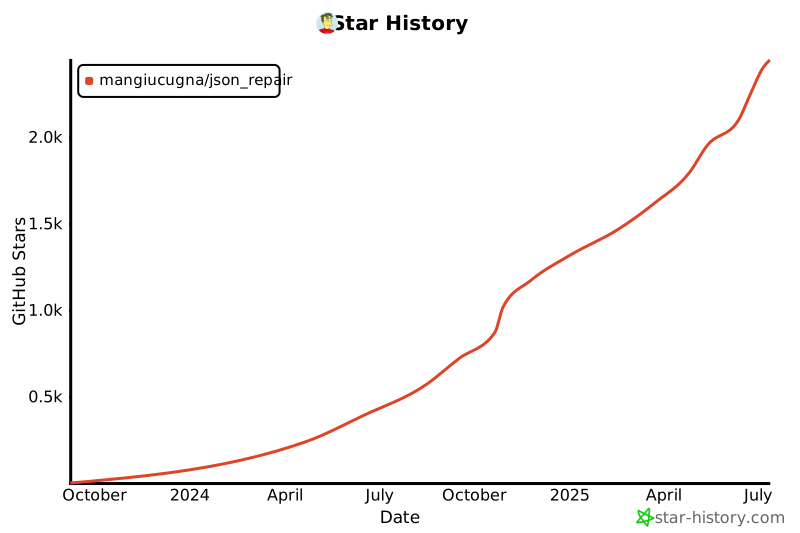
Star History
Project details
Verified details
These details have been verified by PyPIProject links
GitHub Statistics
Maintainers
Release history Release notifications | RSS feed


Download files
Download the file for your platform. If you're not sure which to choose, learn more about installing packages.
Source Distribution
Built Distribution
Filter files by name, interpreter, ABI, and platform.
If you're not sure about the file name format, learn more about wheel file names.
Copy a direct link to the current filters
File details
Details for the file json_repair-0.58.1.tar.gz.
File metadata
- Download URL: json_repair-0.58.1.tar.gz
- Upload date:
- Size: 58.7 kB
- Tags: Source
- Uploaded using Trusted Publishing? Yes
- Uploaded via: twine/6.1.0 CPython/3.13.7
File hashes
| Algorithm | Hash digest | |
|---|---|---|
| SHA256 |
7a4560ef04dcc4ef69c05131372d8608fc7ea8c51de0d76b53958f26d8ecb4cc
|
|
| MD5 |
ca10edd88a2e89d26cba5f945f0e4ed5
|
|
| BLAKE2b-256 |
c51954a7f22971669e583bb223217ae16a21b0bc8d4549c22c88b97cbfcb6fe5
|
Provenance
The following attestation bundles were made for json_repair-0.58.1.tar.gz:
Publisher:
python-publish.yml on mangiucugna/json_repair
-
Statement:
-
Statement type:
https://in-toto.io/Statement/v1 -
Predicate type:
https://docs.pypi.org/attestations/publish/v1 -
Subject name:
json_repair-0.58.1.tar.gz -
Subject digest:
7a4560ef04dcc4ef69c05131372d8608fc7ea8c51de0d76b53958f26d8ecb4cc - Sigstore transparency entry: 1004798375
- Sigstore integration time:
-
Permalink:
mangiucugna/json_repair@bc631297ea19ac26c6f26b5e6aa107adad668982 -
Branch / Tag:
refs/tags/v0.58.1 - Owner: https://github.com/mangiucugna
-
Access:
public
-
Token Issuer:
https://token.actions.githubusercontent.com -
Runner Environment:
github-hosted -
Publication workflow:
python-publish.yml@bc631297ea19ac26c6f26b5e6aa107adad668982 -
Trigger Event:
release
-
Statement type:
File details
Details for the file json_repair-0.58.1-py3-none-any.whl.
File metadata
- Download URL: json_repair-0.58.1-py3-none-any.whl
- Upload date:
- Size: 40.5 kB
- Tags: Python 3
- Uploaded using Trusted Publishing? Yes
- Uploaded via: twine/6.1.0 CPython/3.13.7
File hashes
| Algorithm | Hash digest | |
|---|---|---|
| SHA256 |
d4f10319855573e84376c6205ebf7a5f7f6f02059854e3d03b292d8dde1412bb
|
|
| MD5 |
e72b26e988522f26a21f54e1ea43db8b
|
|
| BLAKE2b-256 |
4954d8b06c401d30b4c32ddcd875878b61e15fd3f7a956a2771a2d8066273841
|
Provenance
The following attestation bundles were made for json_repair-0.58.1-py3-none-any.whl:
Publisher:
python-publish.yml on mangiucugna/json_repair
-
Statement:
-
Statement type:
https://in-toto.io/Statement/v1 -
Predicate type:
https://docs.pypi.org/attestations/publish/v1 -
Subject name:
json_repair-0.58.1-py3-none-any.whl -
Subject digest:
d4f10319855573e84376c6205ebf7a5f7f6f02059854e3d03b292d8dde1412bb - Sigstore transparency entry: 1004798376
- Sigstore integration time:
-
Permalink:
mangiucugna/json_repair@bc631297ea19ac26c6f26b5e6aa107adad668982 -
Branch / Tag:
refs/tags/v0.58.1 - Owner: https://github.com/mangiucugna
-
Access:
public
-
Token Issuer:
https://token.actions.githubusercontent.com -
Runner Environment:
github-hosted -
Publication workflow:
python-publish.yml@bc631297ea19ac26c6f26b5e6aa107adad668982 -
Trigger Event:
release
-
Statement type:






