
This release is a pre-release and may not be stable for production use.

judgekeeper




Check your LLM-as-a-judge.
See how often it agrees with human labels, in one command.
An LLM-as-a-judge is an AI model that grades the answers of another AI model. Teams use one because reading every answer by hand is slow.
Use it on your own judge
cd your-project
uvx judgekeeper@1.0.0b1
You need Python 3.11 or newer and uv. The version is in the command because uv and pip skip betas unless you name one. Without uv, install it in your project's own Python environment, then run it:
pip install judgekeeper==1.0.0b1
judgekeeper
- It reads the results your eval tool already saved (promptfoo, DeepEval, Inspect AI, MLflow, or a CSV) and checks your judge's verdicts for free.
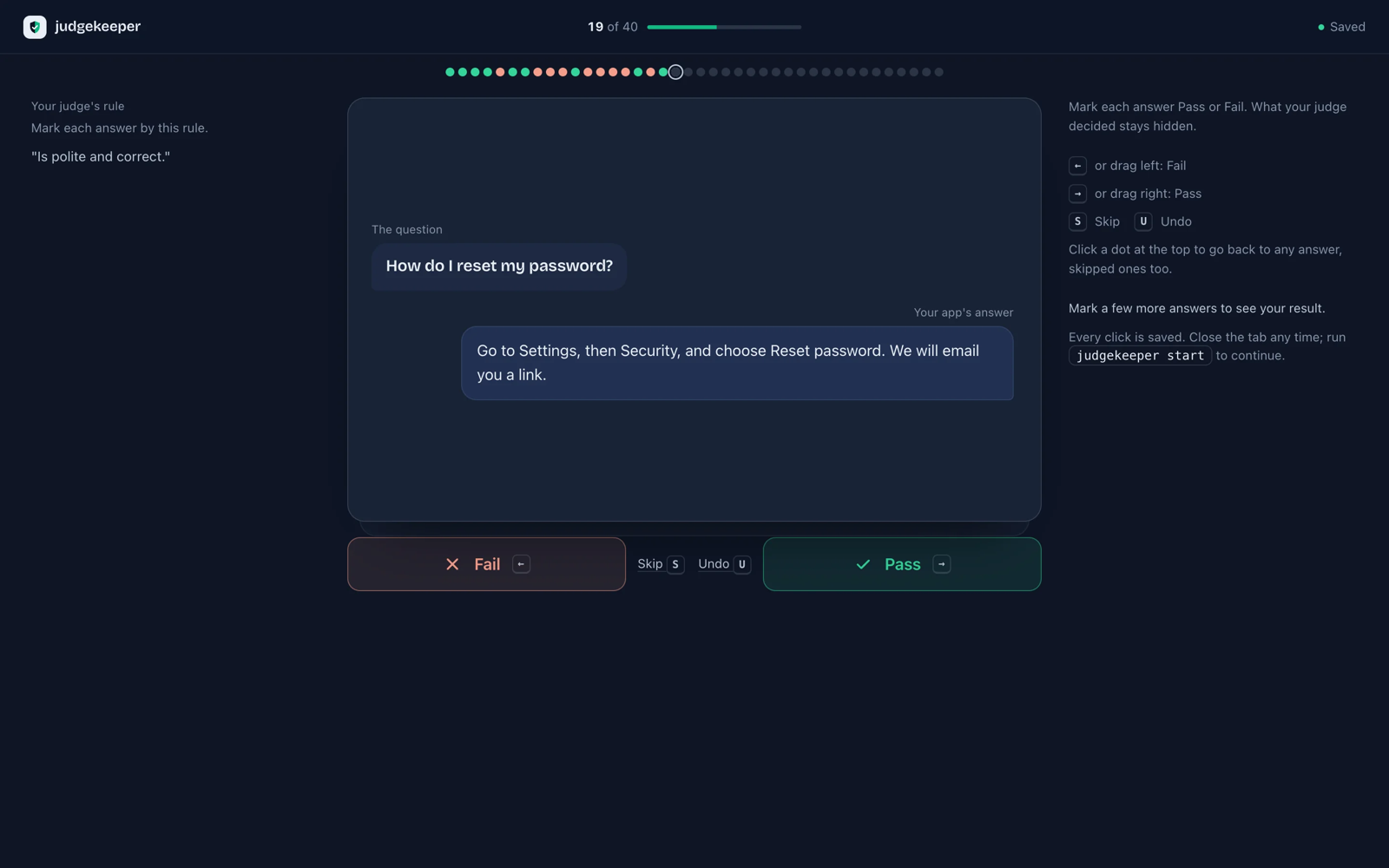
- It opens a page in your browser. You mark answers Pass or Fail without seeing what your judge said.
- Run it again the same way when you are done: it shows how often your judge agrees with you.
- No AI calls and no API key. judgekeeper never runs your app.
This is a beta: fixing your judge and re-checking it on its own are coming.
With a coding agent
Paste this into Claude Code, Codex or Cursor:
Run `uvx judgekeeper@1.0.0b1` in this project and follow what it says.
The agent runs judgekeeper and tells you when the page is open; you do the marking. Its rules are in one file, skills/judgekeeper/SKILL.md.
What you get
TPR: of the answers you passed, how many your judge passed. TNR: of the answers you failed, how many it failed. Kappa: how much you agree beyond chance. Each comes with a range, and judgekeeper says the smallest drop your marks can see. The numbers are estimates from the answers you marked, not a promise about the next ones.
Numbers
- Its ranges hold on real data. We tested the ranges for how often the judge passed answers people passed (TPR) and how often it failed answers people failed (TNR). We used 5 real judges from 3 public datasets (LLMBar, MT-Bench, LLMJudge), with 50 human labels per check, over 1,000 checks per judge. On average the value from all the human labels fell inside the range in 96.0 checks in 100 (lowest 94.6, highest 98.4). Real-data check
- One of those checks: GPT-4 as the judge on MT-Bench, 50 labels: TPR 0.82 (range 0.71 to 0.91), and the value from all 1,814 human labels is 0.85; TNR 0.49 (range 0.36 to 0.65), and from all labels 0.56.
- In simulation too: the ranges held the true value at least 93.6 times in 100 in every tested case, and 96.2 on average. Coverage check
- A real judge, checked: Claude Haiku 4.5 on LLMBar, 419 items: TPR 0.95, TNR 0.88, kappa (agreement after taking away lucky guesses) 0.83. Report
- Tested on Python 3.11 to 3.14 on Linux, and on Windows. Test runs
Status
Beta (1.0.0b1): commands and report fields may still change. judgekeeper --help lists every flag, and the changelog says what changed.
Issues
This project is maintained by one person and does not accept pull requests. Bug reports and ideas are welcome as issues.
License
MIT, for the code. The name judgekeeper and the logo are not covered: see TRADEMARKS.md.
1 maintainer

Metadata
1 maintainer
Release files for judgekeeper 1.0.0b1
For a detailed explanation of source distributions (sdists) and built distributions (wheels), please see the package formats documentation.
Source distribution (sdist)
| File | Size | Uploaded | |
|---|---|---|---|
| judgekeeper-1.0.0b1.tar.gz | 337.8 kB | Details |
Built distribution (wheel)
| File | Interpreter | ABI | Platform | Reset |
|---|---|---|---|---|
| judgekeeper-1.0.0b1-py3-none-any.whl | Python 3 | none | any | Details |
Total release size: 709.5 kB
Release files / judgekeeper-1.0.0b1.tar.gz
| Download URL | judgekeeper-1.0.0b1.tar.gz |
|---|---|
| Size | 337.8 kB |
| Tags | Source |
|
SHA-256 checksum How to use checksums |
c117fe4aee48fef3e1603831bf395056fd7aa25fa188ddff5c4bca2bb696e002
|
|
BLAKE2b-256 checksum How to use checksums |
a0dca49131d95d229fe07c5669a4f269d41f0c3165fc6a0b13a8511d88587e42
|
| Upload date | |
|
Uploaded using Trusted Publishing? What is trusted publishing? |
Yes |
| Uploaded via |
twine/7.0.0 CPython/3.13.14
|
Provenance
Provenance describes where a file came from. On PyPI, provenance is shared via attestations, which provide a verifiable record of the build or publishing details. View details, limitations and caveats.


PyPI Publish Attestation
PyPI verified that this artifact, at this checksum, originated from the publisher listed below.
Signed by GitHub Actions, verified by PyPI on Oct 13, 2026.
Transparency logRelease files / judgekeeper-1.0.0b1-py3-none-any.whl
| Download URL | judgekeeper-1.0.0b1-py3-none-any.whl |
|---|---|
| Size | 371.8 kB |
| Tags | Python 3 |
|
SHA-256 checksum How to use checksums |
8bac6da18fdb2b377d330f47867b681b1ad50c0ac2a58bf828170a9a058823c8
|
|
BLAKE2b-256 checksum How to use checksums |
10bebea8b259cff8a79513f538ea9d877b3f8329a78e1199723e37d47608ab6b
|
| Upload date | |
|
Uploaded using Trusted Publishing? What is trusted publishing? |
Yes |
| Uploaded via |
twine/7.0.0 CPython/3.13.14
|
Provenance
Provenance describes where a file came from. On PyPI, provenance is shared via attestations, which provide a verifiable record of the build or publishing details. View details, limitations and caveats.
PyPI Publish Attestation
PyPI verified that this artifact, at this checksum, originated from the publisher listed below.
Signed by GitHub Actions, verified by PyPI on Oct 13, 2026.
Transparency log













