
JupyterLab extension for browsing and using code examples and snippets from a Git repository

Project description
jupyterlab-code-loader



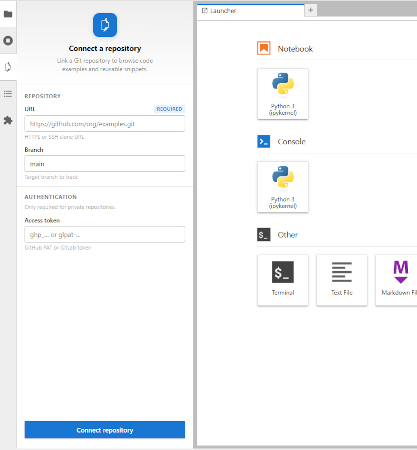
Jupyterlab-code-loader is a self-contained JupyterLab extension that provides a left sidebar panel for browsing, searching, and using code examples (notebooks, Python scripts, R scripts) and reusable code snippets. All content is sourced from a single open Git repository and organized by domain.
Requirements
- JupyterLab >= 4.0
Install
To install the extension, execute:
# from git
pip install jupyterlab-code-loader
Uninstall
To remove the extension, execute:
pip uninstall jupyterlab-code-loader
Configuration
The extension is configured via the setup form on first launch, but all settings can also be controlled through environment variables. Environment variables override values in the config file (~/.jupyter/code-loader.json).
Environment variables
| Variable | Description | Default |
|---|---|---|
CLOADER_REPO_URL |
Git repository URL containing code examples and snippets | (empty) |
CLOADER_BRANCH |
Branch to track | main |
CLOADER_CACHE_DIR |
Local directory for the cloned repository | ~/.jupyter/examples-cache |
CLOADER_REFRESH_INTERVAL |
Cache refresh interval in seconds | 3600 |
CLOADER_WORKSPACE_DIR |
Directory where code examples are copied to | ~/examples |
CLOADER_GIT_TOKEN |
GitHub/GitLab personal access token for private repos | (empty) |
CLOADER_DEFAULT_LOCALE |
Default content language code | en |
CLOADER_SUPPORTED_LOCALES |
Comma-separated list of supported locale codes | en,fr |
CLOADER_ALLOW_RESET |
Show reset button in sidebar (set 0, false, or no to hide) |
(enabled) |
Example
export CLOADER_REPO_URL=https://github.com/aristide/d4n-snippets.git
export CLOADER_BRANCH=master
export CLOADER_SUPPORTED_LOCALES=en,fr
export CLOADER_ALLOW_RESET=true
jupyter lab
Language detection
The extension automatically detects the content language from JupyterLab's active language setting. If the detected language is not in the CLOADER_SUPPORTED_LOCALES list, English (en) is used as the fallback.
Contributing
Development install
Note: You will need NodeJS to build the extension package.
The jlpm command is JupyterLab's pinned version of
yarn that is installed with JupyterLab. You may use
yarn or npm in lieu of jlpm below.
# Clone the repo to your local environment
# Change directory to the jupyterlab-code-loader directory
# create a virtual environment
# install jupyterlab
pip install "jupyterlab>=4.0.0,<5"
# Install package in development mode
pip install -e "."
# Link your development version of the extension with JupyterLab
jupyter labextension develop . --overwrite
# Rebuild extension Typescript source after making changes
jlpm build
You can watch the source directory and run JupyterLab at the same time in different terminals to watch for changes in the extension's source and automatically rebuild the extension.
# Watch the source directory in one terminal, automatically rebuilding when needed
jlpm watch
# Run JupyterLab in another terminal
jupyter lab
With the watch command running, every saved change will immediately be built locally and available in your running JupyterLab. Refresh JupyterLab to load the change in your browser (you may need to wait several seconds for the extension to be rebuilt).
By default, the jlpm build command generates the source maps for this extension to make it easier to debug using the browser dev tools. To also generate source maps for the JupyterLab core extensions, you can run the following command:
jupyter lab build --minimize=False
Development uninstall
pip uninstall jupyterlab-code-loader
In development mode, you will also need to remove the symlink created by jupyter labextension develop
command. To find its location, you can run jupyter labextension list to figure out where the labextensions
folder is located. Then you can remove the symlink named jupyterlab-code-loader within that folder.
Testing the extension
Frontend tests
This extension is using Jest for JavaScript code testing.
To execute them, execute:
jlpm
jlpm test
Integration tests
This extension uses Playwright for the integration tests (aka user level tests). More precisely, the JupyterLab helper Galata is used to handle testing the extension in JupyterLab.
More information are provided within the ui-tests README.
Packaging the extension
See RELEASE
Claude Code Skill: Content Manager
This repository includes a Claude Code skill (cloader-content) that helps populate and manage Git repositories consumed by the extension.
What the skill does
- Scaffold new examples repositories with the correct structure
- Add domains, code examples (notebooks, scripts), and snippets
- Add translations for existing content
- Validate repository structure against the expected schema
- Regenerate the
registry.jsonindex
Installing the skill
Claude Code discovers skills automatically from .claude/skills/ directories. Choose the scope that fits your needs:
Project-level (available when working in this repo):
mkdir -p .claude/skills
cp -r skills/cloader-content .claude/skills/
Personal (available across all your projects):
# Symlink so updates are picked up automatically
mkdir -p ~/.claude/skills
ln -s "$(pwd)/skills/cloader-content" ~/.claude/skills/cloader-content
No restart needed — Claude Code detects skills immediately.
Slash command
This repository also includes a /populate-repo slash command (in .claude/commands/populate-repo.md) that provides a quick way to invoke the skill. When working in this repo, type:
/populate-repo scaffold a new examples repository at ~/my-examples
/populate-repo add a "data-science" domain with a pandas intro notebook
/populate-repo add a bash snippet for curl requests to the data-science domain
/populate-repo validate the repository at ~/my-examples
Or just /populate-repo with no arguments to see available actions.
To use this command in another project, copy it:
mkdir -p /path/to/other-project/.claude/commands
cp .claude/commands/populate-repo.md /path/to/other-project/.claude/commands/
The skill also triggers automatically from natural language when installed — the slash command is just a convenient shortcut.
Usage examples
> Scaffold a new examples repository at ~/my-examples
> Add a "data-science" domain with a pandas intro notebook
> Add a Python snippet for reading CSV files to the data-science domain
> Validate the repository at ~/my-examples
> Rebuild the registry for ~/my-examples
Updating the skill
git pull

# If installed via symlink — no action needed, it already points to the repo.

# If installed via copy, re-copy to pick up changes:
cp -r skills/cloader-content .claude/skills/    # project-level
cp -r skills/cloader-content ~/.claude/skills/   # personal
Standalone scripts
The skill includes helper scripts that can be run directly:
# Validate repository structure
python skills/cloader-content/scripts/validate.py /path/to/repo

# Rebuild registry.json from manifests
python skills/cloader-content/scripts/build_registry.py /path/to/repo --repo-url https://github.com/org/repo
Release history Release notifications | RSS feed

Download files
Download the file for your platform. If you're not sure which to choose, learn more about installing packages.
Source Distribution
Built Distribution
Filter files by name, interpreter, ABI, and platform.
If you're not sure about the file name format, learn more about wheel file names.
Copy a direct link to the current filters
File details
Details for the file jupyterlab_code_loader-0.1.0.tar.gz.
File metadata
- Download URL: jupyterlab_code_loader-0.1.0.tar.gz
- Upload date:
- Size: 335.9 kB
- Tags: Source
- Uploaded using Trusted Publishing? No
- Uploaded via: twine/6.1.0 CPython/3.13.7
File hashes
| Algorithm | Hash digest | |
|---|---|---|
| SHA256 |
f2c4dcb05d4e229e0e0d2db802f6bfc92c8d8bf1435311fd87d666261973c313
|
|
| MD5 |
d8f9c60086e507c685f3134ff8c9bc15
|
|
| BLAKE2b-256 |
a8d2ddd903b68c2c5580ed83a66a5959a6abac11603597485802c8a99ebd66e4
|
File details
Details for the file jupyterlab_code_loader-0.1.0-py3-none-any.whl.
File metadata
- Download URL: jupyterlab_code_loader-0.1.0-py3-none-any.whl
- Upload date:
- Size: 88.2 kB
- Tags: Python 3
- Uploaded using Trusted Publishing? No
- Uploaded via: twine/6.1.0 CPython/3.13.7
File hashes
| Algorithm | Hash digest | |
|---|---|---|
| SHA256 |
02fd2c3a0cc59eae0b16bd9b29d40663d8809adb488b53bb843b8db87c19d5ef
|
|
| MD5 |
e00e4c35e1dc49d92d1f39586e5d2cbf
|
|
| BLAKE2b-256 |
b5127fb8970f6bdeb9bfb917139dc9cdebeebeaa40c92b0c2e49581f25e67eac
|






