
jupyterlab_sentry
Sentry integration for jupyter lab.
Highly customized and crowded jupyter lab environment might face odd behaviors and errors. Error reporting and analysis tools can help us identify and fix errors. Sentry is one of those tools.
Requirements
0.*.*
- JupyterLab >= 3.0
1.*.*
- JupyterLab >= 4.0
1.* versions are developed and tested with JupyterLab 4.0.0a29.
Install
To install the extension, execute:
pip install jupyterlab_sentry
Sentry DSN
We are using jupyter lab extension settings for Sentry DSN.
After installation, you can find that jupyterlab-sentry settings are available in advanced settings.
However, this setting is only applied to the user who set this value manually.
In most cases, you might want all your users to be reported by sentry.
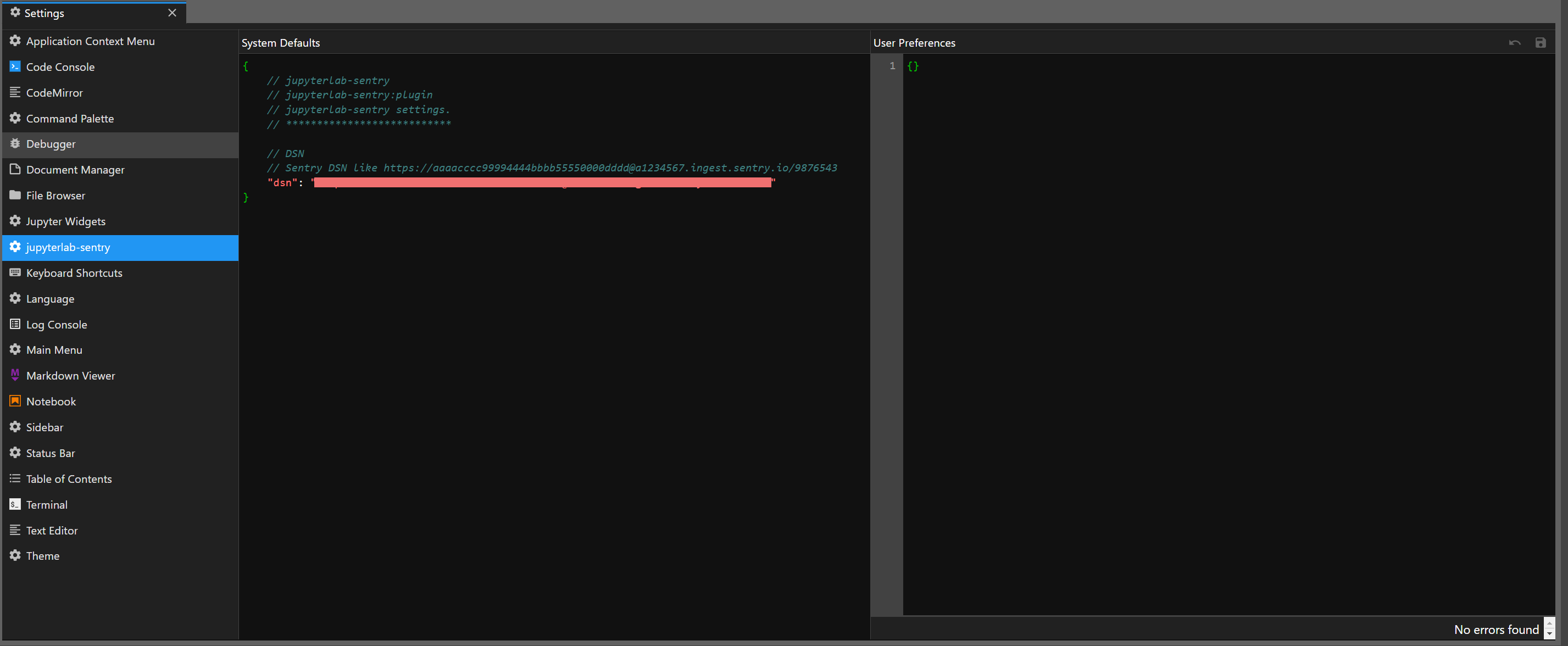
We are using overrides.json. This file can be installed to your node or docker image.
/<project>/Dockerfile
# Choose version whatever you want
FROM jupyter/base-notebook:lab-3.2.9 as base

COPY overrides.json ${CONDA_DIR}/share/jupyter/lab/settings/overrides.json

# ...
/<project>/overrides.json
{
    "jupyterlab-sentry:plugin": {
        "dsn": "https://yourdsn@asdf.ingest.sentry.io/1234"
    }
}
Uninstall
To remove the extension, execute:
pip uninstall jupyterlab_sentry
Contributing
Creating Conda Environment
For 0.*.* versions,
conda create -n jupyterlab-ext --override-channels --strict-channel-priority -c conda-forge -c nodefaults jupyterlab=3 cookiecutter nodejs jupyter-packaging git
Development install
Note: You will need NodeJS to build the extension package.
The jlpm command is JupyterLab's pinned version of
yarn that is installed with JupyterLab. You may use
yarn or npm in lieu of jlpm below.
# Clone the repo to your local environment
# Change directory to the jupyterlab_sentry directory
# Install package in development mode
pip install -e .
# Link your development version of the extension with JupyterLab
jupyter labextension develop . --overwrite
# Rebuild extension Typescript source after making changes
jlpm build
You can watch the source directory and run JupyterLab at the same time in different terminals to watch for changes in the extension's source and automatically rebuild the extension.
# Watch the source directory in one terminal, automatically rebuilding when needed
jlpm watch
# Run JupyterLab in another terminal
jupyter lab
With the watch command running, every saved change will immediately be built locally and available in your running JupyterLab. Refresh JupyterLab to load the change in your browser (you may need to wait several seconds for the extension to be rebuilt).
By default, the jlpm build command generates the source maps for this extension to make it easier to debug using the browser dev tools. To also generate source maps for the JupyterLab core extensions, you can run the following command:
jupyter lab build --minimize=False
Development uninstall
pip uninstall jupyterlab_sentry
In development mode, you will also need to remove the symlink created by jupyter labextension develop
command. To find its location, you can run jupyter labextension list to figure out where the labextensions
folder is located. Then you can remove the symlink named jupyterlab-sentry within that folder.
Packaging the extension
See RELEASE
Our problems and goals
In theory, Sentry agent should be initialized as soon as possible. But, jupyter lab extensions are loaded much later.
Sentry report would be improved if we feed them additional information like user id.
Jupyter lab setting is not bad for deliverying DSN value, but I'm a little worried that users might change their DSN value. It is also a bit complicated to set up overrides.json.
1 maintainer

Metadata
1 maintainer
Release files for jupyterlab-sentry 1.1.0
For a detailed explanation of source distributions (sdists) and built distributions (wheels), please see the package formats documentation.
Source distribution (sdist)
| File | Size | Uploaded | Provenance | Actions |
|---|---|---|---|---|
| jupyterlab_sentry-1.1.0.tar.gz | 267.2 kB | Without provenance | Details for jupyterlab_sentry-1.1.0.tar.gz |
Built distribution (wheel)
| File | Interpreter | ABI | Platform | Actions Reset |
|---|---|---|---|---|
| jupyterlab_sentry-1.1.0-py3-none-any.whl | Python 3 | none | any | Details for jupyterlab_sentry-1.1.0-py3-none-any.whl |
Total release size: 362.5 kB
Release files / jupyterlab_sentry-1.1.0.tar.gz
| Download URL | jupyterlab_sentry-1.1.0.tar.gz |
|---|---|
| Size | 267.2 kB |
| Tags | Source |
|
SHA-256 checksum How to use checksums |
c84d1b3f86a00761d97b9ab8c62f2648672ba98a2c670043979ef77770df4b2d
|
|
BLAKE2b-256 checksum How to use checksums |
38c56021052434f1c46bd35f8cb7b257cb6944d3ea5bb6a2576ebdb1a60c55b0
|
| Upload date | |
|
Uploaded using Trusted Publishing? What is trusted publishing? |
No |
| Uploaded via |
twine/4.0.2 CPython/3.10.9
|
Release files / jupyterlab_sentry-1.1.0-py3-none-any.whl
| Download URL | jupyterlab_sentry-1.1.0-py3-none-any.whl |
|---|---|
| Size | 95.3 kB |
| Tags | Python 3 |
|
SHA-256 checksum How to use checksums |
053f4e865c9776e2567a2be19e1f5845fe71c37dbb30c5f9a62e64d21d1a952a
|
|
BLAKE2b-256 checksum How to use checksums |
9f82a8386d0239621170b5945d4ad84fd390bcb34dac04e6053d841501ec053c
|
| Upload date | |
|
Uploaded using Trusted Publishing? What is trusted publishing? |
No |
| Uploaded via |
twine/4.0.2 CPython/3.10.9
|
Security for jupyterlab-sentry 1.1.0
Provenance
Provenance describes where a file came from. On PyPI, provenance is shared via attestations, which provide a verifiable record of the build or publishing details. View details, limitations and caveats.
No provenance found
None of the files in this release were uploaded with provenance metadata.
A note on package security
PyPI is a repository for distributing packages, not a service for auditing them. While third-party security researchers and our staff do their best to detect and remove malicious packages, PyPI cannot guarantee the quality, security or suitability of any given package.
To learn more about protecting yourself from malicious actors, visit our package security documentation.














