
Jev Pilot
Control your Mac with spoken commands. Jev Pilot listens through your microphone, transcribes speech locally, asks Jev to choose a grounded action, and checks the result before continuing.
This early macOS command-line release is designed for short, explicit commands. Start listening in Terminal, speak commands in the apps you want to control, and keep talking while the session remains open.
What you can do
- Open or switch to installed apps, including familiar names such as Chrome and VS Code.
- Visit websites and search Google or YouTube, including in a named browser.
- Dictate into the focused text field and explicitly ask to press Enter.
- Create a note in Apple Notes or a document in TextEdit, then dictate its contents.
- Copy, cut, paste, undo, and redo in text fields.
- Open, switch, and close browser tabs; go back or forward; reload; zoom in, out, or reset.
- Scroll up or down, or jump to the top or bottom of a page.
- Search in Finder and scroll Finder's file list.
- Enter full screen or minimize the current window or a named running app.
- Run multiple commands in one listening session.
More complex workflows can stop when Jev Pilot cannot find or verify a required control.
Install
You need an Apple Silicon Mac, uv, and a TypeSafe account with a Jev API key. Internet access is needed for Jev decisions and the initial speech-model download. Speech transcription runs locally after the model is cached.
After jvpilot is published to PyPI, install it with:
uv tool install --python 3.12 jvpilot
uv tool update-shell
Restart Terminal if needed for the jvpilot command to appear on your PATH. To install from a source checkout, see Local development.
The first listening run downloads the Nemotron speech model automatically if it is not already cached. This can take several minutes. Later runs reuse the cached model.
Create the configuration directory:
mkdir -p "$HOME/Library/Application Support/Jev Pilot"
Create ~/Library/Application Support/Jev Pilot/.env with your key:
TYPESAFE_API_KEY=your_key_here
Keep this file private. You can also set TYPESAFE_API_KEY in your shell. The environment variable takes precedence, followed by a source checkout's .env, then the user configuration file above. Installed use does not load .env files from the current directory or site-packages.
Grant macOS permissions
Allow Microphone access for the Terminal/Python host macOS identifies when you first listen. If access was denied, check System Settings → Privacy & Security → Microphone.
Desktop controls also need Accessibility access. Request it with:
jvpilot --request-accessibility
Enable the identified host under System Settings → Privacy & Security → Accessibility. Restart that host if needed, then rerun the command until it reports accessibility_trusted: true. Opening or switching apps alone does not require Accessibility; most other controls do.
Start and stop listening
In Terminal, start a session with:
jvpilot --listen --auto-approve-basic
This skips routine confidence prompts for app opening/switching, website navigation, and Google/YouTube searches. Other approvals and safety checks stay active. Run jvpilot --listen to keep those routine prompts too.
To skip routine confidence prompts for other supported commands as well, use:
jvpilot --listen --yes
These commands always require approval, even with --yes: cutting text, closing a browser tab, pressing Enter outside Notes or TextEdit, and using an unfamiliar control. Existing safety blocks and target/result checks remain active; password, payment, purchase, and deletion requests are blocked.
Then:
- Say a command, such as “open Safari.”
- Pause briefly so Jev Pilot can finish the utterance. The default pause is about 650 ms.
- Wait for “Ready for the next command.”
- Say another command without restarting the listener.
If a Y / n prompt appears, enter y to approve or n to decline. After a command fails or is declined, the listener normally stays active; speak a fresh command after the result. Queued follow-up commands behind a failure are discarded.
Stop by saying “stop listening,” “stop pilot,” or “quit pilot.” You can also press Control-C in Terminal. Stopping cancels pending work before its next action; it cannot undo an action already sent. Run the start command again for a new session.
Example commands
| What you want | Say |
|---|---|
| Open an installed app | “open Cursor” · “open Notes” · “open Music” |
| Switch apps | “switch to Chrome” · “switch to Finder” |
| Visit a website | “go to YouTube” · “go to stripe dot com” |
| Choose a browser | “open example.com in Chrome” |
| Search Google | “google best ramen near me” |
| Search YouTube | “search for Messi soccer videos on YouTube” |
| Search in a named browser | “search YouTube for lofi hip hop in Safari” |
| Dictate into the focused field | “type hello world” |
| Dictate, then press Enter | “type hello world and hit enter” |
| Create and fill a note | “create a new note in Notes and type hello world” |
| Create and fill a document | “create a new document in TextEdit and type hello world” |
| Select text | “select all” |
| Edit with the clipboard | “copy” · “cut” · “paste” |
| Undo or redo | “undo” · “redo” |
| Browser tabs | “open a new tab” · “go to the next tab” · “go to the previous tab” · “switch to the GitHub tab” · “close this tab” |
| Browser history | “go back” · “go forward” · “reload the page” |
| Zoom a page | “zoom in” · “zoom out” · “reset zoom” |
| Scroll | “scroll down” · “scroll up a lot” · “scroll to the top” · “scroll to the bottom” |
| Search in Finder | “search Finder for invoices” |
| Enter full screen | “maximize this window” · “maximize Safari” |
| Minimize a window | “minimize this window” · “minimize Safari” |
| Stop the session | “stop listening” |
Text commands need an editable field; select-all also needs existing text. Typing inserts at the caret or replaces selected text. “Maximize” means enter full screen. Use short, explicit requests and name the app for document workflows. If a command is misheard, wait for its result and speak a fresh instruction; completed actions are not automatically undone.
How it works
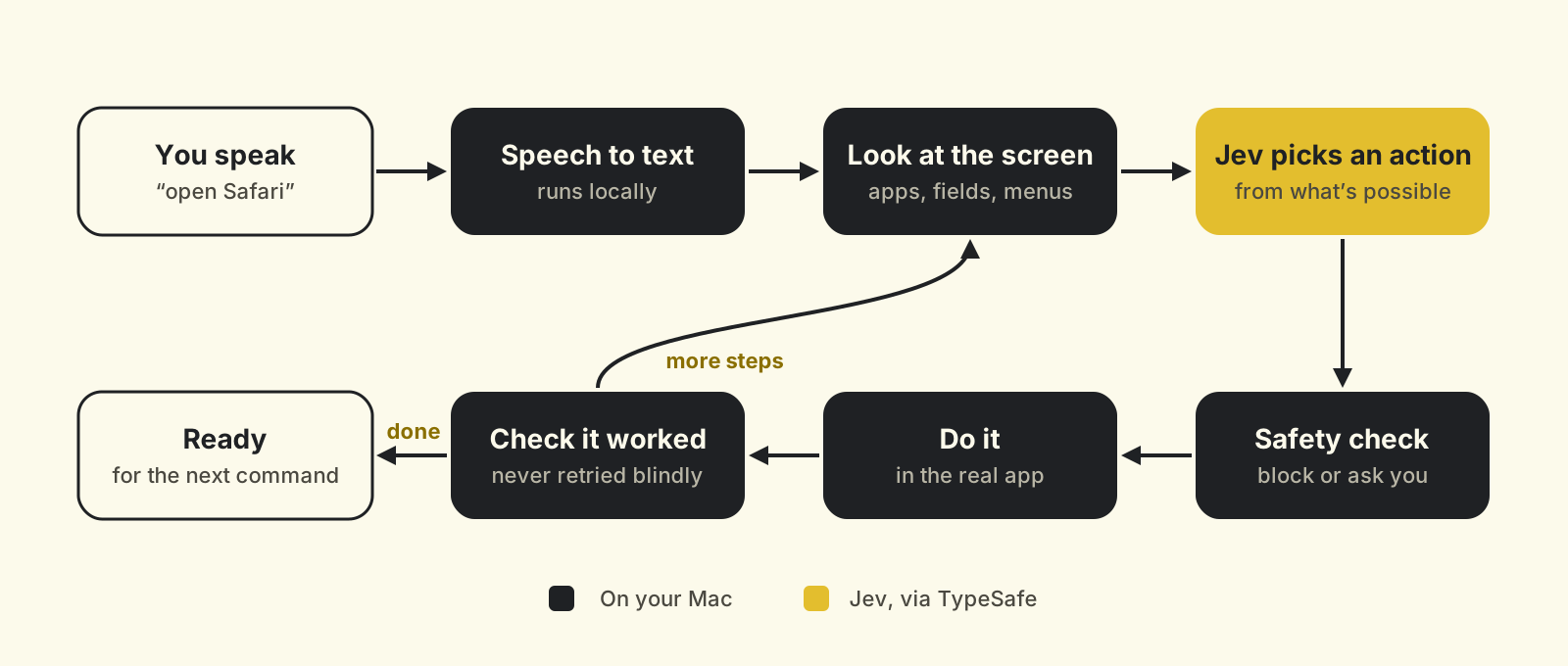
- Listen: your speech is turned into text locally. A pause marks the end of a command.
- Look: Jev Pilot reads what's on screen through macOS Accessibility, the same interface screen readers use. It sees the open apps, text fields, menus and scrollable areas.
- Decide: Jev receives your command and a short list of the actions currently possible, then picks one. It can only choose from that list.
- Check and act: local safety rules can block the action or ask for your approval. Jev Pilot then performs the action and confirms that the app actually changed before taking another step.
Nothing is retried blindly. If a result can't be confirmed, Jev Pilot stops and tells you. For module-level detail, see the architecture guide.
Limits and privacy
Menus must expose supported English labels. Browser tab, history, and zoom controls are tested in Safari; other browsers vary, opening tabs in Helium and other browser-specific controls remain future work. Quitting apps, creating Terminal windows, submitting Terminal commands, and choosing a Music playlist are not supported. Secure, read-only, or unreadable text fields cannot be edited.
An unsupported result means no suitable action was available. An unverified result means an action may have happened, but Jev Pilot could not confirm it. Check the app before repeating a command, especially note creation or typing.
Speech transcription runs on your Mac. Jev requests send your spoken goal and bounded app/control metadata to TypeSafe. Existing document values and clipboard contents stay local. Session reports contain transcripts and dictated text; review them before sharing.
Do not speak passwords, API keys, access tokens, or other credentials. Spoken goals are sent to TypeSafe and saved in local session reports; credential detection and redaction are not provided. Finder candidate filenames may be sent to TypeSafe, but their full file paths stay local unless you include a path in your spoken goal.
Troubleshooting
- Check speech without desktop actions: run
jvpilot --transcribe-only, speak a few phrases, then press Control-C. This does not call Jev or require an API key or Accessibility access. - Commands split too early: increase the pause, for example
jvpilot --listen --auto-approve-basic --silence-ms 900. Lower it for faster turn-taking. - Quiet speech is missed: lower
--speech-thresholdslightly from its default0.012; raise it if background noise triggers utterances. - Desktop controls are unavailable: check Accessibility for the same Terminal/Python host used to listen. The app must expose the relevant control or editable field.
- An app opens but a workflow stops: check the result before trying again. Opening, creation, focus, and typing are separate steps.
- A command reports
unverified: check the app before repeating it. Scrolling needs a scrollable area that macOS Accessibility exposes, and some apps don't expose one. - Share a failure: the latest session report is saved after each command to
~/Library/Application Support/Jev Pilot/Reports/python-cli-last.json. Use--report .build/my-session.jsonto choose another path. Remove private transcript or dictation content before sharing.
Roadmap
Next release: everyday control
- Click things by name: “click Sign in” · “open the Pricing link”, for buttons and links on web pages and in apps.
- Voice text editing: “delete the last word” · “replace Tuesday with Wednesday” · “new paragraph” · “select the last sentence”.
- Media and system controls: “pause music” · “next song” · “play my Main playlist” · “volume to 30” · “turn on dark mode”.
- Window layout: “put Safari on the left half” · “move this window to the other screen”.
- Quit apps and close windows: “quit Music” · “close this window”, with approval whenever unsaved work could be lost.
Later: multi-step commands
- Chained requests: “open Safari, go to GitHub, and open a new tab” as one sentence, with each step checked before the next.
- Apple Shortcuts: “run my Morning shortcut”.
Ideas: voice-played games
- Voice chess: say “knight to f3” to play on sites with typed move entry, such as Lichess.
- Mental-math sprints: speak answers in Zetamac-style arithmetic drills.
- Quiz games: answer Sporcle or Seterra quizzes, and type Wordle guesses, by voice.
- Desktop speedrun: a timed built-in challenge (“open Notes, write a haiku, then search YouTube for lofi”) that teaches the commands and scores your speed and accuracy.
Local development
The active runtime is the Python CLI in app/; the retained Swift sources are historical references. From a source checkout, use uv to create a local environment and install the project in editable mode:
uv venv --python 3.12
source .venv/bin/activate
uv pip install -e .
jvpilot --listen --auto-approve-basic
Jev Pilot's PyPI package and installed command are both named jvpilot; python -m app is also available. Package version and build settings live in pyproject.toml; dependencies are listed in requirements.txt.
In each new terminal, run source .venv/bin/activate from the checkout before starting the development CLI or running checks.
CI runs a small offline suite that uses fake apps, a fake microphone and a fake Jev. To run it locally:
uv pip install pip 'setuptools>=77' packaging pyyaml
python -m unittest discover -s tests -p 'test_*.py' -v
Real-app behavior is tested with the native matrix. It needs Accessibility for your terminal and a configured API key, and it calls live Jev:
python -m scripts.native_matrix --list          # show cases
python -m scripts.native_matrix                 # run every case once
python -m scripts.native_matrix --only v0.2 --repeat 3
python -m scripts.native_matrix --voice         # speak each goal with `say`, then run the transcript
The matrix opens its own disposable TextEdit document, Safari window (served from a local page) and Finder folder, runs each command, then checks the result independently using AppleScript, page-reported scroll/zoom/load events and Accessibility reads. Each run records the first failing stage (discovery, selection, blocked, dispatch or verification) in .build/native-matrix.json. It exits nonzero only if a v0.1 command fails. Leave the Mac alone while it runs, because it moves focus between apps. It also overwrites your clipboard.
See the architecture guide for implementation details. Restart the listener after changing code.
1 maintainer

Metadata
1 maintainer
Release files for jvpilot 0.2.0
For a detailed explanation of source distributions (sdists) and built distributions (wheels), please see the package formats documentation.
Source distribution (sdist)
| File | Size | Uploaded | Provenance | Actions |
|---|---|---|---|---|
| jvpilot-0.2.0.tar.gz | 103.2 kB | Without provenance | Details for jvpilot-0.2.0.tar.gz |
Built distribution (wheel)
| File | Interpreter | ABI | Platform | Actions Reset |
|---|---|---|---|---|
| jvpilot-0.2.0-py3-none-any.whl | Python 3 | none | any | Details for jvpilot-0.2.0-py3-none-any.whl |
Total release size: 174.6 kB
Release files / jvpilot-0.2.0.tar.gz
| Download URL | jvpilot-0.2.0.tar.gz |
|---|---|
| Size | 103.2 kB |
| Tags | Source |
|
SHA-256 checksum How to use checksums |
49742563f3023b79533bfc83eaf95913f13c863a68024f6972da025ad2466bbb
|
|
BLAKE2b-256 checksum How to use checksums |
69f4fdd28252d8b65e4a029e0bc38672a23cbfe62fc24dae5b511f9b16967236
|
| Upload date | |
|
Uploaded using Trusted Publishing? What is trusted publishing? |
Yes |
| Uploaded via |
uv/0.13.1 {"installer":{"name":"uv","version":"0.13.1","subcommand":["publish"]},"python":null,"implementation":{"name":null,"version":null},"distro":{"name":"Ubuntu","version":"24.04","id":"noble","libc":null},"system":{"name":null,"release":null},"cpu":null,"openssl_version":null,"setuptools_version":null,"rustc_version":null,"ci":true}
|
Release files / jvpilot-0.2.0-py3-none-any.whl
| Download URL | jvpilot-0.2.0-py3-none-any.whl |
|---|---|
| Size | 71.5 kB |
| Tags | Python 3 |
|
SHA-256 checksum How to use checksums |
f08f5201618038bf146df62daf922b0dddd3f9a0ed10517fe07f2475fc0a1ba6
|
|
BLAKE2b-256 checksum How to use checksums |
30df5f88b240085777f076bbd73c3984d699c11307f1f9132d904792fdea4876
|
| Upload date | |
|
Uploaded using Trusted Publishing? What is trusted publishing? |
Yes |
| Uploaded via |
uv/0.13.1 {"installer":{"name":"uv","version":"0.13.1","subcommand":["publish"]},"python":null,"implementation":{"name":null,"version":null},"distro":{"name":"Ubuntu","version":"24.04","id":"noble","libc":null},"system":{"name":null,"release":null},"cpu":null,"openssl_version":null,"setuptools_version":null,"rustc_version":null,"ci":true}
|
Security for jvpilot 0.2.0
Provenance
Provenance describes where a file came from. On PyPI, provenance is shared via attestations, which provide a verifiable record of the build or publishing details. View details, limitations and caveats.
No provenance found
None of the files in this release were uploaded with provenance metadata.
A note on package security
PyPI is a repository for distributing packages, not a service for auditing them. While third-party security researchers and our staff do their best to detect and remove malicious packages, PyPI cannot guarantee the quality, security or suitability of any given package.
To learn more about protecting yourself from malicious actors, visit our package security documentation.














