
Python Inferface for the Karlsruhe Hypergraph Partitioning Framework (KaHyPar)

Project description

| License | Linux & macOS Build | Fossa | Zenodo |
|---|---|---|---|
 |
 |
 |
 |
| Code Coverage | Code Quality | Coverity Scan | SonarCloud | Issues |
|---|---|---|---|---|
 |
 |
 |
 |
 |
Table of Contents
- What is a Hypergraph? What is Hypergraph Partitioning?
- What is KaHyPar?
- Requirements
- Building KaHyPar
- Testing and Profiling
- Running KaHyPar
- Using the Library Interfaces
- Bug Reports
- Licensing
- Contributing
What is a Hypergraph? What is Hypergraph Partitioning?
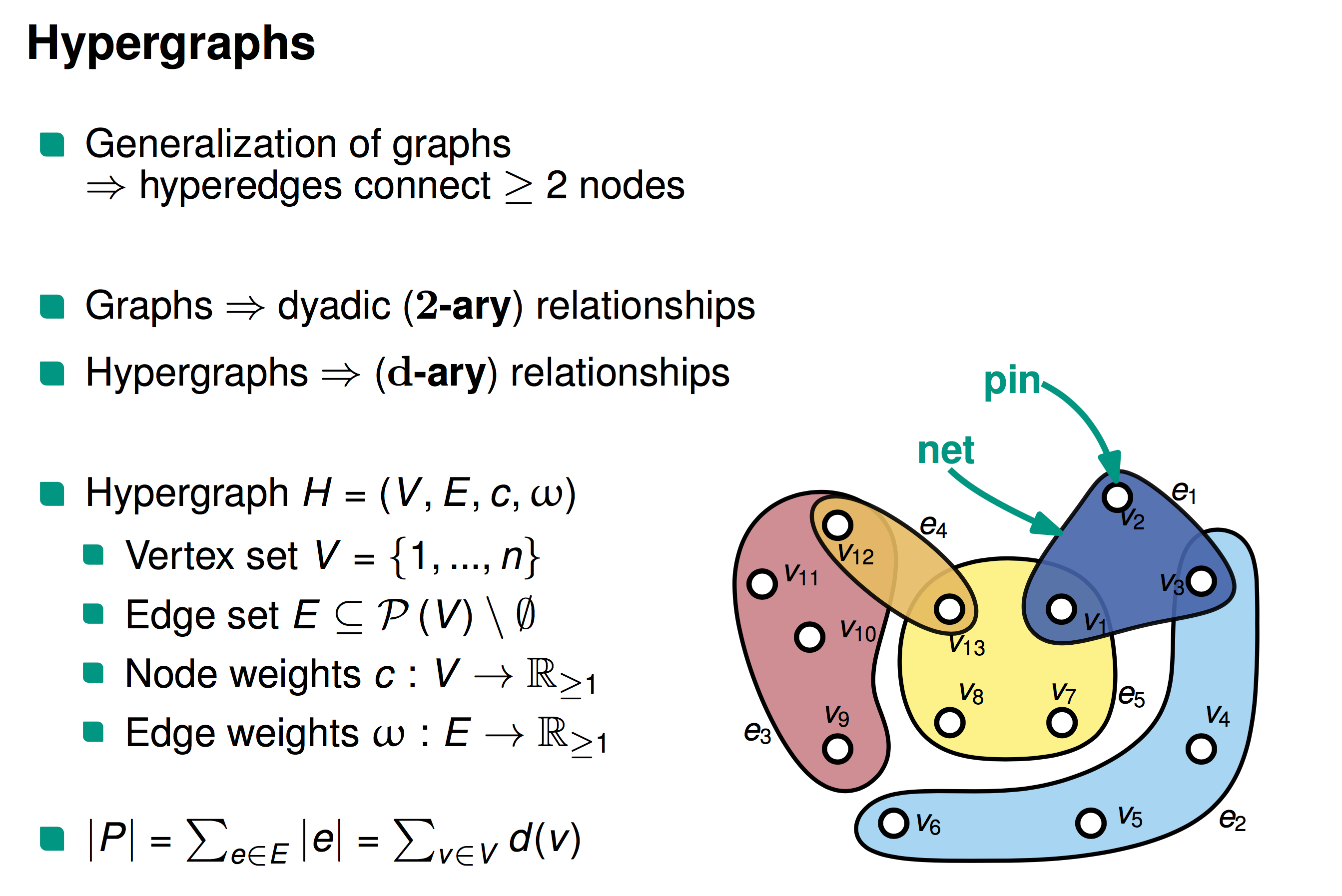
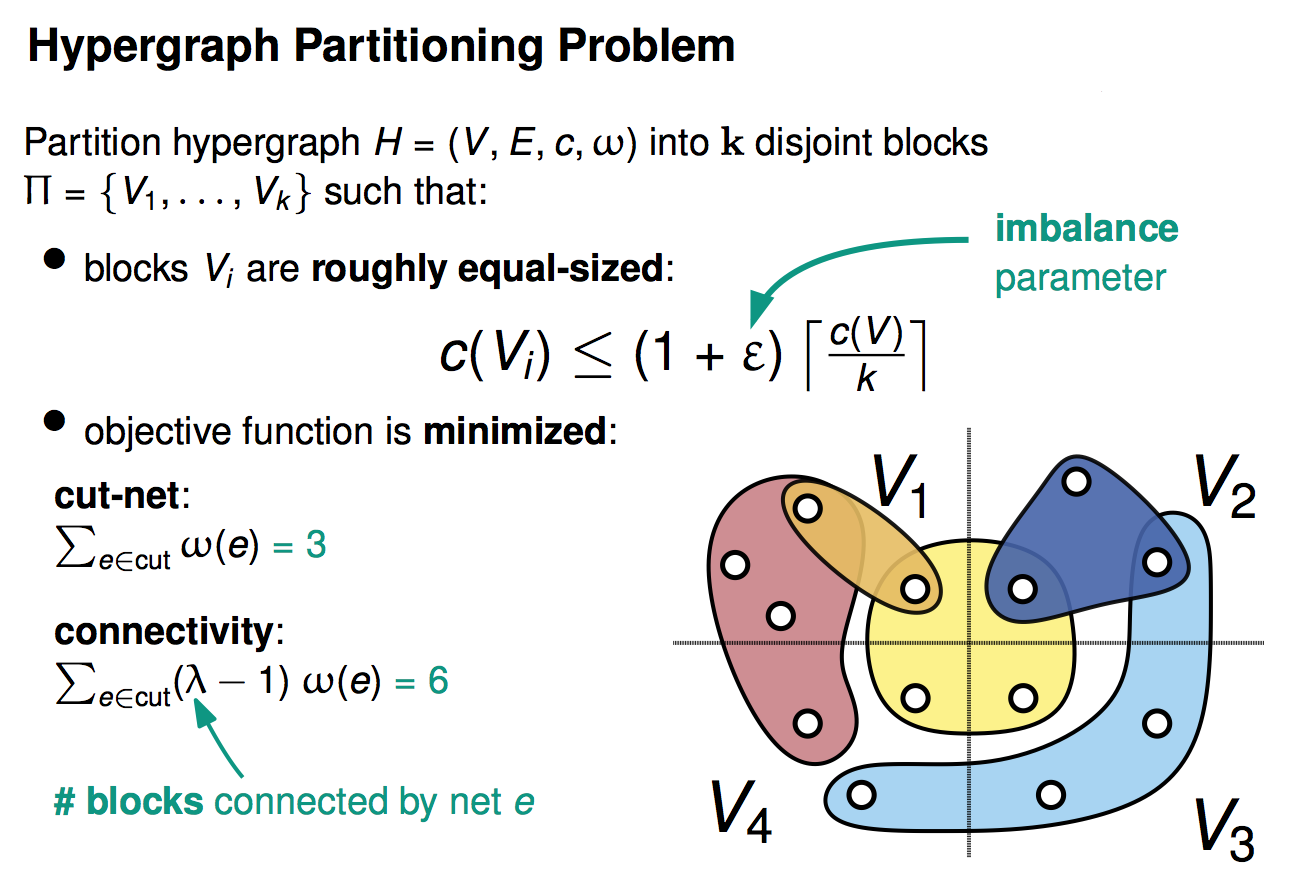
Hypergraphs are a generalization of graphs, where each (hyper)edge (also called net) can connect more than two vertices. The k-way hypergraph partitioning problem is the generalization of the well-known graph partitioning problem: partition the vertex set into k disjoint blocks of bounded size (at most 1 + ε times the average block size), while minimizing an objective function defined on the nets.
The two most prominent objective functions are the cut-net and the connectivity (or λ − 1) metrics. Cut-net is a straightforward generalization of the edge-cut objective in graph partitioning (i.e., minimizing the sum of the weights of those nets that connect more than one block). The connectivity metric additionally takes into account the actual number λ of blocks connected by a net. By summing the (λ − 1)-values of all nets, one accurately models the total communication volume of parallel sparse matrix-vector multiplication and once more gets a metric that reverts to edge-cut for plain graphs.
What is KaHyPar?
KaHyPar is a multilevel hypergraph partitioning framework for optimizing the cut- and the (λ − 1)-metric. It supports both recursive bisection and direct k-way partitioning. As a multilevel algorithm, it consist of three phases: In the coarsening phase, the hypergraph is coarsened to obtain a hierarchy of smaller hypergraphs. After applying an initial partitioning algorithm to the smallest hypergraph in the second phase, coarsening is undone and, at each level, a local search method is used to improve the partition induced by the coarser level. KaHyPar instantiates the multilevel approach in its most extreme version, removing only a single vertex in every level of the hierarchy. By using this very fine grained n-level approach combined with strong local search heuristics, it computes solutions of very high quality. Its algorithms and detailed experimental results are presented in several research publications.
Additional Features
-
Hypergraph partitioning with variable block weights
KaHyPar has support for variable block weights. If command line option
--use-individual-part-weights=trueis used, the partitioner tries to partition the hypergraph such that each block Vx has a weight of at most Bx, where Bx can be specified for each block individually using the command line parameter--part-weights= B1 B2 B3 ... Bk-1. Since the framework does not yet support perfectly balanced partitioning, upper bounds need to be slightly larger than the total weight of all vertices of the hypergraph. Note that this feature is still experimental. -
Hypergraph partitioning with fixed vertices
Hypergraph partitioning with fixed vertices is a variation of standard hypergraph partitioning. In this problem, there is an additional constraint on the block assignment of some vertices, i.e., some vertices are preassigned to specific blocks prior to partitioning with the condition that, after partitioning the remaining “free” vertices, the fixed vertices are still in the block that they were assigned to. The command line parameter
--fixed / -fcan be used to specify a fix file in hMetis fix file format. For a hypergraph with V vertices, the fix file consists of V lines - one for each vertex. The ith line either contains-1to indicate that the vertex is free to move or<part id>to indicate that this vertex should be preassigned to block<part id>. Note that part ids start from 0.KaHyPar currently supports three different contraction policies for partitioning with fixed vertices:
free_vertex_onlyallows all contractions in which the contraction partner is a free vertex, i.e., it allows contractions of vertex pairs where either both vertices are free, or one vertex is fixed and the other vertex is free.fixed_vertex_allowedadditionally allows contractions of two fixed vertices provided that both are preassigned to the same block. Based on preliminary experiments, this is currently the default policy.equivalent_verticesonly allows contractions of vertex pairs that consist of either two free vertices or two fixed vertices preassigned to the same block.
-
Evolutionary framework (KaHyPar-E)
KaHyPar-E enhances KaHyPar with an evolutionary framework as described in our GECCO'18 publication. Given a fairly large amount of running time, this memetic multilevel algorithm performs better than repeated executions of nonevolutionary KaHyPar configurations, hMetis, and PaToH. The command line parameter
--time-limit=xxxcan be used to set the maximum running time (in seconds). Parameter--partition-evolutionary=trueenables evolutionary partitioning. -
Improving existing partitions
KaHyPar uses direct k-way V-cycles to try to improve an existing partition specified via parameter
--part-file=</path/to/file>. The maximum number of V-cycles can be controlled via parameter--vcycles=. -
Partitioning directed acyclic hypergraphs
While the code has not been merged into the main repository yet, there exists a fork that supports acyclic hypergraph partitioning. More details can be found in the corresponding conference publication.
Experimental Results
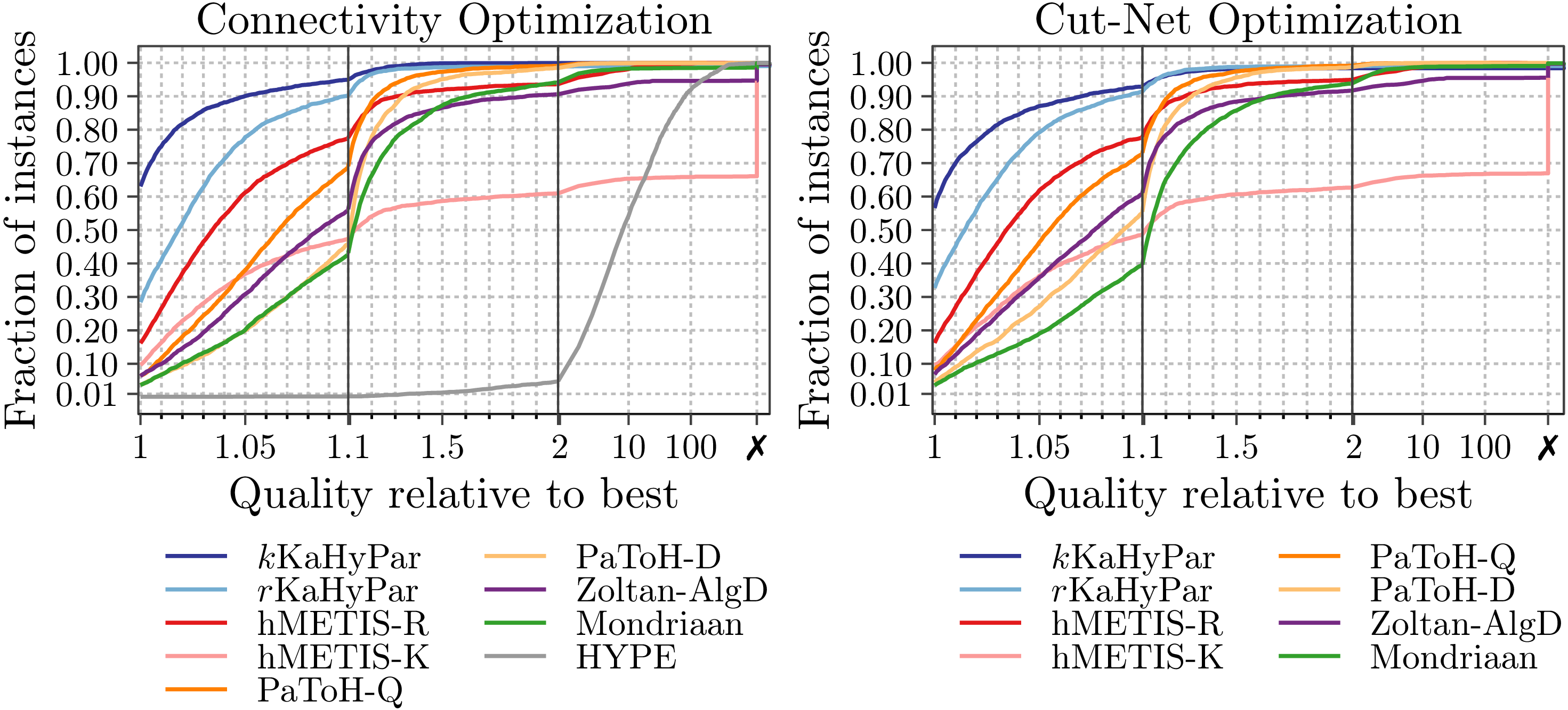
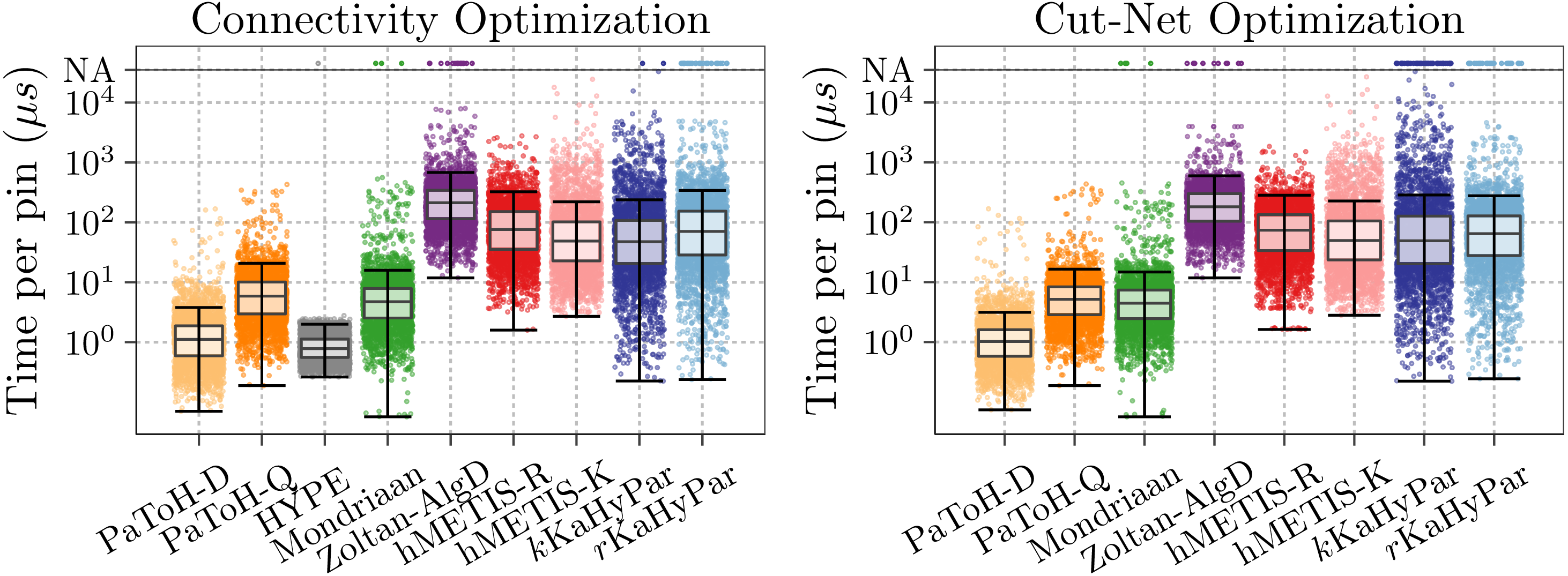
We use the performance profiles to compare KaHyPar to other partitioning algorithms in terms of solution quality.
For a set of 


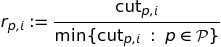
The performance profile 

For connectivity optimization, the performance ratios are computed using the connectivity values 


In our experimental analysis, the performance profile plots are based on the best solutions (i.e., minimum connectivity/cut) each algorithm found for each instance.
Furthermore, we choose parameters 





In the figures, we compare KaHyPar with PaToH in quality (PaToH-Q) and default mode (PaToH-D), the k-way (hMETIS-K) and the recursive bisection variant (hMETIS-R) of hMETIS 2.0 (p1), Zoltan using algebraic distance-based coarsening (Zoltan-AlgD), Mondriaan v.4.2.1 and the recently published HYPE algorithm.
Solution Quality
Running Time
Additional Resources
We provide additional resources for all KaHyPar-related publications:
| kKaHyPar-SEA20 / rKaHyPar-SEA20 |
SEA'20 | Paper | TR | Slides | Experimental Results |
|---|---|---|---|---|---|
| kKaHyPar / rKaHyPar |
- | Dissertation | - | Slides | Experimental Results |
| KaHyPar-MF / KaHyPar-R-MF |
SEA'18 / JEA'19 |
SEA Paper / JEA Paper |
TR | Slides | Experimental Results: SEA / JEA |
| KaHyPar-E (EvoHGP) | GECCO'18 | Paper | TR | Slides | Experimental Results |
| KaHyPar-CA | SEA'17 | Paper | - | Slides | Experimental Results |
| KaHyPar-K | ALENEX'17 | Paper | - | Slides | Experimental Results |
| KaHyPar-R | ALENEX'16 | Paper | TR | Slides | Experimental Results |
Projects using KaHyPar
- CoTenGra - Hyper-optimized Contraction Trees for Large Tensor Networks
- LSOracle - The Logic Synthesis Oracle
- Plasmo.jl - Platform for Scalable Modeling and Optimization
- GraphDot - A GPU-accelerated Python library for graph similarity computation
- ACQDP - Alibaba Cloud Quantum Development Platform
- DECODE - A Computational Pipeline for discovering TCR Binding Rules
- HybridQ - A Hybrid Simulator for Quantum Circuits
- ClusterEnsembles - Consensus Clustering
- TensorCircuit - Quantum Circuit Simulator
- simulate_symacore - Simulation of the Sycamore quantum supremacy circuit
- QML - PennyLane Quantum Machine Learning Demos
Requirements
The Karlsruhe Hypergraph Partitioning Framework requires:
- A 64-bit operating system. Linux, Mac OS X and Windows (through the Windows Subsystem for Linux) are currently supported.
- A modern,
-ready compiler such as
g++version 9 or higher orclangversion 11.0.3 or higher. - The cmake build system.
- The Boost.Program_options library and the boost header files. If you don't want to install boost yourself, you can add the
-DKAHYPAR_USE_MINIMAL_BOOST=ONflag to the cmake command to download, extract, and build the necessary dependencies automatically.
Building KaHyPar
-
Clone the repository including submodules:
git clone --depth=1 --recursive git@github.com:SebastianSchlag/kahypar.git -
Create a build directory:
mkdir build && cd build -
Run cmake:
cmake .. -DCMAKE_BUILD_TYPE=RELEASE -
Run make:
make
Testing and Profiling
Tests are automatically executed while project is built. Additionally a test target is provided.
End-to-end integration tests can be started with: make integration_tests. Profiling can be enabled via cmake flag: -DENABLE_PROFILE=ON.
Running KaHyPar
The standalone program can be built via make KaHyPar. The binary will be located at: build/kahypar/application/.
KaHyPar has several configuration parameters. For a list of all possible parameters please run: ./KaHyPar --help.
We use the hMetis format for the input hypergraph file as well as the partition output file.
The command line parameter --quiet=1 can be used to suppress all logging output. If you are using the library interfaces, adding quiet=1 to the corresponding .ini configuration file has the same effect.
Default / Most Recent Presets
We provide two default framework configurations - one for recursive bipartitioning (rKaHyPar) and one for direct k-way partitioning (kKaHyPar).
To start kKaHyPar optimizing the (connectivity - 1) objective run:
./KaHyPar -h <path-to-hgr> -k <# blocks> -e <imbalance (e.g. 0.03)> -o km1 -m direct -p ../../../config/km1_kKaHyPar_sea20.ini
To start kKaHyPar optimizing the cut net objective run:
./KaHyPar -h <path-to-hgr> -k <# blocks> -e <imbalance (e.g. 0.03)> -o cut -m direct -p ../../../config/cut_kKaHyPar_sea20.ini
To start rKaHyPar optimizing the (connectivity - 1) objective run:
./KaHyPar -h <path-to-hgr> -k <# blocks> -e <imbalance (e.g. 0.03)> -o km1 -m recursive -p ../../../config/km1_rKaHyPar_sea20.ini
To start rKaHyPar optimizing the cut net objective run:
./KaHyPar -h <path-to-hgr> -k <# blocks> -e <imbalance (e.g. 0.03)> -o cut -m recursive -p ../../../config/cut_rKaHyPar_sea20.ini
To start the memetic algorithm kKaHyPar-E optimizing the (connectivity - 1) objective run:
./KaHyPar -h <path-to-hgr> -k <# blocks> -e <imbalance (e.g. 0.03)> -o km1 -m direct -p ../../../config/km1_kKaHyPar-E_sea20.ini
Old Presets
Additionally, we provide different presets that correspond to the configurations used in the publications at ALENEX'16, ALENEX'17, SEA'17, SEA'18, GECCO'18, as well as in our JEA journal paper and in the dissertation of Sebastian Schlag. These configurations are located in the config/old_reference_configs folder. In order to use these configurations, you have to checkout KaHyPar release 1.1.0, since some old code as been removed in the most current release.
To start KaHyPar-MF (using flow-based refinement) optimizing the (connectivity - 1) objective using direct k-way mode run:
./KaHyPar -h <path-to-hgr> -k <# blocks> -e <imbalance (e.g. 0.03)> -o km1 -m direct -p ../../../config/old_reference_configs/km1_kahypar_mf_jea19.ini
To start KaHyPar-MF (using flow-based refinement) optimizing the cut-net objective using direct k-way mode run:
./KaHyPar -h <path-to-hgr> -k <# blocks> -e <imbalance (e.g. 0.03)> -o cut -m direct -p ../../../config/old_reference_configs/cut_kahypar_mf_jea19.ini
To start EvoHGP/KaHyPar-E optimizing the (connectivity - 1) objective using direct k-way mode run
./KaHyPar -h <path-to-hgr> -k <# blocks> -e <imbalance (e.g. 0.03)> -o km1 -m direct -p ../../../config/old_reference_configs/km1_direct_kway_gecco18.ini
Note that the configuration km1_direct_kway_gecco18.ini is based on KaHyPar-CA. However, KaHyPar-E also works with flow-based local improvements. In our JEA publication the km1_kahypar_e_mf_jea19.ini configuration was used.
To start KaHyPar-CA (using community-aware coarsening) optimizing the (connectivity - 1) objective using direct k-way mode run:
./KaHyPar -h <path-to-hgr> -k <# blocks> -e <imbalance (e.g. 0.03)> -o km1 -m direct -p ../../../config/old_reference_configs/km1_direct_kway_sea17.ini
To start KaHyPar in direct k-way mode (KaHyPar-K) optimizing the (connectivity - 1) objective run:
./KaHyPar -h <path-to-hgr> -k <# blocks> -e <imbalance (e.g. 0.03)> -o km1 -m direct -p ../../../config/old_reference_configs/km1_direct_kway_alenex17.ini
To start KaHyPar in recursive bisection mode (KaHyPar-R) optimizing the cut-net objective run:
./KaHyPar -h <path-to-hgr> -k <# blocks> -e <imbalance (e.g. 0.03)> -o cut -m recursive -p ../../../config/old_reference_configs/cut_rb_alenex16.ini
All preset parameters can be overwritten by using the corresponding command line options.
Using the Library Interfaces
The C-Style Interface
We provide a simple C-style interface to use KaHyPar as a library. Note that this interface is not thread-safe yet. However there are some existing workarounds. The library can be built and installed via
make install.library
and can be used like this:
#include <memory>
#include <vector>
#include <iostream>

#include <libkahypar.h>

int main(int argc, char* argv[]) {

  kahypar_context_t* context = kahypar_context_new();
  kahypar_configure_context_from_file(context, "/path/to/config.ini");

  kahypar_set_seed(context, 42);

  const kahypar_hypernode_id_t num_vertices = 7;
  const kahypar_hyperedge_id_t num_hyperedges = 4;

  std::unique_ptr<kahypar_hyperedge_weight_t[]> hyperedge_weights = std::make_unique<kahypar_hyperedge_weight_t[]>(4);

  // force the cut to contain hyperedge 0 and 2
  hyperedge_weights[0] = 1;  hyperedge_weights[1] = 1000;
  hyperedge_weights[2] = 1;  hyperedge_weights[3] = 1000;

  std::unique_ptr<size_t[]> hyperedge_indices = std::make_unique<size_t[]>(5);

  hyperedge_indices[0] = 0; hyperedge_indices[1] = 2;
  hyperedge_indices[2] = 6; hyperedge_indices[3] = 9;
  hyperedge_indices[4] = 12;

  std::unique_ptr<kahypar_hyperedge_id_t[]> hyperedges = std::make_unique<kahypar_hyperedge_id_t[]>(12);

  // hypergraph from hMetis manual page 14
  hyperedges[0] = 0;  hyperedges[1] = 2;
  hyperedges[2] = 0;  hyperedges[3] = 1;
  hyperedges[4] = 3;  hyperedges[5] = 4;
  hyperedges[6] = 3;  hyperedges[7] = 4;
  hyperedges[8] = 6;  hyperedges[9] = 2;
  hyperedges[10] = 5; hyperedges[11] = 6;

  const double imbalance = 0.03;
  const kahypar_partition_id_t k = 2;

  kahypar_hyperedge_weight_t objective = 0;

  std::vector<kahypar_partition_id_t> partition(num_vertices, -1);

  kahypar_partition(num_vertices, num_hyperedges,
       	            imbalance, k,
               	    /*vertex_weights */ nullptr, hyperedge_weights.get(),
               	    hyperedge_indices.get(), hyperedges.get(),
       	            &objective, context, partition.data());

  for(int i = 0; i != num_vertices; ++i) {
    std::cout << i << ":" << partition[i] << std::endl;
  }

  kahypar_context_free(context);
}
To compile the program using g++ run:
g++ -std=c++14 -DNDEBUG -O3 -I/usr/local/include -L/usr/local/lib -lkahypar -L/path/to/boost/lib -I/path/to/boost/include -lboost_program_options program.cc -o program
To remove the library from your system use the provided uninstall target:
make uninstall-kahypar
The Python Interface
To compile the Python interface, do the following:
- Create a build directory:
mkdir build && cd build - If you have boost installed on your system, run cmake:
cmake .. -DCMAKE_BUILD_TYPE=RELEASE -DKAHYPAR_PYTHON_INTERFACE=1. If you don't have boost installed, run:cmake .. -DCMAKE_BUILD_TYPE=RELEASE -DKAHYPAR_PYTHON_INTERFACE=1 -DKAHYPAR_USE_MINIMAL_BOOST=ONinstead. This will download, extract, and build the necessary dependencies automatically. - Go to libary folder:
cd python - Compile the libarary:
make - Copy the libary to your site-packages directory:
cp kahypar.so <path-to-site-packages>
After that you can use the KaHyPar libary like this:
import os
import kahypar as kahypar

num_nodes = 7
num_nets = 4

hyperedge_indices = [0,2,6,9,12]
hyperedges = [0,2,0,1,3,4,3,4,6,2,5,6]

node_weights = [1,2,3,4,5,6,7]
edge_weights = [11,22,33,44]

k=2

hypergraph = kahypar.Hypergraph(num_nodes, num_nets, hyperedge_indices, hyperedges, k, edge_weights, node_weights)

context = kahypar.Context()
context.loadINIconfiguration("<path/to/config>/km1_kKaHyPar_sea20.ini")

context.setK(k)
context.setEpsilon(0.03)

kahypar.partition(hypergraph, context)
For more information about the python library functionality, please see: module.cpp
We also provide a precompiled version as a 
python3 -m pip install --index-url https://pypi.org/simple/ --no-deps kahypar
The Julia Interface
Thanks to Jordan Jalving (@jalving) KaHyPar now also offers a Julia interface, which can currently be found here: kahypar/KaHyPar.jl.
The corresponding dependency can be installed via:
using Pkg
Pkg.add(PackageSpec(url="https://github.com/jalving/KaHyPar.jl.git"))
Pkg.test("KaHyPar")
After that, you can use KaHyPar to partition your hypergraphs like this:
using KaHyPar
using SparseArrays

I = [1,3,1,2,4,5,4,5,7,3,6,7]
J = [1,1,2,2,2,2,3,3,3,4,4,4]
V = Int.(ones(length(I)))

A = sparse(I,J,V)

h = KaHyPar.hypergraph(A)

KaHyPar.partition(h,2,configuration = :edge_cut)

KaHyPar.partition(h,2,configuration = :connectivity)

KaHyPar.partition(h,2,configuration = joinpath(@__DIR__,"../src/config/km1_kKaHyPar_sea20.ini"))
The Java Interface
Romain Wallon has created a Java interface for KaHyPar. Please refer to the readme for a detailed description on how to build and use the interface.
Bug Reports
We encourage you to report any problems with KaHyPar via the github issue tracking system of the project.
Licensing
KaHyPar is free software provided under the GNU General Public License (GPLv3). For more information see the COPYING file. We distribute this framework freely to foster the use and development of hypergraph partitioning tools. If you use KaHyPar in an academic setting please cite the appropriate papers. If you are interested in a commercial license, please contact me.
// Overall KaHyPar framework
@phdthesis{DBLP:phd/dnb/Schlag20,
  author    = {Sebastian Schlag},
  title     = {High-Quality Hypergraph Partitioning},
  school    = {Karlsruhe Institute of Technology, Germany},
  year      = {2020}
}

@article{10.1145/3529090,
  author = {Schlag, Sebastian and
            Heuer, Tobias and
            Gottesb\"{u}ren, Lars and
            Akhremtsev, Yaroslav and
            Schulz, Christian and
            Sanders, Peter},
  title = {High-Quality Hypergraph Partitioning},
  url = {https://doi.org/10.1145/3529090},
  doi = {10.1145/3529090},
  journal = {ACM J. Exp. Algorithmics},
  year = {2022},
  month = {mar}
}

// KaHyPar-R
@inproceedings{shhmss2016alenex,
 author    = {Sebastian Schlag and
              Vitali Henne and
              Tobias Heuer and
              Henning Meyerhenke and
              Peter Sanders and
              Christian Schulz},
 title     = {k-way Hypergraph Partitioning via \emph{n}-Level Recursive
              Bisection},
 booktitle = {18th Workshop on Algorithm Engineering and Experiments, (ALENEX 2016)},
 pages     = {53--67},
 year      = {2016},
}

// KaHyPar-K
@inproceedings{ahss2017alenex,
 author    = {Yaroslav Akhremtsev and
              Tobias Heuer and
              Peter Sanders and
              Sebastian Schlag},
 title     = {Engineering a direct \emph{k}-way Hypergraph Partitioning Algorithm},
 booktitle = {19th Workshop on Algorithm Engineering and Experiments, (ALENEX 2017)},
 pages     = {28--42},
 year      = {2017},
}

// KaHyPar-CA
@inproceedings{hs2017sea,
 author    = {Tobias Heuer and
              Sebastian Schlag},
 title     = {Improving Coarsening Schemes for Hypergraph Partitioning by Exploiting Community Structure},
 booktitle = {16th International Symposium on Experimental Algorithms, (SEA 2017)},
 pages     = {21:1--21:19},
 year      = {2017},
}

// KaHyPar-MF
@inproceedings{heuer_et_al:LIPIcs:2018:8936,
 author ={Tobias Heuer and Peter Sanders and Sebastian Schlag},
 title ={{Network Flow-Based Refinement for Multilevel Hypergraph Partitioning}},
 booktitle ={17th International Symposium on Experimental Algorithms  (SEA 2018)},
 pages ={1:1--1:19},
 year ={2018}
}


@article{KaHyPar-MF-JEA,
  author = {Heuer, T. and Sanders, P. and Schlag, S.},
  title = {Network Flow-Based Refinement for Multilevel Hypergraph Partitioning},
  journal = {ACM Journal of Experimental Algorithmics (JEA)}},
  volume = {24},
  number = {1},
  month = {09},
  year = {2019},
  pages = {2.3:1--2.3:36},
  publisher = {ACM}
}

// KaHyPar-E (EvoHGP)
@inproceedings{Andre:2018:MMH:3205455.3205475,
 author = {Robin Andre and Sebastian Schlag and Christian Schulz},
 title = {Memetic Multilevel Hypergraph Partitioning},
 booktitle = {Proceedings of the Genetic and Evolutionary Computation Conference},
 series = {GECCO '18},
 year = {2018},
 pages = {347--354},
 numpages = {8}
}

// KaHyPar-SEA20 (KaHyPar-HFC)
@InProceedings{gottesbren_et_al:LIPIcs:2020:12085,
author = {Lars Gottesb{\"u}ren and Michael Hamann and Sebastian Schlag and Dorothea Wagner},
title =	{{Advanced Flow-Based Multilevel Hypergraph Partitioning}},
booktitle = {18th International Symposium on Experimental Algorithms (SEA)},
pages =	{11:1--11:15},
series = {Leibniz International Proceedings in Informatics (LIPIcs)},
year =	{2020}
}
Contributing
If you are interested in contributing to the KaHyPar framework feel free to contact me or create an issue on the issue tracking system.
Release history Release notifications | RSS feed


Download files
Download the file for your platform. If you're not sure which to choose, learn more about installing packages.
Source Distributions
Built Distributions
Filter files by name, interpreter, ABI, and platform.
If you're not sure about the file name format, learn more about wheel file names.
Copy a direct link to the current filters
File details
Details for the file kahypar-1.3.3-pp39-pypy39_pp73-manylinux_2_17_x86_64.manylinux2014_x86_64.whl.
File metadata
- Download URL: kahypar-1.3.3-pp39-pypy39_pp73-manylinux_2_17_x86_64.manylinux2014_x86_64.whl
- Upload date:
- Size: 1.1 MB
- Tags: PyPy, manylinux: glibc 2.17+ x86-64
- Uploaded using Trusted Publishing? No
- Uploaded via: twine/4.0.1 CPython/3.8.10
File hashes
| Algorithm | Hash digest | |
|---|---|---|
| SHA256 |
ed43bcdf844d439f52a134f5480248c59e4c3e96c2f18d5740c3d4a40542fce3
|
|
| MD5 |
bcd62e8d31357fe4baf8dadb6434002c
|
|
| BLAKE2b-256 |
deb231f874667c41f388f2d39b2e81241bd2d6c84b303469f6680fb6c0b3d4d1
|
File details
Details for the file kahypar-1.3.3-pp38-pypy38_pp73-manylinux_2_17_x86_64.manylinux2014_x86_64.whl.
File metadata
- Download URL: kahypar-1.3.3-pp38-pypy38_pp73-manylinux_2_17_x86_64.manylinux2014_x86_64.whl
- Upload date:
- Size: 1.1 MB
- Tags: PyPy, manylinux: glibc 2.17+ x86-64
- Uploaded using Trusted Publishing? No
- Uploaded via: twine/4.0.1 CPython/3.8.10
File hashes
| Algorithm | Hash digest | |
|---|---|---|
| SHA256 |
9ec2b52a9ac5db87b585b8a2036742c64d528a7107b0f4e64b5d9c3ab8793a48
|
|
| MD5 |
fb23ed015a2fe61f007cce3b306d8a22
|
|
| BLAKE2b-256 |
7d9ed2923723fe285abc966ad501deee2e037998bdd525be0bea1a1f98fceb20
|
File details
Details for the file kahypar-1.3.3-pp37-pypy37_pp73-manylinux_2_17_x86_64.manylinux2014_x86_64.whl.
File metadata
- Download URL: kahypar-1.3.3-pp37-pypy37_pp73-manylinux_2_17_x86_64.manylinux2014_x86_64.whl
- Upload date:
- Size: 1.1 MB
- Tags: PyPy, manylinux: glibc 2.17+ x86-64
- Uploaded using Trusted Publishing? No
- Uploaded via: twine/4.0.1 CPython/3.8.10
File hashes
| Algorithm | Hash digest | |
|---|---|---|
| SHA256 |
5e6c79b87663388ce609b5d3d0ecc6ae14d27cfa5fa12280bc15863ae9cf6c48
|
|
| MD5 |
0012760c48a6a5cce14b62783fa2a233
|
|
| BLAKE2b-256 |
d9bd5abf479cf3b98a4fb821cd20bc6fd9a437347042df73f0c9dc07a13860fa
|
File details
Details for the file kahypar-1.3.3-cp310-cp310-manylinux_2_17_x86_64.manylinux2014_x86_64.whl.
File metadata
- Download URL: kahypar-1.3.3-cp310-cp310-manylinux_2_17_x86_64.manylinux2014_x86_64.whl
- Upload date:
- Size: 1.1 MB
- Tags: CPython 3.10, manylinux: glibc 2.17+ x86-64
- Uploaded using Trusted Publishing? No
- Uploaded via: twine/4.0.1 CPython/3.8.10
File hashes
| Algorithm | Hash digest | |
|---|---|---|
| SHA256 |
afa285d1f7de8783694eccbd00d786140034764a9bfee1a9f9001626c87352a6
|
|
| MD5 |
f52cadf6128c09fe07f68e6d5f026025
|
|
| BLAKE2b-256 |
1a47bfdbf5fa7a3bcbbc477da21683bcbe8db94f14e49368f58c36d87075e7e6
|
File details
Details for the file kahypar-1.3.3-cp310-cp310-macosx_11_0_arm64.whl.
File metadata
- Download URL: kahypar-1.3.3-cp310-cp310-macosx_11_0_arm64.whl
- Upload date:
- Size: 766.1 kB
- Tags: CPython 3.10, macOS 11.0+ ARM64
- Uploaded using Trusted Publishing? No
- Uploaded via: twine/4.0.1 CPython/3.8.10
File hashes
| Algorithm | Hash digest | |
|---|---|---|
| SHA256 |
542e6afc750aa70bb0994a7070d02823cce7dfc43231c72adf056637dba188e4
|
|
| MD5 |
35f0493ec0fffd4df2502420bb60ce08
|
|
| BLAKE2b-256 |
f4d9b97dd8aaa552efff3c5bea0d32d6c0c3bda3f67b505d06d20636da605525
|
File details
Details for the file kahypar-1.3.3-cp39-cp39-manylinux_2_17_x86_64.manylinux2014_x86_64.whl.
File metadata
- Download URL: kahypar-1.3.3-cp39-cp39-manylinux_2_17_x86_64.manylinux2014_x86_64.whl
- Upload date:
- Size: 1.1 MB
- Tags: CPython 3.9, manylinux: glibc 2.17+ x86-64
- Uploaded using Trusted Publishing? No
- Uploaded via: twine/4.0.1 CPython/3.8.10
File hashes
| Algorithm | Hash digest | |
|---|---|---|
| SHA256 |
512fc0e17f178e45716c23051fffec85522eaf291575705d4a9733e4eceb5a53
|
|
| MD5 |
4e0914f5d25b03b7c690deb92d3a197b
|
|
| BLAKE2b-256 |
4d41129cfa280492b5800fd16b004d89f63ca729681ba6cf2176dfb7f886dee9
|
File details
Details for the file kahypar-1.3.3-cp39-cp39-macosx_11_0_arm64.whl.
File metadata
- Download URL: kahypar-1.3.3-cp39-cp39-macosx_11_0_arm64.whl
- Upload date:
- Size: 766.2 kB
- Tags: CPython 3.9, macOS 11.0+ ARM64
- Uploaded using Trusted Publishing? No
- Uploaded via: twine/4.0.1 CPython/3.8.10
File hashes
| Algorithm | Hash digest | |
|---|---|---|
| SHA256 |
a3fed3c22c70a2374b7cae2ea51576f2901b4dd36a299da590587048b0543f38
|
|
| MD5 |
1809a7aab2dd47cc79c5034ee217e9c6
|
|
| BLAKE2b-256 |
c150b8379d2b25fca416a4861f12dfd4f857abdb7a712894c7ff7a5ded6fd2c1
|
File details
Details for the file kahypar-1.3.3-cp38-cp38-manylinux_2_17_x86_64.manylinux2014_x86_64.whl.
File metadata
- Download URL: kahypar-1.3.3-cp38-cp38-manylinux_2_17_x86_64.manylinux2014_x86_64.whl
- Upload date:
- Size: 1.1 MB
- Tags: CPython 3.8, manylinux: glibc 2.17+ x86-64
- Uploaded using Trusted Publishing? No
- Uploaded via: twine/4.0.1 CPython/3.8.10
File hashes
| Algorithm | Hash digest | |
|---|---|---|
| SHA256 |
86ccc732d4bebc2da118ccba476afb3b94ea04382e4ebc416546b52e494c266b
|
|
| MD5 |
93d63342e9b2977a6497a402e51f6242
|
|
| BLAKE2b-256 |
b5307de8534ab6d83ac0b809ff7ff25faf30f9705701e3dfe8d978c0a3b0df6f
|
File details
Details for the file kahypar-1.3.3-cp38-cp38-macosx_11_0_arm64.whl.
File metadata
- Download URL: kahypar-1.3.3-cp38-cp38-macosx_11_0_arm64.whl
- Upload date:
- Size: 894.4 kB
- Tags: CPython 3.8, macOS 11.0+ ARM64
- Uploaded using Trusted Publishing? No
- Uploaded via: twine/4.0.1 CPython/3.8.10
File hashes
| Algorithm | Hash digest | |
|---|---|---|
| SHA256 |
9e1b0abbb059944a764b89269f6d08e77a68085f7709e43f5698375c08f2a5e2
|
|
| MD5 |
4cdf852fa7cd1dcb58813b219e4296bb
|
|
| BLAKE2b-256 |
f4845a794ea40c79e7ff4de38c75b221bb73705ea22684861dbd93d6cf200d48
|
File details
Details for the file kahypar-1.3.3-cp37-cp37m-manylinux_2_17_x86_64.manylinux2014_x86_64.whl.
File metadata
- Download URL: kahypar-1.3.3-cp37-cp37m-manylinux_2_17_x86_64.manylinux2014_x86_64.whl
- Upload date:
- Size: 1.1 MB
- Tags: CPython 3.7m, manylinux: glibc 2.17+ x86-64
- Uploaded using Trusted Publishing? No
- Uploaded via: twine/4.0.1 CPython/3.8.10
File hashes
| Algorithm | Hash digest | |
|---|---|---|
| SHA256 |
b9a7228395f71ce0344b4079ae33bc237f531260684add21d6baed50f70e8b33
|
|
| MD5 |
b0e1e32d15314e37619a88bf0afd25f5
|
|
| BLAKE2b-256 |
0cac1de5478df878a8d5d8b386361214608223d2cd7f1945afb9ee1c55db2337
|
File details
Details for the file kahypar-1.3.3-cp36-cp36m-manylinux_2_17_x86_64.manylinux2014_x86_64.whl.
File metadata
- Download URL: kahypar-1.3.3-cp36-cp36m-manylinux_2_17_x86_64.manylinux2014_x86_64.whl
- Upload date:
- Size: 1.1 MB
- Tags: CPython 3.6m, manylinux: glibc 2.17+ x86-64
- Uploaded using Trusted Publishing? No
- Uploaded via: twine/4.0.1 CPython/3.8.10
File hashes
| Algorithm | Hash digest | |
|---|---|---|
| SHA256 |
16d2617c6da9ca3f5a87a513b4f5cc49f27070c158461aba7a0b4a76f23315a6
|
|
| MD5 |
86c97dabd81ad931862ca60f3aa86c0c
|
|
| BLAKE2b-256 |
92777797b5f0b0ef6d3fda669c32deb15102ea140b1887471bc1a11d59732310
|






