


Kaval.AI is an opinionated Python library for building well-defined, testable and robust agentic workflows, chatbots and tools.
- Any model, one interface — OpenAI, Google, Anthropic, Ollama and in-browser WebLLM (LLM clients, running in the browser).
- Typed end to end — inputs, outputs and tool calls are Pydantic models (typed inputs and outputs).
- Retrieval built in — RAG over SQLite or PostgreSQL/pgvector, with local or hosted embeddings (RAG).
- Workflows as graphs — conditional routing, parallel fan-out, agents and tool calls, in Python or YAML (workflows).
- Tools your way — Python functions, REST endpoints and MCP servers (tools).
- Streaming from a single model call to a whole workflow (streaming).
- Full observability — every session, run, node and model call is recorded and browsable in the backoffice UI (data model).
Check out docs.kaval.ai for examples and in-depth tutorials.
Install
pip install "kavalai[common]"
common brings the provider SDKs, RAG, MCP and the servers.
See
Installation for more details.
Getting started
Call a model
Name a model as provider/model and make_client does the rest.
from kavalai import make_client

client = make_client("openai/gpt-5.6-luna")
answer = await client.prompt("What is the capital of Estonia?")
print (answer)
Response:
The capital of Estonia is **Tallinn**.
Use structured responses by passing a Pydantic model:
from pydantic import BaseModel


class City(BaseModel):
    name: str
    country: str
    fun_fact: str

city = await client.prompt("Describe Tallinn.", response_model=City)
print(city)
Response:
name='Tallinn' country='Estonia'
fun_fact='Tallinn’s remarkably well-preserved medieval Old Town is a UNESCO
          World Heritage Site, and the city is widely regarded as one of the
          world’s most digitally advanced capitals.'
Tools and agents
Kaval.AI has built-in agent loop that supports tool calling:
from datetime import date

from pydantic import BaseModel

from kavalai import Agent, FunctionKernel, make_client, pythontool
from kavalai.tools.webtools.crawl4ai import web_search


@pythontool
def today() -> str:
    """Return today's date in ISO format."""
    return date.today().isoformat()


class Answer(BaseModel):
    answer: str
    sources: list[str]


kernel = FunctionKernel()
kernel.register_python_tool("today", today)
kernel.register_python_tool("web_search", web_search)

agent = Agent(llm_client=make_client("openai/gpt-5.6-luna"), kernel=kernel)
result = await agent.prompt(
    "When is the next Tallinn Marathon, and how many days away is it?",
    response_model=Answer,
    max_steps=5,
)
print(result.answer)
for url in result.sources:
    print(url)
Response:
The next Tallinn Marathon is scheduled for **Sunday, September 13, 2026**.
From today, **August 28, 2026**, it is **16 days away**.

Sources:
- https://marathonscout.com/races/swedbank-tallinn-marathon
- https://www.jooks.ee/en/tallinn-marathon/
https://marathonscout.com/races/swedbank-tallinn-marathon
https://www.jooks.ee/en/tallinn-marathon/
See using Agents & tools for more.
Using retrieval-augmented generation (RAG)
Retrieval-agumented generation allows the model to operate with data it was not trained with:
FACTS = """\
Green Village has 104 residents.
Green Village was founded on 03.09.1887 by shepherd Elias Thornbury.
President of Green Village is Thomas Cook (born 12.04.1994).
Green Village's oldest resident is Agnes Whitlow (born 02.06.1929).
The annual Turnip Festival takes place every year on the third Saturday of October.
The village bakery, run by Greta Lindqvist (born 27.11.1968), sells exactly 340 loaves every week.
Green Village's football team, FC Green Rovers, has won the regional cup twice (1997 and 2013).
Green Village's only pub, The Rusty Anchor, has been operating since 1923.
""".splitlines()
Index the data the way you want
from kavalai.rag import SqliteRagService

rag = SqliteRagService(":memory:", model="fastembed/BAAI/bge-small-en-v1.5")
await rag.index_batch(
    texts=FACTS,
    metadata_list=[{"village": "Green Village"}] * len(FACTS),
    source_ids=[f"fact-{i}" for i in range(len(FACTS))],
)
Query the dataset
question = "How old was the Green Village's oldest resident on 2025 Turnip Festival?"

hits = await rag.query(question, top_k=5)
for hit in hits:
    print(f"{hit.similarity:.2f}  {hit.content}")
0.79  Green Village's oldest resident is Agnes Whitlow (born 02.06.1929).
0.70  Green Village has 104 residents.
0.68  President of Green Village is Thomas Cook (born 12.04.1994).
0.67  Green Village was founded on 03.09.1887 by shepherd Elias Thornbury.
0.62  The annual Turnip Festival takes place every year on the third Saturday of October.
Check out the RAG tutorial.
Building a workflow
Turn the Green Village index above into a chatbot: a rag_query node
fetches the closest facts for the user's message, and an llm node answers
from them.
from pydantic import BaseModel

from kavalai.workflow import WorkflowBuilder


class Message(BaseModel):
    user_message: str


class Reply(BaseModel):
    agent_response: str


engine = (
    WorkflowBuilder("Green Village support", llm_model="openai/gpt-5.6-luna")
    .data_model("input", Message)
    .data_model("output", Reply)
    .start("get_related_facts")
    .rag_query(
        "get_related_facts",
        query="{{ context.input.user_message }}",
        output="facts",
        top_k=5,
        store="content",
        next="reply",
    )
    .llm(
        "reply",
        prompt=(
            "You are the assistant of the Green Village tourist "
            "information centre. Answer using only these facts:\n"
            "{{ context.facts }}"
        ),
        inputs={"input": "input", "facts": "facts"},
        output="output",
        next="end",
    )
    .end()
    .build_engine(rag_services=rag)
)

state = await engine.run({"user_message": question})
print(state.output_data)
print(state.status, state.token_usage)
Response:
{'agent_response': 'Agnes Whitlow was 96 years old at the 2025 Turnip '
                   'Festival, held on 18 October 2025.'}
completed {'model_calls': 1, 'prompt_tokens': 239,
           'completion_tokens': 109, 'total_tokens': 348}
See Workflows tutorial for more info.
The backoffice UI
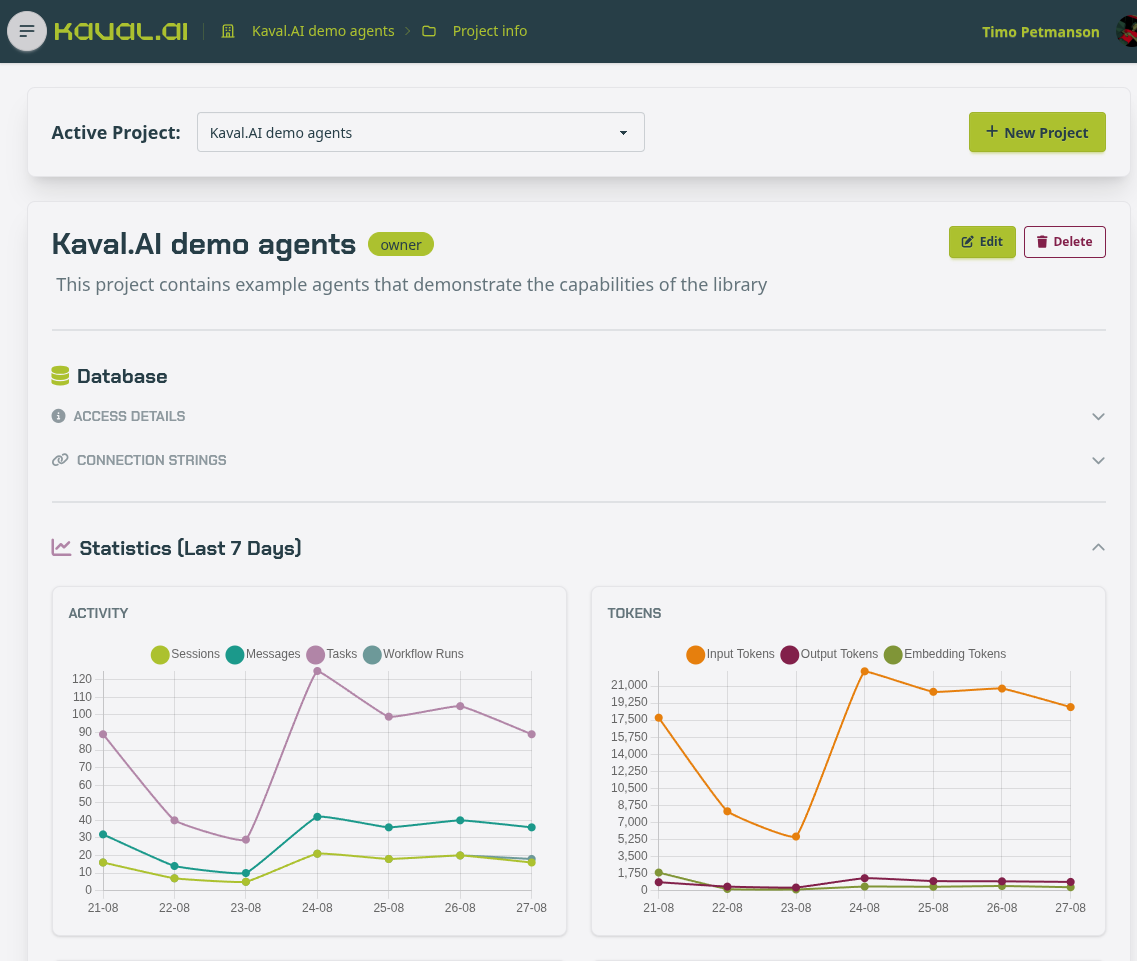
Use the Backoffice UI. to observe and debug chat sessions, workflow runs and inspect RAG.
License
1 maintainer

Release files for kavalai 1.0.5
For a detailed explanation of source distributions (sdists) and built distributions (wheels), please see the package formats documentation.
Source distribution (sdist)
| File | Size | Uploaded | |
|---|---|---|---|
| kavalai-1.0.5.tar.gz | 357.8 kB | Details |
Built distribution (wheel)
| File | Interpreter | ABI | Platform | Reset |
|---|---|---|---|---|
| kavalai-1.0.5-py3-none-any.whl | Python 3 | none | any | Details |
Total release size: 704.4 kB
Release files / kavalai-1.0.5.tar.gz
| Download URL | kavalai-1.0.5.tar.gz |
|---|---|
| Size | 357.8 kB |
| Tags | Source |
|
SHA-256 checksum How to use checksums |
18534bd2fc9a615c8e8229dfe0c12fa9008e33715c3db6bdee3fbcb4211f4c27
|
|
BLAKE2b-256 checksum How to use checksums |
3a5bd39e782f17cbf98c97a4155e0225ee4fde32c4ace195cb41b1fa9847c531
|
| Upload date | |
|
Uploaded using Trusted Publishing? What is trusted publishing? |
Yes |
| Uploaded via |
twine/7.0.0 CPython/3.13.14
|
Provenance
Provenance describes where a file came from. On PyPI, provenance is shared via attestations, which provide a verifiable record of the build or publishing details. View details, limitations and caveats.


PyPI Publish Attestation
PyPI verified that this artifact, at this checksum, originated from the publisher listed below.
Signed by GitHub Actions, verified by PyPI on Sep 25, 2026.
Transparency logRelease files / kavalai-1.0.5-py3-none-any.whl
| Download URL | kavalai-1.0.5-py3-none-any.whl |
|---|---|
| Size | 346.6 kB |
| Tags | Python 3 |
|
SHA-256 checksum How to use checksums |
75c1d1827cc95e8ee78e96f4cb685f5f348b53104ff897e6c58a95b40b84bfb5
|
|
BLAKE2b-256 checksum How to use checksums |
8e5232ef4ec16711d2eab065829cc6714e474f97956872096f5955f1b0292072
|
| Upload date | |
|
Uploaded using Trusted Publishing? What is trusted publishing? |
Yes |
| Uploaded via |
twine/7.0.0 CPython/3.13.14
|
Provenance
Provenance describes where a file came from. On PyPI, provenance is shared via attestations, which provide a verifiable record of the build or publishing details. View details, limitations and caveats.
PyPI Publish Attestation
PyPI verified that this artifact, at this checksum, originated from the publisher listed below.
Signed by GitHub Actions, verified by PyPI on Sep 25, 2026.
Transparency log













