
KB Arena
Compare retrieval architectures on your own documentation and choose with evidence.





KB Arena runs the same corpus and question set through 19 built-in retrieval strategies, lexical, dense, graph, hybrid, hierarchical, reranked, and more. It records retrieval quality, answer quality, latency, cost, and run artifacts, so you can decide which design fits your data before you build on it.
Use it before you commit to a retrieval architecture, or as a regression lab after your corpus, chunking, model, or index changes.
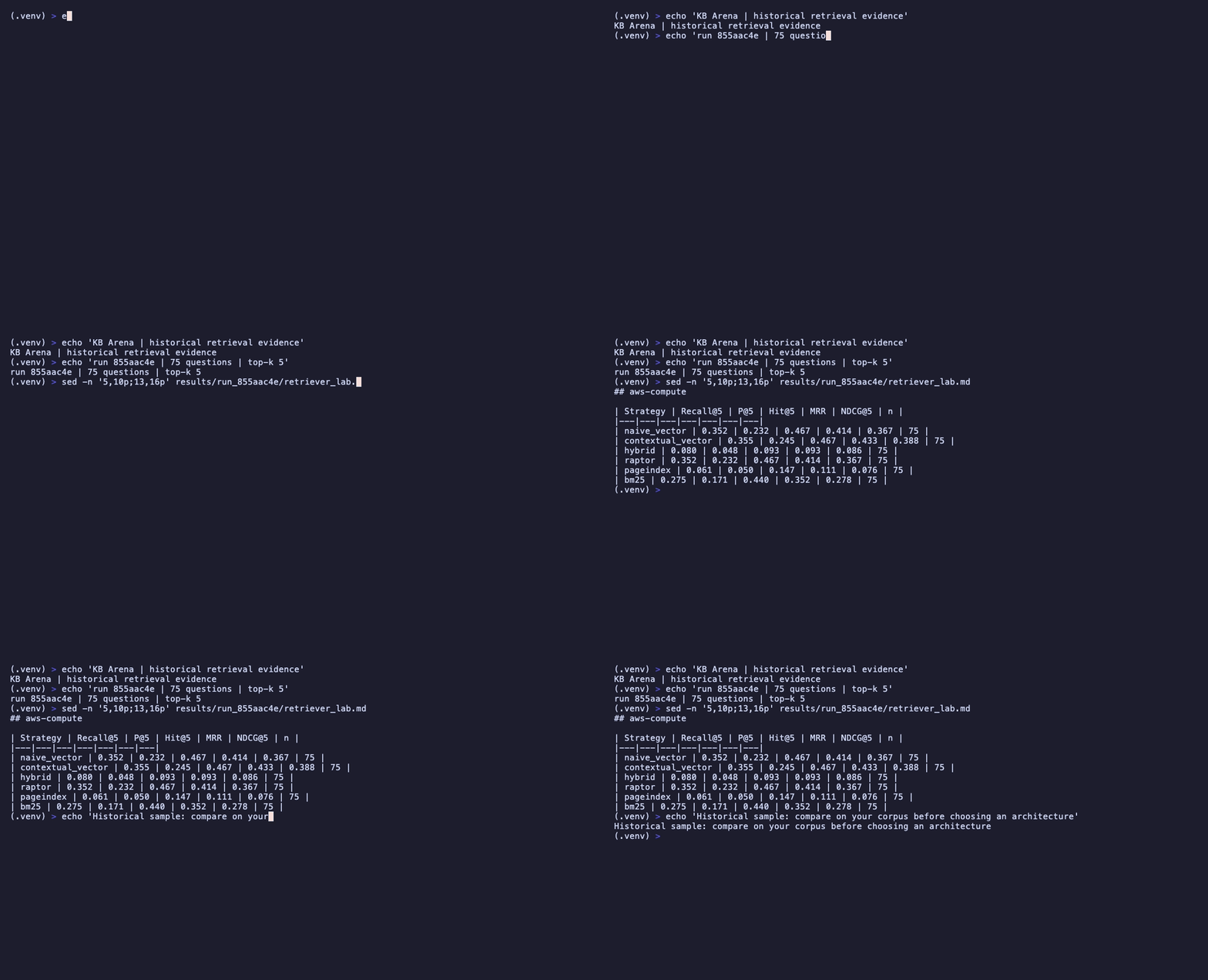
Explore a checked result
The packaged demo uses precomputed AWS Compute results. It needs no API key, Docker service, or Neo4j instance.
pip install kb-arena
kb-arena demo
Open the URL printed by the command. The demo ships 8 benchmark result files for the
aws-compute corpus, one per strategy, so the benchmark table, the per-tier breakdown, the
source drill-down and the strategy comparison all have real numbers behind them.
The Retriever Lab and the spread across repeated runs are empty until you produce them. They
read run directories, and the package bundles none. Run kb-arena retriever-lab and
kb-arena benchmark --runs 3 against a corpus to fill them.
Point it at your own documents
Ingest your files, build the strategy your provider budget allows, and score retrieval for free through BM25, the one built-in strategy that needs no key. Run it on your documents below has the setup for local and hosted providers, and the own-corpus walkthrough runs ingest through an exported evidence bundle with the real console output from each step.
Four ways to run a comparison
- CLI runs
kb-arena, with commands fromingestthroughevidence. See the command reference. - HTTP API starts with
kb-arena serve, which runs the FastAPI server behind the dashboard. See the HTTP reference for every route and its auth gate. - MCP server installs with
pip install 'kb-arena[mcp]', then runs withpython3 -m kb_arena.mcp.server. It exposes corpus, strategy, benchmark, and evidence tools over stdio to an MCP client such as Claude Code or Codex. See the server module. - GitHub Action
retrieval-regression-gateingests a corpus, builds an index, and fails a pull request when a named metric drops past a threshold. See the example workflow.
What KB Arena helps decide
| Question | Comparison |
|---|---|
| Do exact terms matter more than semantic similarity? | BM25 against dense retrieval |
| Does document context improve chunk retrieval? | Naive against contextual vector |
| Do cross-document relationships justify a graph? | Dense against graph and hybrid |
| Does hierarchy help on broad questions? | Dense against RAPTOR and PageIndex |
| Is a reranker worth its latency and cost? | Dense against reranked dense |
| Is a proposed method meaningfully different? | Paired scores, confidence intervals, and rank overlap |
KB Arena does not give a universal leaderboard. A result applies to the corpus, questions, ground truth, configuration, and models named in that run.
Evidence included in this repository
The tracked Retriever Lab run 855aac4e is a historical, reproducible example:
- Corpus:
aws-compute, three documents and 1,549 words - Run date: 2026-04-26
- Questions: 75 across five tiers
- Cutoff: top 5 chunks
- Chunk-level labels: 35 questions have labels, and 40 do not
- Scope: eight strategies from the version available on the run date
| Strategy | Recall@5 | MRR | NDCG@5 |
|---|---|---|---|
| Contextual Vector | 0.355 | 0.433 | 0.388 |
| Naive Vector | 0.352 | 0.414 | 0.367 |
| RAPTOR | 0.352 | 0.414 | 0.367 |
| BM25 | 0.275 | 0.352 | 0.278 |
| Hybrid | 0.080 | 0.093 | 0.086 |
| PageIndex | 0.061 | 0.111 | 0.076 |
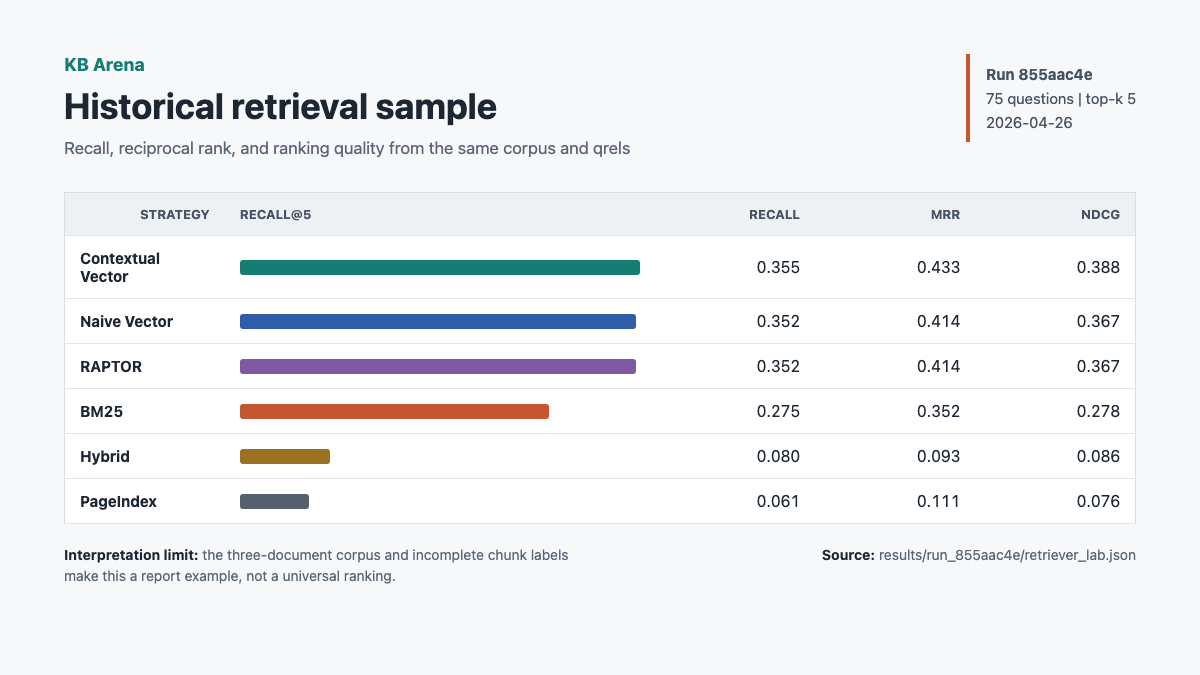
Source: tracked report and run artifact.
These numbers show the report format and calculation path. The corpus is too small, and its chunk labels are too incomplete, to support a general winner claim. Q&A Pairs and Knowledge Graph from that run have zero chunk-level scores because their retrieved identifiers did not map to the available labels. Those zeroes reflect gaps in the current evaluation, not evidence that the methods cannot retrieve useful context.
A larger public corpus for method development
The repository includes a deterministic NIST SP 800-171 Revision 3 corpus built from the official publication. It has 130 control documents and 80 questions across direct, paraphrased, scenario, boundary, and multi-control categories. Each question maps to source control sections, with 48 development, 12 validation, and 20 holdout items.
The question set is not a human-approved benchmark but a machine-generated draft. Do not publish a strategy winner from it until a qualified reviewer checks the questions, answers, constraints, and holdout isolation. See the corpus notes, source manifest, and evaluation method.
Run it on your documents
Local models with Ollama
Install and start Ollama, then pull both generation and embedding models:
ollama pull llama3.1:8b
ollama pull nomic-embed-text

export KB_ARENA_LLM_PROVIDER=ollama
export KB_ARENA_EMBEDDING_PROVIDER=ollama
Create a corpus, place files in raw/, and run the pipeline:
pip install 'kb-arena[all-formats]'
kb-arena init-corpus my-docs
cp -R /path/to/docs/. datasets/my-docs/raw/
kb-arena run --corpus my-docs --skip-graph

run ingests a populated raw/ directory automatically. Remove --skip-graph after starting
Neo4j when you want graph and hybrid comparisons.
Hosted generation and embeddings
The generation and embedding providers are independent:
export KB_ARENA_LLM_PROVIDER=anthropic
export KB_ARENA_ANTHROPIC_API_KEY=...
export KB_ARENA_EMBEDDING_PROVIDER=openai
export KB_ARENA_OPENAI_API_KEY=...

kb-arena run --corpus my-docs
Supported embedding providers are OpenAI, Voyage, Cohere, Gemini, local BGE, and Ollama. See the getting-started guide for formats, Neo4j setup, checkpoints, and provider configuration.
Evaluation paths
Use the retrieval-only path when you need to isolate the index and ranking behavior:
kb-arena label-chunks --corpus my-docs
kb-arena retriever-lab --corpus my-docs --top-k 5
It reports Recall@k, Precision@k, Hit@k, MRR, NDCG@k, MAP, R-Precision, bpref, bootstrap confidence intervals, and per-tier breakdowns.
Use the full benchmark for generated-answer scoring, source attribution, latency, cost, and reliability:
kb-arena benchmark --corpus my-docs --top-k 5
kb-arena report --corpus my-docs --format markdown
Use optimization after you define a development split. Keep a separate holdout for the published comparison:
kb-arena optimize \
  --corpus my-docs \
  --split development \
  --strategies bm25,naive_vector,contextual_vector,raptor \
  --top-ks 3,5,10 \
  --metric ndcg
After you choose the configuration, run the public comparison with
kb-arena benchmark --split holdout.
Optimization remains retrieval-only. QnA Pairs and RAPTOR reuse their prebuilt indexes and sweep top-k only. They do not regenerate pairs or summaries during a search.
Read the evaluation method before interpreting small score differences or synthetic question sets.
Strategy catalog
The catalog includes the strategies below. The default all benchmark excludes Rerank Vector,
SQR, Late Interaction, and SPLADE. Rerank Vector needs the dependency for its selected backend,
SQR needs the optional quantum dependency group, Late Interaction needs late-interaction, and
SPLADE needs splade. The API reports loaded and unavailable strategies at GET /strategies.
The catalog includes the strategies below. The default all benchmark excludes Rerank Vector, SQR,
LightRAG, and Agentic. Rerank Vector needs the dependency for its selected backend, SQR needs the
optional quantum dependency group, LightRAG needs a reachable Neo4j (a degraded result would fail
the benchmark run rather than the strategy), and Agentic costs several LLM calls per question. The
API reports loaded and unavailable strategies at GET /strategies.
| Strategy | Architecture | Default | Notes |
|---|---|---|---|
| Naive Vector | Dense | Yes | Chunk, embed, cosine retrieval |
| Contextual Vector | Dense | Yes | Adds parent context before embedding |
| Q&A Pairs | Generated index | Yes | Creates likely questions at index time |
| Knowledge Graph | Graph | Yes | Retrieves through Neo4j entities and relationships |
| LightRAG | Experimental | No | Local entity neighborhood plus a global community summary, needs Neo4j |
| Hybrid | Hybrid | Yes | Routes and fuses vector and graph results with RRF |
| RAPTOR | Hierarchical | Yes | Retrieves chunks and recursive summaries |
| PageIndex | Hierarchical | Yes | Uses document structure and LLM tree traversal |
| BM25 | Lexical | Yes | Keyless keyword baseline |
| Metadata Filtered | Access-aware dense | No | Applies a tag, owner, classification, and doc ID filter inside retrieval |
| Temporal | Version-aware dense | No | Prefers the newest document version and supports an as-of date |
| Rerank Vector | Reranked dense | No | The BGE backend uses kb-arena[rerank]. |
| QISS | Experimental | Yes | Pure NumPy fidelity reranker over dense candidates |
| SQR | Experimental | No | Qiskit Aer SWAP-test reranker, install kb-arena[quantum] |
| HyDE | Experimental | No | Embeds an LLM-written hypothetical answer instead of the question |
| Multi-Query | Experimental | No | Asks the LLM for several sub-queries and fuses their results with RRF |
| Late Interaction | Token-level dense | No | ColBERT-style MaxSim reranker, install kb-arena[late-interaction] |
| SPLADE | Learned sparse | No | Term-weight expansion over its own sparse index, install kb-arena[splade] |
| Agentic | Experimental | No | Retrieve-judge-refine loop under a hard iteration and call budget |
See strategy details and the plugin guide.
Data and method limits
- Auto-generated questions help expand coverage, but production queries and human review give stronger deployment evidence.
- An LLM judge can introduce model bias. Use a different judge family, keep the prompts and model versions, and inspect disagreements.
- Architecture-native indexes do not always return the same chunk identifiers. Validate qrel mappings before comparing retrieval metrics.
- Cost and latency depend on provider, model, cache state, hardware, concurrency, and region.
- Tune on development data. Publish results only from a sealed holdout.
- Quantum strategies are experiments. The AWS sample does not show a Recall@5 gain over the dense baseline.
The method guide defines the evidence that belongs with a public result.
Project references
- Getting started
- Evaluation method
- Retriever Lab
- Strategy catalog
- Command reference, generated from the code
- HTTP reference, every route and what it asks of a caller
- Environment reference, every setting
- Dataset adapters
- Changelog
- Security policy
- Contributing
Checking a result
A benchmark number is only worth as much as what sits beside it. These three commands are how KB Arena says what a number is, and what it is not.
# Repeat a benchmark, so a difference can be told from noise
kb-arena benchmark --corpus my-docs --runs 3 --seed 7

# Read the spread across those repeats
kb-arena variance --corpus my-docs

# Write the record that travels with a run
kb-arena evidence --corpus my-docs --run-id <id>

variance groups runs by experiment and by build. Two runs from different
commits measured different code, so it lists their values and reports no mean.
Two runs is a range a reader can misread as a bound, so it says when a row rests
on fewer than three.
evidence writes the command, the package version, the commit, the platform and
the seed beside the result. It also writes whether the run may be cited:
"citable": false,
"why_not_citable": "publishable is true only when every scored question is human-reviewed."

kb-arena evidence --check <path> reads a bundle back. It refuses one that calls
itself citable while its own review says otherwise, and one that is not citable
and does not say why.
The committed example lives at
results/run_422209dd.
It needs no API key to repeat.
Public datasets
kb-arena datasets                                  # what is available, and its terms
kb-arena datasets --name crag --destination ~/data/crag
An adapter records who made the data, which revision, under what licence, and
what KB Arena did to it before scoring. A moving revision such as latest is
refused, because a run against one cannot be repeated.
A dataset whose licence forbids redistribution is never bundled. CRAG is CC BY-NC 4.0, so its adapter ships nothing, fetches nothing for you, and refuses to write inside the checkout. See dataset adapters.
The sealed holdout
kb-arena optimize refuses --split holdout without --confirm-holdout. Every
run that reads holdout questions appends to results/holdout_uses.jsonl, judged
by the questions it read rather than by the split it named. kb-arena holdout-uses prints that ledger.
Development
git clone https://github.com/xmpuspus/kb-arena
cd kb-arena
pip install -e '.[dev]'
ruff check .
ruff format --check .
pytest tests/ -q --ignore=tests/live
The frontend uses Next.js 16 and needs Node.js 20.9 or later:
cd web
npm ci
npm run lint
npm run build
Citation
The canonical citation metadata is in CITATION.cff. GitHub can export it through the repository's Cite this repository action. The archived software record is available through the DOI badge above.
License
1 maintainer

Metadata
1 maintainer
Release files for kb-arena 0.11.0
For a detailed explanation of source distributions (sdists) and built distributions (wheels), please see the package formats documentation.
Source distribution (sdist)
| File | Size | Uploaded | |
|---|---|---|---|
| kb_arena-0.11.0.tar.gz | 1.5 MB | Details |
Built distribution (wheel)
| File | Interpreter | ABI | Platform | Reset |
|---|---|---|---|---|
| kb_arena-0.11.0-py3-none-any.whl | Python 3 | none | any | Details |
Total release size: 2.8 MB
Release files / kb_arena-0.11.0.tar.gz
| Download URL | kb_arena-0.11.0.tar.gz |
|---|---|
| Size | 1.5 MB |
| Tags | Source |
|
SHA-256 checksum How to use checksums |
f0f671e13da0b927cf477f3fe0cf5c7bfc77eda59e75a38ffd8b59216801cb44
|
|
BLAKE2b-256 checksum How to use checksums |
5f3360904a9fad563c831118db901396dfb10d1f197d924c12edba53f994b0dd
|
| Upload date | |
|
Uploaded using Trusted Publishing? What is trusted publishing? |
No |
| Uploaded via |
twine/7.0.0 CPython/3.12.4
|
Release files / kb_arena-0.11.0-py3-none-any.whl
| Download URL | kb_arena-0.11.0-py3-none-any.whl |
|---|---|
| Size | 1.3 MB |
| Tags | Python 3 |
|
SHA-256 checksum How to use checksums |
2a6e42df5caa14523965cb77af92cc3a797ebf2613822eaade3668d05c182112
|
|
BLAKE2b-256 checksum How to use checksums |
ccc3d2aef3f2dbe6d3606b9e80d0b364cb05cdaa596d054e7858ff43ae882f9f
|
| Upload date | |
|
Uploaded using Trusted Publishing? What is trusted publishing? |
No |
| Uploaded via |
twine/7.0.0 CPython/3.12.4
|














