
A previous release had provenance metadata, but this release does not. View details.
KBVC — Knowledge Base Version Control
Knowledge Infrastructure Layer for AI/RAG systems.
Version control, semantic graph, full audit trails, and reproducible deployment — for your knowledge base.





What is KBVC?
KBVC is a Knowledge Operating System — an infrastructure layer that sits between your documents and your vector database, giving your knowledge base the same discipline that Git gives your code.
It is not a RAG library. It is not a vector database.
It is the missing infrastructure layer that answers questions no existing tool can:
| Question | Without KBVC | With KBVC |
|---|---|---|
| Which document version produced this embedding? | ❌ Unknown | ✅ kbvc explain <vector_id> |
| What was my knowledge state 3 months ago? | ❌ Gone | ✅ kbvc checkout <commit> |
| How do my documents relate to each other? | ❌ No idea | ✅ kbvc graph |
| Which documents are stale or contradictory? | ❌ Manual audit | ✅ kbvc stale / kbvc contradict list |
| Can I reproduce the exact RAG pipeline from last quarter? | ❌ Never | ✅ kbvc.lock |
| If my LLM gives a bad answer, what document caused it? | ❌ Guessing | ✅ kbvc trace + kbvc explain |
Architecture Overview
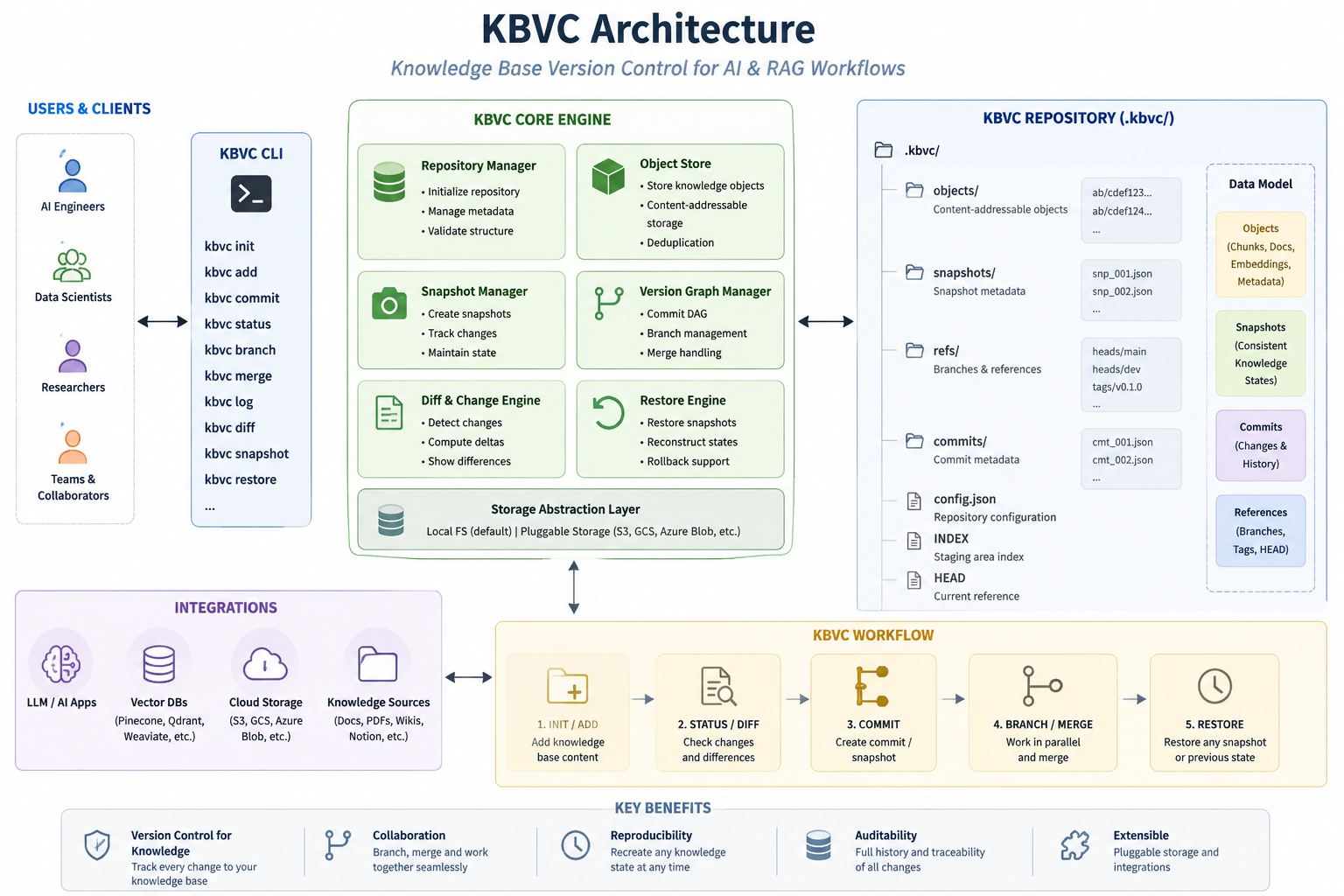
Feature Matrix
| Phase | Commands | What It Unlocks |
|---|---|---|
| 1 | init add commit log |
Git-style commit loop for knowledge |
| 2 | status checkout diff |
Time travel — restore any past state |
| 3 | link query graph |
Knowledge graph + semantic search |
| 4 | branch depends impact annotate history trace doctor |
Audit trails + dependency management |
| 5 | ingest push remote analyze extract stale stats |
Multi-source ingestion + intelligence |
| 6 | backend explain promote |
Infrastructure management + provenance |
| 7 | gc migrate backend migrate schema |
Maintenance + zero-downtime ops |
| 8 | sync |
Volatility-aware auto-commit |
| 9 | contradict list/resolve |
Contradiction detection + resolution |
| 10 | ask |
Grounded knowledge Q&A |
Quick Start
Install
# Core (pick your embedding + vector DB extras)
pip install kbvc[openai,qdrant]

# Local-first setup (no external server)
pip install kbvc[openai,lancedb]

# Everything
pip install kbvc[all]
Initialize a Knowledge Repository
mkdir my-knowledge && cd my-knowledge
kbvc init

# Configure backends
kbvc config set embed.backend openai
kbvc config set embed.key sk-...
kbvc config set vectordb.backend lancedb   # no server needed
Create Your First Knowledge Object
Every document tracked by KBVC is a Knowledge Object (KO) — a Markdown file with a YAML frontmatter header:
---
id: caching-strategy
type: document
tags: [architecture, performance]
volatility: slow
source_type: file
---

## Caching Strategy

We use a two-tier cache: Redis for hot paths (TTL 60s) and
PostgreSQL materialized views for aggregate queries.

## Invalidation

Cache invalidation is triggered by...
kbvc add knowledge/caching-strategy.md
kbvc commit -m "Add caching strategy document"
Explore
kbvc log                         # View commit history
kbvc status                      # See staged vs. committed state
kbvc query "how does caching work?"   # Semantic search
kbvc ask "what is the cache TTL?"     # Grounded Q&A with citations
kbvc graph                       # Visualize knowledge graph
kbvc stats                       # Analytics report
Core Concepts
Knowledge Objects (KOs)
A KO is the fundamental unit of KBVC. Each KO is:
- A Markdown file with YAML frontmatter
- Chunked into sections (one vector per section)
- Versioned independently (v1, v2, v3...)
- Connected to other KOs via typed relations
Volatility levels control how KBVC handles automatic commits:
| Volatility | Meaning | Auto-commit |
|---|---|---|
frozen |
Never changes (e.g. archived decisions) | Never re-embedded |
slow |
Changes occasionally (most documents) | On explicit kbvc sync |
live |
Changes frequently (e.g. meeting notes) | On every kbvc sync |
Commit DAG
Every kbvc commit creates an immutable CommitObject — a SHA-256 hash over:
- Parent commit ID
- Branch name
- Commit message
- All changed KO IDs + their chunk hashes
- Snapshot filenames for graph, prompt, retrieval config
This gives you a fully reproducible, tamper-evident history — just like Git, but for knowledge.
Knowledge Graph
KOs can be linked with typed relations:
kbvc link caching-strategy informed_by system-architecture
kbvc link new-api contradicts old-api
kbvc link auth-module extends base-security
Relation types: informed_by · contradicts · extends · derived_from · supersedes · depends_on · related_to
VSAL — Vector Storage Abstraction Layer
KBVC never touches Qdrant points, pgvector rows, or Pinecone vectors directly. All storage goes through ChunkRecord — a universal unit that every backend adapter maps to its native representation.
This means you can migrate between vector databases without re-embedding:
kbvc migrate backend --from qdrant --to pgvector
Knowledge Object Frontmatter Reference
---
id: my-document              # required; used as ko_id
type: project                # project | education | patent | document | lesson | ...
tags: [ai, rag, python]      # free tags for filtering
volatility: slow             # frozen | slow | live
source_type: file            # file | web | github | pdf | notion | memory
valid_from: "2026-01-01"     # optional temporal validity window
valid_to: null               # null = still valid
---
All Commands
Repository Setup
kbvc init [--name NAME] [--no-git]   # Initialize a KBVC repo
kbvc clone <url> [directory]          # Clone a KBVC repo from Git
kbvc config set <key> <value>         # Set a config value
kbvc config get <key>                 # Read a config value
kbvc config list                      # List all config
Knowledge Authoring
kbvc add <path|.>                     # Stage files for commit
kbvc add <path> --reason "why"       # Stage with an annotation
kbvc commit -m "message"             # Commit staged changes
kbvc commit -m "message" --dry-run   # Preview commit (no write)
kbvc status                          # Show staged vs. committed state
History & Diff
kbvc log                             # Commit history (newest first)
kbvc log --oneline                   # Compact history
kbvc diff                            # Diff staged against HEAD
kbvc diff <commit_id>                # Diff against a specific commit
kbvc history <ko_id>                 # Version history for one KO
kbvc checkout <commit_id>            # Restore knowledge state
kbvc checkout <commit_id> --ko <id>  # Restore single KO
Knowledge Graph
kbvc link <from> <type> <to>         # Create a relation
kbvc graph                           # Print graph summary
kbvc graph --dot                     # Export as DOT (Graphviz)
kbvc depends <ko_id>                 # Show KO dependencies
kbvc impact <ko_id>                  # What depends on this KO?
Search & Q&A
kbvc query "natural language question"  # Vector search
kbvc query "..." --top-k 10             # Return 10 results
kbvc ask "natural language question"    # Grounded Q&A with citations
kbvc ask "..." --top-k 5 --show-ids     # Show raw vector IDs
Intelligence & Analytics
kbvc analyze                         # Suggest relations between KOs
kbvc extract                         # Extract entities from KOs
kbvc stale                           # Find stale/orphaned KOs
kbvc contradict list                 # List contradictions
kbvc contradict resolve <rel_id>     # Resolve a contradiction
kbvc stats                           # Analytics report
Provenance & Audit
kbvc trace <ko_id>                   # Full version trail for a KO
kbvc explain <vector_id>             # Trace vector → source → commit
kbvc annotate <ko_id> "reason"       # Add change reason before commit
kbvc doctor                          # Repo health check
Ingestion
kbvc ingest website <url>            # Scrape a website
kbvc ingest github <repo_url>        # Import a GitHub repo
kbvc ingest pdf <file.pdf>           # Convert PDF to KO
kbvc ingest notion <page_url>        # Import a Notion page
kbvc ingest text <file.txt>          # Import a plain text file
Branches & Remotes
kbvc branch                          # List branches
kbvc branch <name>                   # Create a branch
kbvc branch checkout <name>          # Switch branch
kbvc remote add <name> <url>         # Add a remote
kbvc push                            # Push to configured remote
Infrastructure
kbvc backend init                    # Create vector DB schema
kbvc backend info                    # Show backend status
kbvc migrate backend --from X --to Y # Migrate vector store
kbvc migrate embeddings --from M --to M2  # Swap embedding model
kbvc migrate schema                  # Update lock file schema
kbvc gc                              # Garbage-collect orphan vectors
kbvc sync                            # Volatility-aware auto-commit
kbvc sync --volatility live          # Only sync live KOs
kbvc sync --dry-run                  # Preview what would be committed
kbvc promote "<memory text>"         # Promote agent memory to KO
Backends
Embedding Backends
| Backend | Install Extra | Models |
|---|---|---|
| OpenAI | kbvc[openai] |
text-embedding-3-small (default), text-embedding-3-large, ada-002 |
| Gemini | kbvc[gemini] |
gemini-embedding-001 |
| Ollama | kbvc[ollama] |
any locally-served model (nomic-embed-text, etc.) |
| HuggingFace | kbvc[hf] |
any sentence-transformers model |
# OpenAI
kbvc config set embed.backend openai
kbvc config set embed.key sk-...
kbvc config set embed.model text-embedding-3-small

# Ollama (local, no API key)
kbvc config set embed.backend ollama
kbvc config set embed.model nomic-embed-text
kbvc config set embed.url http://localhost:11434
Vector DB Backends
| Backend | Install Extra | Best For |
|---|---|---|
| LanceDB | kbvc[lancedb] |
Local dev, no server, embedded |
| Qdrant | kbvc[qdrant] |
Production, cloud-native |
| pgvector | kbvc[pgvector] |
PostgreSQL shops |
| Chroma | kbvc[chroma] |
Local dev, Python-first |
| Pinecone | kbvc[pinecone] |
Managed serverless |
# LanceDB (no server needed — best for local dev)
kbvc config set vectordb.backend lancedb
kbvc config set vectordb.url ./kbvc_lance

# Qdrant
kbvc config set vectordb.backend qdrant
kbvc config set vectordb.url http://localhost:6333
kbvc config set vectordb.collection kbvc

# pgvector
kbvc config set vectordb.backend pgvector
kbvc config set vectordb.url "postgresql://user:pass@localhost/mydb"
The kbvc.lock File
Every commit writes a kbvc.lock file to your repo root — analogous to package-lock.json. It records:
kbvc_version: "0.1.0"
embedding:
  provider: openai
  model: text-embedding-3-small
  dimensions: 1536
vector_store:
  provider: qdrant
  collection: kbvc
committed_at: "2026-01-15T10:30:00Z"
commit_id: "a3f2c1d9..."
Commit kbvc.lock to Git. Anyone cloning your repo with kbvc clone will see exactly what backend configuration was used and can reproduce it.
Use Cases
AI Product Teams
Track your RAG knowledge base like code. Every prompt change, every document update, every embedding model swap is versioned and auditable. Reproduce any past retrieval configuration exactly.
Research Labs
Manage evolving scientific knowledge with contradiction detection and lineage tracking. Know when a newer paper supersedes an older one. Build multi-hop knowledge graphs connecting related findings.
Enterprise Knowledge Management
Enforce governance over internal knowledge bases. Who changed what, when, and why. Detect when two documents contradict each other. Get alerts when downstream KOs depend on stale upstream content.
LLM Application Developers
Debug why your LLM gave a specific answer — trace it back to the exact document chunk, its version, and the commit that created its embedding. Swap embedding models without rewriting your pipeline.
Development Setup
git clone https://github.com/Saiyam-Sandhir-Jain/kbvc.git
cd kbvc
pip install -e ".[dev,openai,qdrant]"
pytest tests/ -v
See CONTRIBUTING.md for the full contributor guide.
License
MIT © Saiyam Jain
1 maintainer

Metadata
1 maintainer
Release files for kbvc 0.1.4
For a detailed explanation of source distributions (sdists) and built distributions (wheels), please see the package formats documentation.
Loss of provenance
These files do not have provenance metadata, despite files in a prior release including this data.
We recommend further investigation before installing these files. View details.
Source distribution (sdist)
| File | Size | Uploaded | Provenance | Actions |
|---|---|---|---|---|
| kbvc-0.1.4.tar.gz | 132.2 kB | Without provenance | Details for kbvc-0.1.4.tar.gz |
Built distribution (wheel)
| File | Interpreter | ABI | Platform | Actions Reset |
|---|---|---|---|---|
| kbvc-0.1.4-py3-none-any.whl | Python 3 | none | any | Details for kbvc-0.1.4-py3-none-any.whl |
Total release size: 253.6 kB
Release files / kbvc-0.1.4.tar.gz
Loss of provenance
This file belongs to a release without provenance metadata, despite a prior release including this data.
We recommend further investigation before installing this file. View details.
| Download URL | kbvc-0.1.4.tar.gz |
|---|---|
| Size | 132.2 kB |
| Tags | Source |
|
SHA-256 checksum How to use checksums |
ba3153198d96573e8b0bf82a34d5d5ffe07fa68bc1378cc3b50e96a92b92297f
|
|
BLAKE2b-256 checksum How to use checksums |
66af0d04da1935b3fb873329d036fd6e56ed3295b617bc2201c28052b772c87c
|
| Upload date | |
|
Uploaded using Trusted Publishing? What is trusted publishing? |
No |
| Uploaded via |
twine/6.1.0 CPython/3.13.12
|
Release files / kbvc-0.1.4-py3-none-any.whl
Loss of provenance
This file belongs to a release without provenance metadata, despite a prior release including this data.
We recommend further investigation before installing this file. View details.
| Download URL | kbvc-0.1.4-py3-none-any.whl |
|---|---|
| Size | 121.4 kB |
| Tags | Python 3 |
|
SHA-256 checksum How to use checksums |
dd803d4b62d6acbd0767f4d6da09a3202afc64cb99b2342c1edb4b3a0f688c9f
|
|
BLAKE2b-256 checksum How to use checksums |
8e47ec72c6b98c879ca53b8803fb10e0dc6af49e2156a02478902391b42295db
|
| Upload date | |
|
Uploaded using Trusted Publishing? What is trusted publishing? |
No |
| Uploaded via |
twine/6.1.0 CPython/3.13.12
|
Security for kbvc 0.1.4
Provenance
Provenance describes where a file came from. On PyPI, provenance is shared via attestations, which provide a verifiable record of the build or publishing details. View details, limitations and caveats.
Loss of provenance
A previous release of these files had provenance metadata, but this release does not.
While this could reflect a routine change by the project maintainers, it may also indicate that the release files have been compromised.
Release comparison
- Removed 0.1.0 2 files With provenance
- Added 0.1.4 2 files Without provenance
A note on package security
PyPI is a repository for distributing packages, not a service for auditing them. While third-party security researchers and our staff do their best to detect and remove malicious packages, PyPI cannot guarantee the quality, security or suitability of any given package.
To learn more about protecting yourself from malicious actors, visit our package security documentation.














