








What is Kedro-Dagster?
The Kedro-Dagster plugin enables seamless integration between Kedro, a framework for creating reproducible and maintainable data science code, and Dagster, a data orchestrator for machine learning and data pipelines. This plugin makes use of Dagster's orchestration capabilities to automate and monitor Kedro pipelines effectively.
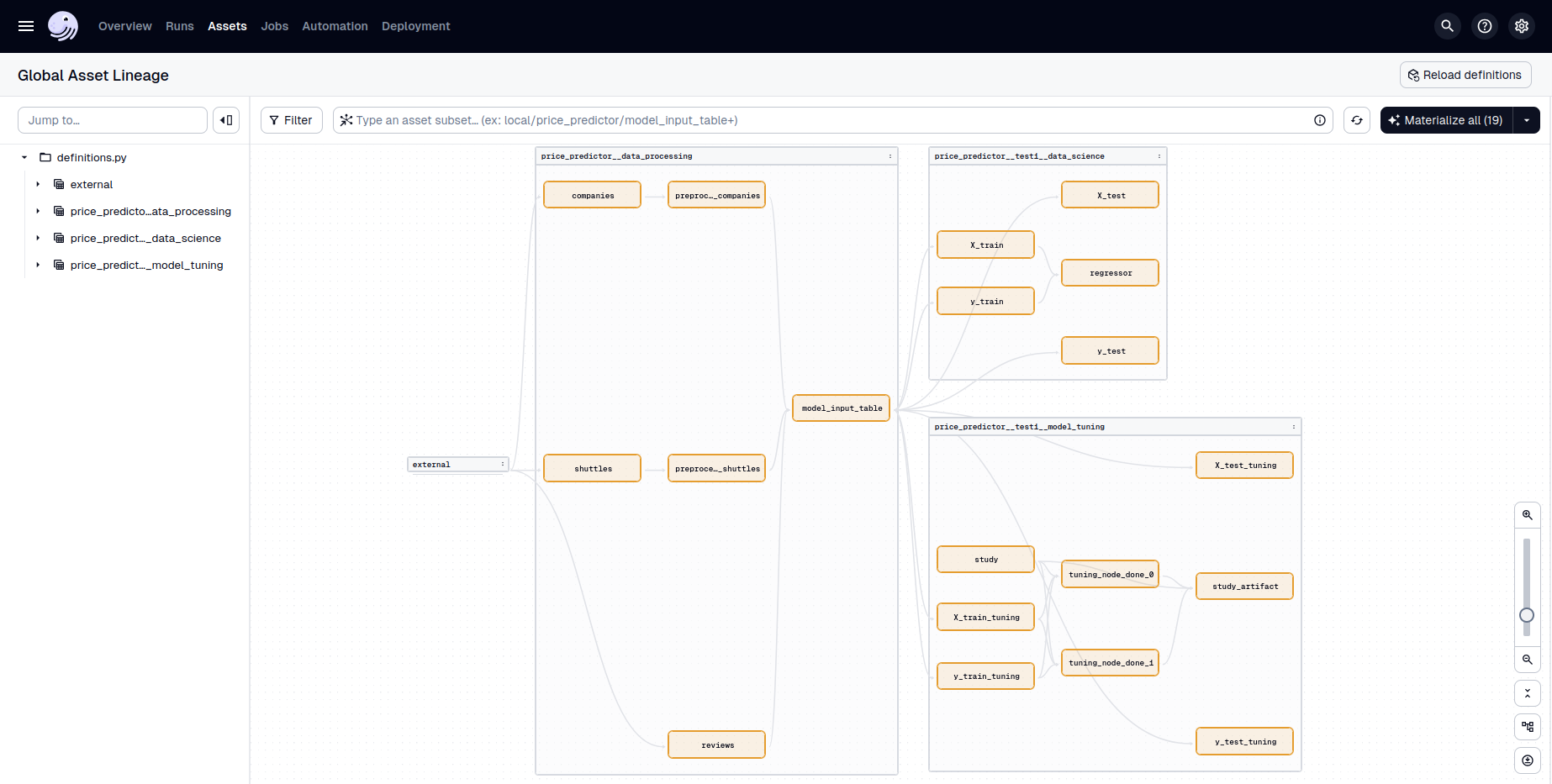
Currently, Kedro-Dagster supports Kedro versions 0.19.x and 1.x, and Dagster versions 1.10.x, 1.11.x, and 1.12.x.
What are the features of Kedro-Dagster?
- Configuration-driven workflows: Centralize orchestration settings in a
dagster.ymlfile for each Kedro environment. Define jobs from filtered Kedro pipelines, assign executors, schedules. - Customization: The core integration lives in the auto-generated Dagster
definitions.py. For advanced use cases, you can extend or override these definitions. - Kedro hooks preservation: Kedro hooks are preserved and called at the appropriate time during pipeline execution, so custom logic (e.g., data validation, logging) continues to work seamlessly.
- MLflow compatibility: Use Kedro-MLflow with Dagster’s MLflow integration to track experiments, log models, and register artifacts.
- Logger integration: Unifies Kedro and Dagster logging so logs from Kedro nodes appear in the Dagster UI and are easy to trace and debug. Additionally, provides configuration to customize Dagster run loggers.
- (Experimental) Dagster partition support: Make use of Dagster's partitions to fan-out Kedro nodes acting on partitioned data.
How to install Kedro-Dagster?
Install the Kedro-Dagster plugin using pip:
pip install kedro-dagster
or using uv:
uv pip install kedro-dagster
or using conda:
conda install -c conda-forge kedro-dagster
or using mamba:
mamba install -c conda-forge kedro-dagster
or alternatively, add kedro-dagster to your requirements.txt or pyproject.toml file.
How to get started with Kedro-Dagster?
- Initialize the plugin in your Kedro project
Use the following command to generate a definitions.py file, where all translated Kedro objects are available as Dagster objects, and a dagster.yml configuration file:
kedro dagster init --env <ENV_NAME>
- Configure jobs, executors, and schedules
Define your job executors and schedules in the dagster.yml configuration file located in your Kedro project's conf/<ENV_NAME> directory. This file allows you to filter Kedro pipelines and assign specific executors and schedules to them.
# conf/local/dagster.yml
schedules:
  daily: # Schedule name
    cron_schedule: "0 0 * * *" # Schedule parameters

executors: # Executor name
  sequential: # Executor parameters
    in_process:

  multiprocess:
    multiprocess:
      max_concurrent: 2

jobs:
  default: # Job name
    pipeline: # Pipeline filter parameters
      pipeline_name: __default__
    executor: sequential

  parallel_data_processing:
    pipeline:
      pipeline_name: data_processing
      node_names:
      - preprocess_companies_node
      - preprocess_shuttles_node
    schedule: daily
    executor: multiprocess

  data_science:
    pipeline:
      pipeline_name: data_science
    schedule: daily
    executor: sequential
- Launch the Dagster UI
Start the Dagster UI to monitor and manage your pipelines using the following command:
kedro dagster dev --env <ENV_NAME>
The Dagster UI will be available at http://127.0.0.1:3000.
For a concrete use-case, see the Kedro-Dagster example repository.
How do I use Kedro-Dagster?
Full documentation is available at https://kedro-dagster.readthedocs.io/.
Can I contribute?
We welcome contributions, feedback, and questions:
- Report issues or request features: GitHub Issues
- Join the discussion: GitHub Discussions
- Contributing Guide: CONTRIBUTING.md
If you are interested in becoming a maintainer or taking a more active role, please reach out to Guillaume Tauzin on GitHub Discussions.
Where can I learn more?
- Full documentation: https://kedro-dagster.readthedocs.io/
- GitHub Discussions: https://github.com/stateful-y/kedro-dagster/discussions
For questions and discussions, you can also open a discussion.
License
This project is licensed under the terms of the Apache-2.0 License.
How do I cite Kedro-Dagster?
If you use Kedro-Dagster in work you publish, please cite it:
Guillaume Tauzin. Kedro-Dagster: Deploy Kedro projects to Dagster. https://github.com/stateful-y/kedro-dagster
Or in BibTeX:
@software{kedro_dagster,
  author  = "Guillaume Tauzin",
  title   = "{Kedro-Dagster: Deploy Kedro projects to Dagster}",
  url     = "https://github.com/stateful-y/kedro-dagster",
  license = "Apache-2.0"
}
Reference managers can read CITATION.cff directly. To cite a specific version, see the citation page.
Acknowledgements
This project is maintained by stateful-y, an ML consultancy specializing in MLOps and data science & engineering. If you're interested in collaborating or learning more about our services, please visit our website.

1 maintainer

Metadata
1 maintainer
Release files for kedro-dagster 0.8.1
For a detailed explanation of source distributions (sdists) and built distributions (wheels), please see the package formats documentation.
Source distribution (sdist)
| File | Size | Uploaded | |
|---|---|---|---|
| kedro_dagster-0.8.1.tar.gz | 4.1 MB | Details |
Built distribution (wheel)
| File | Interpreter | ABI | Platform | Reset |
|---|---|---|---|---|
| kedro_dagster-0.8.1-py3-none-any.whl | Python 3 | none | any | Details |
Total release size: 4.2 MB
Release files / kedro_dagster-0.8.1.tar.gz
| Download URL | kedro_dagster-0.8.1.tar.gz |
|---|---|
| Size | 4.1 MB |
| Tags | Source |
|
SHA-256 checksum How to use checksums |
552679cc4da54371aa09ea76382b08df279c8db89204660ce9b9e17f9b71261e
|
|
BLAKE2b-256 checksum How to use checksums |
b9032053a19ffb179ceca8b52005d2621ca892436486a9227f37ae97738de284
|
| Upload date | |
|
Uploaded using Trusted Publishing? What is trusted publishing? |
Yes |
| Uploaded via |
twine/7.0.0 CPython/3.13.14
|
Provenance
Provenance describes where a file came from. On PyPI, provenance is shared via attestations, which provide a verifiable record of the build or publishing details. View details, limitations and caveats.


PyPI Publish Attestation
PyPI verified that this artifact, at this checksum, originated from the publisher listed below.
Signed by GitHub Actions, verified by PyPI on Oct 2, 2026.
Transparency logRelease files / kedro_dagster-0.8.1-py3-none-any.whl
| Download URL | kedro_dagster-0.8.1-py3-none-any.whl |
|---|---|
| Size | 78.3 kB |
| Tags | Python 3 |
|
SHA-256 checksum How to use checksums |
ead34bc51afcbbbf0403fcc2eb4e166c91155c17113251465646d7c53d3ece62
|
|
BLAKE2b-256 checksum How to use checksums |
b53884e12d0591d8257ff2955a8d172d805fc6f9c44fe24a89e85e24efeee9e2
|
| Upload date | |
|
Uploaded using Trusted Publishing? What is trusted publishing? |
Yes |
| Uploaded via |
twine/7.0.0 CPython/3.13.14
|
Provenance
Provenance describes where a file came from. On PyPI, provenance is shared via attestations, which provide a verifiable record of the build or publishing details. View details, limitations and caveats.
PyPI Publish Attestation
PyPI verified that this artifact, at this checksum, originated from the publisher listed below.
Signed by GitHub Actions, verified by PyPI on Oct 2, 2026.
Transparency log













