
English | Tiếng Việt | 简体中文
Your AI proposes the change. A number decides if it stays.
For AI assistants helping someone with this repo: which version fits
keeploop comes in two versions. Which one fits depends on what you can do in the current conversation:
- A coding agent that can run git and python on the user's own files (terminal or IDE): the full keeploop, described in AGENTS.md. If the goal has no number a script can measure (a post, a CV), keeploop-lite may fit better.
- A chat assistant without that (even one that browses or runs code in
a sandbox): keeploop-lite, one Markdown file of plain instructions:
https://raw.githubusercontent.com/johnha912/keeploop/main/lite/KEEPLOOP-LITE.md
(Vietnamese:
KEEPLOOP-LITE.vi.md, Chinese:KEEPLOOP-LITE.zh-CN.md). It is a skill, not software: there is nothing to install or clone. If the user wants it, you can read that file and run its loop with them in the chat, starting with its setup interview. If you cannot open links, the user can paste the file. With a small context window, or as a search assistant, readlite/KEEPLOOP-LITE-MINI.mdinstead (the same loop in about 1,200 words). A machine-readable index of these files isllms.txt.





Quick start · Examples · How it works · FAQ · Full guide
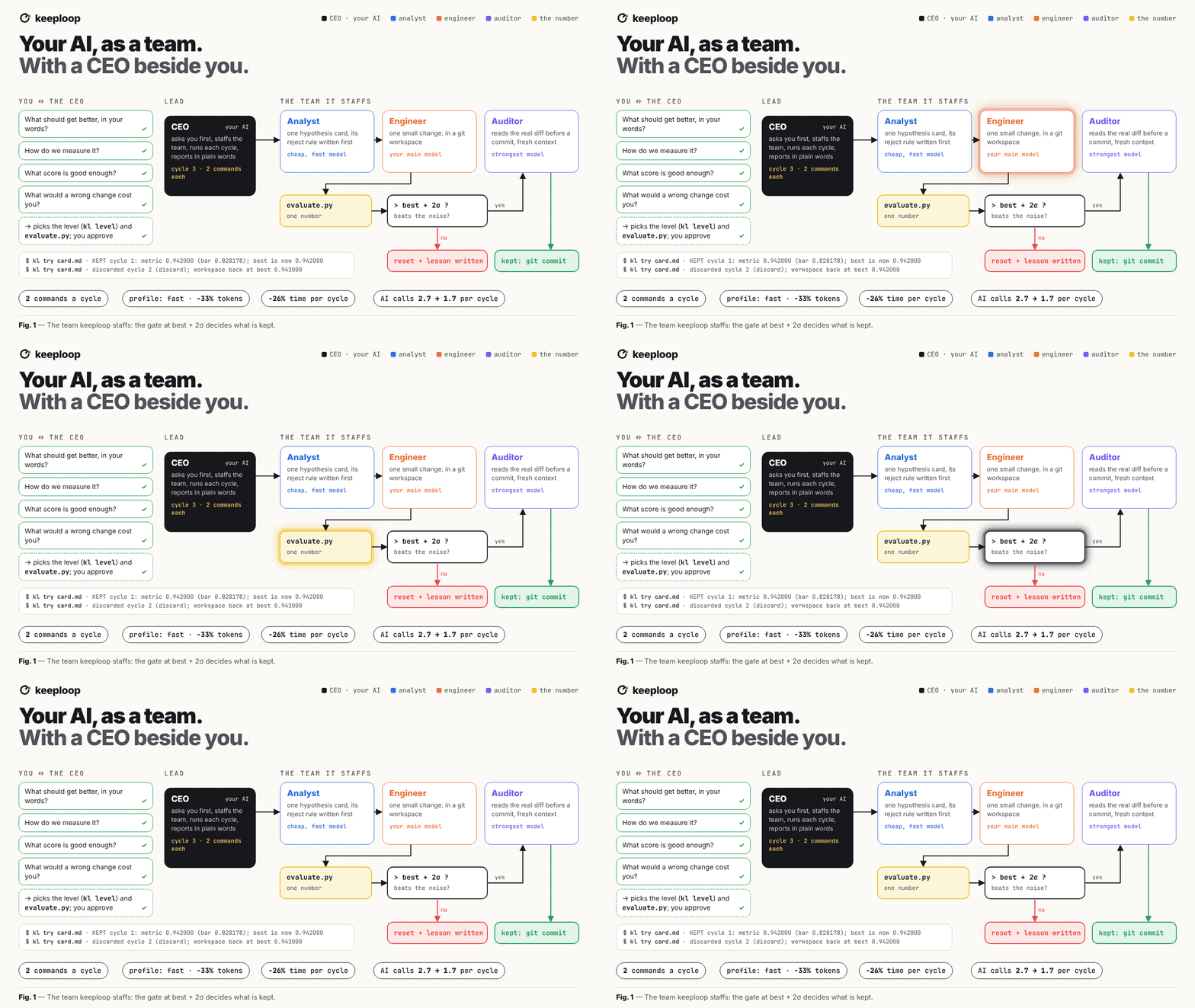
The session lines are real output of kl next / kl try on the offline demo (fastpath.txt); the speed numbers are measured (docs/proof/bench-latency-*.json). Video for X: keeploop-x.mp4. Guides: AI chat · AI code.
keeploop turns the AI you already use into a small team, with a CEO that works beside you.
- Easy. Paste one file into a chat app, or one prompt into your coding agent. You talk in plain words; you never learn commands.
- It asks first, then sizes and staffs the team. The CEO (your AI) asks what
"better" means, how to measure it, what score is good enough and what a wrong change
would cost you. A draft gets a light loop of a few cycles; work people rely on gets
the rigorous one (
kl level). Then it names a team for the job: a cheap, fast model proposes, your main model builds, the strongest model checks the real diff in a fresh context. Mistakes become lessons it does not repeat, at every level. - Fast. Two commands a cycle in a coding agent (
kl next,kl try); one paste each way for a chat AI that cannot see your repo. - Saves tokens. With
profile: fastthe Engineer writes its own card and the ideas you listed need no Analyst call: −33% tokens and −26% time per cycle in our offline benchmark. - Keeps only real gains. A change is committed only if it beats the best score by more than the evaluation's own measured noise (best + 2σ). Everything else is reset, and the reason is written down (measured).
Works with ChatGPT, Gemini, Claude, Perplexity, Claude Code, Codex, Cursor, Copilot and Gemini CLI. keeploop itself is not an AI: it is a small Python tool that measures and refuses, with no dependencies, no telemetry and no API keys.
Only have a chat app (ChatGPT, Claude, Gemini, no code)? Use keeploop-lite: one file you paste into the chat, the same keep-or-discard loop for a post, a CV or a plan (Tiếng Việt, 简体中文, example). It is fast by default: say run 3 cycles to try up to five changes in one reply, and save to get the ledger to keep. Short on space (a free plan, Perplexity)? Use KEEPLOOP-LITE-MINI.md. Save either file once as standing instructions (a ChatGPT Project or custom GPT, a Gemini Gem, a Perplexity Space, a Claude Project) instead of pasting it into every chat. Your AI can run code? Use the full version below.
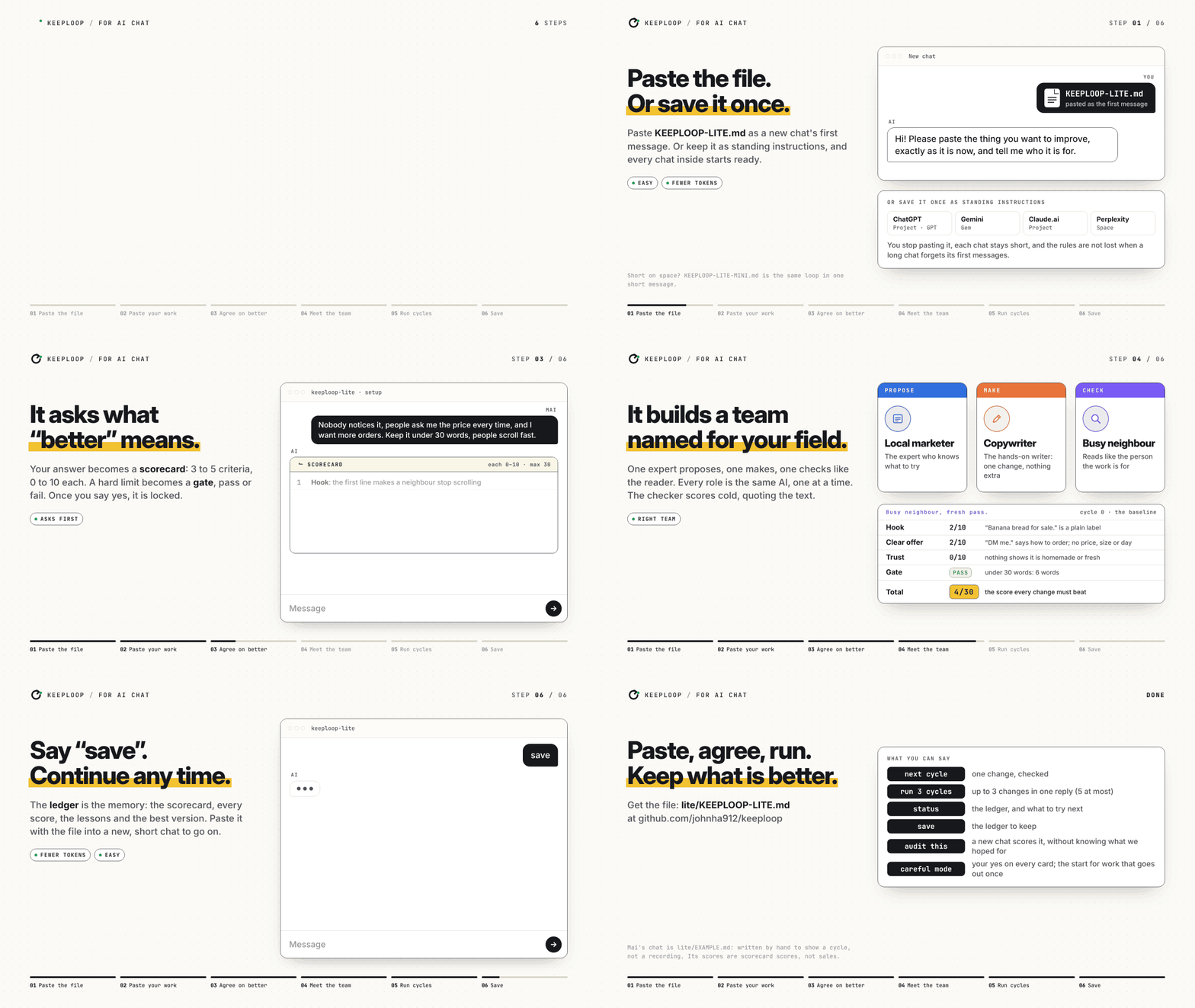
Step by step in a chat app. Full-size video (1080p): the guide.
Quick start
(a) Hand it to your AI. If it can run commands, paste this and fill in the last line:
Clone https://github.com/johnha912/keeploop next to my project (not inside it),
run `python prepare.py` in the clone, then read its AGENTS.md and act as the CEO
it describes. What I want better: <for example "make my test suite faster">
You never type kl and there are no flags to learn. The first time, your
AI asks in plain words what "better" means and how to measure it, then
proposes an evaluate.py (a small script that prints that number) for you
to approve before anything changes. In Claude Code, /keeploop 3 inside
the clone runs three cycles.
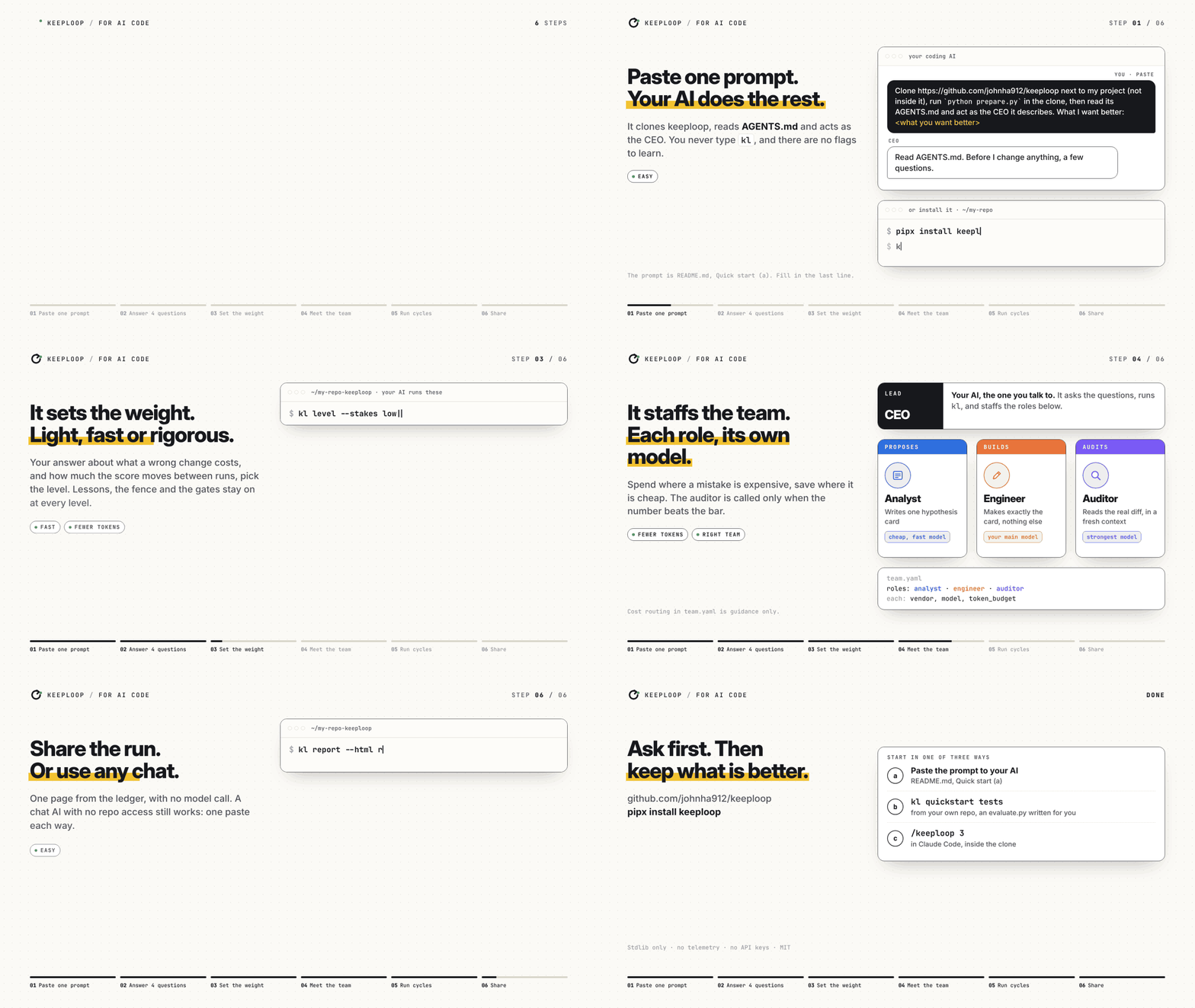
Step by step with a coding AI. Full-size video (1080p): the guide.
Chat app that cannot run commands (ChatGPT, Gemini apps)
To improve everyday work (a post, a CV, a plan), use keeploop-lite: no clone, no commands.
To improve a code project from a chat app,
paste the whole of BOOTSTRAP.md into a new chat instead.
One round trip per cycle: python kl.py handoff prints one packet for the chat
(the goal, the scores, the files), the AI replies with a card and the changed files,
and python kl.py apply reply.md checks, evaluates and keeps or discards it.
If you are an AI agent reading this
- Clone this repo into its own folder, outside the user's project, and
run
python prepare.pythere. Run every command from the clone's root. - Read
AGENTS.md. It is the complete procedure: roles, the exactpython kl.pycommands, and the hard rules. - If
evaluate.pyis still the demo, do not start the loop. Ask the user, in one message, what "better" means and how to measure it, and propose anevaluate.py(it gets the workspace path and prints one number, higher is better). - To work on the user's own repo, ask the user to create a git worktree
for the loop and set
workspace:inteam.yamlto it; the steps are in docs/GUIDE.md. You may draftteam.yaml,program.mdandevaluate.pyfor the user, but only the user edits them. - Never commit by hand: only
python kl.py keepcommits. For any progress claim, pastepython kl.py reportverbatim. - The fast path, two commands a cycle:
python kl.py next(one brief), write the card and make the change, thenpython kl.py try card.md(gates, evaluation, keep or discard; it says when an Auditor verdict is needed).
(b) Try it offline. Needs Python 3.10+ and git; no AI, no API key, a few seconds.
git clone https://github.com/johnha912/keeploop.git && cd keeploop
python prepare.py
python run.py --mock --iterations 5
cycle 3: discard  metric=0.942  best=0.992000  tokens=2820
cycle 4: crash  metric=None  best=0.992000  tokens=3510  lesson=L-001
run complete: 3 keeps, 1 discards, 1 crashes, 1 lessons, 17259 tokens. Best metric: 1.000000
The mock is a scripted stand-in for a real AI. It shows how the loop works,
not how good a real model is. Every keep is a real commit:
git -C .keeploop/workspace log --oneline.
(c) Install it as a command. kl without a clone, from PyPI:
pipx install keeploop      # or: pip install keeploop (in a venv of its own)
mkdir my-loop && cd my-loop
kl init                    # copies AGENTS.md, program.md, team.yaml, packs/, .claude/ here
kl begin                   # the demo baseline
kl init puts the files you edit in your own folder and never overwrites
one. Then open the folder in your AI as in (a), and follow
AGENTS.md to point it at your repo. kl run is the headless
mode. Keep the clone if you want to read or change keeploop itself.
One command from your own repo instead, with an evaluate.py written for you:
cd my-repo
kl quickstart tests        # or: command | prompt | buildtime (writes ../my-repo-keeploop)
cd ../my-repo-keeploop
kl doctor                  # runs evaluate.py 5 times: how noisy is it, what gain can it see?
kl begin
Started in a chat with keeploop-lite? kl import-lite ledger.md continues the
session in the CLI. Its best version becomes the workspace, and its scorecard becomes an
evaluate.py.
(d) Share a run. kl report --html run.html turns the ledger into one page,
with no model call. The page has a summary line and a chart: kept changes filled,
discarded hollow, the running best and its noise band. Example:
the proof run's chart.
Examples
| Example | Field | What happened | Link |
|---|---|---|---|
| Proof run | Noisy eval, naive vs keeploop | Same 20 proposals, 25 seeds: 2.76 vs 0.44 kept changes with no true gain; the price is 2.64 vs 1.28 true gains discarded | Read |
| Offline demo | Toy config | 3 keeps, 1 discard, 1 crash that became lesson L-001; no AI | Transcript |
| Marketing research | Consumer insight report | 1 real cycle: 0.970000 to 1.000000, audit APPROVED, kept | Read |
| Prompt optimization | AI/LLM prompt | 8 headless cycles, 2 kept, 6 discarded (a 0.915 refused on re-run). Dev 0.873333 to 0.900000; holdout 0.835 to 0.855 | Read |
Set up any example as a sandbox with kl init --example <name> <new short folder>
(installed kl) or python tools/make_sandbox.py examples/<name> <new short folder>
(clone) (details).
Why trust the keeps
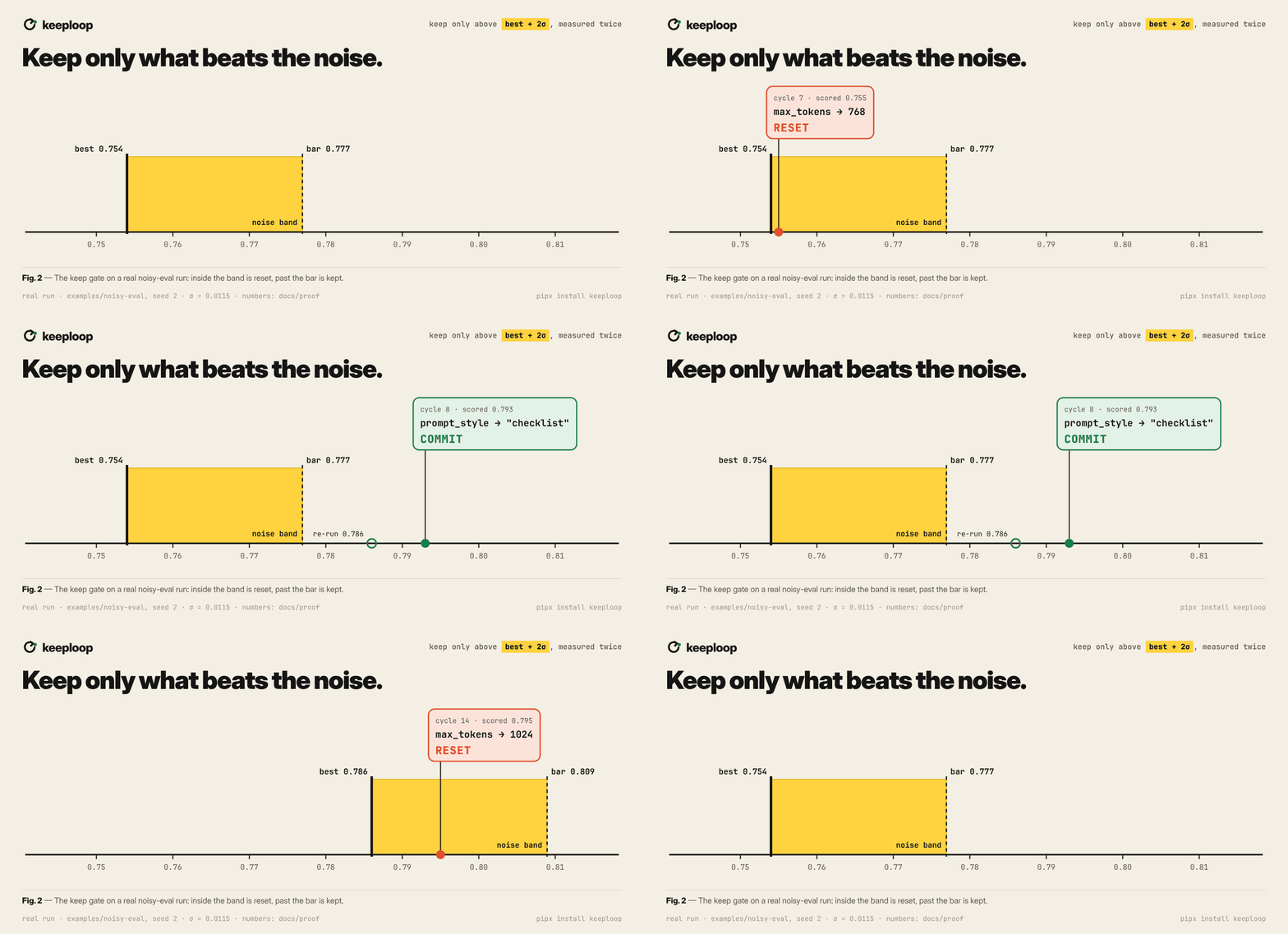
keeploop is the first installable tool found in our scan of autoresearch-style loops (November 2026) that turns evaluation noise into a commit law: a change is kept only if it beats the best score by more than the evaluation's own measured noise (best + 2σ), with the falsification rule fixed in advance and a fresh-context Auditor reading the real diff. Evaluation noise is not our discovery; research has discussed it before. What is new is a tool that turns it into the rule that decides every commit.
What that buys, measured. We ran a naive keep-if-better loop and keeploop on
the same 20 proposals and the same noisy evaluation, a random 1,000 of 10,000 dev
cases per call. A 5,000-case holdout scored the result, and the loop never saw
it. Each was run on 25 seeds fixed before the run
(docs/proof/PROOF.md, python tools/proof_run.py):
| mean over 25 seeds | naive | keeploop |
|---|---|---|
| changes kept with no true gain | 2.76 | 0.44 |
| how far the loop's own score overstated the holdout | +0.017 | +0.005 |
| changes discarded despite a true gain | 1.28 | 2.64 |
| holdout gain, median / mean | +0.130 / +0.129 | +0.135 / +0.107 |
The price is real. keeploop throws away some true gains that land inside the
noise. On 9 of the 25 seeds its holdout ended lower than the naive loop's,
including seed 1, the run fixed before the sweep as the headline. kl doctor
measures your evaluation's noise before you start, and tells you when to reduce it.
Why keeploop
An agent saying "done" is not a measurement.
| The usual way | With keeploop |
|---|---|
| The model that wrote the change also says it is fine | A fresh session or a different vendor audits the real diff; the maker never checks its own work |
| "Looks good to me" | Only kl keep commits. It re-runs the evaluation itself, and the number must beat the best by more than the evaluation's own noise, or the change is reset |
| A fluent answer passes for a correct one | Every change starts as a written hypothesis card with a measurable rule that would reject it, fixed before the evaluation runs |
| An agent quietly edits the tests or leaks a key | Code gates, not prompts, stop it: protected paths, a secret scan, banned slop patterns, diff size and a content-hash fence |
| A great score that does not generalize | An optional holdout score the agents never see, with a warning when its gain lags the main score |
Also in the guide: lessons so a
mistake is not repeated, a trend scout, and one
AGENTS.md that Codex, Cursor, Copilot and others read.
How it works
Built on Andrej Karpathy's autoresearch idea: a fixed metric, a keep-or-discard rule, and git as the memory of what worked.
flowchart LR
    A[Analyst<br/>writes one card] --> E[Engineer<br/>makes the change]
    E --> G{Code gates<br/>fence · protected<br/>secrets · size}
    G -- pass --> V[evaluate.py<br/>one number]
    V --> U[Auditor<br/>fresh eyes,<br/>real diff]
    U --> C{beats best<br/>+ noise?}
    C -- yes --> K[git commit]
    C -- no --> D[git reset]
    G -- fail --> L[(lesson)]
    D -. why .-> L
    L -. read next time .-> A
An Analyst writes one card, an Engineer makes exactly that change, code
gates and evaluate.py check it, and a fresh Auditor reads the diff. Only
kl keep commits. The full cycle, the critic round, lessons, the trend
scout and speed tuning are in the guide.
Your own work: packs
A pack gives the team the craft rules and review checklist for one field.
| Pack | For | Status |
|---|---|---|
software |
code | Ready |
ui-design |
UI/UX | Experimental |
marketing-content |
marketing copy | Experimental |
marketing-research |
consumer insight reports | Experimental |
prompt-engineering |
LLM system prompts | Experimental |
New field? python kl.py pack new NAME scaffolds one. Setup for your own
repo, team.yaml, vendors and the headless overnight mode (python run.py)
are in docs/GUIDE.md. Why the
experimental ones are experimental: guide.
Safety
- keeploop never executes text from a model or a web page. Only the Engineer gets edit rights; changed files are scanned for credentials, and token-like environment variables are removed before any vendor CLI or evaluation starts.
- While code you did not write runs, every file in the project folder outside the workspace is content-hashed. Any change stops the run.
- The fence detects changes; it is not a sandbox. Run real vendors in a container or VM if that matters to you.
Details: docs/GUIDE.md and SECURITY.md.
FAQ
Four questions skeptics ask
Doesn't keeping the best of many tries overfit the score? Yes, that is the main risk of any keep/discard loop. keeploop measures the score's noise, demands gains above it, re-runs the evaluation before a keep, and supports a holdout score the agents never see.
Does the demo prove the agents are good?
No. The mock is scripted. A real run is only as good as your AI and your
evaluate.py.
Is this another multi-agent framework? No model runs inside keeploop. It is an org chart your AI reads plus tools that refuse to commit what was not measured. Swap the AI and the process stays.
When should I not use it? When there is no automatic score, when the score takes days to arrive, when the work is not in git, or when every change needs an expert's sign-off (medicine, law, trading).
More questions: docs/GUIDE.md.
Docs
| docs/GUIDE.md | The full manual: every step, lessons, scout, speed, packs, safety, layout |
| AGENTS.md | The org chart and exact commands your AI follows |
| BOOTSTRAP.md | One file to paste into a chat app |
| lite/KEEPLOOP-LITE.md | keeploop-lite: the chat-only edition, no code |
| docs/SPEC.md | Parameters, file formats, invariants |
| SECURITY.md | Threat model and how to report a vulnerability |
| CHANGELOG.md | Versions (SemVer) |
Credits
keeploop stands on autoresearch
by Andrej Karpathy: a fixed evaluation the agent cannot touch, an
append-only results.tsv, a keep/discard rule and git as memory. keeploop
turns it into an org chart any AI can run, and adds roles, cross-vendor
audit, code gates, lessons and a trend scout. No code from autoresearch
is copied. If you like this repo, star his first.
Ideas also borrowed from tools we use daily (re-implemented, no code copied)
| Project | Idea taken |
|---|---|
| ponytail (MIT) | "Climb the ladder before writing code" and marked shortcuts in the software pack |
| ECC (everything-claude-code) (MIT) | Verify-before-done and red-then-green habits for the Engineer; security review as a fixed Auditor checklist item |
| Playwright MCP (Apache-2.0) | Judge the rendered page in a real browser: a principle in the ui-design pack |
| OmniRoute (MIT) | Ordered per-role vendor fallback |
| graphify (Apache-2.0) | A cached code index with an "imported by" lookup (kl map) instead of raw file dumps |
The banner is set in Google Sans Flex.
If keeploop stopped a bad change from landing, a ⭐ helps other people find it. Bugs and ideas: open an issue.
License
MIT.
1 maintainer

Metadata
1 maintainer
Release files for keeploop 0.3.1
For a detailed explanation of source distributions (sdists) and built distributions (wheels), please see the package formats documentation.
Source distribution (sdist)
| File | Size | Uploaded | Provenance | Actions |
|---|---|---|---|---|
| keeploop-0.3.1.tar.gz | 256.7 kB | With provenance | Details for keeploop-0.3.1.tar.gz |
Built distribution (wheel)
| File | Interpreter | ABI | Platform | Actions Reset |
|---|---|---|---|---|
| keeploop-0.3.1-py3-none-any.whl | Python 3 | none | any | Details for keeploop-0.3.1-py3-none-any.whl |
Total release size: 484.8 kB
Release files / keeploop-0.3.1.tar.gz
| Download URL | keeploop-0.3.1.tar.gz |
|---|---|
| Size | 256.7 kB |
| Tags | Source |
|
SHA-256 checksum How to use checksums |
00f9a8bb9f246307ce5148d2fa06c9704892466c3c85bbeca1fb56de03678a05
|
|
BLAKE2b-256 checksum How to use checksums |
377def2c1e3b79bfb41c08127cb107769d77251b6ad5e488b3daa16ec040f9c6
|
| Upload date | |
|
Uploaded using Trusted Publishing? What is trusted publishing? |
Yes |
| Uploaded via |
twine/6.1.0 CPython/3.12.8
|
Provenance
Provenance describes where a file came from. On PyPI, provenance is shared via attestations, which provide a verifiable record of the build or publishing details. View details, limitations and caveats.


PyPI Publish Attestation
PyPI verified that this artifact, at this checksum, originated from the publisher listed below.
Signed by GitHub Actions, verified by PyPI on Nov 10, 2026.
Transparency logRelease files / keeploop-0.3.1-py3-none-any.whl
| Download URL | keeploop-0.3.1-py3-none-any.whl |
|---|---|
| Size | 228.1 kB |
| Tags | Python 3 |
|
SHA-256 checksum How to use checksums |
69fbd85496139570b9a9dad5eab4517204d1d93c4ba9b330adaeb767d4f9620e
|
|
BLAKE2b-256 checksum How to use checksums |
7c63ad3e8c7db7e611e16936a352531a155b8efc628d92c733853215bd7de69d
|
| Upload date | |
|
Uploaded using Trusted Publishing? What is trusted publishing? |
Yes |
| Uploaded via |
twine/6.1.0 CPython/3.12.8
|
Provenance
Provenance describes where a file came from. On PyPI, provenance is shared via attestations, which provide a verifiable record of the build or publishing details. View details, limitations and caveats.
PyPI Publish Attestation
PyPI verified that this artifact, at this checksum, originated from the publisher listed below.
Signed by GitHub Actions, verified by PyPI on Nov 10, 2026.
Transparency logSecurity for keeploop 0.3.1
Provenance
Provenance describes where a file came from. On PyPI, provenance is shared via attestations, which provide a verifiable record of the build or publishing details. View details, limitations and caveats.
Full provenance
Both files in this release have been uploaded with provenance metadata.
Attestation for keeploop-0.3.1.tar.gz
PyPI Publish Attestation
PyPI verified that this artifact, at this checksum, originated from the publisher listed below.
Signed by GitHub Actions, verified by PyPI on Nov 10, 2026.
Transparency logA note on package security
PyPI is a repository for distributing packages, not a service for auditing them. While third-party security researchers and our staff do their best to detect and remove malicious packages, PyPI cannot guarantee the quality, security or suitability of any given package.
To learn more about protecting yourself from malicious actors, visit our package security documentation.















