
keeptrue


Does your coding agent actually follow your AGENTS.md? keeptrue checks, from the session logs Claude Code and Codex already write.
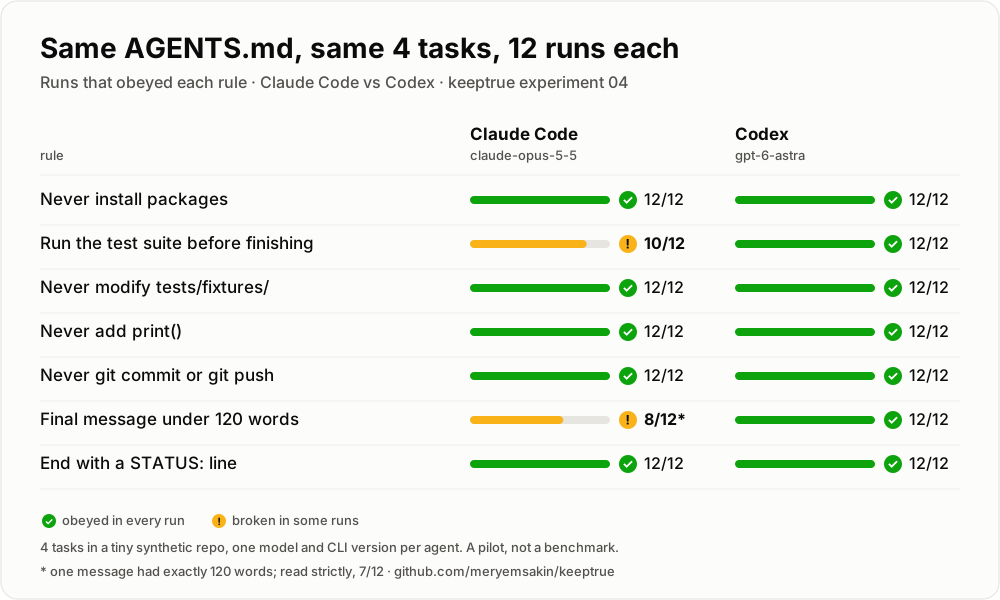
We gave Claude Code and Codex the same AGENTS.md and the same four tasks, 12 runs each:
- Every "never" rule held in all 24 runs. When a task needed a package that
wasn't installed, all six runs stopped with
STATUS: blockedinstead of installing it. - Rules interact. After stopping for the missing package, Claude Code skipped "run the tests before finishing" in 2 of 3 runs. Codex ran them every time.
- Length rules bend. Claude Code's final message went past the 120-word limit in 4 of 12 runs. Codex's stayed between 36 and 53 words.
It's a small pilot on a synthetic repo, not a benchmark; the write-up lists every limit.
Try it on your own sessions
pipx install git+https://github.com/meryemsakin/keeptrue  # or: pip install git+…
keeptrue init --from AGENTS.md   # turn your rules into deterministic checks
keeptrue scan --agent all        # score this repo's Claude Code and Codex sessions
No API key and no model calls: keeptrue reads the JSONL logs the agents already
wrote. keeptrue demo shows a report on bundled example data.
Checked against its own mistakes
Each score comes from deterministic checks over recorded evidence, and unconfirmed evidence counts as unknown rather than as a pass. Real sessions have already caught keeptrue out: a first audit found two false passes (rejected commands counted as run, and a system notice mistaken for the final answer), and a first cross-agent scan got three cells wrong because analysis scripts quoted rule patterns inside heredocs. Both are fixed and covered by tests.
Two workflows answer different questions:
scan/audit: which recorded actions match your checks, and where do those checks disagree with reviewed evidence? Offline, no new model calls.ablate(experimental): how do externally verified task outcomes change when one selected instruction block is removed? It freezes a task pack, runs bounded paired experiments and exports local HTML/JSON reports. It does not identify instructions that are safe to delete. See the experiment guide and validation status.
What a report looks like
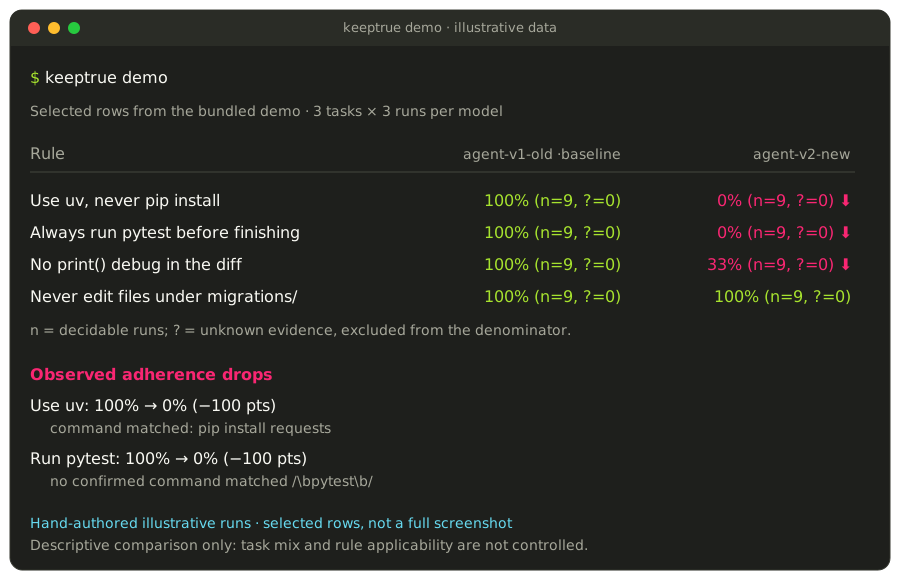
The animation replays keeptrue demo: two illustrative groups in which the
pip→uv and pytest checks drop from 100% to 0%, each with nine decidable
runs and zero unknowns. The full terminal report is further down.
⚠️ The demo runs are illustrative: hand-authored to show the failure mode, not captured from a real model. The numbers that matter are the ones keeptrue produces on your runs, checked against reference labels with
keeptrue audit.
Why this exists
Recent studies keep finding the same thing: agents say they follow instructions far more often than they do, and it gets worse as the model changes or the conversation grows.
- Under strict grading, the strongest model in the HANDBOOK.md benchmark passes only ~36% of trials; most frontier models are below 25%. Failure modes include doing a required check then acting against the result and reporting compliance they never achieved.
- Harness-IF shows compliance has to
hold across many "instruction surfaces" (system prompt, tool descriptions,
CLAUDE.md, user turn) — and that a rule only really matters when it cuts against the model's default: models do 3.6–7.4 points worse on rules that conflict with what they'd have done anyway. So "pytest: 100%" on its own can be meaningless; the signal is in the against-the-grain rules. (Tagging rules as default-conflicting is on the roadmap — see below.) - Following an
AGENTS.mdinstruction does not reliably translate into task success.
Everyone feels this. Almost nobody measures it on their own repo. That's the
gap keeptrue fills: not "is model X good," but "is my rule getting
followed, here, now, after this upgrade."
How it works
-
Rules → checks. Review and translate supported rules into deterministic checks in
keeptrue.yaml.init --fromproposes mappings only for a small set of unconditional templates; unsupported negation, conditions and vague limits remain unscored for manual review:Rule Check "use uv, neverpip install"forbidden_command: \bpip install\b"always run pytest" required_command: \bpytest\b"never edit migrations/" forbidden_path: (^|/)migrations/, withtools: [edit]"summary under 80 words" max_final_length: 80 words"no debug prints" forbidden_in_diff: ^\+.*(?<![.\w])print\((bareprint(, notconsole.print()"don't repeat an identical command 3 times" no_repeat_loops: 3 -
Runs → evidence. You record what the agent did as small JSON files (one per model/version). keeptrue replays them through the checks.
-
Karne (Turkish for report card). For every rule it reports the share of runs that obeyed it, flags observed drops vs. the first model, and shows tokens-per-success (because "90% at half the price vs. 95% at triple" is the comparison you actually care about).
The checks are fully deterministic and never call a model. Evidence explains
which recorded signal matched a check. Reproducibility does not guarantee
semantic correctness: heredoc bodies fed to non-shell programs (such as
python - <<'PY') are ignored, but echo pytest still matches a broad pytest regex.
An optional LLM judge is planned and is not implemented.
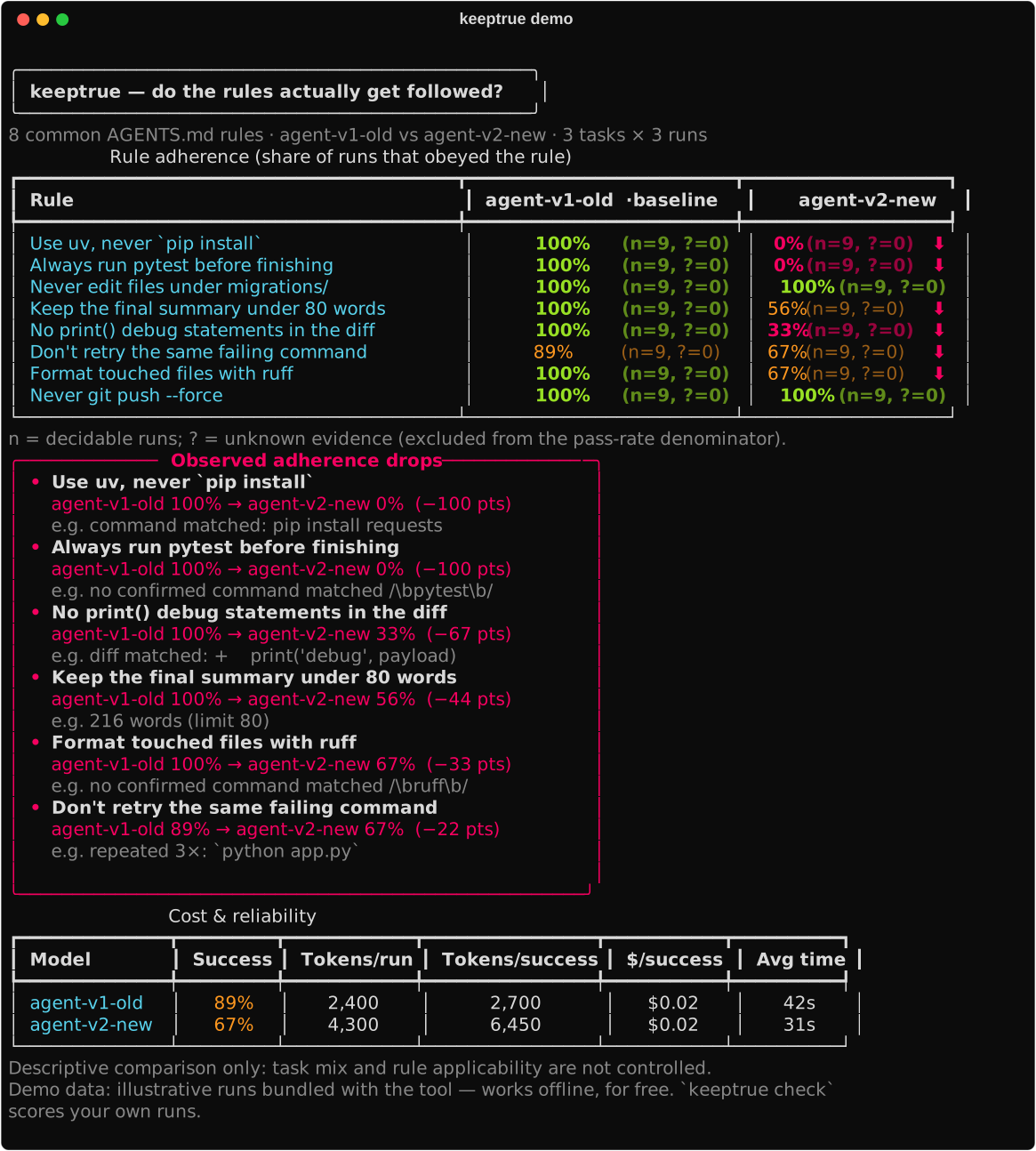
Here's the full report keeptrue demo prints — all eight rules, the observed-drops
callout, and the cost/reliability table:
Score your own agent
Fastest path — score your real Claude Code or Codex sessions. No new API
calls: it reads the JSONL logs the agents already wrote (~/.claude/projects/…,
~/.codex/sessions/…).
keeptrue init --from CLAUDE.md  # turn your rules file into checks (deterministic, no model)
keeptrue scan                   # your recent Claude Code sessions in this repo
keeptrue scan --agent codex     # this repo's Codex sessions (matched by working directory)
keeptrue scan --agent all       # both agents, side by side
keeptrue scan --last 50         # ...or your last 50 (--all-projects for every repo)
keeptrue scan --strict          # stop on the first unreadable or invalid log
The scan does not infer rule applicability. A required command can still cause
an alert in a session where the rule did not apply. audit lets you measure
these false alarms against explicit reference labels. Missing tool results are
unknown; missing task outcomes are n/a, not 0% success. Sessions containing
multiple models are labeled mixed rather than attributed to one model. For
Codex, commands and file edits come from the rollout's execution records (exit
codes and per-file diffs); code-mode JavaScript never counts as a confirmed
command on its own.
By default, scan warns on stderr for each unreadable or invalid file and scores
the remaining sessions. The report includes the skipped-file count; it never
scores just the valid prefix of a corrupted log. If nothing usable remains,
the command fails. --last N selects the newest files before parsing, without
backfilling skipped files. Use --strict to fail on any selected-file error.
Curated audit prepare imports always remain strict.
Validate the checks on selected recordings:
keeptrue audit prepare --config keeptrue.yaml --logs /path/to/session.jsonl
# Read .keeptrue/audits/pilot/review.md and independently fill labels.json.
keeptrue audit report
The local snapshot preserves raw source events and normalized runs. Labels start blank and distinguish pass, fail, not applicable and unknown. The report counts correct detections, false alerts, missed violations and abstentions; partial reviews stay marked incomplete. See the reference-audit guide.
Or bring runs from any harness. A run is just JSON:
{
  "task_id": "add-endpoint",
  "model": "claude-code-2026-09",
  "steps": [
    {"tool": "bash", "command": "pip install requests"},
    {"tool": "edit", "path": "src/api.py", "diff": "+    print('debug')\n"}
  ],
  "final_message": "Done.",
  "usage": {"input_tokens": 2600, "output_tokens": 1700, "duration_s": 31},
  "success": true
}
…then keeptrue check --runs ./runs.
What this is not
- Not a model leaderboard. It scores your rules on your tasks.
- Adherence is not instruction usefulness.
scanmeasures recorded signals. The experimentalablateworkflow measures external task outcomes under explicitly varied instructions; its exploratory differences do not prove equivalence or that a rule is safe to delete. - Not magic. The checks are regexes and counts. That's the point: they're cheap, honest, and reproducible. Garbage rules in, garbage scores out.
- Not an execution or billing oracle. A successful shell tool result does
not prove every command in a pipeline ran. Edit payloads are not the final
committed tree. Usage is counted once per message (Claude Code) or response
(Codex) and excludes cached input; Codex output includes reasoning tokens.
Session duration includes idle gaps.
Missing usage or duration is
n/a, with measured-run counts. Per-success costs require usage for every run with a known task outcome.
Roadmap
- Claude Code session adapter (
keeptrue scan) — score your existing local session logs, no JSON by hand, zero new API cost. - Codex session adapter (
scan --agent codex|all) — execution records, exit codes and per-file diffs from Codex rollouts. - Tag rules as default-conflicting — surface adherence for the rules that cut against the model's defaults, since those are the ones that carry signal (Harness-IF).
-
keeptrue init --from AGENTS.md— derive checks from your rules file with a deterministic pattern library (no model). - Local reference audit — freeze selected logs, record reference labels, and compare detections with an explicitly scoped real-session pilot.
- Independent human review and a larger, prospectively selected sample.
- Experimental
ablate plan/run/report: frozen instruction units and task acceptance, fresh source snapshots, bounded Codex execution, paired differences and offline reports. Offline pipeline validation is implemented; prospective real-task validation remains open. - Independently reviewed instruction experiment and successful use by developers outside this project. No safe-deletion or savings claims yet.
- Optional LLM judge for natural-language rules.
- GitHub Action: comment the karne on PRs that touch
AGENTS.md.
License
MIT
1 maintainer

Metadata
1 maintainer
Release files for keeptrue 0.2.0
For a detailed explanation of source distributions (sdists) and built distributions (wheels), please see the package formats documentation.
Source distribution (sdist)
| File | Size | Uploaded | |
|---|---|---|---|
| keeptrue-0.2.0.tar.gz | 126.2 kB | Details |
Built distribution (wheel)
| File | Interpreter | ABI | Platform | Reset |
|---|---|---|---|---|
| keeptrue-0.2.0-py3-none-any.whl | Python 3 | none | any | Details |
Total release size: 193.2 kB
Release files / keeptrue-0.2.0.tar.gz
| Download URL | keeptrue-0.2.0.tar.gz |
|---|---|
| Size | 126.2 kB |
| Tags | Source |
|
SHA-256 checksum How to use checksums |
31668edcf5060d2382aeeb253c95d45940fa556055828aa196d50992b40b96fb
|
|
BLAKE2b-256 checksum How to use checksums |
42a4ee0790ee408658f458210f9d709826d43ddbec60553e6a81f9fe9bc50c5c
|
| Upload date | |
|
Uploaded using Trusted Publishing? What is trusted publishing? |
Yes |
| Uploaded via |
twine/7.0.0 CPython/3.13.14
|
Provenance
Provenance describes where a file came from. On PyPI, provenance is shared via attestations, which provide a verifiable record of the build or publishing details. View details, limitations and caveats.


PyPI Publish Attestation
PyPI verified that this artifact, at this checksum, originated from the publisher listed below.
Signed by GitHub Actions, verified by PyPI on Sep 30, 2026.
Transparency logRelease files / keeptrue-0.2.0-py3-none-any.whl
| Download URL | keeptrue-0.2.0-py3-none-any.whl |
|---|---|
| Size | 67.0 kB |
| Tags | Python 3 |
|
SHA-256 checksum How to use checksums |
4d08eb71d8834ebfc258d96127e93aee434b35cb7664ada97c01b3782d36ed07
|
|
BLAKE2b-256 checksum How to use checksums |
5815f79caf6de91b0a87cb8d4290493b6f9c711923a9e08ca79707c921ff5ea9
|
| Upload date | |
|
Uploaded using Trusted Publishing? What is trusted publishing? |
Yes |
| Uploaded via |
twine/7.0.0 CPython/3.13.14
|
Provenance
Provenance describes where a file came from. On PyPI, provenance is shared via attestations, which provide a verifiable record of the build or publishing details. View details, limitations and caveats.
PyPI Publish Attestation
PyPI verified that this artifact, at this checksum, originated from the publisher listed below.
Signed by GitHub Actions, verified by PyPI on Sep 30, 2026.
Transparency log












