
Keras Recommenders
Keras Recommenders is a library for building recommender system models using Keras.
It was developed with a focus on enabling fast experimentation on recommender system.
It's built on Keras and aims to have a gentle learning curve in recommender models.
Note: Currently, Keras-recommenders is only support multi task learning framework, more models is preparing!
Welcome to join us!
Installation
Make sure you have TensorFlow 2.x and DeepCTR installed, and install from pip:
pip install keras-recommenders
Quick Start
from keras_recommenders.ple import PLE

model = PLE(dnn_feature_columns, num_tasks=2, task_types=['binary', 'regression'],
            task_names=['task 1','task 2'], num_levels=2, num_experts_specific=8,
            num_experts_shared=4, expert_dnn_units=[64,64], gate_dnn_units=[16,16],
            tower_dnn_units_lists=[[32,32],[32,32]])

model.compile("adam", loss=["binary_crossentropy", "mean_squared_error"], metrics=['AUC','mae'])

model.fit(X_train, [y_task1, y_task2], batch_size=256, epochs=5, verbose=2)

y_pred = model.predict(X_test, batch_size=256)
Multi-task Learning Models for Recommender Systems
Currently this project is developed based on DeepCTR :https://github.com/shenweichen/DeepCTR.
You can easy to use the code to design your multi task learning model for multi regression or classification tasks.
Example 1
Dataset: http://archive.ics.uci.edu/ml/machine-learning-databases/adult/
Task 1: (Classification) aims to predict whether the income exceeds 50K.
Task 2: (Classification) aims to predict this person’s marital status is never married.
Example 2
Dataset: https://archive.ics.uci.edu/ml/machine-learning-databases/census-income-mld/
Preparing
| Model | Description | Paper |
|---|---|---|
| Shared-Bottom | shared-bottom | Multitask learning(1998) |
| ESMM | Entire Space Multi-Task Model | Entire Space Multi-Task Model: An Effective Approach for Estimating Post-Click Conversion Rate(SIGIR'18) |
| MMoE | Multi-gate Mixture-of-Experts | Modeling Task Relationships in Multi-task Learning with Multi-gate Mixture-of-Experts(KDD'18) |
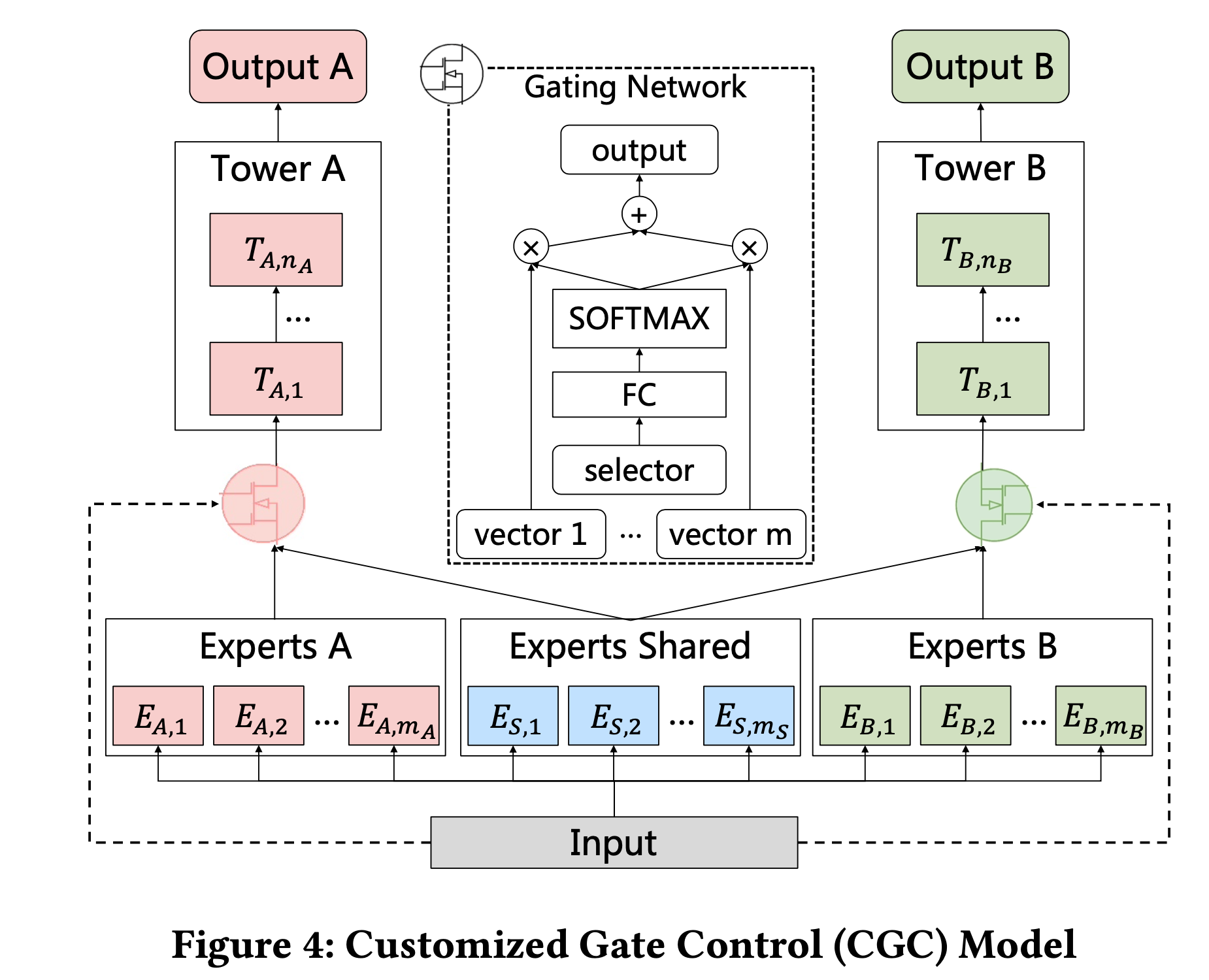
| CGC | Customized Gate Control | Progressive Layered Extraction (PLE): A Novel Multi-Task Learning (MTL) Model for Personalized Recommendations(RecSys '20) |
| PLE | Progressive Layered Extraction | Progressive Layered Extraction (PLE): A Novel Multi-Task Learning (MTL) Model for Personalized Recommendations(RecSys '20) |
Shared-Bottom & MMOE

ESMM

CGC
PLE

1 maintainer

Metadata
1 maintainer
Release files for keras-recommenders 0.0.3
For a detailed explanation of source distributions (sdists) and built distributions (wheels), please see the package formats documentation.
Source distribution (sdist)
| File | Size | Uploaded | Provenance | Actions |
|---|---|---|---|---|
| keras-recommenders-0.0.3.tar.gz | 11.7 kB | Without provenance | Details for keras-recommenders-0.0.3.tar.gz |
Release files / keras-recommenders-0.0.3.tar.gz
| Download URL | keras-recommenders-0.0.3.tar.gz |
|---|---|
| Size | 11.7 kB |
| Tags | Source |
|
SHA-256 checksum How to use checksums |
407e8288d1a0d52153bce5efb48bb95744e1667d16382305d9cb372e12264cf1
|
|
BLAKE2b-256 checksum How to use checksums |
11f0d61c7c2aef13eb16af45640970e11cef422730a8cd0826658eeb7a3b26e9
|
| Upload date | |
|
Uploaded using Trusted Publishing? What is trusted publishing? |
No |
| Uploaded via |
twine/3.4.1 importlib_metadata/4.6.1 pkginfo/1.5.0.1 requests/2.24.0 requests-toolbelt/0.9.1 tqdm/4.50.2 CPython/3.7.9
|
Security for keras-recommenders 0.0.3
Provenance
Provenance describes where a file came from. On PyPI, provenance is shared via attestations, which provide a verifiable record of the build or publishing details. View details, limitations and caveats.
No provenance found
None of the files in this release were uploaded with provenance metadata.
A note on package security
PyPI is a repository for distributing packages, not a service for auditing them. While third-party security researchers and our staff do their best to detect and remove malicious packages, PyPI cannot guarantee the quality, security or suitability of any given package.
To learn more about protecting yourself from malicious actors, visit our package security documentation.














