Share:


About
Helper package with multiple U-Net implementations in Keras as well as useful utility tools helpful when working with image segmentation tasks
Features:
- U-Net models implemented in Keras
- Vanilla U-Net implementation based on the original paper
- Customizable U-Net
- U-Net optimized for satellite images based on DeepSense.AI Kaggle competition entry
- Utility functions:
- Plotting images and masks with overlay
- Plotting images masks and predictions with overlay (prediction on top of original image)
- Plotting training history for metrics and losses
- Cropping smaller patches out of bigger image (e.g. satellite imagery) using sliding window technique (also with overlap if needed)
- Plotting smaller patches to visualize the cropped big image
- Reconstructing smaller patches back to a big image
- Data augmentation helper function
- Notebooks (examples):
- Training custom U-Net for whale tails segmentation
- Semantic segmentation for satellite images
- Semantic segmentation for medical images ISBI challenge 2015
Installation:
pip install git+https://github.com/karolzak/keras-unet
or
pip install keras-unet
Usage examples:
- U-Net implementations in Keras:
- Utils:
Vanilla U-Net
Model scheme can be viewed here
from keras_unet.models import vanilla_unet

model = vanilla_unet(input_shape=(512, 512, 3))
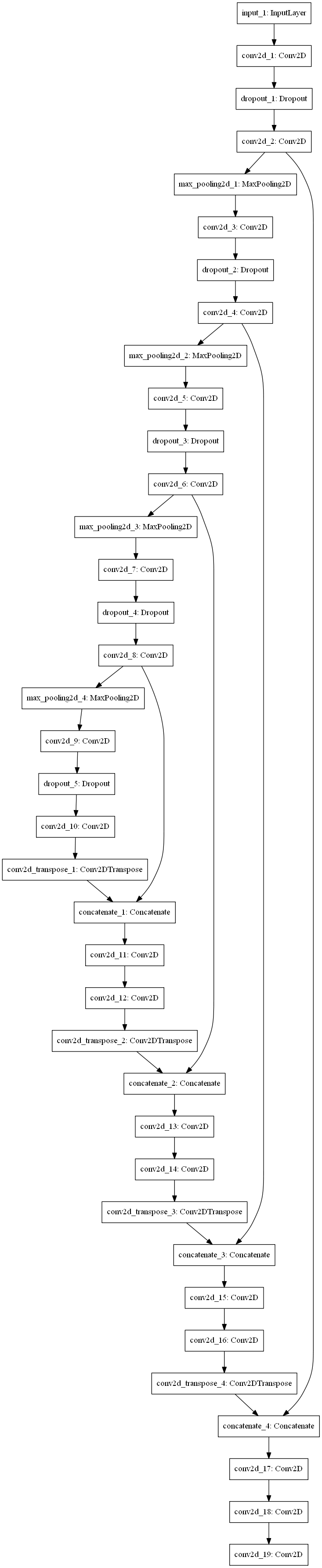
Customizable U-Net
Model scheme can be viewed here
from keras_unet.models import custom_unet

model = custom_unet(
    input_shape=(512, 512, 3),
    use_batch_norm=False,
    num_classes=1,
    filters=64,
    dropout=0.2,
    output_activation='sigmoid')
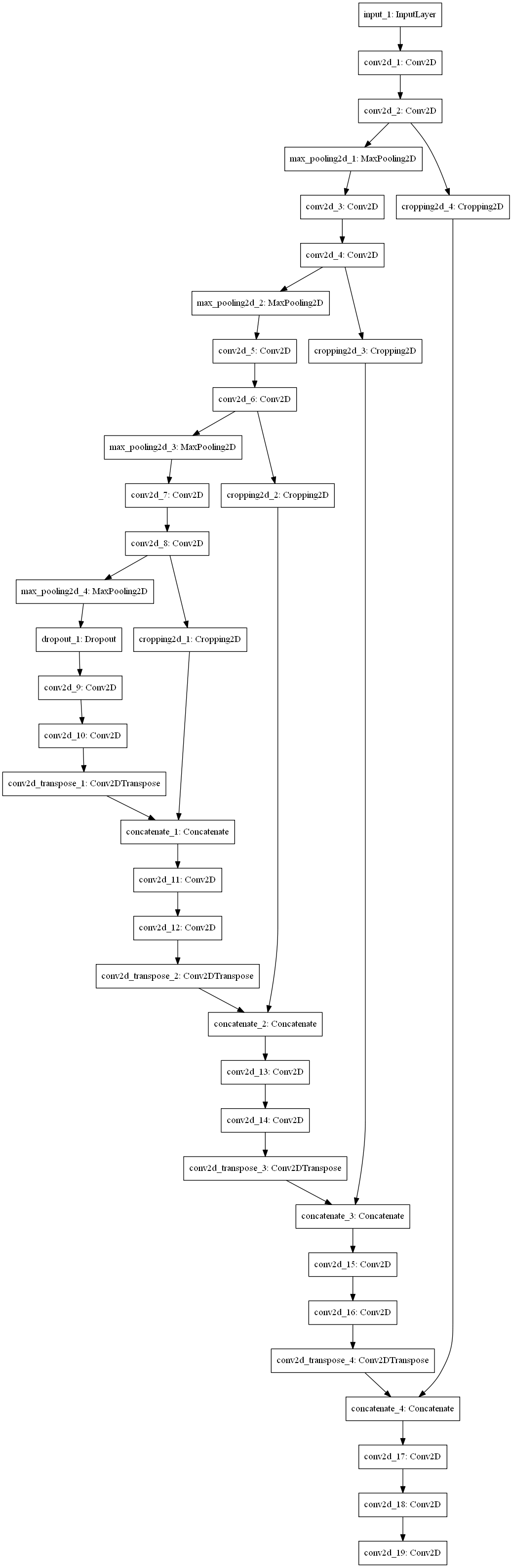
U-Net for satellite images
Model scheme can be viewed here
from keras_unet.models import satellite_unet

model = satellite_unet(input_shape=(512, 512, 3))
Plot training history
history = model.fit_generator(...)

from keras_unet.utils import plot_segm_history

plot_segm_history(
    history, # required - keras training history object
    metrics=['iou', 'val_iou'], # optional - metrics names to plot
    losses=['loss', 'val_loss']) # optional - loss names to plot
Output:


Plot images and segmentation masks
from keras_unet.utils import plot_imgs

plot_imgs(
    org_imgs=x_val, # required - original images
    mask_imgs=y_val, # required - ground truth masks
    pred_imgs=y_pred, # optional - predicted masks
    nm_img_to_plot=9) # optional - number of images to plot
Output:

Get smaller patches/crops from bigger image
from PIL import Image
import numpy as np
from keras_unet.utils import get_patches

x = np.array(Image.open("../docs/sat_image_1.jpg"))
print("x shape: ", str(x.shape))

x_crops = get_patches(
    img_arr=x, # required - array of images to be cropped
    size=100, # default is 256
    stride=100) # default is 256

print("x_crops shape: ", str(x_crops.shape))
Output:
x shape:  (1000, 1000, 3)
x_crops shape:  (100, 100, 100, 3)
Plot small patches into single big image
from keras_unet.utils import plot_patches

print("x_crops shape: ", str(x_crops.shape))
plot_patches(
    img_arr=x_crops, # required - array of cropped out images
    org_img_size=(1000, 1000), # required - original size of the image
    stride=100) # use only if stride is different from patch size
Output:
x_crops shape: (100, 100, 100, 3)

Reconstruct a bigger image from smaller patches/crops
import matplotlib.pyplot as plt
from keras_unet.utils import reconstruct_from_patches

print("x_crops shape: ", str(x_crops.shape))

x_reconstructed = reconstruct_from_patches(
    img_arr=x_crops, # required - array of cropped out images
    org_img_size=(1000, 1000), # required - original size of the image
    stride=100) # use only if stride is different from patch size

print("x_reconstructed shape: ", str(x_reconstructed.shape))

plt.figure(figsize=(10,10))
plt.imshow(x_reconstructed[0])
plt.show()
Output:
x_crops shape:  (100, 100, 100, 3)
x_reconstructed shape:  (1, 1000, 1000, 3)

1 maintainer

Metadata
1 maintainer
Release files for keras-unet 0.1.2
For a detailed explanation of source distributions (sdists) and built distributions (wheels), please see the package formats documentation.
Source distribution (sdist)
| File | Size | Uploaded | Provenance | Actions |
|---|---|---|---|---|
| keras-unet-0.1.2.tar.gz | 14.4 kB | Without provenance | Details for keras-unet-0.1.2.tar.gz |
Built distribution (wheel)
| File | Interpreter | ABI | Platform | Actions Reset |
|---|---|---|---|---|
| keras_unet-0.1.2-py3-none-any.whl | Python 3 | none | any | Details for keras_unet-0.1.2-py3-none-any.whl |
Total release size: 31.3 kB
Release files / keras-unet-0.1.2.tar.gz
| Download URL | keras-unet-0.1.2.tar.gz |
|---|---|
| Size | 14.4 kB |
| Tags | Source |
|
SHA-256 checksum How to use checksums |
ed3999e4beea836b47856c777992a509b051c4d72c9ebc69c96cf4001dc7bf46
|
|
BLAKE2b-256 checksum How to use checksums |
995aa7282e456db59c4f2a31db75e2943cab3ab71da88a6b2085cd8f08df9979
|
| Upload date | |
|
Uploaded using Trusted Publishing? What is trusted publishing? |
No |
| Uploaded via |
twine/3.2.0 pkginfo/1.5.0.1 requests/2.24.0 setuptools/41.2.0 requests-toolbelt/0.9.1 tqdm/4.48.0 CPython/3.8.3
|
Release files / keras_unet-0.1.2-py3-none-any.whl
| Download URL | keras_unet-0.1.2-py3-none-any.whl |
|---|---|
| Size | 17.0 kB |
| Tags | Python 3 |
|
SHA-256 checksum How to use checksums |
8b62b31fd63db9d895a3c3ffd86539e98f04ed58c22967962199de9c8767a162
|
|
BLAKE2b-256 checksum How to use checksums |
b0f6783d69bd0c5b250abcf0d0f187ce7b3e2cc2332315068d2fd14662b0471e
|
| Upload date | |
|
Uploaded using Trusted Publishing? What is trusted publishing? |
No |
| Uploaded via |
twine/3.2.0 pkginfo/1.5.0.1 requests/2.24.0 setuptools/41.2.0 requests-toolbelt/0.9.1 tqdm/4.48.0 CPython/3.8.3
|
Security for keras-unet 0.1.2
Provenance
Provenance describes where a file came from. On PyPI, provenance is shared via attestations, which provide a verifiable record of the build or publishing details. View details, limitations and caveats.
No provenance found
None of the files in this release were uploaded with provenance metadata.
A note on package security
PyPI is a repository for distributing packages, not a service for auditing them. While third-party security researchers and our staff do their best to detect and remove malicious packages, PyPI cannot guarantee the quality, security or suitability of any given package.
To learn more about protecting yourself from malicious actors, visit our package security documentation.