
Kestra is an infinitely scalable orchestration and scheduling platform, creating, running, scheduling, and monitoring millions of complex pipelines.

Project description

Event-driven declarative orchestrator to simplify data operations












Website • Twitter • Linked In • Slack • Documentation
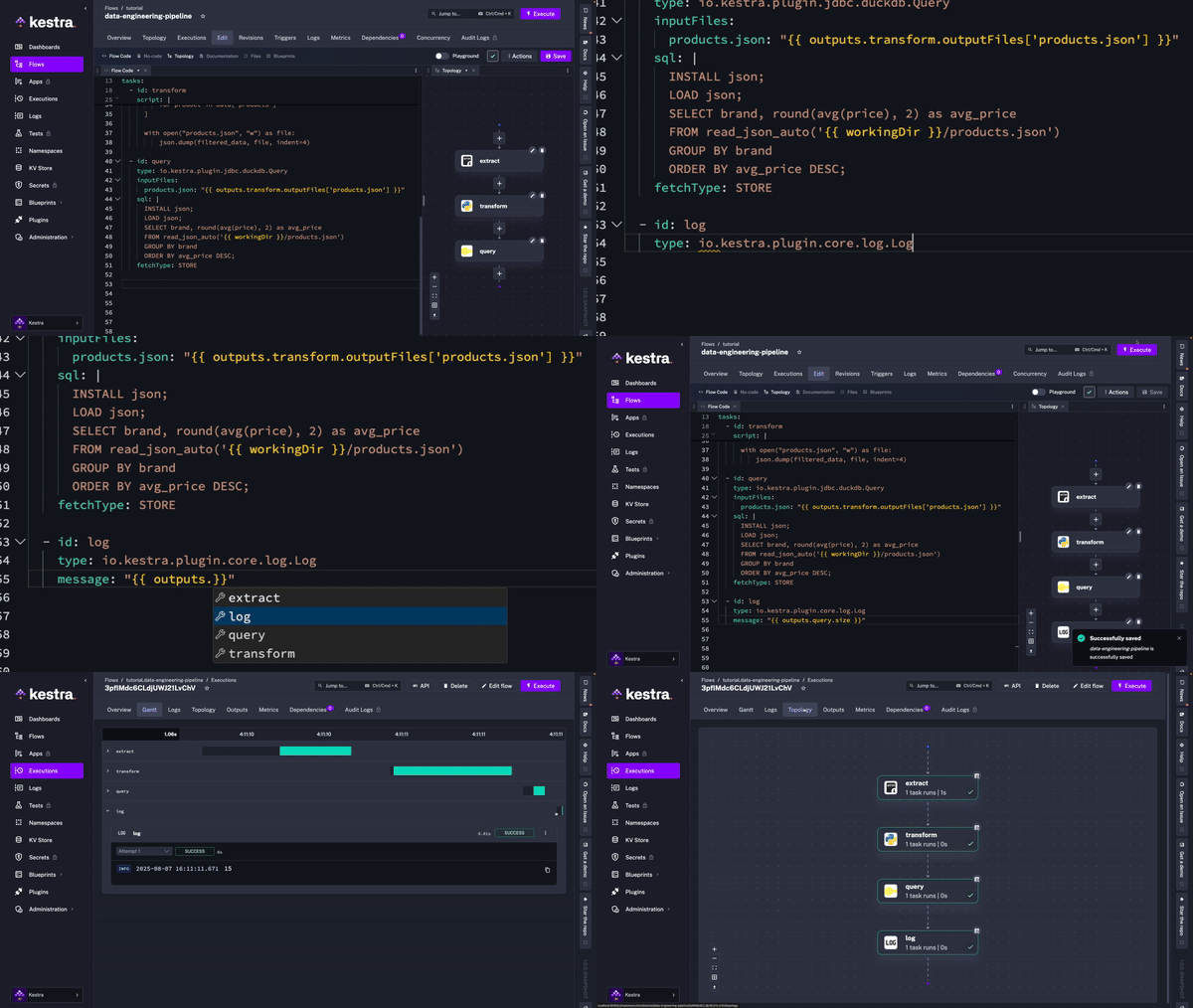
Live Demo
Try Kestra using our live demo.
What is Kestra
Kestra is an open-source, event-driven orchestrator that simplifies data operations and improves collaboration between engineers and business users. By bringing Infrastructure as Code best practices to data pipelines, Kestra allows you to build reliable workflows and manage them with confidence.
Thanks to the declarative YAML interface for defining orchestration logic, everyone who benefits from analytics can participate in the data pipeline creation process. The UI automatically adjusts the YAML definition any time you make changes to a workflow from the UI or via an API call. Therefore, the orchestration logic is defined declaratively in code, even if some workflow components are modified in other ways.
Key concepts
Flowis the main component in Kestra. It's a container for your tasks and orchestration logic.Namespaceis used to provide logical isolation, e.g., to separate development and production environments. Namespaces are like folders on your file system — they organize flows into logical categories and can be nested to provide a hierarchical structure.Tasksare atomic actions in a flow. By default, all tasks in the list will be executed sequentially, with additional customization options, a.o. to run tasks in parallel or allow a failure of specific tasks when needed.Triggersdefine when a flow should run. In Kestra, flows are triggered based on events. Examples of such events include:- a regular time-based schedule
- an API call (webhook trigger)
- ad-hoc execution from the UI
- a flow trigger - flows can be triggered from other flows using a flow trigger or a subflow, enabling highly modular workflows.
- custom events, including a new file arrival (file detection event), a new message in a message bus, query completion, and more.
Inputsallow you to pass runtime-specific variables to a flow. They are strongly typed, and allow additional validation rules.
Extensible platform via plugins
Most tasks in Kestra are available as plugins, but many type of tasks are available in the core library, including a.o. script tasks supporting various programming languages (e.g., Python, Node, Bash) and the ability to orchestrate your business logic packaged into Docker container images.
To create your own plugins, check the plugin developer guide.
Rich orchestration capabilities
Kestra provides a variety of tasks to handle both simple and complex business logic, including:
- retries
- timeout
- error handling
- conditional branching
- dynamic tasks
- sequential and parallel tasks
- skipping tasks or triggers when needed by setting the flag
disabledtotrue. - configuring dependencies between tasks, flows and triggers
- advanced scheduling and trigger conditions
- backfills
- documenting your flows, tasks and triggers by adding a markdown description to any component
- adding labels to add additional metadata to your flows such as the flow owner or team:
id: hello
namespace: prod
description: Hi from `Kestra` and a **markdown** description.
labels:
  owner: john-doe
  team: data-engineering
tasks:
  - id: hello
    type: io.kestra.core.tasks.log.Log
    message: Hello world!
    description: a *very* important task
    disabled: false
    timeout: 10M
    retry:
      type: constant # type: string
      interval: PT15M # type: Duration
      maxDuration: PT1H # type: Duration
      maxAttempt: 5 # type: int
      warningOnRetry: true # type: boolean, default is false
  - id: parallel
    type: io.kestra.core.tasks.flows.Parallel
    concurrent: 3
    tasks:
      - id: task1
        type: io.kestra.core.tasks.scripts.Bash
        commands:
          - 'echo "running {{task.id}}"'
          - 'sleep 10'
      - id: task2
        type: io.kestra.core.tasks.scripts.Bash
        commands:
          - 'echo "running {{task.id}}"'
          - 'sleep 10'
      - id: task3
        type: io.kestra.core.tasks.scripts.Bash
        commands:
          - 'echo "running {{task.id}}"'
          - 'sleep 10'
triggers:
  - id: schedule
    type: io.kestra.core.models.triggers.types.Schedule
    cron: "*/15 * * * *"
    backfill:
      start: 2023-06-25T14:00:00Z
Built-in code editor
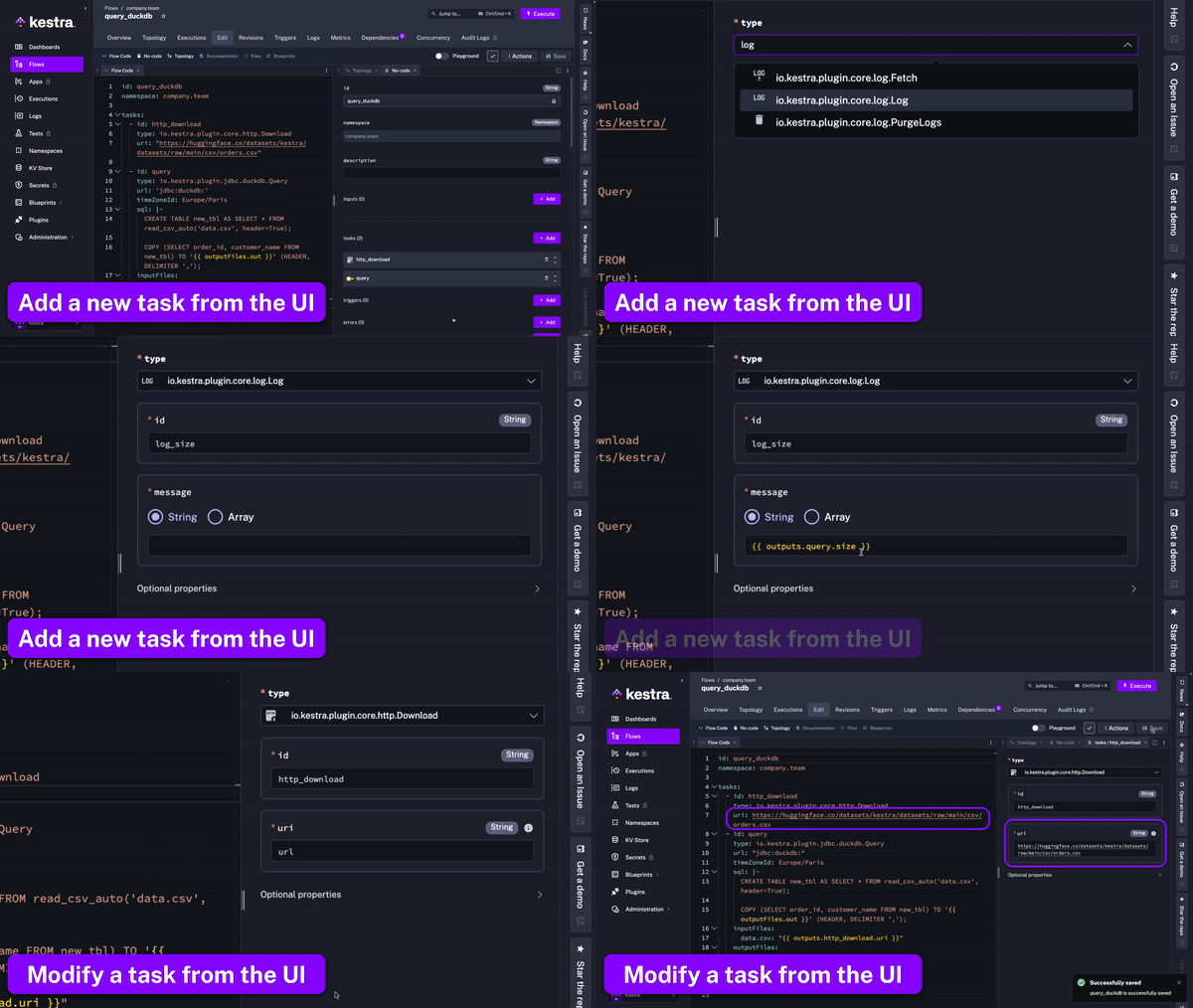
You can write workflows directly from the UI. When writing your workflows, the UI provides:
- autocompletion
- syntax validation
- embedded plugin documentation
- topology view (view of your dependencies in a Directed Acyclic Graph) that get updated live as you modify and add new tasks.
Getting Started
To get a local copy up and running, follow the steps below.
Prerequisites
Make sure that Docker is installed and running on your system. The default installation requires the following:
Launch Kestra
Download the Docker Compose file:
curl -o docker-compose.yml https://raw.githubusercontent.com/kestra-io/kestra/develop/docker-compose.yml
Alternatively, you can use wget https://raw.githubusercontent.com/kestra-io/kestra/develop/docker-compose.yml.
Start Kestra:
docker-compose up
Open http://localhost:8080 in your browser and create your first flow.
Hello-World flow
Here is a simple example logging hello world message to the terminal:
id: hello
namespace: prod
tasks:
  - id: hello-world
    type: io.kestra.core.tasks.log.Log
    message: Hello world!
For more information:
- Follow the getting started tutorial.
- Read the documentation to understand how to:
- Develop your flows
- Deploy Kestra
- Use our Terraform provider to deploy your flows
- Develop your own plugins.
Plugins
Kestra is built on a plugin system. You can find your plugin to interact with your provider; alternatively, you can follow these steps to develop your own plugin.
For a full list of plugins, check the plugins page.
Here are some examples of the available plugins:
This list is growing quickly and we welcome contributions.
Community Support
If you need help or have any questions, reach out using one of the following channels:
- GitHub discussions - useful to start a conversation that is not a bug or feature request.
- Slack - join the community and get the latest updates.
- Twitter - to follow up with the latest updates.
Roadmap
See the open issues for a list of proposed features (and known issues) or look at the project board.
Contributing
We love contributions, big or small. Check out our contributor guide for details on how to contribute to Kestra.
See our Plugin Developer Guide for details on developing and publishing Kestra plugins.
License
Apache 2.0 © Kestra Technologies
Release history Release notifications | RSS feed


Download files
Download the file for your platform. If you're not sure which to choose, learn more about installing packages.
Source Distribution
Built Distribution
Filter files by name, interpreter, ABI, and platform.
If you're not sure about the file name format, learn more about wheel file names.
Copy a direct link to the current filters
File details
Details for the file kestra-0.10.1.tar.gz.
File metadata
- Download URL: kestra-0.10.1.tar.gz
- Upload date:
- Size: 7.2 kB
- Tags: Source
- Uploaded using Trusted Publishing? No
- Uploaded via: twine/4.0.2 CPython/3.11.4
File hashes
| Algorithm | Hash digest | |
|---|---|---|
| SHA256 |
ec34adc8c39785598739d783f61275e4f7a4fd1e5d3381164e2936f3b5c88541
|
|
| MD5 |
db0bf4b6791b5e7e7fd51810ab4fd85d
|
|
| BLAKE2b-256 |
97578a652eae7812a482527d9842e787c385c6565b5fd7a092a5b8e1567a9fa4
|
File details
Details for the file kestra-0.10.1-py3-none-any.whl.
File metadata
- Download URL: kestra-0.10.1-py3-none-any.whl
- Upload date:
- Size: 6.3 kB
- Tags: Python 3
- Uploaded using Trusted Publishing? No
- Uploaded via: twine/4.0.2 CPython/3.11.4
File hashes
| Algorithm | Hash digest | |
|---|---|---|
| SHA256 |
a1f63469070991027dd8f2f5ac67f5b9567632cb7e1214e91417429f09651a08
|
|
| MD5 |
19aa0e7e54dc3b7e12ef947a4fe5eb6f
|
|
| BLAKE2b-256 |
33bf6c33a43d5ddc1c297dcd4372bec41d3dfb9059039c0c5130f6aa3daa2ee9
|






