
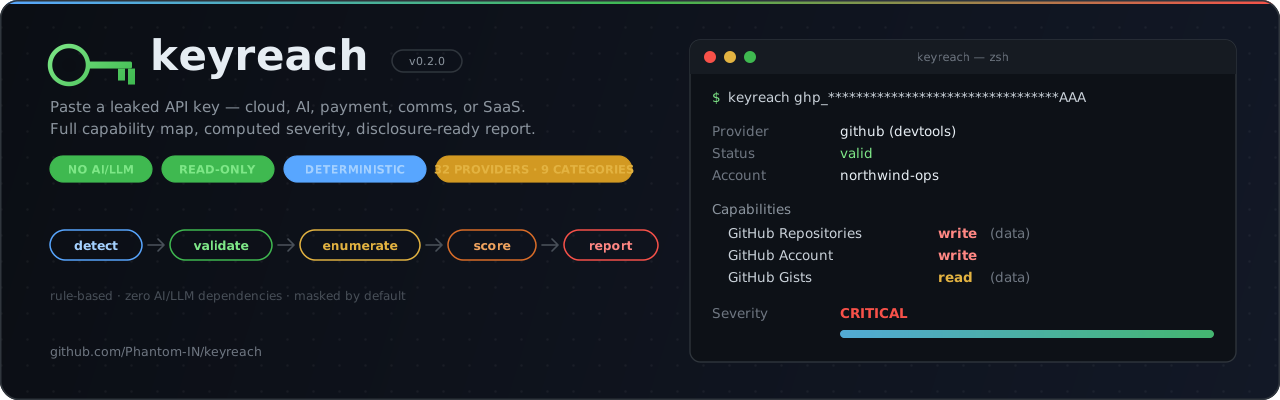
keyreach
Paste any leaked API key — cloud, AI, payment, comms, dev-tool, database, or SaaS — and get a full capability map plus a disclosure-ready security report with a computed severity, in one command.







v0.2.0 — Phase 2 complete.
Thirty-two providers across nine categories, usable from a terminal. The whole pipeline — detect → validate → enumerate → score → report — is built and covered: cloud (
aws), AI (openai,anthropic), payment (stripe,razorpay,paystack,paypal), communications (slack,twilio,telegram,discord,zoom), email/marketing (sendgrid,mailgun,postmark,resend,mailchimp), dev platforms (github,gitlab,bitbucket,npm,dockerhub), databases/data infra (mongodb,supabase,redis,pinecone), monitoring/observability (datadog,sentry,newrelic,grafana), and generic (generic— a JWT/bearer-token inspector built around no single vendor). Each key is scored from the capabilities keyreach actually confirmed, with the rationale attached. Reports render as terminal, JSON, Markdown or a self-contained HTML file, and a scheduled drift canary re-verifies detection rules and probe endpoints against the vendors they came from.Code lands one roadmap item at a time, each on its own feature branch and pull request, so the whole build is auditable in the open. Phase 0 (R0.1–R0.9), Phase 1 (R1.1–R1.6) and Phase 2 (R2.1–R2.10) are done; Phase 3 (ecosystem integration) is next. Follow along in
ROADMAP.md.
What it is
When a hunter finds an exposed key — a Google AIza…, an OpenAI sk-…, an AWS
AKIA…, a Stripe sk_live_…, a Slack xoxb-… — the value of that finding
depends entirely on what the key can actually do. Answering that today means
chaining a different tool per provider, ad-hoc curl recipes for everything
else, and hand-writing the report every single time.
keyreach collapses that into one deterministic command. Give it a key you own or are authorized to test, and it:
- identifies which provider the key belongs to, by rule;
- confirms whether it is live and whose account it belongs to;
- enumerates, read-only, exactly which services, scopes, and resources it reaches;
- computes a severity band (Info → Critical) from those confirmed capabilities, with a visible rationale;
- emits a disclosure-ready report — masked key, per-capability evidence, impact, and remediation — ready to paste into a HackerOne or Bugcrowd submission.
It is built for bug bounty hunters, pentesters, red teams, and blue teams doing exposure triage.
What it is NOT
keyreach is deliberately narrow. Knowing what it won't do is as important as knowing what it will.
| It is not… | Because that is… |
|---|---|
| A secret scanner. keyreach never crawls repos, S3 buckets, or Docker images looking for secrets. It starts from a key you already have — optionally piped in from a scanner. | TruffleHog / gitleaks / Nosey Parker territory. This is a deliberate wedge, not a gap. |
| An exploitation framework. No privilege escalation, no lateral movement, no destructive actions, no spend. | Pacu's domain. keyreach stays a scoping-and-reporting tool. |
| A CSPM / continuous audit platform. No posture management across a whole cloud estate. | Prowler / ScoutSuite's job. |
| An AI tool. No LLM-assisted classification, no "smart" heuristics that call a model, ever. | See below — it is a hard architectural constraint, not a preference. |
Core principles
These are non-negotiable and shape every decision downstream
(plan.md §1).
-
Deterministic and rule-based — no AI/LLM, ever. keyreach contains zero AI or LLM calls and zero AI/LLM SDK dependencies, anywhere. Detection, validation, enumeration, scoring, and reporting are all driven by explicit rules and real provider responses. Three reasons this is non-negotiable:
- Security — keyreach handles live secrets. Sending a key to an external model would itself be a credential leak.
- Reproducibility — the same key against the same provider state must always produce the same capability map, severity, and report. A finding you can't reproduce is a finding you can't report.
- Auditability — every verdict traces to a concrete rule and a concrete API response, so both you and the team receiving your report can verify exactly why the tool said what it said.
If a rule can't decide a capability, keyreach reports it as
unknown. It never guesses. A CI check (ai_ban) fails any build that introduces an AI/LLM dependency or model endpoint. -
Read-only by default. Every probe is non-destructive. keyreach never writes, deletes, or spends money in its default operation. The HTTP layer default-denies non-idempotent methods; anything aggressive is opt-in, explicitly flagged, and loudly warned.
-
Single-key ergonomics. One key in, full picture out. No scanning workflow to wade through.
-
Transparent severity. Severity is computed from the capabilities keyreach actually confirmed, with a visible rationale — never a hardcoded per-provider label. That rationale is the bounty argument.
-
Authorized use only. Built for keys you own or are explicitly authorized to test — bounty scope or engagement. See
SECURITY.md.
How it works
detect → validate → enumerate → score → report
- detect — deterministic pattern and entropy rules identify the provider.
- validate — the cheapest read-only liveness and identity call.
- enumerate — read-only probes map which services, scopes, and resources the key reaches.
- score — a pure, rule-based function turns confirmed capabilities into a severity band plus rationale.
- report — terminal, JSON, Markdown, or HTML output; masked key, evidence, impact, remediation.
Provider plugins declare probes; the engine executes them through a
single shared HTTP layer that owns rate limiting, record/replay, redaction, and
the read-only guard. That is what makes determinism enforceable in one place —
see implementation_plan.md §2.
Install
Python 3.11+.
pipx install keyreach          # recommended: isolated, on your PATH
pip install keyreach           # or into an existing environment
From source:
git clone https://github.com/Phantom-IN/keyreach.git
cd keyreach
pipx install -e .              # or: pip install -e '.[dev]'
keyreach --help
keyreach depends on httpx, pydantic, typer, rich, Jinja2 and PyYAML,
and on nothing else. There is no AI/LLM SDK in any dependency group, runtime or
dev, and a CI check fails the build if one appears.
Usage
$ keyreach AIza...
    __                                   __
   / /_____  __  ______  ___  ____ _____/ /_
  / //_/ _ \/ / / / ___// _ \/ __ `/ ___/ __ \
 / ,< /  __/ /_/ / /   /  __/ /_/ / /__/ / / /
/_/|_|\___/\__, /_/    \___/\__,_/\___/_/ /_/
          /____/
  v0.2.0  |  deterministic  |  read-only  |  no AI
  Use only against keys you own or are explicitly authorized to test.
keyreach KEY                      # detect → validate → enumerate → score → terminal report
keyreach KEY --report md -o out.md
keyreach KEY --report html -o out.html  # self-contained; open straight from disk
keyreach KEY --json               # machine-readable, schema-validated
keyreach -f keys.txt              # batch from a file, one key per line
cat keys.txt | keyreach -f -      # batch from stdin (keeps keys out of shell history)
keyreach KEY --provider google    # force provider, skip detection
keyreach KEY --no-enumerate       # validity + identity only
keyreach KEY --aggressive         # opt-in noisy enumeration; off by default, warned
keyreach KEY --delay 500ms        # pace probes
keyreach KEY --unmask             # show full key (off by default)
keyreach KEY --fail-on high       # exit 2 if band >= high (CI gating)
keyreach KEY --quiet              # no banner, no warnings
Some credentials are two halves, and keyreach takes them colon-joined. AWS, Twilio and Razorpay all authenticate with a pair, so paste the pair:
keyreach 'AKIA...:<secret access key>'                  # AWS
keyreach 'ASIA...:<secret>:<session token>'             # AWS, temporary
keyreach 'AC<32 hex>:<auth token>'                      # Twilio
keyreach 'rzp_live_...:<key secret>'                    # Razorpay
keyreach 'CLIENT_ID:CLIENT_SECRET' --provider paypal    # PayPal
keyreach 'ACCOUNT_ID:CLIENT_ID:CLIENT_SECRET' --provider zoom   # Zoom
Half a credential is still recognised and still reported — keyreach tells you which half is missing rather than calling a live credential dead, and it makes no request it cannot authenticate.
stdout is the report; stderr is everything else. The banner, warnings and
errors go to stderr, so keyreach KEY --json | jq works and
keyreach KEY --report md > finding.md writes a file containing nothing but the
finding.
Exit codes — fixed, documented, and safe to gate CI on:
| Code | Meaning |
|---|---|
0 |
Ran cleanly; nothing reached the --fail-on threshold |
2 |
A finding at or above --fail-on |
1 |
Something went wrong — bad flag, unreadable file, unknown provider |
2 means a finding and nothing else. A malformed command line exits 1, so a
typo in a CI config can never be mistaken for a Critical key.
--report html is one self-contained file — every style rule inlined, no
external stylesheet, font, script or image, so it opens correctly straight
from disk with no network available. It carries the same ten sections as
--report md, in the same order. Because a single HTML document cannot
honestly represent several findings at once, it refuses --file/stdin; use
--report md or --json for a batch, or run keyreach once per key.
What the output looks like
Abridged --report md for a GitHub token — the full report also carries a
reproduction command and a documentation link for every capability, plus
remediation steps. This one is generated from a committed test fixture, so
nothing below came from a real account.
# Exposed github API key reaches GitHub Repositories and 4 other services

**Severity: CRITICAL** — Anyone holding this key can change data or move money.
Treat this as an active compromise: rotate now, then audit for use.

| Field | Value |
| --- | --- |
| Provider | `github` (devtools) |
| Key | `ghp_*********************************AAA` |
| Status | valid |
| Account | northwind-ops |
| scopes | read:org, repo, user |

## Why this severity

- Write or admin access to a service holding private data or able to spend:
  GitHub Repositories (write) — Can list the account's private repositories,
  which is the source code the account was relying on nobody being able to
  read. The token holds repo, which GitHub documents as granting more than read
  over this resource. No write was attempted.
- Reaches 5 distinct services, so the exposure is the project rather than a
  single API.

## Capabilities

| Service | Access | Data | Cost |
| --- | --- | --- | --- |
| GitHub Account | write | no | no |
| GitHub Email Addresses | write | yes | no |
| GitHub Gists | read | yes | no |
| GitHub Organizations | read | no | no |
| GitHub Repositories | write | yes | no |

## Evidence

### GitHub Repositories — write

```text
GET https://api.github.com/user/repos?per_page=1&visibility=private
  -> 200, private repositories: 1 listed
```

Reproduce (read-only):

```console
curl -s -H 'Authorization: Bearer <key>' \
  'https://api.github.com/user/repos?per_page=1&visibility=private'
```
Three things in there are the product rather than the formatting. The severity
is derived, not assigned by provider name — write on private repositories
plus private data is what produced Critical, and the rationale says so in terms
a triager can check. The evidence counts, never quotes: it proves the key
listed a private repository without putting the repository's name in a bug
bounty report. And the write was never performed — it comes from the
X-OAuth-Scopes header GitHub documents, which is why the same token's
organization capability stays a read.
Provider coverage
Prioritized by leak frequency × blast radius, across cloud/infra, AI/LLM,
payment, communications, email/marketing, dev platforms, databases/data infra,
monitoring, auth/identity, and a generic bearer/JWT inspector. The full target
list is plan.md §8; the shipping order is
ROADMAP.md.
32 providers across 9 categories. v0.1 shipped 10 — the target was ≥10
across ≥4, including cloud, AI, payment and comms — R2.1 and R2.2 added two
each, R2.3 opened the email category with five, R2.4 took dev platforms to five,
R2.5 opened databases with four, R2.6 opened monitoring/observability with
four, and R2.7 opened generic with one. The count is asserted by a test
rather than counted by hand (tests/test_provider_contract.py), so a deleted
provider or a typo'd category fails the build. R2.8 added no new provider but
changed how two of them are built: npm and pinecone now ship as
declarative .yml files rather than hand-written Python, played back by
keyreach/core/probes.py — see Contributing below.
| Provider | Category | Credential | What a live key is shown to reach |
|---|---|---|---|
google |
cloud | AIza… |
Maps, Places, Geocoding, Roads; Gemini reachability |
aws |
cloud | AKIA…:secret, ASIA…:secret:token |
caller identity, account/root detection, IAM and read-only service probes |
openai |
ai | sk-…, sk-proj-…, sk-svcacct-…, sk-admin-… |
models, files, vector stores, fine-tunes; org projects, members and spend for admin keys |
anthropic |
ai | sk-ant-…, sk-ant-admin… |
models, files; organization, members, API keys and cost for admin keys |
stripe |
payment | sk_live_…, sk_test_…, rk_… |
account, balance, charges, customers, payment intents, payouts, subscriptions |
razorpay |
payment | rzp_live_…:secret |
payments, orders, customers, settlements |
paystack |
payment | sk_live_…, sk_test_… |
balance, customers, settlements, subaccounts, transactions |
paypal |
payment | client_id:client_secret (needs --provider paypal) |
disputes, invoices, products, subscription plans — with write read from the granted OAuth scopes |
slack |
comms | xoxb-…, xoxp-… |
workspace, members, channels, files |
twilio |
comms | AC…:auth token |
account and tier, balance, message log, call log, phone numbers |
telegram |
comms | <bot id>:<secret> |
bot identity, webhook target, commands; group-message reach when privacy mode is off |
discord |
comms | bot token (needs --provider discord) |
application, bot identity, servers; message-content and member reach from the privileged-intent flags |
zoom |
comms | account_id:client_id:client_secret (needs --provider zoom) |
users, cloud recordings, meetings, groups — with write read from the granted scopes |
sendgrid |
SG.… |
account, profile, templates, suppressions, API keys — with write and send read from the scopes SendGrid publishes for the key | |
mailgun |
account API key (needs --provider mailgun) |
domains, mailing lists, inbound routes, API keys | |
postmark |
server or account token (needs --provider postmark) |
server config and bounces for a server token; every server, domain and sender signature for an account token | |
resend |
re_… |
API keys, audiences, broadcasts, domains — or, for a sending-only key, the send capability alone | |
mailchimp |
<hex>-<dc> |
account, audiences, campaigns, reports, automations — with access read from the role Mailchimp returns | |
github |
devtools | ghp_…, gho_…, github_pat_… |
account, private repositories, organizations, email addresses, gists |
gitlab |
devtools | glpat-… |
account, private projects, groups — with write and admin read from the token's own scopes |
bitbucket |
devtools | <email>:<api token> (needs --provider bitbucket) |
account, email addresses, workspaces |
npm |
devtools | access token (needs --provider npm) |
every token on the account, staged package versions |
dockerhub |
devtools | <identifier>:dckr_pat_… / dckr_oat_… |
repositories including private ones; org members, settings and tokens for an organization token |
mongodb |
database | <client id>:<client secret> (needs --provider mongodb) |
Atlas organizations and projects — the list of every cluster the credential could reach |
supabase |
database | <ref>:sb_secret_… / sb_publishable_…, or a legacy JWT |
auth settings, storage buckets, the exposed table schema, and the end-user list for a key that bypasses Row Level Security |
redis |
database | <account key>:<secret key> (needs --provider redis) |
Redis Cloud subscriptions and the cloud accounts they deploy into |
pinecone |
database | pcsk_… |
indexes, collections, backups and assistants — the shape of what the account has embedded |
datadog |
monitoring | API_KEY:APP_KEY (needs --provider datadog) |
dashboards, monitors, users, roles — a bare API key alone still validates |
sentry |
monitoring | auth token (needs --provider sentry) |
organizations, projects, members, teams — with write and admin read from the org's own access field |
newrelic |
monitoring | NRAK-… |
account identity via NerdGraph, APM applications via REST v2 |
grafana |
monitoring | glc_… |
the organization's Grafana Cloud access policies and every token issued under them |
generic |
generic | any JWT, or TOKEN@https://… for an arbitrary bearer token |
decoded JWT claims (no signature check); whether an operator-named endpoint accepts the token |
Severity is computed, and the differences are the point. A sk_live_ Stripe
key rates Critical and a sk_test_ one does not, because Stripe documents
sandbox payments as not processed. A GitHub token holding repo is reported as
write access to private source code — read out of the X-OAuth-Scopes
header GitHub documents, not from a push keyreach made — while the same token's
organization capability stays a read, because repo grants nothing there.
What keyreach declines to claim is as deliberate as what it reports. It
never calls a model, so it cannot confirm that an AI key can run inference or
spend, and does not pretend to. It never sends an SMS, so a Twilio credential is
reported for the message log it can read rather than the toll fraud it could
probably commit. Where a vendor documents an access model — Stripe's
"unrestricted permissions on all Stripe APIs" for sk_, AWS's root user,
Anthropic's unscoped Console admin keys — keyreach reports the stronger verdict
and cites the sentence. Everywhere else it under-reports and says so. See
plan.md §1.
Two things about detection are worth knowing.
Some credentials cannot be detected at all. PayPal, Discord and Zoom all authenticate with credentials that are opaque strings — no published prefix, length or charset. keyreach will not ship a rule guessed from that, because a pattern matching "long opaque string, colon, long opaque string" would claim a large share of every base64 blob a scanner emits, and Discord's community three-segment pattern would claim every JWT. So name it yourself, and the report records that you did rather than pretending a rule recognised it:
keyreach 'CLIENT_ID:CLIENT_SECRET' --provider paypal
keyreach 'BOT_TOKEN' --provider discord
keyreach 'ACCOUNT_ID:CLIENT_ID:CLIENT_SECRET' --provider zoom
keyreach 'API_KEY' --provider mailgun
keyreach 'SERVER_OR_ACCOUNT_TOKEN' --provider postmark
keyreach 'EMAIL:API_TOKEN' --provider bitbucket
keyreach 'ACCESS_TOKEN' --provider npm
keyreach 'CLIENT_ID:CLIENT_SECRET' --provider mongodb
keyreach 'ACCOUNT_KEY:SECRET_KEY' --provider redis
keyreach 'API_KEY:APP_KEY' --provider datadog
keyreach 'AUTH_TOKEN' --provider sentry
Supabase legacy keys name their own project. An anon or service_role key
is a JWT carrying the project reference, so --provider supabase is enough. A
current sb_secret_… key is opaque and needs <project ref>:<key>.
Mailgun and npm are providers keyreach could once detect and no longer can.
Both shipped a rule from R0.5, and both vendors have since stopped documenting
any credential format — Mailgun's authentication page and npm's access-token
page each describe how to send a token and never what one looks like. A rule
nobody can re-verify is worse than no rule, so both were withdrawn; see
ROADMAP.md R2.3 and R2.4. A withdrawn rule is not silence: the
entropy fallback still reports the value as a secret of unknown provenance.
Firebase is deliberately absent. Google documents that a Firebase API key
"only identifies your Firebase project and app" and that "none of the
Firebase-related APIs use an API key as authorization". A string that authorises
nothing has no capability map, and the same AIza… format does authorise
Google Cloud APIs — which the google provider already probes.
PyPI is recognised and deliberately not probed. Its token format is documented and the rule is sound, but PyPI publishes exactly one endpoint that accepts an API token — a package upload. keyreach will not perform a write to establish a capability, so it reports the vendor, the severity and the rotation guide, and stops there.
Sentry's DSN gets nothing at all — not even a detection rule. Sentry's own
docs say a DSN "only allow[s] submission of new events... they do not allow
read access to any information", the same write-only shape as a New Relic
License key or a PyPI token. Unlike PyPI, no rule was written for it: doing so
would hand a live, working DSN to the sentry auth-token plugin, which would
report it "invalid" for not being one — worse than the silence it gets instead.
New Relic ships one key of at least four. Only the NRAK- User key is
detected and probed. License keys are the exact shape of a SHA-1 hash (New
Relic documents them only as "a 40-character hexadecimal string"), so no rule
was written; they are also un-enumerable, the same way PyPI's token is —
confirming one is live means sending real telemetry, which keyreach will not do.
Grafana means Grafana Cloud's access policy tokens, not a self-hosted
instance. A self-managed Grafana's service-account tokens (glsa_…)
authenticate against whatever host the operator chose, which the token itself
never names — a harder version of GitLab's self-managed gap, since GitLab at
least has gitlab.com as a real default to fall back on. Grafana has no
analogous default, so only Cloud's organization-level glc_… tokens, reachable
at a fixed host, are covered.
A JWT is finally detected, on purpose, by a provider that names no vendor.
Discord's community token pattern and Supabase's legacy keys are both JWTs,
and both were deliberately kept out of their own provider's detection: a
rule matching three base64 segments would claim every JWT ever pasted at
keyreach. generic is where that pattern belongs instead — it never claims a
vendor, so it cannot misattribute one. It decodes the claims with no
signature check and reports the credential valid=False when no target URL
was given, the same treatment aws gives a bare access key ID: real facts
were read, nothing was confirmed live.
keyreach 'eyJhbGciOiJIUzI1NiJ9.eyJzdWIiOiJ1c2VyLTEyMyJ9.<signature>'
keyreach 'eyJhbGciOiJIUzI1NiJ9.eyJzdWIiOiJ1c2VyLTEyMyJ9.<signature>@https://internal.example.com/whoami'
Postmark's two token types look identical, so keyreach does not ask you which you have. It tries both headers, and Postmark's own refusal names the one it wanted — a server token reaches one server's mail, an account token reaches every server on the account and can create more.
Some prefixes belong to two vendors. Stripe and Paystack both document
sk_live_ and sk_test_. keyreach probes both and reports whichever one
authenticates, rather than ranking a guess — so a sk_live_ key costs one
wasted request against the vendor it does not belong to. --provider settles it
for free if you already know.
Enumeration is quiet by default. The wider AWS cross-service sweep is behind
--aggressive, because a sweep looks like reconnaissance to whoever is watching
the account.
Documentation
| Document | What it covers |
|---|---|
plan.md |
The product plan — what keyreach is and why. Scope, goals, non-goals, severity model intent, report contents, safety policy. |
implementation_plan.md |
The technical blueprint — how it is built. Architecture, interfaces, determinism enforcement, testing, CI guardrails, CLI spec. |
ROADMAP.md |
Every planned item, with acceptance criteria. One item per feature branch. |
CONTRIBUTING.md |
Dev setup, the build-in-public workflow, commit conventions, and the hard rules. |
SECURITY.md |
Responsible use, and how to report a vulnerability in keyreach itself. |
CLAUDE.md |
Working rules for agents and contributors touching this repo. |
CREDITS.md |
The prior art keyreach learns from and reuses. |
Contributing
Contributions are very welcome — especially new provider plugins. The target is
that adding a provider is a small, self-contained, ~30-minute contribution:
recognize the key, one cheap read-only validity check, a set of read-only
probes, and metadata. A provider that authenticates with a static header, has
no identity call and needs no chained request can often be a .yml file
instead of Python — see keyreach/providers/npm.yml for a worked example.
Start with CONTRIBUTING.md, then the provider checklist in
CLAUDE.md. Every roadmap item is tracked as an issue and lands via
its own pull request.
Legal & ethics
Use keyreach only against keys you own or are explicitly authorized to test — your own infrastructure, an in-scope bug bounty program, or a documented engagement. Validating a key generates authentication traffic and log entries on the target service. Testing credentials without authorization may be illegal in your jurisdiction, regardless of how the key was exposed.
keyreach is read-only by design and ships no exploitation features, but the
responsibility for authorization is yours. The authors accept no liability for
misuse. Full policy: SECURITY.md.
License
Apache License 2.0 — see LICENSE and NOTICE.
Third-party attributions are recorded in NOTICE and
THIRD_PARTY_LICENSES.md. keyreach never copies
AGPL/GPL code; such projects are studied and re-implemented from public
documentation only.
Credits
keyreach builds on work by the TruffleHog team, streaak (KeyHacks), Mazin Ahmed (secrets-patterns-db), Ozgur Alp (gmapsapiscanner), Andrés Riancho (enumerate-iam), Rhino Security Labs, gitleaks, Yelp (detect-secrets), Prowler, NCC Group (ScoutSuite), and ProjectDiscovery (nuclei).
Full acknowledgements: CREDITS.md.
1 maintainer

Metadata
1 maintainer
Release files for keyreach 0.2.0
For a detailed explanation of source distributions (sdists) and built distributions (wheels), please see the package formats documentation.
Source distribution (sdist)
| File | Size | Uploaded | |
|---|---|---|---|
| keyreach-0.2.0.tar.gz | 548.2 kB | Details |
Built distribution (wheel)
| File | Interpreter | ABI | Platform | Reset |
|---|---|---|---|---|
| keyreach-0.2.0-py3-none-any.whl | Python 3 | none | any | Details |
Total release size: 842.4 kB
Release files / keyreach-0.2.0.tar.gz
| Download URL | keyreach-0.2.0.tar.gz |
|---|---|
| Size | 548.2 kB |
| Tags | Source |
|
SHA-256 checksum How to use checksums |
a275279e64420b118f6fcc6fe7a3d53277556d708d3529f28f0ecd68b788ffbb
|
|
BLAKE2b-256 checksum How to use checksums |
3f71126691eed655978def659413698866816458a74be3c02777c337fc101bae
|
| Upload date | |
|
Uploaded using Trusted Publishing? What is trusted publishing? |
Yes |
| Uploaded via |
twine/7.0.0 CPython/3.13.14
|
Provenance
Provenance describes where a file came from. On PyPI, provenance is shared via attestations, which provide a verifiable record of the build or publishing details. View details, limitations and caveats.


PyPI Publish Attestation
PyPI verified that this artifact, at this checksum, originated from the publisher listed below.
Signed by GitHub Actions, verified by PyPI on Aug 17, 2026.
Transparency logRelease files / keyreach-0.2.0-py3-none-any.whl
| Download URL | keyreach-0.2.0-py3-none-any.whl |
|---|---|
| Size | 294.2 kB |
| Tags | Python 3 |
|
SHA-256 checksum How to use checksums |
3de74ccfea9d3ac0997a43754f0473e7acfdca7e01c36368d42c84818fa42c5d
|
|
BLAKE2b-256 checksum How to use checksums |
239af701752e6785ea80b9f9441ca9c3b2518d291ff3bde5a4f4a76eb69770cd
|
| Upload date | |
|
Uploaded using Trusted Publishing? What is trusted publishing? |
Yes |
| Uploaded via |
twine/7.0.0 CPython/3.13.14
|
Provenance
Provenance describes where a file came from. On PyPI, provenance is shared via attestations, which provide a verifiable record of the build or publishing details. View details, limitations and caveats.
PyPI Publish Attestation
PyPI verified that this artifact, at this checksum, originated from the publisher listed below.
Signed by GitHub Actions, verified by PyPI on Aug 17, 2026.
Transparency log













