Keywarden
Check SSH posture around the public keys you already push. Keywarden does not push keys, and it does not store them.
You keep using whatever already places authorized_keys on a machine (Ansible, a script, by hand). Keywarden reads the effective daemon config and the keys that are actually authorized, fingerprints those keys, and drops the bodies before it writes a report.
One command checks this machine, one host, or every host in an Ansible inventory. It is a point-in-time check: there is no daemon, scheduler, or stored state.
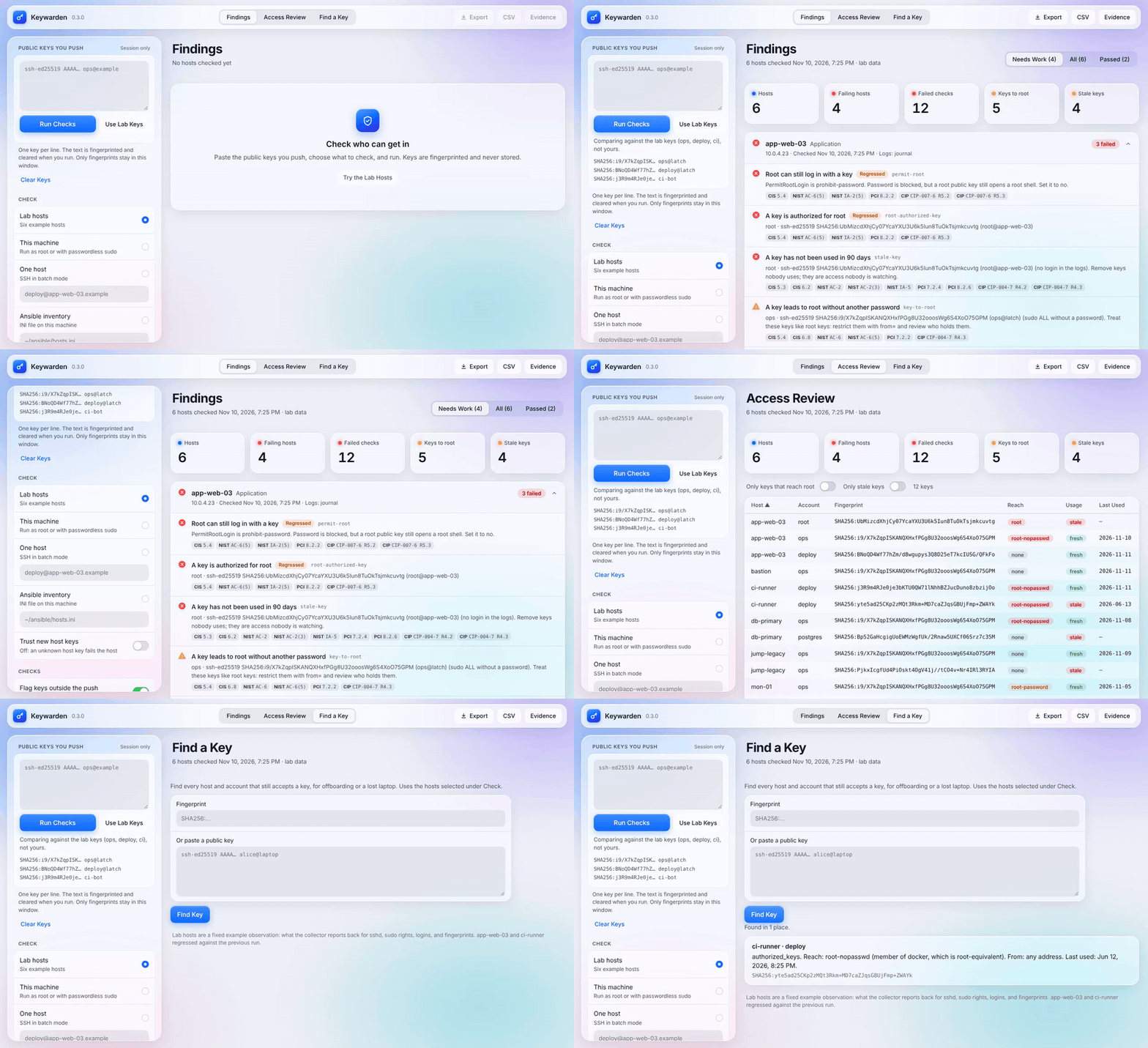
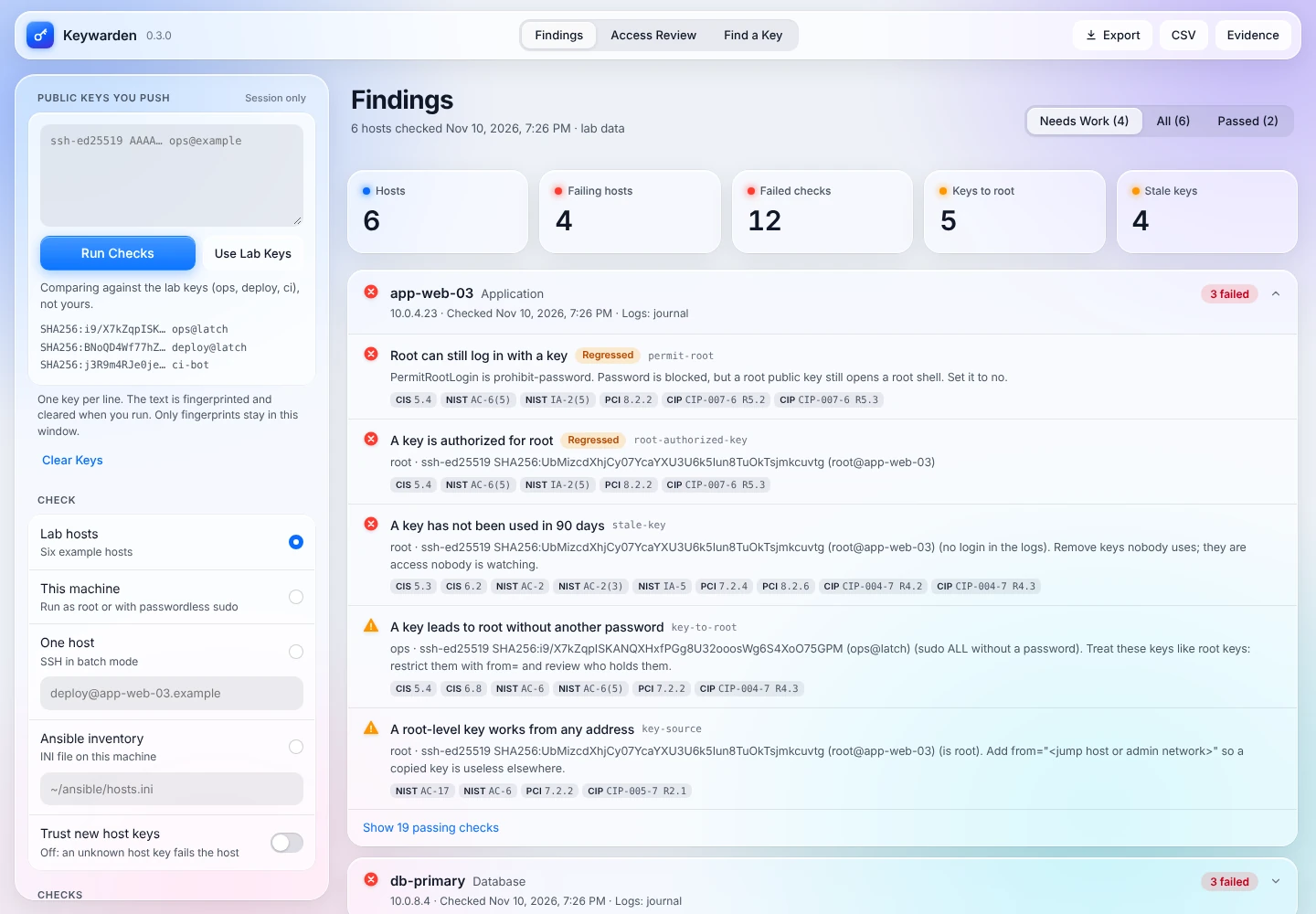
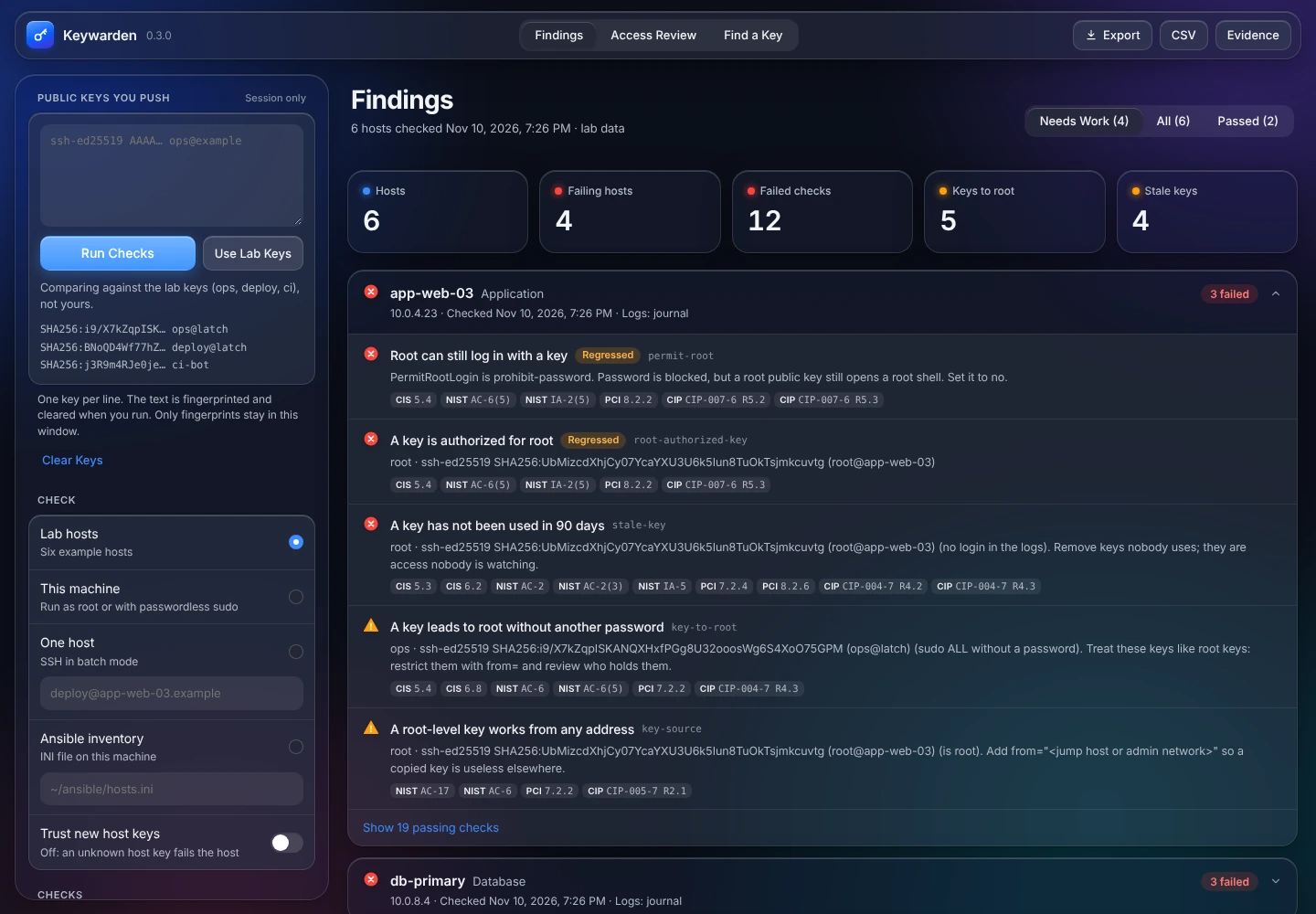
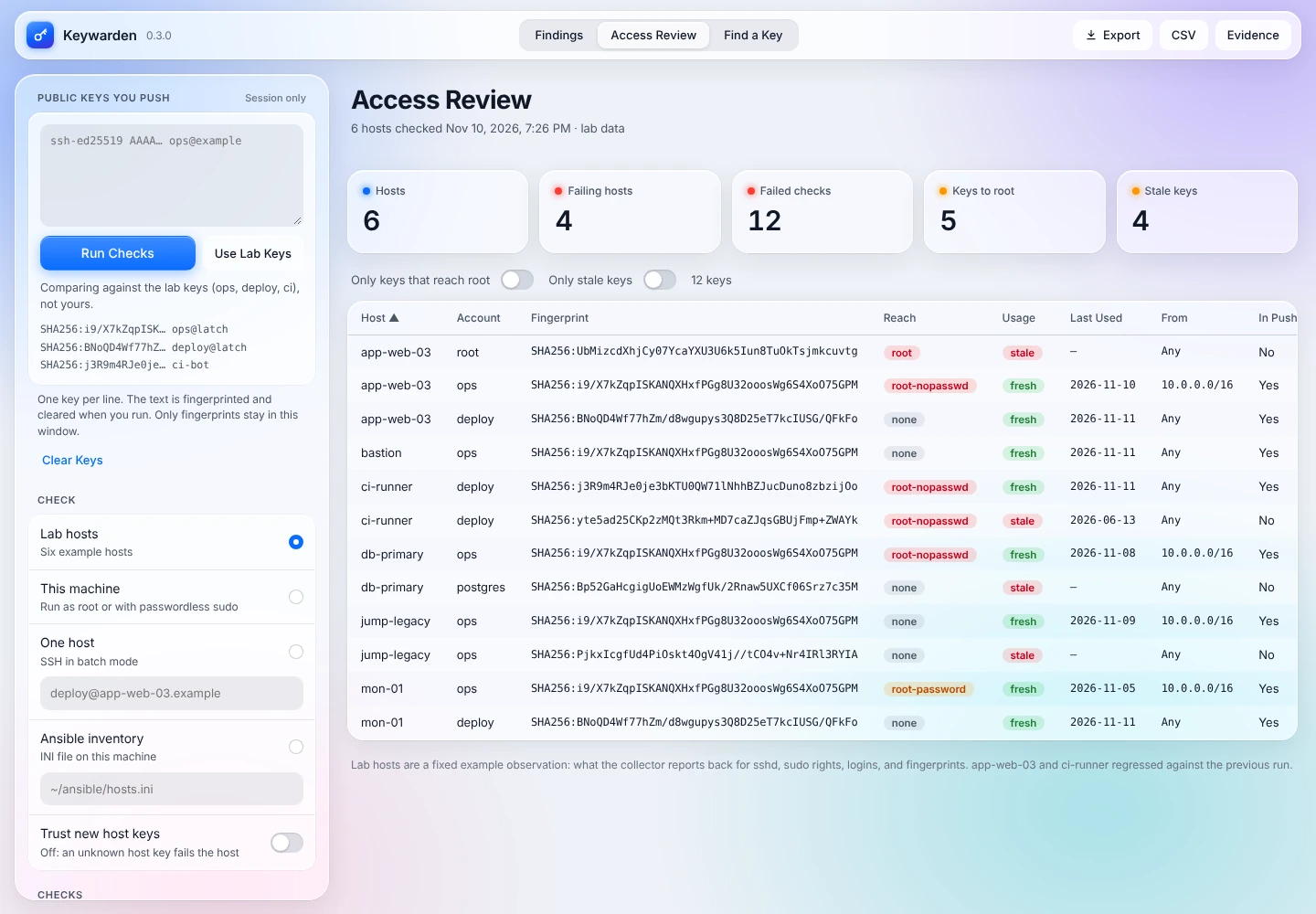
keywarden ui on the built-in lab hosts. Screenshots: findings, light · findings, dark · access review.
Install
Python 3.9 or newer. No third-party packages. --local needs Linux or another POSIX system; the browser UI, --host, and --inventory also run on Windows using its built-in ssh.
python3 -m pip install keywarden-ssh
Or straight from a tag:
python3 -m pip install "git+https://github.com/generalwax2018/keywarden.git@v0.3.0"
The distribution name is keywarden-ssh. The keywarden package on PyPI is an unrelated project; do not install it expecting this tool.
Or clone this repository and run it from the tree:
git clone https://github.com/generalwax2018/keywarden.git
cd keywarden
PYTHONPATH=src python3 -m keywarden --version
Use it in a browser
keywarden ui
This opens Keywarden in a browser tab, served from your machine. Paste the public keys you push, choose what to check (this machine, one host, an Ansible inventory, or collector output you paste), and run. Results show failing hosts first, with the access review table and a "find a key" search beside them. Export the findings as JSON or the key table as CSV. Press Fill lab keys and Run checks to try it on six made-up hosts first.
The server listens on 127.0.0.1 only, on a random port, and the link it prints carries a one-time token. It refuses requests without that token, from another web page, or with a Host header other than localhost, so a site you visit cannot drive it. The page loads nothing from the internet. Key text is fingerprinted on arrival and cleared from the box; the tab holds fingerprints only, and nothing is written to disk unless you export. Use --port to pick the port and --no-browser to print the link without opening it.
Check this machine
keywarden check --local --allow team.pub
team.pub is the public keys you intend to be authorized, one OpenSSH line each. Keywarden fingerprints them for the comparison and does not copy them into the report.
A failing check exits 1. A clean or warning-only check exits 0. Bad input, including a private key, exits 2 and writes no report.
The terminal shows a summary line, then failures and warnings in colour. Passing checks are counted but hidden; --verbose lists them. Colour is off when the output is not a terminal or NO_COLOR is set, and --color always|never overrides it.
keywarden check --local --allow team.pub --output keywarden-report.json
The JSON file has fingerprints, key types, bit lengths, comments, daemon settings, and findings. It does not have key bodies. Do not point --allow at a private key. If one is present, Keywarden stops and keeps nothing.
Check one other host
keywarden check --host deploy@app-web-03.example --allow team.pub --json
This is ssh in batch mode (no password prompt). The remote command prints sshd -T and authorized_keys back to this process. Fingerprints are computed here. Nothing is written on the remote host.
A host key that is missing or changed fails the connection. Keywarden does not accept it. --accept-new trusts a key you have not seen before and is off unless you pass it. Use the known_hosts file your SSH client already has.
Reading root, and reading other accounts, needs to be allowed: run as root, or have passwordless sudo. With general passwordless sudo the collector uses it for sshd -T, stat, test, ls, grep of the sshd config, and cat of authorized_keys. With sudo limited to sshd -T and cat, those two still work, and file modes behind an unreadable home are reported as unknown. If root's file cannot be read, the root-key check is a warning, not a pass. A hidden root key must not look clean, and an account whose home cannot be read is listed as not checked instead of being skipped.
Every line read from an authorized_keys file is prefixed before it crosses the wire, and the parser refuses output that is out of order, repeated, or truncated. A user who writes collector markers into their own key file cannot change what the report says about the daemon or other accounts; the host fails with collector-output instead.
--account adds a specific user. Repeat it. Accounts that already have an authorized_keys file are included when the file is visible.
Check an Ansible inventory
keywarden check --inventory hosts.ini --allow team.pub
hosts.ini is the INI inventory you already use. Keywarden reads ansible_user, ansible_host, ansible_port, and ansible_ssh_private_key_file (and their ansible_ssh_* spellings), from host lines, [group:vars], and parent groups through [group:children]. A nearer group overrides a parent, and a host line overrides both, as in Ansible. A private-key path is handed to ssh -i; Keywarden never opens the file. Passwords, become passwords, and every other variable are dropped as the file is read. YAML inventories are not supported yet and are refused with a message. Each host is one SSH, in order. A host that cannot be reached is a failure, and the rest are still checked.
The terminal shows failures only. A check that names a key is printed once per fingerprint, with every host where that fingerprint failed. Other failures stay on their own line: hostname and check. Passes are not printed. Exit 1 if any host failed. --output writes the JSON report, still without key bodies. The fingerprints array is the unique set. --prior is for one host, not an inventory.
[web]
app-web-03 ansible_user=deploy
bastion ansible_host=10.0.0.9 ansible_user=ops ansible_port=2222
There is no scheduler. The next run is the next time you start the command.
What is checked
| Code | Fails when |
|---|---|
permit-root |
PermitRootLogin is anything but no. prohibit-password and without-password still allow a root key, so they fail. |
password-auth |
PasswordAuthentication is on |
keyboard-interactive |
KbdInteractiveAuthentication is on |
empty-passwords |
PermitEmptyPasswords is on |
pubkey-auth |
PubkeyAuthentication is off |
root-authorized-key |
root has a key. Unreadable is a warning. |
root-account |
another account has uid 0, root is missing, or root's password field is empty |
permissions |
.ssh or authorized_keys is group- or world-accessible |
weak-algorithm |
DSA, or RSA under 3072 bits |
outside-push |
a non-root key is not in --allow |
cert-authority |
a line is marked cert-authority |
ssh-certificate |
a certificate is expired, not yet valid, a host certificate, or unreadable |
accepted-algorithms |
PubkeyAcceptedAlgorithms still allows ssh-rsa, ssh-dss, or SHA-1 |
ca-algorithms |
CASignatureAlgorithms still allows those |
trusted-user-ca |
TrustedUserCAKeys is set, so a signed key can bypass the push |
revoked-keys |
a user CA is trusted and RevokedKeys is none (warning) |
authorized-keys-command |
a command can inject keys that are not in the file |
authorized-keys-file |
sshd also reads a path other than .ssh/authorized_keys |
hostbased-auth |
host-based authentication is on |
auth-methods |
AuthenticationMethods still allows a password |
sshd-config |
sshd -T could not run, so daemon checks were skipped (warning) |
match-blocks |
sshd_config has Match blocks (warning; see below) |
collector-output |
the collector output was malformed or tampered with |
unreachable |
an inventory host could not be reached |
key-to-root |
a key opens an account with passwordless root: NOPASSWD sudo to a shell or ALL, or a root-equivalent group such as docker (warning) |
key-source |
a root-level key has no from= restriction (warning) |
forced-command-forwarding |
a command= key still allows port or agent forwarding (warning) |
key-environment |
a key sets environment= and PermitUserEnvironment is on |
expired-key |
a line's expiry-time has passed, or cannot be read (warning) |
log-level |
LogLevel is QUIET, FATAL, or ERROR, so logins are not recorded |
auth-log |
the sshd log could not be read, so key usage was not checked (warning) |
stale-key |
an authorized key has no login in --stale-days (default 90). A warning when the logs are shorter than that. |
Fields that are absent from the observation are skipped, not treated as a pass.
sshd -T prints the default settings, before any Match block applies. When the config has Match blocks, Keywarden also runs sshd -T -C user=root,... and fails permit-root, password-auth, or keyboard-interactive if a block makes root worse than the default. A Match block can only make a result worse, never better. Blocks for other users, groups, or source addresses are not evaluated; match-blocks warns so you know to read them.
Key text is fingerprinted in memory and then dropped. A private key, including a PuTTY private key, stops the run and is not written. The report never contains a key body. --allow is not deleted; it is your file.
forced-commands-only is a warning. Pass --no-weak or --no-outside to skip those two comparisons.
Key comments are often an email address or a machine name. Pass --redact-comments to leave them out of the terminal output and the report.
Access review
Every check also builds a table with one row per authorized key: host, account, fingerprint, type, comment, whether it is in --allow, what logging in leads to (reach), its from= and other options, and when it was last used.
keywarden check --local --allow team.pub --keys
keywarden check --inventory hosts.ini --allow team.pub --csv access-review.csv
--keys prints the table. --csv writes it for a spreadsheet or a ticket. The JSON report has it under keys. Cells that start with =, +, -, or @ are prefixed with ' so a key comment cannot run as a spreadsheet formula. A command= value is never printed, only that one is set, because forced commands sometimes carry tokens.
Reach. For each account with a key, Keywarden reads sudo -l -U <account> and the account's groups:
| Reach | Meaning |
|---|---|
root |
the account is root, or uid 0 |
root-nopasswd |
NOPASSWD sudo to ALL, a shell, or a command with a known shell escape (vim, less, find, tee, systemctl, and others), or membership in docker, lxd, lxc, incus-admin, or disk |
root-password |
the same sudo rules, but with a password; or membership in sudo, wheel, or admin when the rules cannot be read |
limited |
sudo to specific commands that are not on the shell-escape list. The list is not exhaustive; review these rules by hand. |
none |
not in sudoers, or sudo is not installed |
unknown |
sudo rules could not be read (run as root or with passwordless sudo) |
Each sudo -l -U call is written to the host's auth log by sudo itself.
Last used. Keywarden reads Accepted publickey for <account> ... SHA256:<fingerprint> lines. sshd writes these at the default LogLevel INFO. It prefers the systemd journal, read only for ssh.service and sshd.service entries logged as uid 0, which a local user cannot forge. Without a journal it reads /var/log/auth.log* or /var/log/secure*, including rotated and gzipped files. A local user can write fake lines to those files with logger, so the report names which source it used (authLog). The log tells you how far back it reaches; a key is only called stale when the logs cover the whole --stale-days window. A login through a certificate counts toward the cert-authority line that trusted it. A certificate pasted directly into authorized_keys is marked unmatched, because sshd logs the key inside it rather than the line.
Only the newest login line and a count per account and key leave the host. Pass --redact-addresses to drop the last login address from the output.
Evidence for an assessor
keywarden check --inventory hosts.ini --allow team.pub --waivers keywarden.toml --evidence ssh-evidence.html
--evidence (or Evidence in keywarden ui) writes one self-contained HTML file: who ran the check and with what visibility, the hosts in scope, every finding with the controls it bears on, the access review table, accepted risks, and a SHA-256 of the embedded JSON report so an assessor can tell it was not edited. A control coverage table groups the results under CIS Controls v8, NIST SP 800-53 Rev. 5, PCI DSS v4.0, and NERC CIP. Every finding in the JSON report also carries its controls.
The mapping is in docs/compliance.md. It supports an assessment and does not replace one: a passing check is evidence toward a control on the hosts checked, not proof the control is met.
Find a key
Offboarding someone, or a laptop was stolen: find every place their key gets in.
keywarden where --key alice.pub --inventory hosts.ini
keywarden where SHA256:CU0yV+3RbcXlukC+M6dq938Ou+kt105Ipe/qaP4n4LU --host deploy@app-web-03.example
Each hit names the host, the account, whether the key is in authorized_keys or trusted as a cert-authority, its reach, its from= limit, and its last login. A key that logged in recently but is not in any readable authorized_keys is listed too: it may come from AuthorizedKeysCommand, another key file, or a file Keywarden could not read. Hosts and accounts that could not be read are printed on stderr, because "not found" only covers what was visible.
Like grep, where exits 0 when it finds the key, 1 when it does not, and 2 on bad input. A private key passed to --key is refused.
Waivers
Some findings are deliberate: a break-glass key on root, an admin account with passwordless sudo. Record them instead of turning the check off:
# keywarden.toml (Python 3.11+), or the same fields as JSON: {"waivers": [ {...} ]}
[[waiver]]
code = "root-authorized-key"
host = "bastion-*"                # optional glob; default every host
fingerprint = "SHA256:..."        # optional; default every key in the finding
reason = "break-glass key, sealed in the vault"
owner = "secops"                  # owner or ticket is required
ticket = "SEC-1234"
expires = "2027-03-01"            # required
keywarden check --inventory hosts.ini --allow team.pub --waivers keywarden.toml
A waived finding is reported as accepted, with the reason, ticket, and end date, and does not fail the run. When a finding names several keys, it is accepted only if every key is waived; otherwise it keeps its severity and says which keys were waived. An expired waiver stops working and the finding says so. A waiver that matched nothing is printed on stderr so the file does not collect dead entries.
Drift
Keep the previous report (it has no key bodies) and pass it next time:
keywarden check --local --allow team.pub --prior keywarden-report.json
A check that was a pass and is now a fail is marked regressed. A new failure is new. A failure that cleared is cleared. A check that was already failing and now names a fingerprint it did not name before is new-keys, with the added fingerprints in newFingerprints. Each finding that names keys carries a fingerprints array.
Offline observation
If you would rather not have Keywarden open SSH itself, run the collector on the host and pipe it. Do not save that stream: it contains public keys. The report does not. Collector output from 0.1.0 (protocol 1) is refused; run the current collector.
python3 -c 'from keywarden.collect import REMOTE_SCRIPT; print(REMOTE_SCRIPT)' | sh | keywarden check --observation - --allow team.pub
What this release does not do
- It does not install, rotate, or delete keys.
- It does not remember a push, a host list, or a report unless you choose
--output. - It does not run on a schedule or keep evidence for you. Run it from cron or CI and keep the reports you want.
- It checks inventory hosts one at a time, up to 256 per run.
- It reads
/etc/passwdand~/.ssh/authorized_keys. Accounts that exist only in LDAP or SSSD, and keys served byAuthorizedKeysCommand, are not listed (the command itself is flagged). Their logins still show up inwhere.
Tests
python3 -m unittest discover -s tests -v
Fingerprint and certificate tests run when ssh-keygen is installed and are skipped otherwise. CI also runs the collector against a real OpenSSH server, including an authorized_keys file that tries to rewrite the report.
Contributing
See CONTRIBUTING.md. Report security issues privately; see SECURITY.md.
License
MIT.
1 maintainer

Metadata
1 maintainer
Release files for keywarden-ssh 0.3.0
For a detailed explanation of source distributions (sdists) and built distributions (wheels), please see the package formats documentation.
Source distribution (sdist)
| File | Size | Uploaded | Provenance | Actions |
|---|---|---|---|---|
| keywarden_ssh-0.3.0.tar.gz | 93.5 kB | With provenance | Details for keywarden_ssh-0.3.0.tar.gz |
Built distribution (wheel)
| File | Interpreter | ABI | Platform | Actions Reset |
|---|---|---|---|---|
| keywarden_ssh-0.3.0-py3-none-any.whl | Python 3 | none | any | Details for keywarden_ssh-0.3.0-py3-none-any.whl |
Total release size: 171.8 kB
Release files / keywarden_ssh-0.3.0.tar.gz
| Download URL | keywarden_ssh-0.3.0.tar.gz |
|---|---|
| Size | 93.5 kB |
| Tags | Source |
|
SHA-256 checksum How to use checksums |
aaf379e8b49861f6cbf5ff801d528663cb2bb13f4a8e8dc7be9b897d20ccf0dd
|
|
BLAKE2b-256 checksum How to use checksums |
45ef8a22eeea69d580d825335f12be5a0b7a5ac964b8ce488159dd28db041759
|
| Upload date | |
|
Uploaded using Trusted Publishing? What is trusted publishing? |
Yes |
| Uploaded via |
twine/7.0.0 CPython/3.13.16
|
Provenance
Provenance describes where a file came from. On PyPI, provenance is shared via attestations, which provide a verifiable record of the build or publishing details. View details, limitations and caveats.


PyPI Publish Attestation
PyPI verified that this artifact, at this checksum, originated from the publisher listed below.
Signed by GitHub Actions, verified by PyPI on Nov 11, 2026.
Transparency logRelease files / keywarden_ssh-0.3.0-py3-none-any.whl
| Download URL | keywarden_ssh-0.3.0-py3-none-any.whl |
|---|---|
| Size | 78.3 kB |
| Tags | Python 3 |
|
SHA-256 checksum How to use checksums |
aaa0f0dab8df593502dd5842e93148341ffe2626216b4cb8493ed792cd72df55
|
|
BLAKE2b-256 checksum How to use checksums |
719306f434fef921316c5e2846e39d1a2f18b8182abd8e8865fcfe1dd4b9d057
|
| Upload date | |
|
Uploaded using Trusted Publishing? What is trusted publishing? |
Yes |
| Uploaded via |
twine/7.0.0 CPython/3.13.16
|
Provenance
Provenance describes where a file came from. On PyPI, provenance is shared via attestations, which provide a verifiable record of the build or publishing details. View details, limitations and caveats.
PyPI Publish Attestation
PyPI verified that this artifact, at this checksum, originated from the publisher listed below.
Signed by GitHub Actions, verified by PyPI on Nov 11, 2026.
Transparency logSecurity for keywarden-ssh 0.3.0
Provenance
Provenance describes where a file came from. On PyPI, provenance is shared via attestations, which provide a verifiable record of the build or publishing details. View details, limitations and caveats.
Full provenance
Both files in this release have been uploaded with provenance metadata.
Attestation for keywarden_ssh-0.3.0.tar.gz
PyPI Publish Attestation
PyPI verified that this artifact, at this checksum, originated from the publisher listed below.
Signed by GitHub Actions, verified by PyPI on Nov 11, 2026.
Transparency logA note on package security
PyPI is a repository for distributing packages, not a service for auditing them. While third-party security researchers and our staff do their best to detect and remove malicious packages, PyPI cannot guarantee the quality, security or suitability of any given package.
To learn more about protecting yourself from malicious actors, visit our package security documentation.