
Kernel FDA

This repository implements Kernel Fisher Discriminant Analysis (Kernel FDA) as described in https://arxiv.org/abs/1906.09436. FDA, equivalent to Linear Discriminant Analysis (LDA), is a classification method that projects vectors onto a smaller subspace. This subspace is optimized to maximize between-class scatter and minimize within class scatter, making it an effective classification method. Kernel FDA improves on regular FDA by enabling nonlinear subspaces using the kernel trick.
FDA and Kernel FDA classify vectors by comparing their projection in the fisher subspace to class centroids, adding a new class is just a matter of adding a new centroid. Thus, this model is implemented here with the hope of using Kernel FDA as a oneshot learning algorithm.
Usage
Kfda uses scikit-learn's interface.
-
Initializing:
cls = Kfda(n_components=2, kernel='linear')for a classifier that a linear kernel with 2 components. For kernel of degree 2, useKfda(n_components=2, kernel='poly', degree=2)for a polynomial kernel of degree 2. See https://scikit-learn.org/stable/modules/metrics.html#polynomial-kernel for a list of kernels and their parameters, or the source code docstrings for a complete description of the parameters. -
Fitting:
cls.fit(X, y) -
Prediction:
cls.predict(X) -
Scoring:
cls.score(X, y)
Examples
See examples for examples on MNIST, faces, and oneshot learning.
After running them, you can plug corresponding pairs of generated
*embeddings.tsv and *labels.tsv into Tensorflow's
Embedding Projector
to visualize the embeddings.
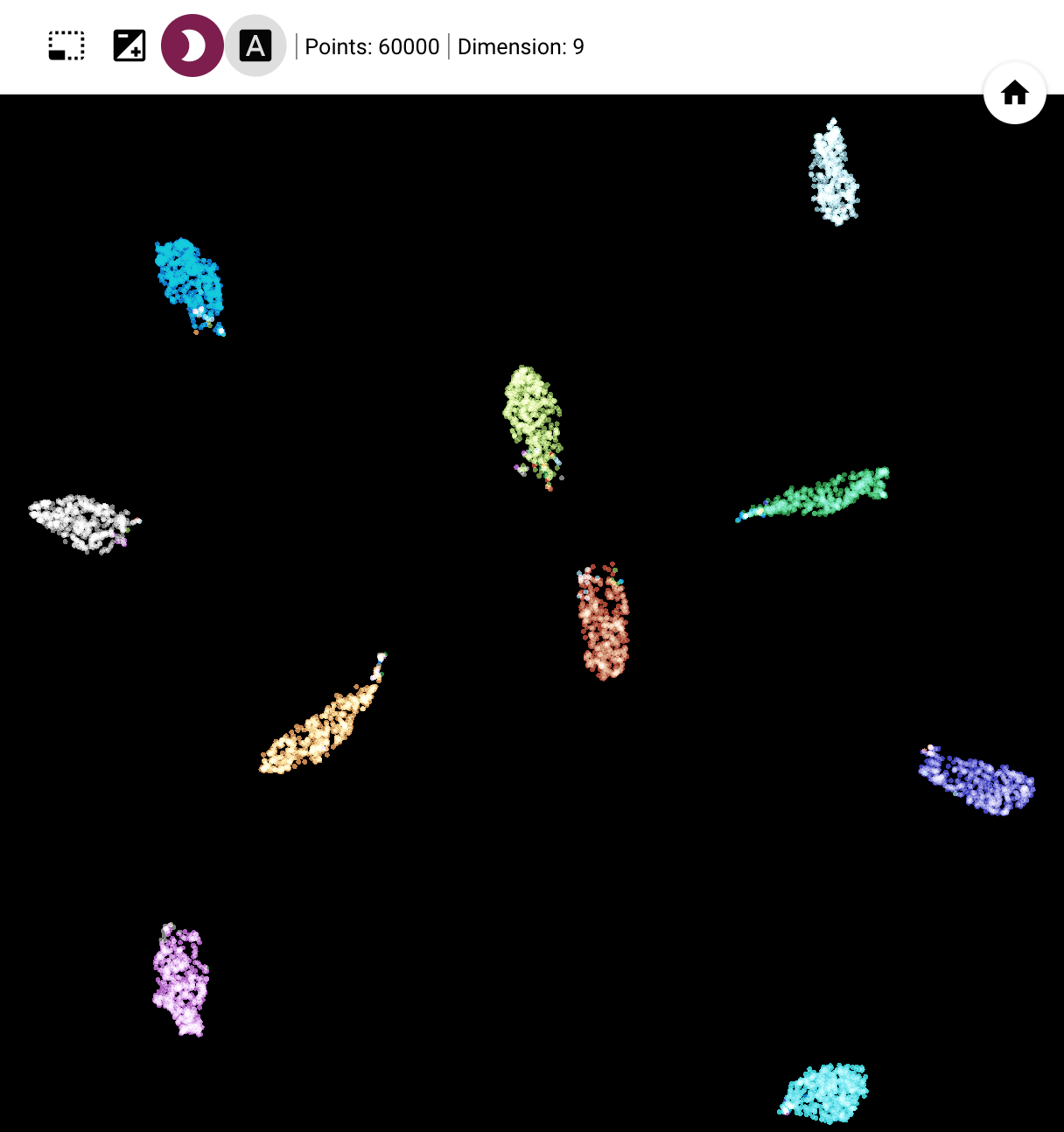
For example, running mnist.py and then loading
mnist_test_embeddings.tsv and mnist_test_labels.tsv shows the
following using the UMAP visualizer:
Notebook
Another place to see example usage is the Colab Notebook.
Caveats
Similar to SVM, the most glaring constraint of KFDA is the memory limit in training.
Training a Kernel FDA classifier requires creating matrices that are n_samples by n_samples large, meaning the memory requirement grows with respect to O(n_samples^2).
The accuracy, while high (0.97 on MNIST), seems to be limited by the training set size. With a training size of 10000 and a testing size of 60000, performance on MNIST averages around 0.97 accuracy using 9 fisher directions and the RBF kernel:
cls = Kfda(kernel='rbf', n_components=9)
This may be due to the constrained training size. Accuracy can be improved without increasing training size by implementing invariant kernels that would implicitly handle scale and rotation without requiring an extended dataset.
Oneshot Learning
Oneshot learning means that an algorithm can learn a new class with as little as one sample. This is possible for Kernel FDA because it finds a subspace that purposefully spreads out distinct classes. Introducing a new label involves simply adding another centroid for use in prediction. See the Colab Notebook. or the example for examples.
1 maintainer

Metadata
1 maintainer
Release files for kfda 0.1.1
For a detailed explanation of source distributions (sdists) and built distributions (wheels), please see the package formats documentation.
Source distribution (sdist)
| File | Size | Uploaded | |
|---|---|---|---|
| kfda-0.1.1.tar.gz | 5.3 kB | Details |
Built distribution (wheel)
| File | Interpreter | ABI | Platform | Reset |
|---|---|---|---|---|
| kfda-0.1.1-py3-none-any.whl | Python 3 | none | any | Details |
Total release size: 11.7 kB
Release files / kfda-0.1.1.tar.gz
| Download URL | kfda-0.1.1.tar.gz |
|---|---|
| Size | 5.3 kB |
| Tags | Source |
|
SHA-256 checksum How to use checksums |
122224712f8e9f06e96cc9129d4832871d4a855b13c0b7e4a20b6271740d2ee0
|
|
BLAKE2b-256 checksum How to use checksums |
8fe5a4b327665038c3aa0f4966d3ab60fe5bcb59eaa63d832858b976d07d2db8
|
| Upload date | |
|
Uploaded using Trusted Publishing? What is trusted publishing? |
No |
| Uploaded via |
twine/3.1.1 pkginfo/1.5.0.1 requests/2.22.0 setuptools/46.0.0 requests-toolbelt/0.9.1 tqdm/4.41.0 CPython/3.8.2
|
Release files / kfda-0.1.1-py3-none-any.whl
| Download URL | kfda-0.1.1-py3-none-any.whl |
|---|---|
| Size | 6.4 kB |
| Tags | Python 3 |
|
SHA-256 checksum How to use checksums |
9ddcab446b25dc0ac0770979aca7473f10db0e16951dafaa7e90d51297683ae9
|
|
BLAKE2b-256 checksum How to use checksums |
586a74ff6846b076c1181aae42c6965241621cda616d9228d8b88ae8f4917741
|
| Upload date | |
|
Uploaded using Trusted Publishing? What is trusted publishing? |
No |
| Uploaded via |
twine/3.1.1 pkginfo/1.5.0.1 requests/2.22.0 setuptools/46.0.0 requests-toolbelt/0.9.1 tqdm/4.41.0 CPython/3.8.2
|














