
Kerbal Gravity Program (KGRP)
KGRP is a mission planner for Kerbal Space Program that runs outside the game. You define a spacecraft, stack events (coast, maneuver, burn, engine toggle, science, and more) on a timeline, and KGRP simulates them with real orbital mechanics. Plan in KGRP, then fly the plan in KSP.
It is built for KSP players who want to work out transfers, delta-v budgets, and timelines before launching — and it is flexible enough that you can model arbitrary spacecraft and solar systems (KSP stock, OPM, or your own).
Status: stable (v1.0.0). The core is solid; the math is checked and the planner flies end to end.
Demo
Watch KGRP plan and fly a mission right in the terminal:

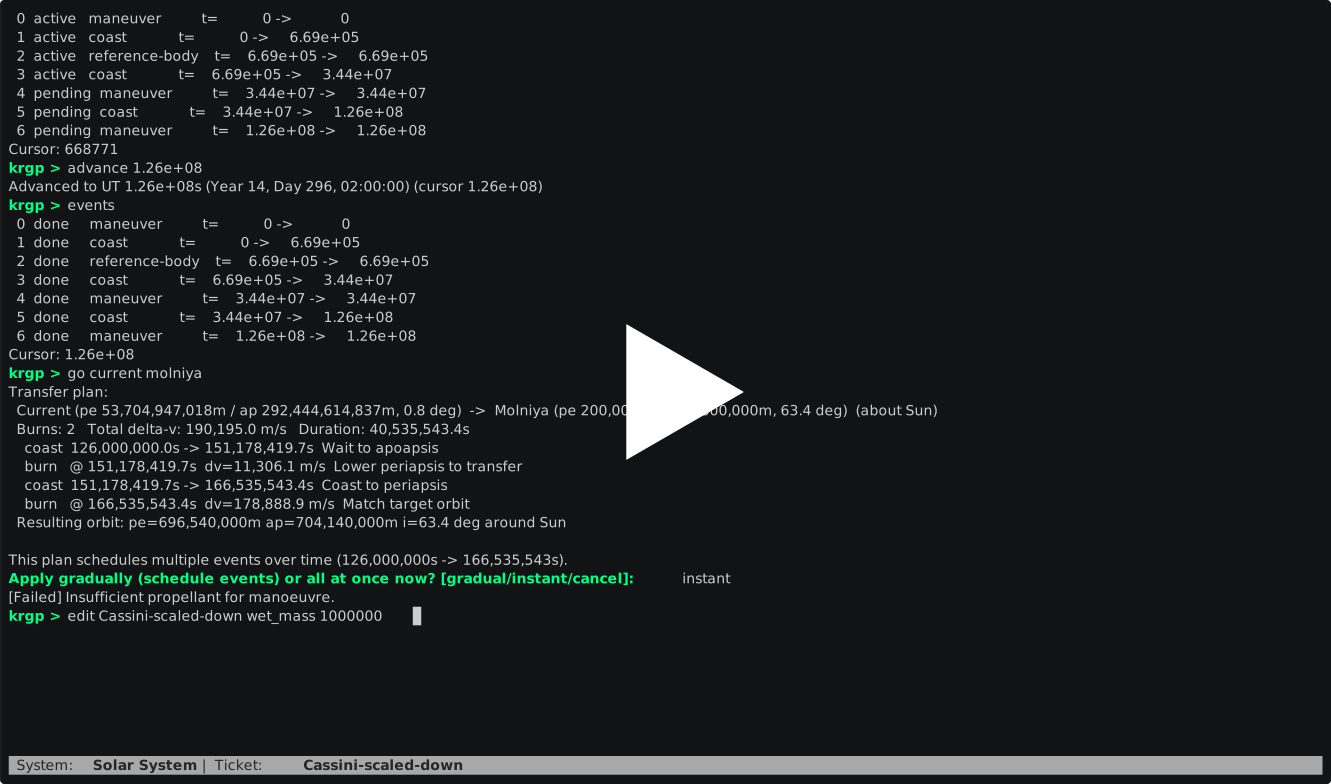
On sites that allow raw HTML, embed the player directly:
<script id="asciinema-player-fBPRPZsKrolGCy2I" src="https://asciinema.org/a/fBPRPZsKrolGCy2I.js" async></script>
Features
- Round-trip mission planner — define a vessel, schedule a timeline of
events, and step the sim forward with
advance. gotransfer planner — pick a start and end orbit and KGRP computes the burns, coast phases, and total delta-v for you.- Editable orbit presets — low orbit, synchronous, escape, custom orbits.
- Full event timeline — coast, propagate, rkf45, maneuver, burn, engine control, attitude, rcs, stage, resource transfer, dock, undock, reference-body change, surface (land/launch), science, checkpoint.
- 3D renderer — a PyVista/Qt window to watch the mission unfold.
- Save/load — systems, tickets, and whole missions as JSON.
Installation
Requires Python 3.10+.
# From the terminal (using pip):
pip install kgrp

# Or using uv
uv tool install kgrp

# This installs the `kgrp` command (entry point -> CLI_use.CLI:main).
Verify it works:
kgrp
You should see the KGRP prompt (krgp >). Type help and press Enter.
Quickstart
KGRP is a REPL. The whole loop is five commands, typed at the krgp >
prompt (launch with kgrp):
load system planets_ksp.json   # or: new system  (build your own)
new ticket                     # wizard creates a vessel + first ticket
go                             # pick two orbits; KGRP plans the burns
advance <end-ut>               # run the timeline (UT is printed by go)
render                         # optional 3D view
help lists every command; help <command> (e.g. help go) explains one.
That is it: load a system -> new ticket -> plan with go -> advance the
timeline -> render.
Workflow example
1. A local transfer (Kerbin -> Mun)
krgp > load system planets_ksp.json
krgp > new ticket
# ... answer the wizard prompts (name, body = Kerbin, defaults are fine) ...
krgp > go current moon:3a
Transfer plan:
  Current (~800,000m circular, 0.0 deg)  ->  Mun orbit (12,000,000m circular)  (about Kerbin)
  Burns: 2   Total delta-v: 1,126.6 m/s   Duration: 27,066.6s
    burn   @ 0.0s  dv=775.9 m/s  Raise apoapsis to transfer
    coast  0.0s -> 27,066.6s  Coast to apoapsis
    burn   @ 27,066.6s  dv=350.7 m/s  Circularize / match target
krgp > advance 27067
# vessel is now on the transfer; advance further to reach the Mun
krgp > render
go takes <start-orbit> <end-orbit> plus optional key=value overrides
(peri_alt=, apo_alt=, incl=, arg_p=, lan=). Or run go with no
arguments to pick both orbits from a menu.
2. An interplanetary transfer (Kerbin -> Duna)
Use go -i <target> (alias go_i <target>). It plans the escape burn, the
heliocentric leg, and the arrival burn in one shot:
krgp > go_i duna
Interplanetary transfer plan (Kerbin -> Duna):
  Escape from Kerbin -> SOI exit -> Kerbol frame
  Total delta-v: 2,583.5 m/s   Burns: 3
    [Kerbin] escape burn  dv=870.3 m/s
    coast to SOI exit @ 196,411s
    refbody -> Kerbol
    burn   @ 1,994,868.8s  dv=946.1 m/s  Raise apoapsis to transfer
    coast  1,994,868.8s -> 8,719,637.1s
    burn   @ 8,719,637.1s  dv=767.2 m/s  Circularize / match target
krgp > advance 8719637    # or 'advance 8.7M' if your fingers object
krgp > render
Override the arrival orbit with the same key=value overrides, e.g.
go_i duna peri_alt=200000 apo_alt=200000. go -i / go_i work from any body
that orbits a star (stock or OPM).
3. Save the mission and come back
krgp > save mission duna_trip.json
krgp > exit
# later:
kgrp
krgp > load mission duna_trip.json
save mission writes one file with the system, ticket, and vessels; load mission brings it all back. You can also save system / load system and
save ticket / load ticket separately.
Command overview
Type help for the full list, and help <command> (e.g. help go,
help add) for details. The headline commands:
| Command | What it does |
|---|---|
load / save |
Load/save a system, ticket, or whole mission from JSON. |
new |
Creation wizards for a system or a ticket. |
status |
Show the active system and ticket. |
tree |
Print the body hierarchy (-v for orbital elements). |
system |
Inspect the loaded system (info, bodies, validate). |
vessel |
Manage vessels (list, create, delete, engine). |
edit |
Tweak a body or vessel's fields (mass, orbit elements, ...). |
add |
Schedule a ticket event (add <type> [key=value ...]). |
events / remove |
List / remove scheduled events. |
advance |
Run the timeline forward to a UT (advance 2d 5h). |
time |
Scrub the timeline to a UT without simulating. |
reset |
Restore the ticket to its initial state. |
go |
Plan a transfer between two orbits. |
go_i |
Interplanetary transfer (escape + heliocentric transfer). |
preset |
Manage editable orbit presets. |
render |
Open the 3D renderer window. |
help / clear / exit |
Help, clear screen, quit. |
Time input is human-friendly
You rarely need raw seconds:
advance 2d 5h          # a duration, added to the current UT
advance 21600          # or a raw UT in seconds
time "Year 2, Day 100" # a calendar timestamp
go current preset:molniya incl=30   # per-use orbit overrides
Valid time units: y (year), mo (month), d (day), h (hour), m
(minute), s (second). Words like days/hours work too.
Tips for new players
- Start from a preset, not a blank page.
new tickethands you a vessel with an engine and fuel already attached — you do not start with a paperweight. - Let
godo the math. Instead of hand-computing burns, rungoand read the delta-v budget it prints. - Use
advanceto walk time, one coast/burn at a time.timejumps the cursor without simulating (handy for inspection). - Save your work.
save missionwrites a single file with the system, ticket, and vessels;load missionbrings it all back. - Stuck?
helpandhelp <command>are always available, andsystem validatewill tell you if your system has problems.
Project layout
CLI_use/— the REPL, command parsing, completion, and thegoplanner.basic_systems/— physics: bodies, orbits, integrators, and the renderer.planets_ksp.json/planets_ksp_opm.json— stock and OPM system data.planets.json- Actual Solar System datatests/— pytest suite (python -m pytest).
Running the tests
python -m pytest
Credits
Built by Gautham, powered by an unreasonable amount of Kerbal optimism.
- Jebediah Kerman — chief test pilot. Assumes every plan works until physically proven otherwise (and sometimes after).
- Bill & Bob — held the ladder. Reviewed nothing.
- The math — probably fine. Mostly. We checked it, like, twice.
- The deep-space navigation charts — still don't list your spelling mistakes, but they do list Duna now.
- You — for reading this far instead of just launching and hoping.
KGRP plans the mission. Flying it is still gloriously your problem.
License
GNU GPLv3 — see the LICENSE file. Go forth and transfer.
1 maintainer

Download files
Download the file for your platform. If you're not sure which to choose, learn more about installing packages.
Source Distribution
Built Distribution
Filter files by name, interpreter, ABI, and platform.
If you're not sure about the file name format, learn more about wheel file names.
Copy a direct link to the current filters
File details
Details for the file kgrp-1.0.0.tar.gz.
File metadata
- Download URL: kgrp-1.0.0.tar.gz
- Upload date:
- Size: 29.0 MB
- Tags: Source
- Uploaded using Trusted Publishing? No
- Uploaded via:
twine/7.0.0 CPython/3.14.2
File hashes
| Algorithm | Hash digest | |
|---|---|---|
| SHA256 |
e2acebfda35df259c29ec3c2d83634f5d1df32801eaf2ea2756c6641340c1671
|
|
| MD5 |
be02518925147177615a4833364f7444
|
|
| BLAKE2b-256 |
98bb72d2551f09df23cbbc22fa5550301f306adb1b5daf48d8d2599206e14db8
|
File details
Details for the file kgrp-1.0.0-py3-none-any.whl.
File metadata
- Download URL: kgrp-1.0.0-py3-none-any.whl
- Upload date:
- Size: 101.4 kB
- Tags: Python 3
- Uploaded using Trusted Publishing? No
- Uploaded via:
twine/7.0.0 CPython/3.14.2
File hashes
| Algorithm | Hash digest | |
|---|---|---|
| SHA256 |
5f60b854fbff3b5e77aba552e25ce9b9ebf3bb4c23e09b94c557c9c01440cd95
|
|
| MD5 |
19dcedd69fc7b46e1e47e74838a86c09
|
|
| BLAKE2b-256 |
123de5499dfe272c431e93cc013080302d1bf510031d34edc170c6361d6a6e36
|














