
Kiji Inspector: Mechanistic Interpretability for AI Agent Tool Selection










Status
This project is under heavy active development. We are planning to release a stable version of the framework in the coming weeks.
In the meantime, join our Slack Community
Learn more about our approach and early results:
What This Project Does
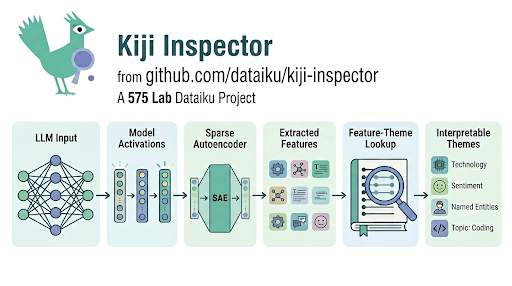
This project trains Sparse Autoencoders (SAEs) on the internal activations of an AI agent to understand why it selects specific tools. Given a user request like "Search our docs for API limits," the agent must choose between tools (e.g., internal_search vs web_search). We extract the model's hidden representations at the moment of that decision, decompose them into interpretable features using a JumpReLU SAE, and validate the resulting explanations through automated fuzzing and causal ablation experiments.
The key insight: train the SAE on raw activations (not difference vectors), then use contrastive pairs post-hoc to identify which learned features correspond to specific tool-selection decisions. This preserves the SAE's general feature dictionary while enabling targeted analysis of decision-relevant features.
Install
For loading and running pretrained SAEs:
pip install kiji-inspector
For the HuggingFace-based training and analysis extras (accelerate etc.):
pip install 'kiji-inspector[full]'
The vLLM extraction path is not covered by any extra: upstream vLLM wheels do
not ship the hidden-states connector, so it requires the Docker image built
from the repository Dockerfile, which compiles vLLM from the
Davidnet/vllm fork.
Quick Start
from kiji_inspector import SAE

sae, feature_descriptions = SAE.from_pretrained(
    repo_id="575-lab/kiji-inspector-google-gemma-4-E4B-it",
    layer=30,
)

# encode/decode operate in the SAE's normalized space
features = sae.encode(sae.normalize_input(activations))
reconstruction = sae.denormalize_output(sae.decode(features))
normalize_input applies the exact transform the SAE was trained under —
(x - mean_vec) / rms_scale, a single global mean vector and RMS constant
computed over the training set. Raw activations must go through it or the
JumpReLU thresholds are meaningless; denormalize_output inverts it when a
reconstruction is written back into the model.
Training and data-generation entrypoints live under the package namespace:
python -m kiji_inspector.generate_pairs 1300
python -m kiji_inspector.pipeline --layers 10 20 30
vLLM hidden-state extraction (native connector)
Activation extraction uses vLLM's native extract_hidden_states speculator
method together with the ExampleHiddenStatesConnector, which writes captured
hidden states to safetensors files that the extractor loads and cleans up per
request. This capability ships in the 575lab/kiji-inspector:dev image, which
builds the Davidnet/vllm fork
(branch hidden-states-inline-return-squashed); the public v0.19.0 wheel does
not contain the connector.
Run all extraction, tests, and API checks inside that image:
docker pull 575lab/kiji-inspector:dev

# Smoke test the connector (Qwen3-8B):
samples/run_hidden_states_test.sh 575lab/kiji-inspector:dev

# Iterate on the checked-out source with a bind mount:
docker run --rm --gpus all \
  -v "$PWD:/workspace" \
  -v "${HF_CACHE:-$HOME/.cache/huggingface}:/root/.cache/huggingface" \
  -e HF_HOME=/root/.cache/huggingface \
  -e PYTHONPATH=/workspace/src \
  -w /workspace \
  575lab/kiji-inspector:dev \
  python -m pytest tests/test_activation_extractors.py
The historical patches/ directory (applied against a stock v0.19.0 wheel)
predates the fork-based image and is retained for reference only; the current
image bakes those changes into the fork and does not run apply-patch.sh. See
patches/README_PATCH.md for the legacy workflow.
To run the pipeline against a Qwen3.6 subject model (a reasoning model), pass --no-thinking so the decision token sits at the final-answer position:
python -m kiji_inspector.pipeline --subject-model Qwen/Qwen3.6-35B-A3B --no-thinking
Using a locally downloaded model
--subject-model also accepts a local model directory (paths must start with
/, ./, ../, or ~; anything else is treated as a hub ID). Inside Docker
the directory must be volume-mounted, and you pass the container path:
docker run --rm --gpus all \
  -v "$PWD:/workspace" \
  -v /home/user/models:/models:ro \
  -v "${HF_CACHE:-$HOME/.cache/huggingface}:/root/.cache/huggingface" \
  -e HF_HOME=/root/.cache/huggingface \
  -e PYTHONPATH=/workspace/src \
  -w /workspace \
  575lab/kiji-inspector:dev \
  python -m kiji_inspector.pipeline \
    --subject-model /models/programs/downloaded-model
Note: SAE.from_pretrained(base_model=...) resolves SAE repos through an
exact-match registry of hub IDs, so it won't match a local path — pass
repo_id directly instead.
📓 Examples
Two end-to-end notebooks demonstrate the library. Both run on Colab — the first needs an L4 (24 GB), the second an A100 high-RAM runtime.
| Notebook | What it shows | Open |
|---|---|---|
quickstart_colab.ipynb |
Minimal walkthrough: capture the decision-token activation of google/gemma-4-E4B-it via a forward pre-hook, load the layer-30 SAE with SAE.from_pretrained, normalize with sae.normalize_input, and describe the top features firing on a single prompt. |
|
home_repair_colab.ipynb |
Full agent demo: a Nemotron-3-Nano-30B home repair advisor calls four tools across three appliance problems, the residual stream is captured at every decision point, and a trained JumpReLU SAE decomposes those activations into themed features. Includes the interactive index.html viewer served from Colab. |
|
🤝 Contributing
We welcome contributions! Whether you're fixing a bug, improving documentation, or proposing a new feature, your help is appreciated.
Ways to Contribute
- Report Bugs - Open an issue with steps to reproduce
- Improve Docs - Documentation PRs are always welcome
- Submit Features - Open an issue to discuss your idea before submitting a PR
- Share Feedback - Start a discussion
Community
- Slack - Join our community to ask questions and connect with other contributors
- Contributors - See CONTRIBUTORS.md for the list of people who have contributed
📄 License
Copyright (c) 2026 Dataiku SAS
This project is licensed under the Apache 2.0 License - see the LICENSE file for details.
Download files
Download the file for your platform. If you're not sure which to choose, learn more about installing packages.
Source Distribution
Built Distribution
Filter files by name, interpreter, ABI, and platform.
If you're not sure about the file name format, learn more about wheel file names.
Copy a direct link to the current filters
File details
Details for the file kiji_inspector-0.7.0.tar.gz.
File metadata
- Download URL: kiji_inspector-0.7.0.tar.gz
- Upload date:
- Size: 148.3 kB
- Tags: Source
- Uploaded using Trusted Publishing? Yes
- Uploaded via:
twine/6.1.0 CPython/3.13.7
File hashes
| Algorithm | Hash digest | |
|---|---|---|
| SHA256 |
9b88c4c1f0ed2d7ac087349dd2bd9a373b84bc22dfc62c44b672c2403e964135
|
|
| MD5 |
622c25cea65c750b1b35f138c776b502
|
|
| BLAKE2b-256 |
5bc9f4e2048d35a7e528b7351401eefada01296e5d39ebb97e9314865ace74a8
|
Provenance
The following attestation bundles were made for kiji_inspector-0.7.0.tar.gz:
Publisher:
publish-kiji-inspector.yml on dataiku/kiji-inspector
-
Statement:
-
Statement type:
https://in-toto.io/Statement/v1 -
Predicate type:
https://docs.pypi.org/attestations/publish/v1 -
Subject name:
kiji_inspector-0.7.0.tar.gz -
Subject digest:
9b88c4c1f0ed2d7ac087349dd2bd9a373b84bc22dfc62c44b672c2403e964135 - Sigstore transparency entry: 2453356703
- Sigstore integration time:
-
Permalink:
dataiku/kiji-inspector@dfa1e49a429dc5c9d61143db90d871a3d1ace1af -
Branch / Tag:
refs/tags/kiji-inspector-v0.7.0 - Owner: https://github.com/dataiku
-
Access:
public
-
Token Issuer:
https://token.actions.githubusercontent.com -
Runner Environment:
github-hosted -
Publication workflow:
publish-kiji-inspector.yml@dfa1e49a429dc5c9d61143db90d871a3d1ace1af -
Trigger Event:
push
-
Statement type:
File details
Details for the file kiji_inspector-0.7.0-py3-none-any.whl.
File metadata
- Download URL: kiji_inspector-0.7.0-py3-none-any.whl
- Upload date:
- Size: 144.4 kB
- Tags: Python 3
- Uploaded using Trusted Publishing? Yes
- Uploaded via:
twine/6.1.0 CPython/3.13.7
File hashes
| Algorithm | Hash digest | |
|---|---|---|
| SHA256 |
adfe2122ce9808627ffa811c2156cbb37cc64de4af81ed94441956a0522e1ccf
|
|
| MD5 |
3f3334dd0d504bcab94ae3f14fb64483
|
|
| BLAKE2b-256 |
bbc14ff6c0546b90cbc0cf4bbc5764fa3e9331d1e486e9f5dcd190e2cb884e09
|
Provenance
The following attestation bundles were made for kiji_inspector-0.7.0-py3-none-any.whl:
Publisher:
publish-kiji-inspector.yml on dataiku/kiji-inspector
-
Statement:
-
Statement type:
https://in-toto.io/Statement/v1 -
Predicate type:
https://docs.pypi.org/attestations/publish/v1 -
Subject name:
kiji_inspector-0.7.0-py3-none-any.whl -
Subject digest:
adfe2122ce9808627ffa811c2156cbb37cc64de4af81ed94441956a0522e1ccf - Sigstore transparency entry: 2453356745
- Sigstore integration time:
-
Permalink:
dataiku/kiji-inspector@dfa1e49a429dc5c9d61143db90d871a3d1ace1af -
Branch / Tag:
refs/tags/kiji-inspector-v0.7.0 - Owner: https://github.com/dataiku
-
Access:
public
-
Token Issuer:
https://token.actions.githubusercontent.com -
Runner Environment:
github-hosted -
Publication workflow:
publish-kiji-inspector.yml@dfa1e49a429dc5c9d61143db90d871a3d1ace1af -
Trigger Event:
push
-
Statement type:














