
AI that double-checks itself before it speaks: a skeptic harness that attacks LLM claims against source documents.

Project description
killpass
AI that double-checks itself before it speaks.




pip install killpass
The problem
AI assistants believe things too easily.
Ask an AI "Did this company raise its forecast?" It reads a headline that says "Company Raises Outlook" and answers yes. The actual document says the forecast was cut. The AI trusted the headline instead of the source.
Every team building AI products hits this. It is the main reason people distrust AI answers.
What killpass does
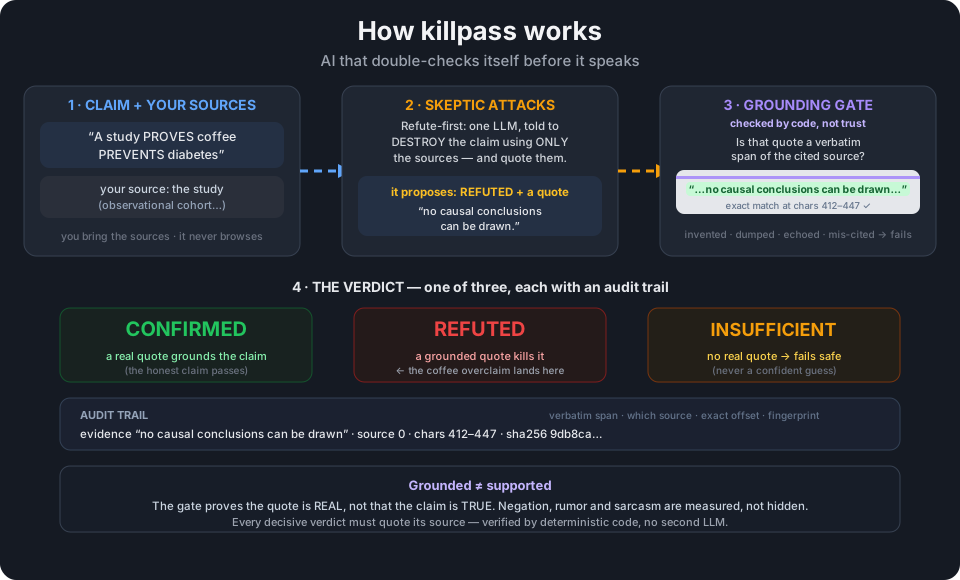
It gives your AI a built-in skeptic: a second AI whose only job is to prove the first one wrong before the answer reaches a human. Spell-check, but for AI claims.
How it works, in three steps
- Your AI makes a claim. "This company raised its forecast."
- killpass sends the claim to a skeptic AI with one instruction: go to the source document and try to destroy this claim. A claim you cannot prove from the source fails.
- You get a verdict:
- CONFIRMED: the claim survived, with the exact quote from the source.
- REFUTED: the sentence in the document that kills it.
- INSUFFICIENT: the source does not settle it, so the claim fails safe rather than guessing.
Why believe this works
killpass comes from verification patterns used in a real research system.
In one run, a system nominated four stocks because headlines said "raised guidance." Each claim went through the skeptic. All four died. One press release said "Updates," not "Raises." Another buried a forecast cut inside the same document. A third funded its good news with a new loan the headline never mentioned. The skeptic read the actual SEC filings and caught what the reader-AI missed, four times out of four.
It works on any news, not just finance
The same three lines handle any domain. The clearest demo is one study, two claims (run examples/any_news_demo.py yourself, tested with a free local model at temperature 0):
| Claim | Verdict | The deciding quote |
|---|---|---|
| "A new study proves coffee prevents diabetes" | REFUTED | "As an observational study, no causal conclusions can be drawn." |
| "An observational study found coffee drinkers had a 12% lower incidence" | CONFIRMED | "...showed a 12% lower incidence of type 2 diabetes..." |
Same study. Same source. Opposite verdicts. killpass passes the honest claim and kills the overclaim.
One honest limit: killpass verifies claims against the sources you provide. It checks whether the document says something. It does not discover truth. If the source lies, the verdict faithfully cites the lie, and it names the quote so you can check.
Who needs this
Any team whose AI answers questions from documents: legal tech, finance tools, medical summaries, customer support, research assistants. They ship wrong answers today, and they know it.
The honest limit (read this)
killpass checks that a verdict is grounded in a real, verbatim source span. It does not check that the claim is true. A quote can exist in a document yet be negated ("we deny guidance was raised") or come from a third-party rumor. A substring engine cannot catch those, so killpass measures the residual instead of faking a filter. On a small shipped benchmark (a handful of hand-written cases, one local model at temperature 0), negation and rumor did not false-confirm. That is a smoke check, not an accuracy rate. Full model: SECURITY.md. Frozen contract: SCHEMA.md.
For engineers (30 seconds)
from killpass import Skeptic

skeptic = Skeptic(llm=my_llm)  # my_llm: prompt -> text, any model

verdict = skeptic.attack(
    claim="Acme Corp raised its FY26 guidance",
    sources=[acme_press_release, acme_10q],
)

print(verdict.result)             # CONFIRMED | REFUTED | INSUFFICIENT
print(verdict.downgrade_reason)   # why, if INSUFFICIENT (documented codes, SCHEMA.md)
for span in verdict.evidence:     # each: a verbatim quote + which source
    print(span.quote, "-> source", span.source_index,
          "@", (span.start_char, span.end_char))  # exact offsets, or None
for ref in verdict.source_manifest:  # audit trail: sha256 of each judged source
    print(ref.index, ref.sha256)
Design principles (full detail in DESIGN.md):
- Refute-first prompting. The skeptic gets rewarded for killing claims, not confirming them.
- Evidence or it did not happen. Every verdict must quote its source.
- Unclear fails. Ambiguity never passes.
- Model-agnostic. Bring any LLM. killpass is the harness, not the brain.
Bring any source: PDF, Word, web page, text
The judge only ever sees text. Small loaders turn real-world documents into text first, so what got judged stays inspectable:
from killpass import Skeptic, load

sources = [
    load("acme_press_release.pdf"),          # PDF (pip install killpass[pdf])
    load("board_minutes.docx"),               # Word, no extra install
    load("https://ir.acme.com/news/q2.html"), # web page, no extra install
    open("notes.txt").read(),                 # plain text always works
]
verdict = Skeptic(llm=my_llm).attack("Acme raised its guidance", sources)
Fetching stays separate from judging on purpose. load() runs before the skeptic, never during, so verdicts stay reproducible and nothing browses the web mid-judgment.
Status
v0.4.0, published and hardened. pip install killpass. 63 tests plus an adversarial fixture pack in CI. The verdict contract is frozen at schema v3 (SCHEMA.md). Multiple rounds of adversarial review hardened the design, before and after each change. The verification patterns were extracted from a real research system.
Limitations
killpass does one job. Given a claim, sources, and any LLM callable, it returns CONFIRMED, REFUTED, or INSUFFICIENT with an audit trail. A decisive verdict must quote real text. The library then checks every quote is a verbatim span from exactly one source: not invented, not pasted across sources, not a dump of the source, not a copy of the claim, not from text the model never fully saw if you capped length. If no quote passes, you get INSUFFICIENT, not a soft maybe.
Grounded is not the same as true. A pass means the model's decisive answer ties to a real, checked quote from your sources. It does not mean the claim is true in the world, that the source is honest, complete, or current, or that the model reasoned correctly about meaning.
What killpass does not do:
- It does not retrieve documents, browse the web, or run an agent loop.
- It does not use NLI models, embeddings, or a second LLM to re-check the first.
- It does not detect sarcasm, irony, or "someone said" rumor as falsehood.
- It does not fully solve negation (a denial can still contain the words of the claim) or every prompt injection where a source fakes the end of the model's instructions.
- It does not replace human judgment on high-stakes decisions.
What you can count on. The guarantee is mechanical quote grounding for decisive verdicts, not an accuracy percentage. On the small shipped benchmark, the residual classes above did not false-confirm, and real contradictions came through. That is a measurement on a handful of cases, not the product promise. Use dual_attack when you want two independent skeptics; disagreement returns ESCALATE. Prefer INSUFFICIENT over a pretty answer you cannot show the quote for.
Questions?
The hard ones (why not chain-of-thought, does cost go up, grounded vs true, which models, is it production-ready) get honest answers in the FAQ.
Extending killpass
killpass stays one small thing on purpose. A written doctrine governs its growth, reach, never scope: no path may assemble the sources, re-encode the verdict, or frame a domain as a supported job. Want a CLI or a framework adapter? Build it as a community leaf under your own name. See ARCHITECTURE.md.
Hardening
Multiple rounds of adversarial review hardened the grounding gate and the verdict schema, then froze them. What the tool guarantees, and where it can still be fooled, live in plain language in SECURITY.md. The frozen verdict contract is in SCHEMA.md.
License
Apache 2.0.
Release history Release notifications | RSS feed


Download files
Download the file for your platform. If you're not sure which to choose, learn more about installing packages.
Source Distributions
Built Distribution
Filter files by name, interpreter, ABI, and platform.
If you're not sure about the file name format, learn more about wheel file names.
Copy a direct link to the current filters
File details
Details for the file killpass-0.4.0-py3-none-any.whl.
File metadata
- Download URL: killpass-0.4.0-py3-none-any.whl
- Upload date:
- Size: 23.9 kB
- Tags: Python 3
- Uploaded using Trusted Publishing? No
- Uploaded via: twine/7.0.0 CPython/3.11.15
File hashes
| Algorithm | Hash digest | |
|---|---|---|
| SHA256 |
1b8a4f10d7f9050724551152dc40b390e0dd84579dfb800aecd17005c013e040
|
|
| MD5 |
7886addf47ff94745c730bb90808c15b
|
|
| BLAKE2b-256 |
813c2173887ceb67fbf5d810ef66b4c1eed93c33e83a49a252a8fe141a4ecae9
|






