

kiln
Claude Code's workshop
Start every new project, and rescue every old one, like a senior engineer would — even if you're not one.
Make Claude Code build production-grade repos, bring yours up to that grade, and keep them that way.


Reference · Changelog · Contributing · Français
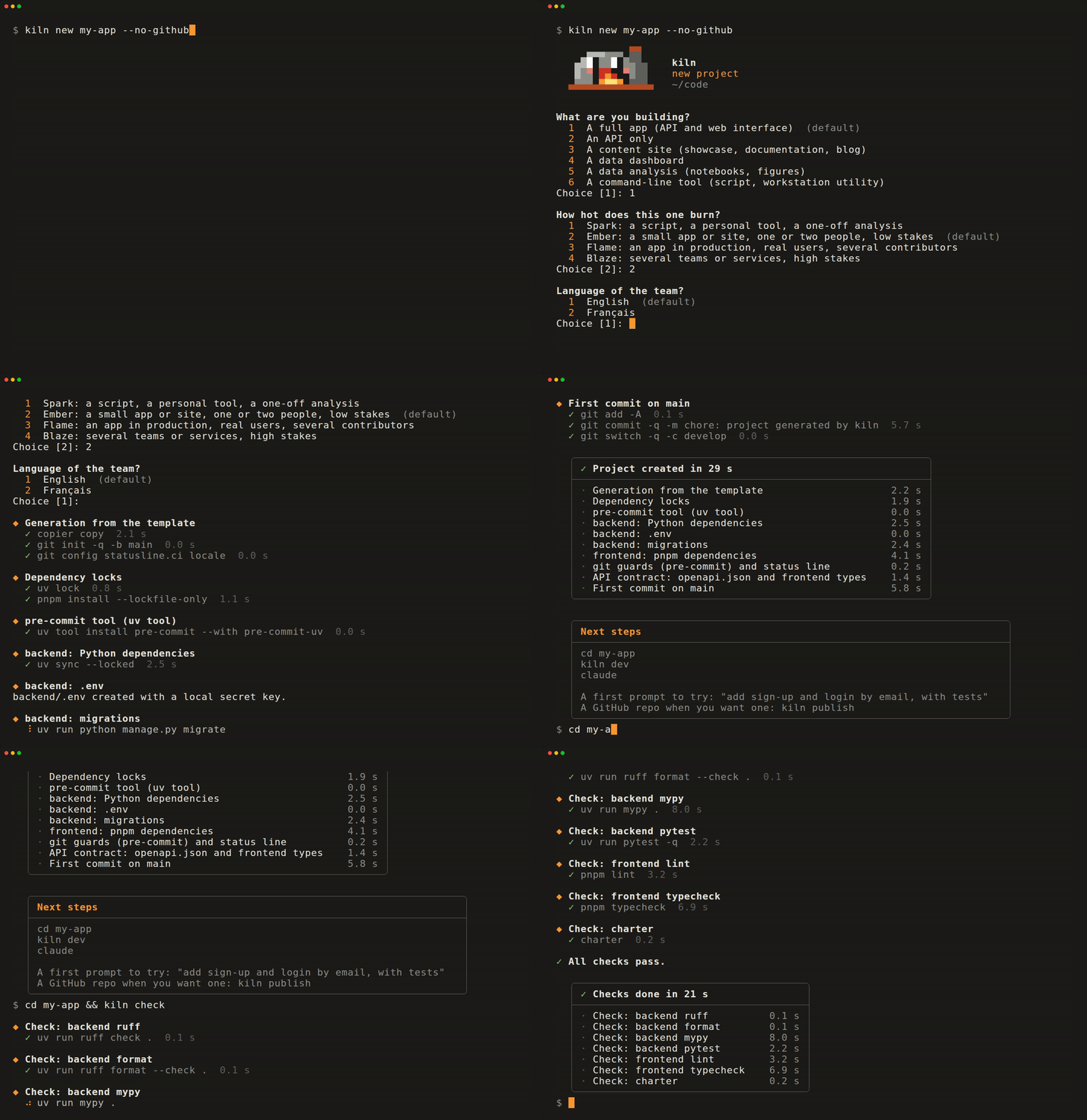
A real run, played at 1.5× with the waits cut: kiln new, then kiln check in the new repo.
Claude Code writes code fast. A repo needs more than that to stay healthy: a current stack, rules an agent cannot argue its way around, a git workflow that survives a bad afternoon, and someone to stop it going stale on day ninety. kiln brings all four to a new repo in three questions, and to the one you already have, however old and messy: it lays down the rules, lists what falls short, and Claude Code works it off. Then it keeps every repo current, release after release. kiln itself calls no AI and needs no API key.
Highlights
- A new repo in three questions (what you build, how big, the team's language): code, tests, linters, CI, pre-commit hooks, containers and the instructions Claude reads first.
- A repo you already have, however old:
kiln adoptbrings it under kiln on a work branch, without touching an existing file. The rules are checked after each edit Claude makes, the debt they find is listed for Claude to work off, andkiln check,kiln devandkiln statusserve it like a repo kiln created. kiln updatereplays the template, takes compatible dependency upgrades, converts what a release renamed and runs your checks before you commit.--rehearsetries it on a throwaway clone first,--allupdates every repo in your code folder.charter, kiln's rule checker, checks each file Claude edits in about 0.15 s: banned tools, names, file sizes, personal data in logs. Counts that may only go down (ratchets) and coverage floors hold at each commit and in CI. A waiver needs a reason and an end date.kiln gridlists the practices kiln stands behind, each with its reason, its sources (checked and dated) and how it is detected.kiln scoremeasures any repo against them in about a second, without a token: a score out of 100, one per pillar, and the gaps to close first.- Skills for worktrees, merges, releases and reviews; hooks that keep Claude off
mainanddevelop; a status line that shows CI, tickets and production. - A private repo's CI runs on your machine (
kiln ci, its verdict kept as a git note) and spends no GitHub minutes; a public repo's runs on GitHub, where it is free.
Install
uv tool install kiln-cli # the command is kiln; uv fetches Python 3.14 if needed
Or try it without installing anything: uvx kiln-cli new my-app for a new repo,
uvx kiln-cli adopt in one you already have. macOS, Linux and Windows through WSL;
pnpm for JavaScript fronts, podman for containers.
Quick start
A new repo:
$ kiln new my-app            # three questions, then a private GitHub repo (--no-github: local)
$ cd my-app && kiln dev      # the stack's dev servers, output prefixed by service
$ kiln check                 # ruff, mypy, pytest, ESLint, type checks, then charter
$ claude                     # Claude Code, with kiln's rules, skills and hooks loaded
A repo you already have, on a work branch:
$ git switch -c chore/kiln-adopt
$ kiln adopt                 # the rules and a backlog, no file touched; then what falls short
$ claude                     # Claude Code works it off, with kiln's rules, skills and hooks
What you get
| You build | Backend | Frontend |
|---|---|---|
A full app (app) |
Django + Django Ninja | Nuxt + Vue |
An API (api) |
FastAPI | — |
A content site (site) |
— | Astro |
A data dashboard (dashboard) |
polars, marimo, Plotly | Streamlit |
A data analysis (analysis) |
polars, marimo, Plotly | — |
A command-line tool (cli) |
Python, installable | — |
Next.js, Dash and Java 25 + Maven are there too, and kiln's tests generate and check every combination. Django and Nuxt are complete; the other stacks are frozen but maintained: new grid rules go to Django and Nuxt first.
Every repo also gets uv, pnpm and podman (never pip, npm or docker), CI that calls kiln's
reusable workflows, protected main and develop branches, a docs/backlog/ of typed tickets,
and a size (spark, ember, flame or blaze) that sets how much process it carries. A
Django app can ship to a hardened VPS (Caddy, read-only containers, automatic rollback, tested
backups), a Nuxt front to Vercel.
Kept current
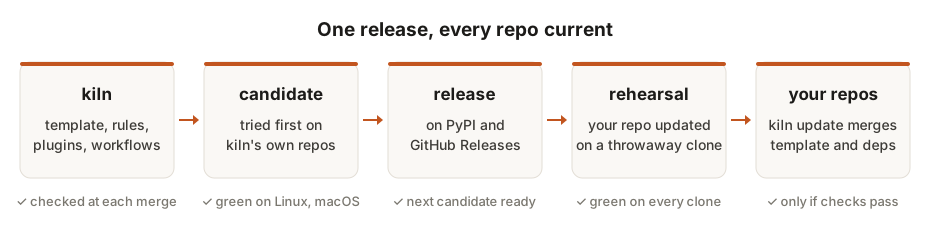
A kiln release first ships as a candidate, tagged only once its CI is green on Linux and macOS,
including an update from every release since v0.3.0 through an installed tool. It is promoted
when the next candidate is ready, then rehearsed on a clone of each repo before
kiln update --all merges it, one worktree per repo. Repos quote kiln's workflows at the exact
release they follow, so nothing reaches them between releases, and kiln update shows what is
new in each release it crosses. A repo brought in by kiln adopt follows kiln's workflows at the
latest release, moved forward by kiln update too.
The grid
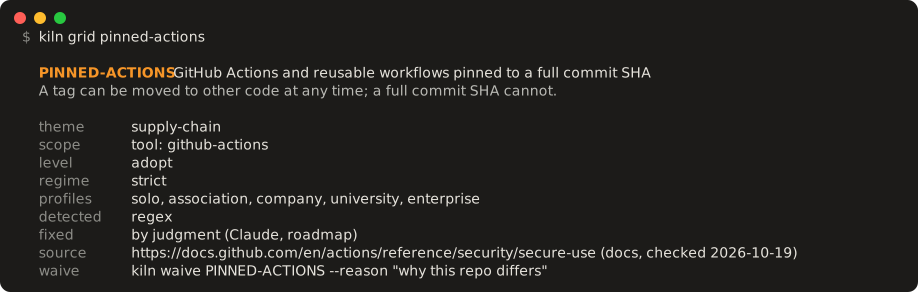
kiln grid <ID>: one rule in full, with its reason, a source checked on a date, and how a repo can waive it.
One small TOML file per rule, on two axes: its theme (supply chain, containers, tests…) and its
scope (universal, a language, a framework, a tool). Each says why, cites sources weighed in a
fixed order (official docs, security advisories, measured studies, adoption data, blogs) and
carries a level from Thoughtworks' Technology Radar: adopt, trial, assess, hold. Only adopted
rules count: 40 of them (supply chain, CI, containers, tests, code standards, Django and Vue
security), each run on two real repos for false positives; 95 drafts wait behind
kiln grid --level assess.
Each scored rule ships with a repo that passes it and one that fails it.
Compared with Copier and cookiecutter
kiln is Copier underneath: every project keeps its
.copier-answers.yml, and plain Copier still works on it. kiln adds what comes after day one,
and gives up some breadth for it.
| cookiecutter | Copier | kiln | |
|---|---|---|---|
| Generate a project | ✅ | ✅ | ✅ |
| Any language or framework | ✅ | ✅ | ❌ |
| Community templates to start from | ✅ | ✅ | ❌ |
| Apply template updates to existing projects | ❌ | ✅ | ✅ |
| Pick the stack from what you build | ❌ | ❌ | ✅ |
Change the stack later (kiln set frontend=nuxt) |
❌ | partial | ✅ |
| Upgrade dependencies and run the checks in the same step | ❌ | ❌ | ✅ |
| Rehearse, then update every repo at once | ❌ | ❌ | ✅ |
| Shared CI workflows, quoted at a release | ❌ | ❌ | ✅ |
A rule engine with dated waivers (charter) |
❌ | ❌ | ✅ |
| Claude Code skills, hooks and instructions | ❌ | ❌ | ✅ |
kiln is opinionated on purpose. For a neutral templating engine, use Copier; for a workflow that stays maintained, use kiln, or fork it and make the opinions yours.
Reference
Every command and option, every kiln set key, the reusable workflows and the Claude Code
plugins: docs/reference.md. In a terminal, kiln <command> --help.
Status
kiln runs a handful of real repos every day, one of them in production. One maintainer writes it
with Claude Code, under the same rules it gives your repos. Releases are numbered like Claude
Code's: in 0.x, each release bumps the patch, breaking changes come first in the
changelog and kiln update converts them; the minor marks a milestone. Strict
semver starts at 1.0. What comes next is for the repos you already have: any Django or Nuxt repo
scored against the grid in seconds, then brought up to it by script wherever a script can
(v0.5.0).
Contributing
Issues and pull requests are welcome: see CONTRIBUTING.md, the
code of conduct, and the
good first issue label to
start. In a kiln repo, /kiln:report turns a kiln defect into a ready-to-post issue or pull
request, posted only once you approve. If kiln saves you time, a star helps others find it.
License
1 maintainer

Metadata
1 maintainer
Release files for kiln-cli 0.4.2
For a detailed explanation of source distributions (sdists) and built distributions (wheels), please see the package formats documentation.
Source distribution (sdist)
| File | Size | Uploaded | Provenance | |
|---|---|---|---|---|
| kiln_cli-0.4.2.tar.gz | 2.9 MB | Without provenance | Details |
Built distribution (wheel)
| File | Interpreter | ABI | Platform | Reset |
|---|---|---|---|---|
| kiln_cli-0.4.2-py3-none-any.whl | Python 3 | none | any | Details |
Total release size: 3.1 MB
Release files / kiln_cli-0.4.2.tar.gz
| Download URL | kiln_cli-0.4.2.tar.gz |
|---|---|
| Size | 2.9 MB |
| Tags | Source |
|
SHA-256 checksum How to use checksums |
569d31d102c3fb515f09ea5ea9a96740c831d4cd00655bccaba634b610d0c37a
|
|
BLAKE2b-256 checksum How to use checksums |
0d80dc6d38b14728bdc700b556cf882b68e5af21bb36e181fbd4af639887afab
|
| Upload date | |
|
Uploaded using Trusted Publishing? What is trusted publishing? |
No |
| Uploaded via |
uv/0.13.4 {"installer":{"name":"uv","version":"0.13.4","subcommand":["publish"]},"python":null,"implementation":{"name":null,"version":null},"distro":{"name":"Ubuntu","version":"24.04","id":"noble","libc":null},"system":{"name":null,"release":null},"cpu":null,"openssl_version":null,"setuptools_version":null,"rustc_version":null,"ci":true}
|
Release files / kiln_cli-0.4.2-py3-none-any.whl
| Download URL | kiln_cli-0.4.2-py3-none-any.whl |
|---|---|
| Size | 232.8 kB |
| Tags | Python 3 |
|
SHA-256 checksum How to use checksums |
2050f3c2d6193c65b54b1e98673e1085ad15ca52f0f78705fa7982ac2d5fd000
|
|
BLAKE2b-256 checksum How to use checksums |
128c22996c83be773c6262ad71724d9f0ef49b341e6bfa2c62cbd168baafaab2
|
| Upload date | |
|
Uploaded using Trusted Publishing? What is trusted publishing? |
No |
| Uploaded via |
uv/0.13.4 {"installer":{"name":"uv","version":"0.13.4","subcommand":["publish"]},"python":null,"implementation":{"name":null,"version":null},"distro":{"name":"Ubuntu","version":"24.04","id":"noble","libc":null},"system":{"name":null,"release":null},"cpu":null,"openssl_version":null,"setuptools_version":null,"rustc_version":null,"ci":true}
|
Security for kiln-cli 0.4.2
Provenance
Provenance describes where a file came from. On PyPI, provenance is shared via attestations, which provide a verifiable record of the build or publishing details. View details, limitations and caveats.
No provenance found
None of the files in this release were uploaded with provenance metadata.
A note on package security
PyPI is a repository for distributing packages, not a service for auditing them. While third-party security researchers and our staff do their best to detect and remove malicious packages, PyPI cannot guarantee the quality, security or suitability of any given package.














