

kivi
Credit risk modeling with pandas
A toolkit for the whole scorecard project:
screen and bin the variables, fit and scale the model, calibrate it, price the cut-offs, monitor the model and provision for the loans it approves.








English · 简体中文
Documentation · Quickstart · User guide · API · Release notes
✨ Highlights
- 🏦 Built for risk teams. Covers a credit scorecard project end to end: variable profiles, classing, variable selection, reject inference, a logistic fit, scaling to points, evaluation, calibration on a master scale, cut-off strategy and expected loss, deployment and monitoring by period, plus vintage and roll-rate analysis of the approved loans and their IFRS 9 expected credit loss.
- 📐 Fit once, reuse everywhere. Bin edges, category groupings, WOE tables, master scales and cut-offs are fitted on the development sample and applied unchanged to later samples.
bin_edgeslearns quantile or uniform edges,chimerge_edges,tree_edgesandmonotonic_edgesalso use the target, andchimerge_groupsmerges categories with similar event rates. The outer edges are infinite, so every future value still lands in a bin. - 🔍 Transparent results. Tables return raw counts, smoothed shares and a contribution per bin, grade or cut-off, not just one number.
- 📏 Uncertainty in view.
roc_auc_intervalgives the DeLong confidence interval of an AUC and a Gini, anddelong_testtests whether two scores rank the same sample equally well. - 💾 Reproducible in production.
fit_specbins a whole data frame, andBinningSpecsaves the edges and WOE tables as versioned JSON, so production groups new data exactly as development did. - 🧩 Nothing silently dropped. Missing values, special codes such as
-1and categories seen in only one sample get their own group, and a category that a fitted grouping or WOE table does not know raises an error unless you say where it belongs. - ⚖️ Sample weights throughout. Binning, WOE, PSI, the metrics, calibration, the model fits, the strategy tables, the monitoring report, vintage tables and the stage table take sample weights, and integer weights count like repeated rows: the same counts, rates and coefficients. Only quantile edges differ, because weighted quantiles do not interpolate.
- 🧊 Honest smoothing. Empty cells are replaced by
smoothing(default 0.5) before normalizing, and the reported counts are never altered. - 🐼 Just pandas and NumPy. No Spark, no database drivers and no global random state in the core.
- 🌏 Bilingual, tested docs. Every example in the English and Chinese manuals runs in CI.
📊 Gallery
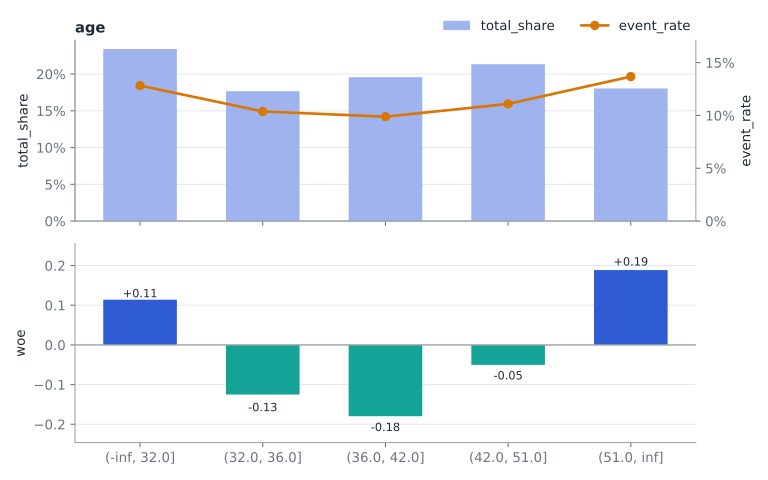
WOE chart: share of customers, event rate and WOE per bin. |
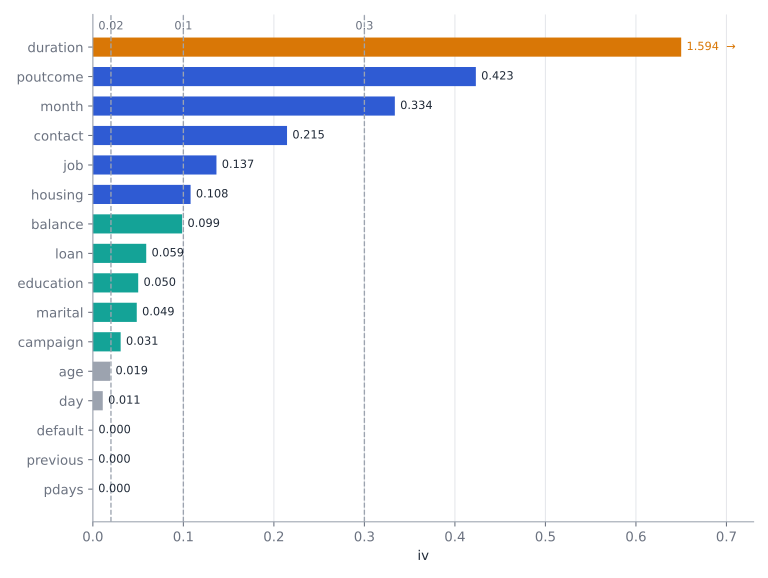
Variable screening: IV ranking with the usual reading bands; duration is a leak.
|
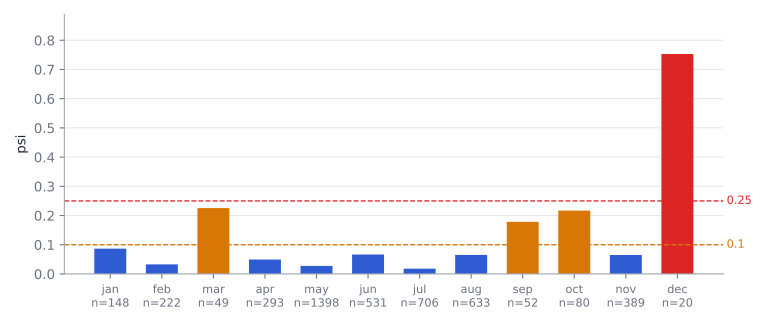
Monitoring: PSI per period against the development sample, with the 0.1 and 0.25 thresholds and sample sizes. |
|
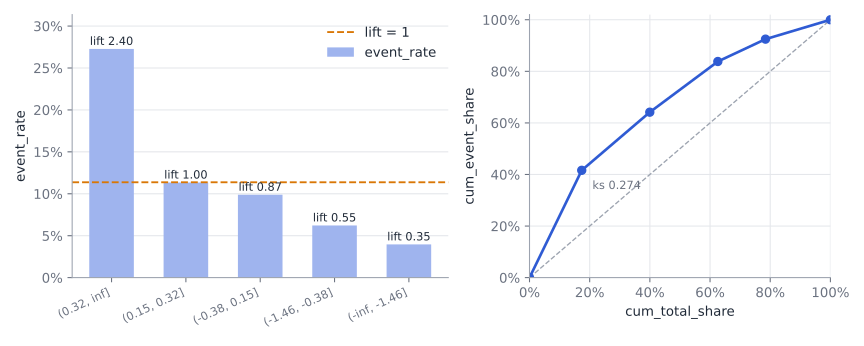
Gains: event rate and lift per score band, and the share of events captured. |
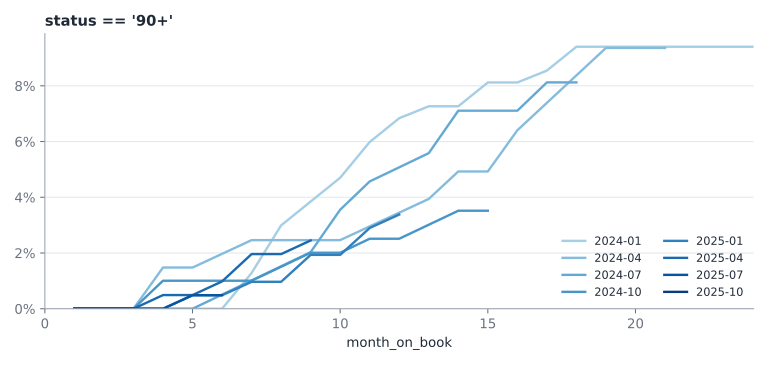
Vintage curves: cumulative 90+ bad rate of each origination cohort. |
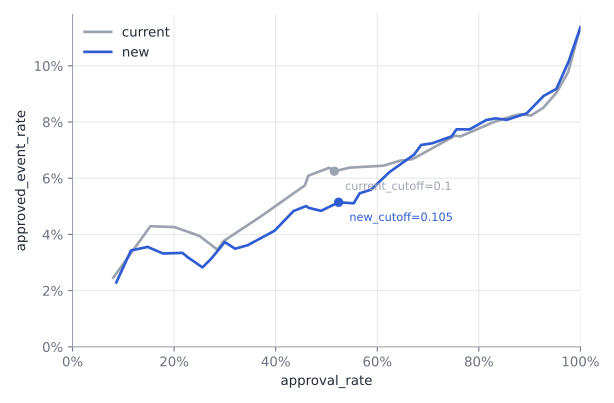
Cut-off strategy: the bad rate of the approved book at each approval rate, for a current and a new score. |
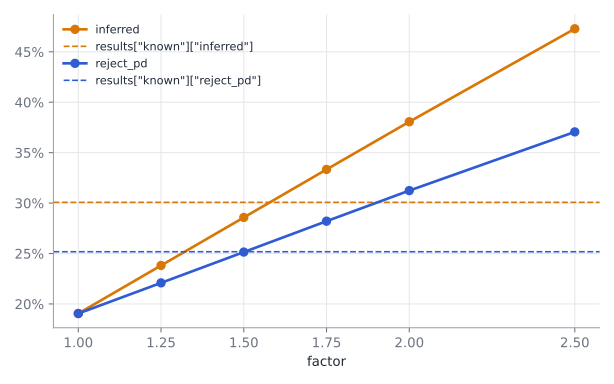
Reject inference: the inferred bad rate and the refitted PD of the declined applicants for each factor.
|
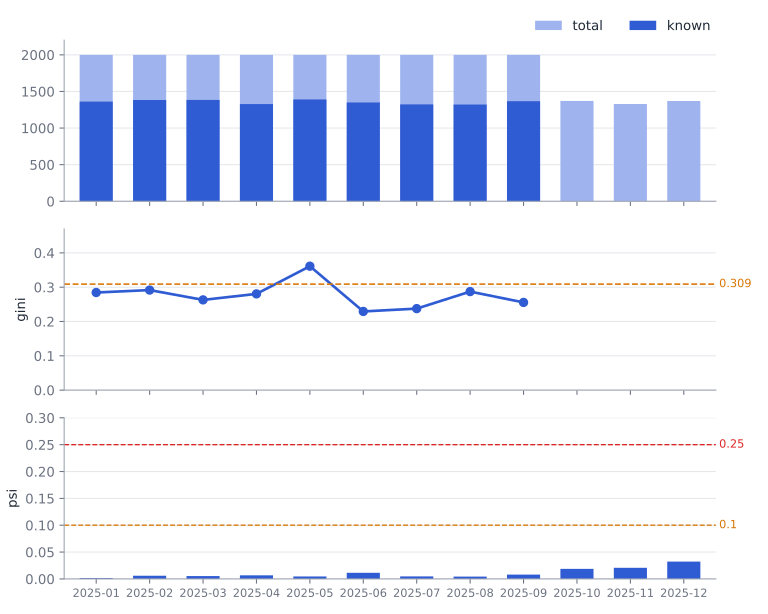
Model monitoring: population, known outcomes, Gini and PSI of the score in every month. |
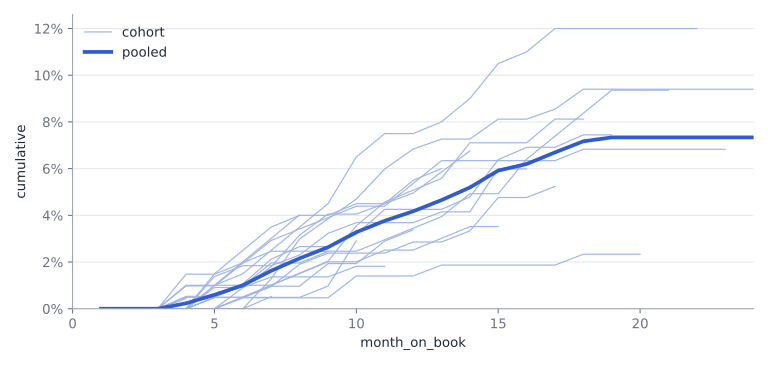
Lifetime PD: the cumulative PD of each cohort and the pooled term structure used for the expected credit loss. |
🧭 How it works
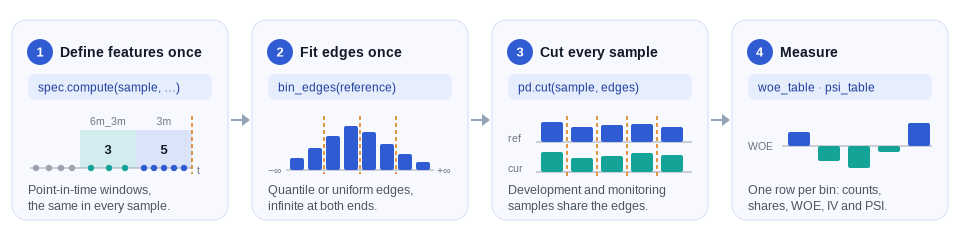
Every step fits on the development sample and applies the result unchanged to later samples:
| Step | Modules | Main functions |
|---|---|---|
| Profile the candidates | kivi.univariate |
profile_table |
| Bin and encode | kivi.binning, kivi.woe |
bin_edges, monotonic_edges, chimerge_groups, woe_table, woe_transform |
| Select and fit | kivi.selection, kivi.reject_inference |
stepwise, logistic_regression, fuzzy_augmentation |
| Scale and evaluate | kivi.scorecard, kivi.metrics |
points_table, roc_auc, roc_auc_interval, gains_table |
| Calibrate | kivi.calibration |
master_scale, assign_grades, jeffreys_test |
| Decide | kivi.strategy |
cutoff_table, swap_set, expected_loss_table |
| Deploy and monitor | kivi.spec, kivi.monitoring, kivi.stability |
fit_spec, monitoring_table, stability_table, csi_table |
| Follow the loans | kivi.vintage, kivi.lifetime |
vintage_table, transition_pd, expected_credit_loss, assign_stages |
Binning shows the pattern: fit the edges once, cut every sample with them, then measure.
📦 Installation
pip install kivi
Requires Python 3.10+, NumPy 1.24+ and pandas 2.0+. For the latest development version, use pip install "git+https://github.com/gchensy/kivi".
Upgrading from 0.2.x? The API changed in 0.3. Read the migration guide before upgrading existing code.
🚀 Quickstart
import pandas as pd
from kivi.binning import bin_edges
from kivi.datasets import Dataset
from kivi.stability import psi_table
from kivi.woe import woe_table

data = Dataset.bank_data()                      # 4,521 bank marketing customers
reference, current = data.iloc[:3000], data.iloc[3000:]

edges = bin_edges(reference["age"], bins=5)     # 1. fit once on the reference
before = pd.cut(reference["age"], edges)        # 2. cut every sample
after = pd.cut(current["age"], edges)

evidence = woe_table(before, reference["target"])  # 3. measure
stability = psi_table(before, after)

print(evidence[["event", "non_event", "woe", "iv"]].round(3))
print(f"IV = {evidence['iv'].sum():.3f}, PSI = {stability['psi'].sum():.4f}")
              event  non_event    woe     iv
bin
(-inf, 32.0]     90        612  0.114  0.003
(32.0, 36.0]     55        475 -0.125  0.003
(36.0, 42.0]     58        529 -0.180  0.006
(42.0, 51.0]     71        569 -0.050  0.001
(51.0, inf]      74        467  0.189  0.007
IV = 0.019, PSI = 0.0024
Categorical columns skip the edges; pass their labels as they are, or group them first with category_groups or chimerge_groups:
jobs = woe_table(reference["job"], reference["target"])
print(f"IV(job) = {jobs['iv'].sum():.3f}")      # IV(job) = 0.137
🧰 API at a glance
| Function | What it does |
|---|---|
kivi.univariate.profile_table |
One row per candidate: missing values, distribution, event rates, the IV of a quick binning and the Gini of numeric values |
kivi.binning.bin_edges |
Fit quantile or uniform edges on a reference sample, with infinite outer edges |
kivi.binning.cut |
Assign values to bins, with a separate group for each special value such as -1 |
kivi.binning.chimerge_edges |
Merge fine quantile bins with ChiMerge until neighbours differ significantly |
kivi.binning.tree_edges |
Decision-tree splits by entropy or Gini, with a minimum share per bin |
kivi.binning.monotonic_edges |
Merge fine quantile bins until the WOE is monotonic |
kivi.binning.category_groups, kivi.binning.chimerge_groups, kivi.binning.group_categories |
Group the categories of a categorical variable: pool the rare ones or merge those with similar event rates, then apply the grouping to every sample |
kivi.woe.woe_table |
Counts, shares, WOE and IV for every group |
kivi.woe.woe_transform |
Replace each group with its development WOE, with an explicit policy for unseen groups |
kivi.woe.woe, kivi.woe.iv, kivi.stability.psi |
WOE, IV and PSI from counts that are already aggregated |
kivi.selection.correlation_filter, kivi.selection.vif |
Drop correlated variables by IV, and variance inflation factors |
kivi.selection.logistic_regression, kivi.selection.stepwise |
NumPy logistic regression and stepwise selection that keeps every coefficient positive, with frequency weights |
kivi.reject_inference.fuzzy_augmentation, kivi.reject_inference.parceling, kivi.reject_inference.reweighting |
Infer the outcomes of declined applicants, as weighted rows or as weights of the approved ones |
kivi.scorecard.score_scaling, kivi.scorecard.pd_to_score, kivi.scorecard.score_to_pd |
PDO scaling factor and offset, and conversion between PD and score |
kivi.scorecard.points_table, kivi.scorecard.woe_to_points, kivi.scorecard.reason_codes |
Points per group with PDO scaling, scores for new data, and reason codes |
kivi.metrics.roc_auc, kivi.metrics.gini, kivi.metrics.ks, kivi.metrics.brier_score |
AUC, Gini, KS and Brier score of a score or PD against a binary target |
kivi.metrics.gains_table |
Gains and lift by score band, with cumulative capture and KS |
kivi.metrics.roc_table, kivi.metrics.roc_auc_interval, kivi.metrics.delong_test |
The ROC curve with one row per threshold, the DeLong confidence interval of an AUC and a Gini, and the DeLong test of two scores |
kivi.calibration.master_scale, kivi.calibration.fit_grade_pd, kivi.calibration.assign_grades |
Build a master scale from the PD of each grade or fit it to default rates, and give each PD its grade |
kivi.calibration.calibration_table, kivi.calibration.binomial_test, kivi.calibration.jeffreys_test, kivi.calibration.hosmer_lemeshow |
Event rate against predicted PD per grade, with binomial, Jeffreys and Hosmer-Lemeshow tests |
kivi.calibration.prior_correction, kivi.calibration.corrected_intercept, kivi.calibration.herfindahl_index |
Correct PDs for an oversampled sample, and measure grade concentration |
kivi.calibration.platt_fit, kivi.calibration.platt_predict, kivi.calibration.isotonic_fit, kivi.calibration.isotonic_predict |
Recalibrate a score to probabilities with Platt scaling or isotonic regression |
kivi.strategy.cutoff_table, kivi.strategy.swap_set |
Approval and bad rates of each cut-off, and the swap set between a current and a new score |
kivi.strategy.expected_loss, kivi.strategy.expected_loss_table |
Expected loss, PD × LGD × EAD, of each exposure and by grade |
kivi.spec.fit_spec, kivi.spec.BinningSpec |
Bin and WOE-encode a whole data frame, and save the specification as versioned JSON |
kivi.stability.psi_table |
Per-group PSI contributions between two samples |
kivi.stability.csi_table |
Characteristic stability index: how much each variable's shift moves the average score |
kivi.monitoring.monitoring_table, kivi.monitoring.stability_table |
One row per period with the population, the known outcomes, AUC, Gini, KS and the PSI of the score, and the PSI of every variable by period |
kivi.vintage.vintage_table |
Cumulative bad rate of each origination cohort by month on book |
kivi.vintage.transition_matrix, kivi.vintage.roll_rates |
Movements between delinquency buckets and the forward roll rate of each bucket |
kivi.lifetime.convert_pd, kivi.lifetime.transition_pd |
Convert PD term structures between cumulative, marginal and conditional PDs, and project them from a transition matrix |
kivi.lifetime.expected_credit_loss, kivi.lifetime.significant_increase, kivi.lifetime.assign_stages, kivi.lifetime.stage_table |
IFRS 9: 12-month and lifetime expected credit loss, significant increase in credit risk, stages 1 to 3 and the loss allowance by stage |
kivi.datasets.load_bank, kivi.datasets.make_loan_panel, kivi.datasets.make_applications |
The bundled bank marketing data, and seeded synthetic loan panels and loan applications |
📚 Documentation
| English | 中文 | |
|---|---|---|
| Quickstart | Read | 阅读 |
| Risk modeling workflow | Read | 阅读 |
| Univariate profile | Read | 阅读 |
| Binning | Read | 阅读 |
| WOE and IV | Read | 阅读 |
| Variable selection | Read | 阅读 |
| Reject inference | Read | 阅读 |
| Scorecard | Read | 阅读 |
| Model performance | Read | 阅读 |
| Calibration | Read | 阅读 |
| Credit strategy | Read | 阅读 |
| Binning specifications | Read | 阅读 |
| PSI | Read | 阅读 |
| Model monitoring | Read | 阅读 |
| Vintage and roll-rate analysis | Read | 阅读 |
| Lifetime PD and expected credit loss | Read | 阅读 |
| Example data | Read | 阅读 |
| Conventions | Read | 阅读 |
| Glossary | Read | 阅读 |
| Migrating from 0.2.x | Read | 阅读 |
🗺️ Roadmap
- ✅ Quantile and uniform binning, WOE, IV and PSI on a pandas core
- ✅ English and Simplified Chinese documentation with tested examples
- ✅ Special values such as
-1or-999in their own bins - ✅ Charted risk examples: special values, coarse classing, IV screening, PSI monitoring
- ✅ Supervised binning: ChiMerge, decision tree and monotonic WOE
- ✅ WOE encoding of new data, with an explicit policy for unseen groups
- ✅ Sample weights in binning, WOE and PSI
- ✅ Scorecard workflow: variable selection, logistic regression, PDO scaling, reason codes, evaluation and calibration
- ✅ CSI, vintage and roll-rate analysis, batch binning with saved specifications
- ✅ Platt and isotonic calibration, and sample weights in the metrics
- ✅ Credit strategy: cut-off tables, swap sets and expected loss
- ✅ Reject inference with weighted model fits
- ✅ Master scales and univariate variable profiles
- ✅ Topic guides on one outline, a conventions page and a glossary
- ✅ Categorical grouping, ROC tables and DeLong tests of the AUC
- ✅ Model monitoring by period
- ✅ Lifetime PD term structures, IFRS 9 expected credit loss and stage allocation
- 🔜 Type hints checked in CI, test coverage and an API review towards 1.0
🤝 Contributing
git clone https://github.com/gchensy/kivi.git
cd kivi
python -m pip install -e '.[test,docs,lint]'
pre-commit install                                        # ruff before every commit
python -m pytest                                          # unit tests
python -m sphinx -W -b doctest docs docs/_build/doctest   # documentation examples
python docs/build.py                                      # English and Chinese HTML
After editing English pages or docstrings, run python docs/build.py --update-po and translate the new entries in docs/locale/zh_CN/LC_MESSAGES/kivi.po. See Writing documentation for the translation steps and the conventions of the pages, and the development guide for the checks that every pull request runs.
📄 License
The code is released under the MIT License. The bundled Bank Marketing data by S. Moro, P. Rita and P. Cortez (2014) is licensed under CC BY 4.0; see DATA-LICENSE.txt.
If kivi helps your models, a ⭐ helps others find it.
1 maintainer

Metadata
1 maintainer
Release files for kivi 0.8.0
For a detailed explanation of source distributions (sdists) and built distributions (wheels), please see the package formats documentation.
Source distribution (sdist)
| File | Size | Uploaded | Provenance | Actions |
|---|---|---|---|---|
| kivi-0.8.0.tar.gz | 822.1 kB | With provenance | Details for kivi-0.8.0.tar.gz |
Built distribution (wheel)
| File | Interpreter | ABI | Platform | Actions Reset |
|---|---|---|---|---|
| kivi-0.8.0-py3-none-any.whl | Python 3 | none | any | Details for kivi-0.8.0-py3-none-any.whl |
Total release size: 1.0 MB
Release files / kivi-0.8.0.tar.gz
| Download URL | kivi-0.8.0.tar.gz |
|---|---|
| Size | 822.1 kB |
| Tags | Source |
|
SHA-256 checksum How to use checksums |
35ff232fd2f2c35a22e7cfb3e47f1ddbbcfeb2df261d24113e15ccc430128080
|
|
BLAKE2b-256 checksum How to use checksums |
600b539c028c276ccba5396c4b3a2cea4d53060c3088034a2378986bba5369b9
|
| Upload date | |
|
Uploaded using Trusted Publishing? What is trusted publishing? |
Yes |
| Uploaded via |
twine/7.0.0 CPython/3.13.16
|
Provenance
Provenance describes where a file came from. On PyPI, provenance is shared via attestations, which provide a verifiable record of the build or publishing details. View details, limitations and caveats.


PyPI Publish Attestation
PyPI verified that this artifact, at this checksum, originated from the publisher listed below.
Signed by GitHub Actions, verified by PyPI on Nov 21, 2026.
Transparency logRelease files / kivi-0.8.0-py3-none-any.whl
| Download URL | kivi-0.8.0-py3-none-any.whl |
|---|---|
| Size | 226.1 kB |
| Tags | Python 3 |
|
SHA-256 checksum How to use checksums |
6f93b409009c256bec251be73e515ebbefde59baedc5856f89d5ef54175ebb3c
|
|
BLAKE2b-256 checksum How to use checksums |
973bbf554881809219333dddf300aada1a37dbc7801f14cd78b488af6f45499d
|
| Upload date | |
|
Uploaded using Trusted Publishing? What is trusted publishing? |
Yes |
| Uploaded via |
twine/7.0.0 CPython/3.13.16
|
Provenance
Provenance describes where a file came from. On PyPI, provenance is shared via attestations, which provide a verifiable record of the build or publishing details. View details, limitations and caveats.
PyPI Publish Attestation
PyPI verified that this artifact, at this checksum, originated from the publisher listed below.
Signed by GitHub Actions, verified by PyPI on Nov 21, 2026.
Transparency logSecurity for kivi 0.8.0
Provenance
Provenance describes where a file came from. On PyPI, provenance is shared via attestations, which provide a verifiable record of the build or publishing details. View details, limitations and caveats.
Full provenance
Both files in this release have been uploaded with provenance metadata.
Attestation for kivi-0.8.0.tar.gz
PyPI Publish Attestation
PyPI verified that this artifact, at this checksum, originated from the publisher listed below.
Signed by GitHub Actions, verified by PyPI on Nov 21, 2026.
Transparency logA note on package security
PyPI is a repository for distributing packages, not a service for auditing them. While third-party security researchers and our staff do their best to detect and remove malicious packages, PyPI cannot guarantee the quality, security or suitability of any given package.
To learn more about protecting yourself from malicious actors, visit our package security documentation.














