

Klotse
A native Kubernetes desktop manager for Windows, macOS and Linux. Browse clusters, workloads, nodes and custom resources; read logs; open shells; scale, cordon and drain, all from one window.
Built with Python, PySide6 (Qt Widgets) and the official Kubernetes Python client. It uses your existing kubeconfig and authentication helpers, so there is nothing to sign in to and no server component.
Status: early. Read-only use against real clusters has been tried; most of the mutating actions (cordon, drain, delete, scale) are covered by automated tests with fake services, not yet by live-cluster runs. Try them on a non-production cluster first.
Features
- Multiple clusters. Every context in your kubeconfig is listed on the left; each open cluster gets its own tab and its own connection. Klotse never connects by itself: it starts with a clean list. When you exit with clusters open it asks whether to reconnect them next time (Yes remembers them, No starts clean, Cancel stays open).
- Cluster groups. Organise a long context list into nested groups (
prod/eu): right-click the Disconnected section or a cluster to create groups and move clusters, or choose Suggest groups… to propose them from the context names (shared prefixes such asteam.api.prod.us1andus2, or a regular expression whose capture groups become the levels). Right-click a group for Connect all. - Resources. Overview, Workloads, Nodes, Namespaces, Pods, Deployments, ReplicaSets, StatefulSets, DaemonSets, Jobs, CronJobs, ConfigMaps, Secrets, Services, Ingresses, NetworkPolicies, PVCs, PVs, StorageClasses, Events, CustomResourceDefinitions, and read-only browsing of custom resource instances.
- Always fresh. The visible tab refreshes every 10 s (5/10/30/60 s selectable) and immediately when the cluster reports a change. Hidden tabs and clusters are not polled.
- Details. YAML view for any resource, with Secret values masked until you pick the keys to decode.
managedFieldsare hidden by default (View → Show managedFields in details). - Pods and containers. Logs (streaming, search, follow), Shell, Attach, terminate and force terminate. Double-click a pod for its own tab with every regular, init and ephemeral container.
- Nodes. Cordon/uncordon, drain (with the usual kubectl options), a privileged nsenter shell, delete. Double-click a node for its pods, with the node actions in a bar above them. Pod counts per node.
- Bulk actions. Select several rows (Ctrl/Shift) to scale, terminate, cordon or delete them in one confirmed
step. Scale accepts a number or a relative change such as
*2,/2,+1,-1. - Usage. CPU and memory in use (from metrics-server, when present) on Nodes and Pods, plus optional request, limit and percent-of-request/limit columns on Pods.
- Your columns. The Columns… button on every list lets you hide and reorder built-in columns and add label columns with short headings. Saved per resource kind.
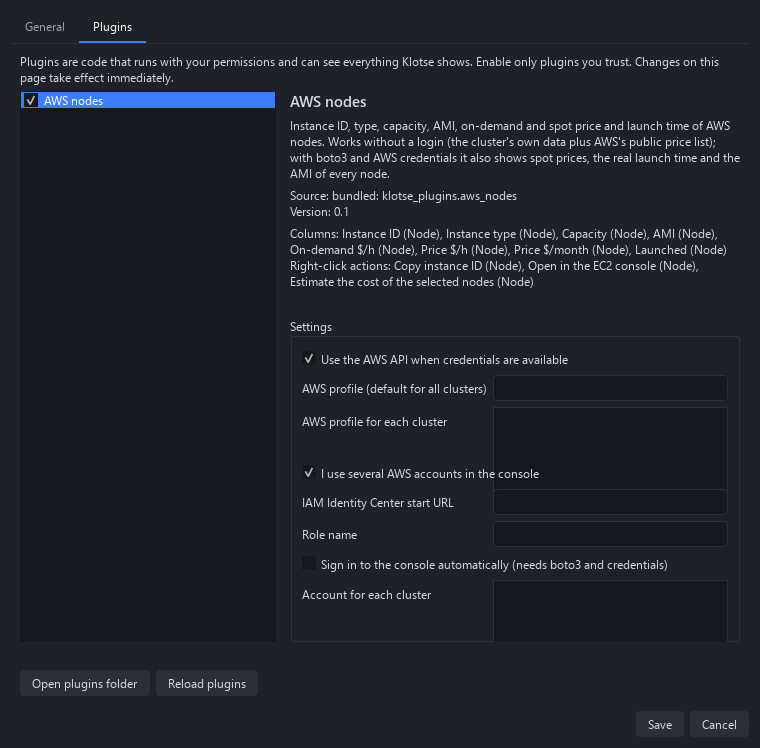
- Plugins. Extra columns, right-click actions, Overview cards and per-cluster settings from plugins (Klotse ships one for AWS nodes: instance ID, AMI, price per hour and month, spot price, launch time, and the cluster's cost on the Overview), off until you enable them in Preferences → Plugins. Settings that differ per cluster, such as the AWS profile, are in the Plugins menu and in the right-click menu of a connected cluster. Write your own as a single Python file: see PLUGINS.md.
- Edit menu and Preferences. Undo/redo/cut/copy/paste/select all (Copy in a table copies the selected rows as tab-separated text). Preferences lets you choose a custom kubeconfig and open the settings folder.
- macOS. Choose Terminal or iTerm2 for shells (Preferences → Terminal).
Screenshots
The screenshots below were made with invented data (a made-up eight-node EKS cluster with fake prices and instance IDs), not a real cluster or AWS account. They show the AWS nodes plugin, which is off until you enable it in Preferences → Plugins. The text was rendered with Windows fonts, so spacing on your system may differ a little.
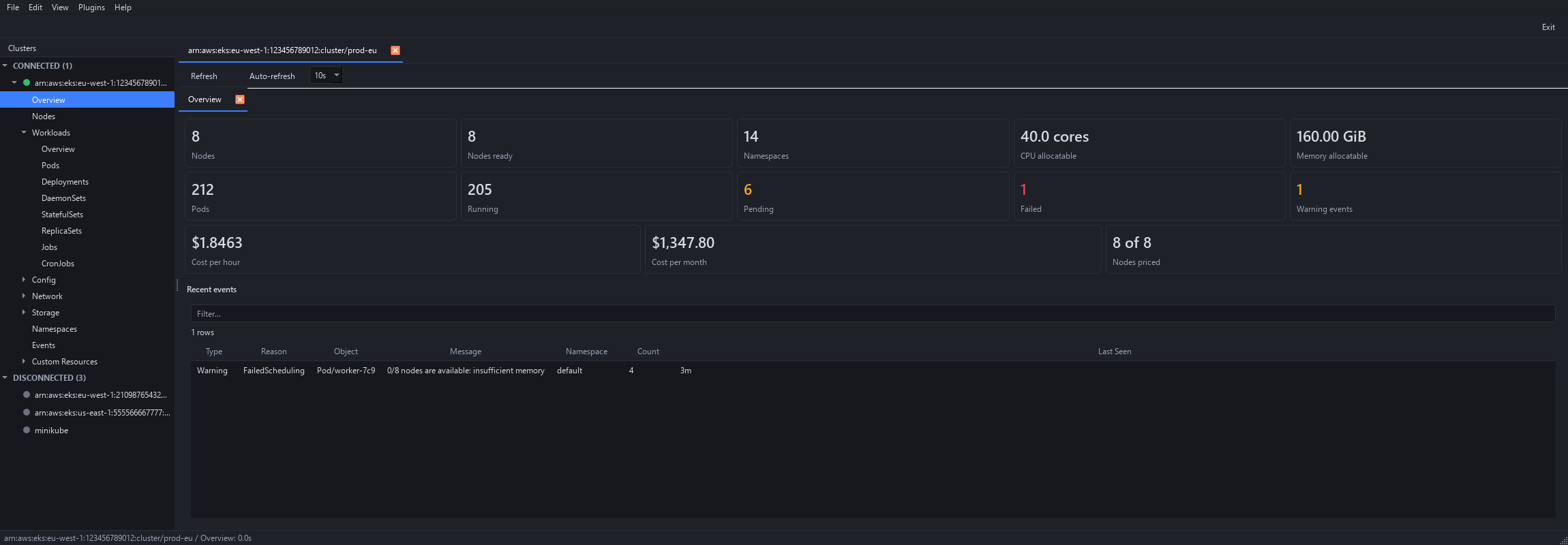
Cluster Overview. The usual cluster and workload cards, plus the plugin's Cost per hour, Cost per month and Nodes priced cards (the sum of every node's current price; spot nodes without a spot price are not counted).
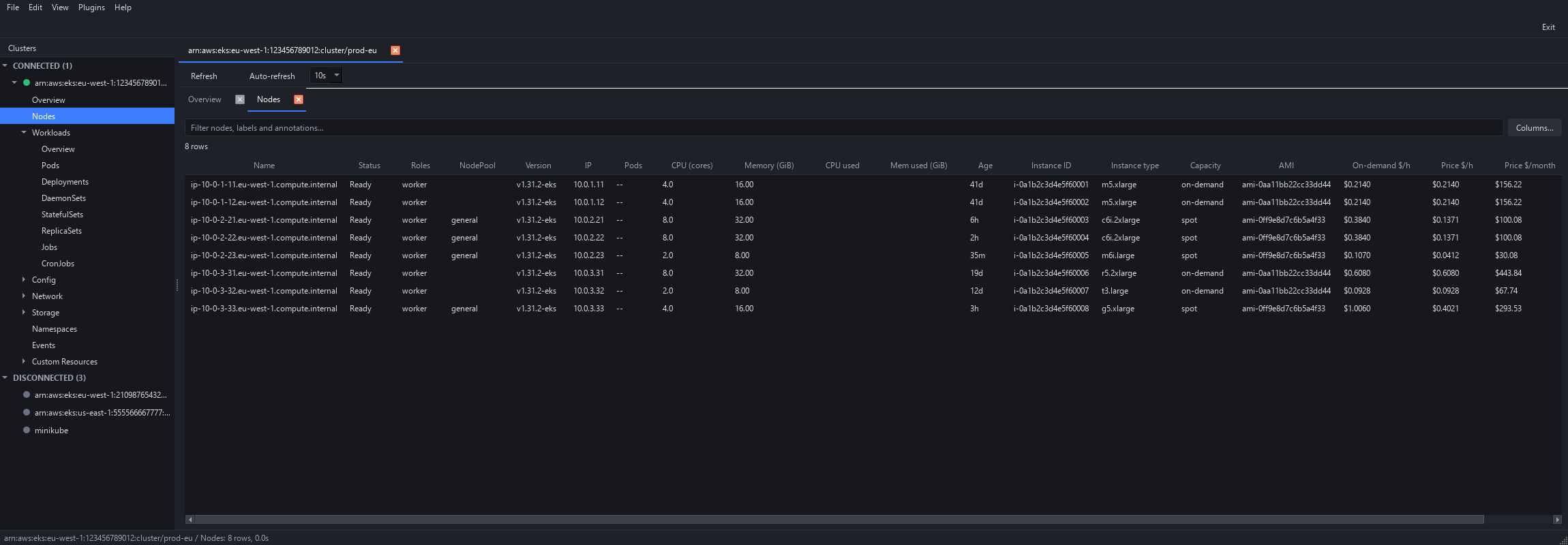
Nodes with plugin columns. Instance ID, instance type, capacity, AMI, on-demand and current price per hour, and price per month, next to the built-in node columns. The values come from the Node objects (instance ID, type, capacity, node group image), from AWS's public price data, and, when AWS credentials are available, from EC2 (the AMI and launch time of every node, and current spot prices: the spot nodes here show a lower price than their on-demand rate).
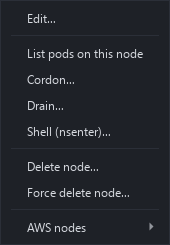
Right-click a node. After the built-in node actions, each plugin adds a submenu (here: Copy instance ID, Open in the EC2 console, Estimate the cost of the selected nodes).
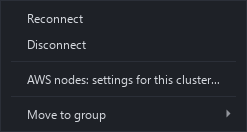
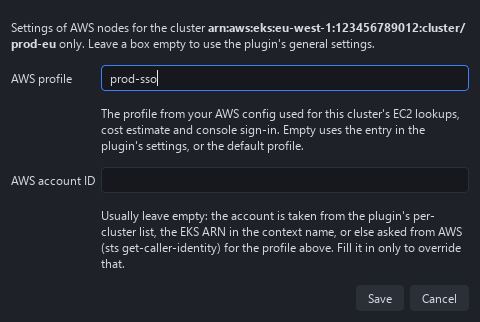
Per-cluster plugin settings. Right-click a connected cluster in the left list, or use the Plugins menu, to open a plugin's settings for that cluster only: here the AWS profile (and, if you need it, the account) for that cluster. The Plugins menu appears only while an enabled plugin has such settings.

Preferences → Plugins. Plugins are off until you tick them here; the page lists what each one adds and its general settings, and applies changes at once.
Requirements
- Python 3.10 or newer
- A kubeconfig with at least one context (or pick one in Edit → Preferences)
kubectlon yourPATH, for drain, shells and attach- Python dependencies (installed by the launchers):
PySide6-Essentials,kubernetes,PyYAML
Install
Native packages are built for Windows (an installer and a portable .zip) and macOS (a .dmg for Apple Silicon and
one for Intel). Version 0.1.0 is on the project's Releases page, with
a SHA256SUMS.txt to check the downloads against. You can also run Klotse from source (below) or build the packages
yourself (see Development).
- The Windows installer has been tested (install, run, uninstall). The macOS apps are built and self-tested in CI, and the 0.1.0 release has been tested on an Apple Silicon Mac (M3 Pro, macOS 26.7.1). The Intel build has not been run on an Intel Mac.
- The packages are not signed yet, so expect a warning on first start: on Windows choose More info → Run anyway, on macOS right-click the app and choose Open.
kubectlis not included and has to be installed separately.
Linux, or anywhere with Python 3.10+: pipx
There is no native Linux package yet. Install with pipx, which keeps Klotse and its
dependencies in their own environment and puts a klotse command on your PATH:
pipx install git+https://github.com/mbartsch/klotse   # straight from GitHub (works today)
pipx install klotse                                   # from PyPI
klotse --install-desktop-entry                        # optional, Linux: add Klotse to the application menu
klotse --uninstall-desktop-entry removes the menu entry again. On a minimal Debian/Ubuntu install Qt may also need
these libraries for its X11 support (the project's CI installs exactly this list on Ubuntu and starts Klotse under
X11); most desktops already have them:
sudo apt install libegl1 libxkbcommon-x11-0 libxcb-cursor0 libxcb-icccm4 libxcb-image0 libxcb-keysyms1 \
  libxcb-randr0 libxcb-render-util0 libxcb-shape0 libxcb-xinerama0 libxcb-xkb1
On other distributions install the equivalent packages. If Klotse stops with "could not load the Qt platform plugin
xcb", run QT_DEBUG_PLUGINS=1 klotse to see which library is missing.
Run
macOS / Linux:
./run.sh              # creates .venv and installs dependencies on first run
./run.sh --check      # check that the imports work, without opening the window
./run.sh --install    # reinstall dependencies
Windows:
run.bat               # starts without a console window
run.bat --console     # keeps tracebacks visible
run.bat --check
run.bat --install
Or, in an existing environment:
pip install -r requirements.txt
PYTHONPATH=src python -m klotse
Configuration
Settings are stored as a plain INI file, one section per resource kind and one entry per line:
[columns.Pod]
order.0=name
order.1=namespace
order.2=ready
hidden.0=cpu_req
hidden.1=cpu_lim
labels.0=app.kubernetes.io/name
labels_name.0=App
labels.1=example.com/team
order is the order of the built-in columns, hidden lists the ones that are hidden, and labels the label
columns; labels_name.N gives labels.N a short heading. A key that is missing means the default; an empty key
(hidden=) means none. You can edit the file by hand while Klotse is closed.
Open its folder from Edit → Preferences… → Open config folder. The same file holds the custom kubeconfig path
and the macOS terminal choice. A custom kubeconfig is passed both to the Kubernetes client and, as --kubeconfig,
to every kubectl command Klotse starts.
Settings from the earlier name of the project (Kubeman) are copied over on the first start.
Development
pip install -r requirements-dev.txt
PYTHONPATH=src QT_QPA_PLATFORM=offscreen python -m pytest -q
Tests run offscreen with fake services and synthetic Kubernetes objects; they never touch a real cluster or your
real settings. run_tests.sh / run_tests.bat wrap the same command.
After all tests pass the pytest process can still exit non-zero (a crash during Qt teardown in some test orders). This is a known, unresolved issue that predates recent work, so check the pass count and the exit status separately.
To build the native packages (details, signing and releases in packaging/README.md):
powershell -ExecutionPolicy Bypass -File packaging\windows\build.ps1   # Windows: zip, plus installer if Inno Setup is installed
packaging/macos/build.sh                                               # macOS: Klotse.app and a .dmg
A packaged app can check itself: Klotse --version and Klotse --self-test [REPORT_FILE]. GitHub Actions builds
everything on a version tag (v0.1.0) or on demand and drafts a release.
AGENTS.md documents the architecture, file map and behavior to preserve; read it before larger
changes. Work goes through pull requests from a branch; do not commit to master directly.
Roadmap
Klotse is written in Python with PySide6 today. The idea is to move to Qt/C++ (or a similar language) at some point. Nothing is decided and there is no timeline; the Python version is the one being developed in the meantime.
License
Klotse is released under the Apache License 2.0.
Kubernetes is a registered trademark of The Linux Foundation. Klotse is an independent project and is not affiliated with or endorsed by The Linux Foundation or the Kubernetes project.
Author
Marcelo H. Bartsch · https://github.com/mbartsch/klotse
1 maintainer

Metadata
1 maintainer
Release files for klotse 0.2.0
For a detailed explanation of source distributions (sdists) and built distributions (wheels), please see the package formats documentation.
Source distribution (sdist)
| File | Size | Uploaded | Provenance | Actions |
|---|---|---|---|---|
| klotse-0.2.0.tar.gz | 558.9 kB | With provenance | Details for klotse-0.2.0.tar.gz |
Built distribution (wheel)
| File | Interpreter | ABI | Platform | Actions Reset |
|---|---|---|---|---|
| klotse-0.2.0-py3-none-any.whl | Python 3 | none | any | Details for klotse-0.2.0-py3-none-any.whl |
Total release size: 1.0 MB
Release files / klotse-0.2.0.tar.gz
| Download URL | klotse-0.2.0.tar.gz |
|---|---|
| Size | 558.9 kB |
| Tags | Source |
|
SHA-256 checksum How to use checksums |
efbc3175aa3d49c60157e0aea69fc5b417b5db99bef900df3743d511cf69a5eb
|
|
BLAKE2b-256 checksum How to use checksums |
3695ba85839f48ad0617cbe14753719f27e5a0e52ba78ef72b15c2e28814cfd5
|
| Upload date | |
|
Uploaded using Trusted Publishing? What is trusted publishing? |
Yes |
| Uploaded via |
twine/7.0.0 CPython/3.13.16
|
Provenance
Provenance describes where a file came from. On PyPI, provenance is shared via attestations, which provide a verifiable record of the build or publishing details. View details, limitations and caveats.


PyPI Publish Attestation
PyPI verified that this artifact, at this checksum, originated from the publisher listed below.
Signed by GitHub Actions, verified by PyPI on Nov 4, 2026.
Transparency logRelease files / klotse-0.2.0-py3-none-any.whl
| Download URL | klotse-0.2.0-py3-none-any.whl |
|---|---|
| Size | 478.3 kB |
| Tags | Python 3 |
|
SHA-256 checksum How to use checksums |
7f7fcce2206ca1ad03c65552f736407daafc3709df0e2d01cc0480faeb7d5a72
|
|
BLAKE2b-256 checksum How to use checksums |
a35f915cd8093f5177009e8d3a03eaa32a7691c83dd041faac92430616ab2d5a
|
| Upload date | |
|
Uploaded using Trusted Publishing? What is trusted publishing? |
Yes |
| Uploaded via |
twine/7.0.0 CPython/3.13.16
|
Provenance
Provenance describes where a file came from. On PyPI, provenance is shared via attestations, which provide a verifiable record of the build or publishing details. View details, limitations and caveats.
PyPI Publish Attestation
PyPI verified that this artifact, at this checksum, originated from the publisher listed below.
Signed by GitHub Actions, verified by PyPI on Nov 4, 2026.
Transparency logSecurity for klotse 0.2.0
Provenance
Provenance describes where a file came from. On PyPI, provenance is shared via attestations, which provide a verifiable record of the build or publishing details. View details, limitations and caveats.
Full provenance
All 2 files in this release have been uploaded with provenance metadata.
Attestation for klotse-0.2.0.tar.gz
PyPI Publish Attestation
PyPI verified that this artifact, at this checksum, originated from the publisher listed below.
Signed by GitHub Actions, verified by PyPI on Nov 4, 2026.
Transparency logA note on package security
PyPI is a repository for distributing packages, not a service for auditing them. While third-party security researchers and our staff do their best to detect and remove malicious packages, PyPI cannot guarantee the quality, security or suitability of any given package.
To learn more about protecting yourself from malicious actors, visit our package security documentation.














