
Hex and square lattice KMC classes.

Project description
kmclab
kmclab is a lightweight Python package providing lattice-based kinetic Monte Carlo (KMC) tools for simulating the surface diffusion of supported metal atoms and small clusters. The framework enables direct extraction of diffusion coefficients from first-principles–derived rate catalogs and includes built-in capabilities for trajectory visualization, mean-squared displacement analysis, and statistical averaging over multiple stochastic realizations.
Lattice classes
kmclab currently provides two primary classes that differ in lattice geometry and site connectivity:
- hexa_kmc : diffusion on a hexagonal lattice
- square_kmc : diffusion on a square lattice
Both classes share an identical workflow and analysis interface, allowing simulations and post-processing routines to be applied consistently across different lattice types.
Core functionality
Each lattice class supports the following diffusion-focused capabilities:
KMC time evolution
- Propagates adatom diffusion using direction-dependent hopping rates
- Supports stoichiometric sites, defective sites (including but not limited to oxygen vacancies and dopants acting as either trapping or blocking defects), and adsorbate-modified sites
Trajectory visualization
Generate animation GIFs of KMC trajectories:
- single-panel: lattice evolution
- two-panel: lattice and MSD vs time evolution
Mean-squared displacement (MSD) analysis and diffusion coefficient calculation
- Compute MSD as a function of time for individual surface realization
- Perform ensemble averaging over multiple stochastic realizations
- Automatically extract diffusion coefficients from the linear (diffusive) MSD regime
Installation
(Optional) Create a new conda environment:
conda create -n test_env python=3.11
conda activate test_env
(Optional) If you use the Spyder IDE you need to also:
conda install spyder-kernels
Install using pip
pip install kmclab
To upgrade to the latest version
pip install -U kmclab
Or you may clone the repository and install in editable mode:
git clone https://github.com/shirinasadix/kmclab.git
cd kmclab
pip install -e .
Usage
Package Structure
kmclab/
├── src/
│   └── kmclab/
│       ├── hexa.py
│       ├── square.py
│       └── __init__.py
├── tests/
├── pyproject.toml
└── README.md
Examples
Minimal Example (Ag monomer diffusion on anatase-TiO2(101) at room temperature)
from kmclab import hexa_kmc

KMC = hexa_kmc(n_atoms = 5, n_defects = 4, n_adsorbates = 4, lattice_size = 10)

KMC.run(n_steps = 100)

KMC.anim1panel()    # Keep `n_steps` for this function relatively small (≈1000), as larger values can significantly increase runtime.
KMC.anim2panel()    # Keep `n_steps` for this function relatively small (≈1000), as larger values can significantly increase runtime.
KMC.msdplot()
Single Run (Visualization)
Here is the step by step guide:
Step 1: Import the KMC class
from kmclab import hexa_kmc         # hexagonal lattice
#from kmclab import square_kmc      # square lattice
Step 2: Define simulation parameters
The parameters set for hexagonal lattice:
hexa_params = {
    # System composition
    'n_atoms': 5,                # Number of mobile adatoms
    'n_defects': 5,              # Number of surface defects
    'n_adsorbates': 5,           # Number of surface adsorbates

    # Lattice and simulation control
    'lattice_size': 10,          # Linear size of the lattice
    'T': 300,                    # Temperature (K)
    'seed': 1,                   # Random number seed

    'len_vertical' : 0.38e-3,    # Vertical lattice hop distances (µm)
    'len_horizontal' : 0.51e-3,  # Horizontal lattice hop distances (µm)
    'adsorbates_freq' : -1,      # Adsorbate redistribution frequency (required only if n_adsorbates > 0) (-1 disables)

    # Defect behavior
    'defect_type': 1,            # 1 = trapping defects, 2 = blocking defects (required only if n_defects > 0 )

    # Kinetic prefactor
    'k_0': 1,

    # Diffusion energy barriers on stoichiometric sites along defferent directions (eV)
    'energy_barrier_north': 0.46,
    'energy_barrier_south': 0.46,
    'energy_barrier_northeast': 0.65,
    'energy_barrier_northwest': 0.65,
    'energy_barrier_southeast': 0.65,
    'energy_barrier_southwest': 0.65,

    # Trapping defect energy barriers (required only if n_defects > 0 and defect_type == 1)
    'energy_barrier_trapping_defect_north': 1.2,
    'energy_barrier_trapping_defect_south': 1.2,
    'energy_barrier_trapping_defect_east': 1.1,
    'energy_barrier_trapping_defect_west': 1.1,
    'energy_barrier_trapping_defect_northeast': 1.1,
    'energy_barrier_trapping_defect_northwest': 1.1,
    'energy_barrier_trapping_defect_southeast': 1.1,
    'energy_barrier_trapping_defect_southwest': 1.1,

    # Blocking defect energy barriers (required only if n_defects > 0 and defect_type == 2)
    'energy_barrier_blocking_defect_north': 1.2,
    'energy_barrier_blocking_defect_south': 1.2,
    'energy_barrier_blocking_defect_northeast': 1.2,
    'energy_barrier_blocking_defect_northwest': 1.2,
    'energy_barrier_blocking_defect_southeast': 1.2,
    'energy_barrier_blocking_defect_southwest': 1.2,

    # Adsorbate-related diffusion barriers (required only if n_adsorbates > 0)
    'energy_barrier_adsorbate_north': 0.72,
    'energy_barrier_adsorbate_south': 0.72,
    'energy_barrier_adsorbate_northeast': 0.72,
    'energy_barrier_adsorbate_northwest': 0.72,
    'energy_barrier_adsorbate_southeast': 0.72,
    'energy_barrier_adsorbate_southwest': 0.72
}
The parameters set for square lattice:
square_params = {

    # System composition
    'n_atoms': 5,                 # Number of mobile adatoms
    'n_defects': 5,               # Number of surface defects
    'n_adsorbates': 5,            # Number of surface adsorbates

    # Lattice and simulation control
    'lattice_size': 10,           # Linear size of the lattice
    'T': 300,                     # Temperature (K)
    'seed': 1,                    # Random number seed

    'len_vertical' : 0.297e-3,    # Vertical lattice hop distances (µm)
    'len_horizontal' : 0.660e-3,  # Horizontal lattice hop distances (µm)
    'adsorbates_freq' : 3,        # Adsorbate redistribution frequency (required only if n_adsorbates > 0) (-1 disables)

    # Defect behavior
    'defect_type': 1,             # 1 = trapping defects, 2 = blocking defects (required only if n_defects > 0 )

    # Kinetic prefactor
    'k_0': 1,

    # Diffusion energy barriers on stoichiometric sites along defferent directions (eV)
    'energy_barrier_north' : 0.26,
    'energy_barrier_south' : 0.26,
    'energy_barrier_east' : 0.91,
    'energy_barrier_west' : 0.91,
    'energy_barrier_northeast' : 0.91,
    'energy_barrier_northwest' : 0.91,
    'energy_barrier_southeast' : 0.91,
    'energy_barrier_southwest' : 0.91,

    # Trapping defect energy barriers (required only if n_defects > 0 and defect_type == 1)
    'energy_barrier_trapping_defect_north' : 0.99,
    'energy_barrier_trapping_defect_south' : 0.99,
    'energy_barrier_trapping_defect_northeast' : 0.99,
    'energy_barrier_trapping_defect_northwest' : 0.99,
    'energy_barrier_trapping_defect_southeast' : 0.99,
    'energy_barrier_trapping_defect_southwest' : 0.99,

    # Blocking defect energy barriers (required only if n_defects > 0 and defect_type == 2)
    'energy_barrier_blocking_defect_north' : 0.99,
    'energy_barrier_blocking_defect_south' : 0.99,
    'energy_barrier_blocking_defect_east' : 0.99,
    'energy_barrier_blocking_defect_west' :0.99,
    'energy_barrier_blocking_defect_northeast' : 0.99,
    'energy_barrier_blocking_defect_northwest' : 0.99,
    'energy_barrier_blocking_defect_southeast' : 0.99,
    'energy_barrier_blocking_defect_southwest' : 0.99,

    # Adsorbate-related diffusion barriers (required only if n_adsorbates > 0)
    'energy_barrier_adsorbate_north' : 0.72,
    'energy_barrier_adsorbate_south' : 0.72,
    'energy_barrier_adsorbate_east' : 0.72,
    'energy_barrier_adsorbate_west' : 0.72,
    'energy_barrier_adsorbate_northeast' : 0.72,
    'energy_barrier_adsorbate_northwest' : 0.72,
    'energy_barrier_adsorbate_southeast' : 0.72,
    'energy_barrier_adsorbate_southwest' : 0.72}
Step 3: Run the KMC simulation
KMC = hexa_kmc(**hexa_params)                                   # hexagonal lattice
KMC.run(n_steps = 100)  # Total KMC steps (must be > 10)        # hexagonal lattice

#KMC = square_kmc(**square_params)                              # square lattice
#KMC.run(n_steps = 100)  # Total KMC steps (must be > 10)       # square lattice
Step 4: Visualize the results
Lattice Evolution Animation
KMC.anim1panel() # Keep `n_steps` for this function relatively small (≈1000), as larger values can significantly increase runtime.
Demo (anim1panel)
Ag monomer diffusion on stoichiometric anatase-TiO2(101)
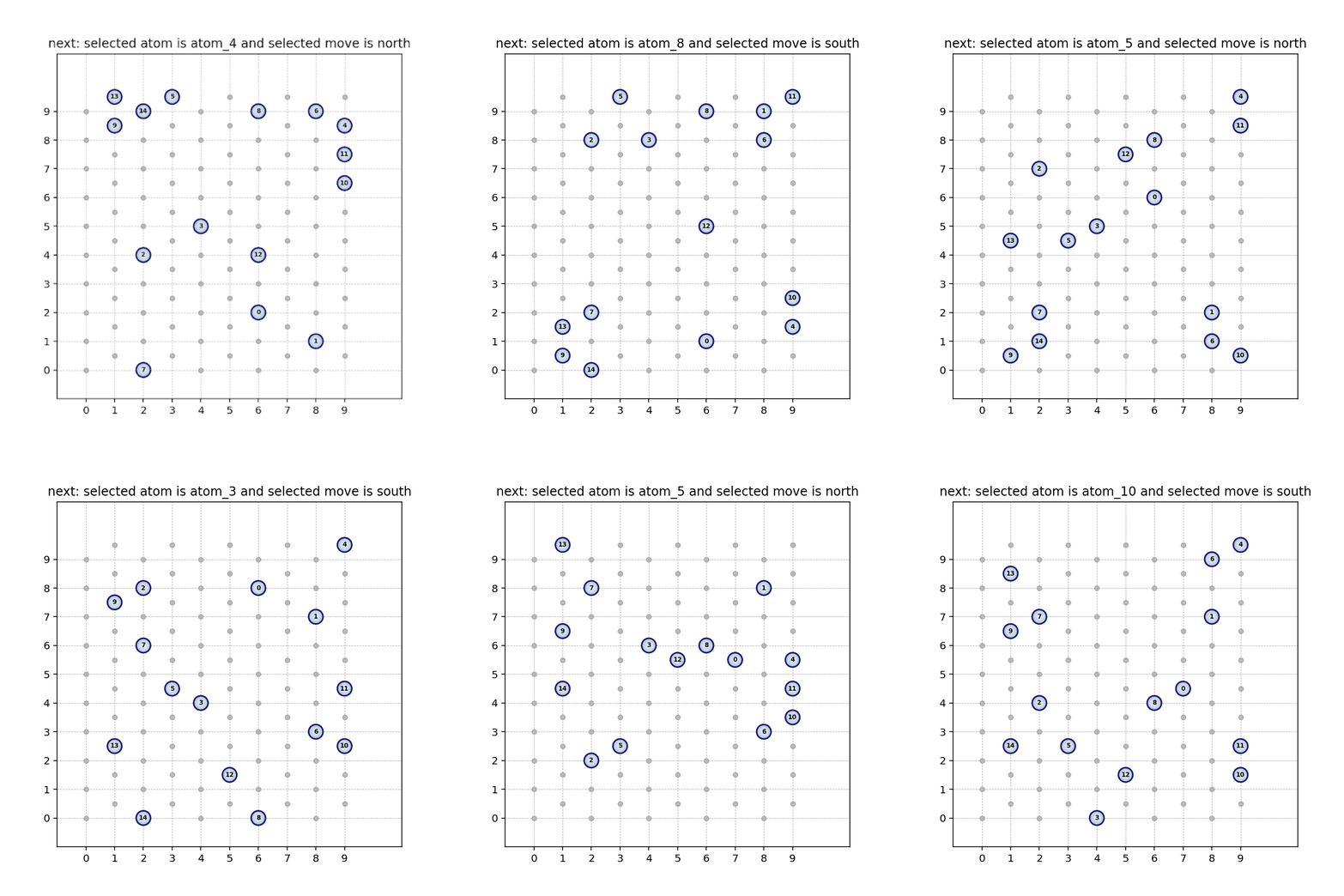
Lattice Evolution + MSD vs Time Evolution Animation
KMC.anim2panel() # Keep `n_steps` relatively small (≈1000), as larger values can significantly increase runtime.
Demo (anim2panel)
Ag monomer diffusion on reduced anatase-TiO2(101)

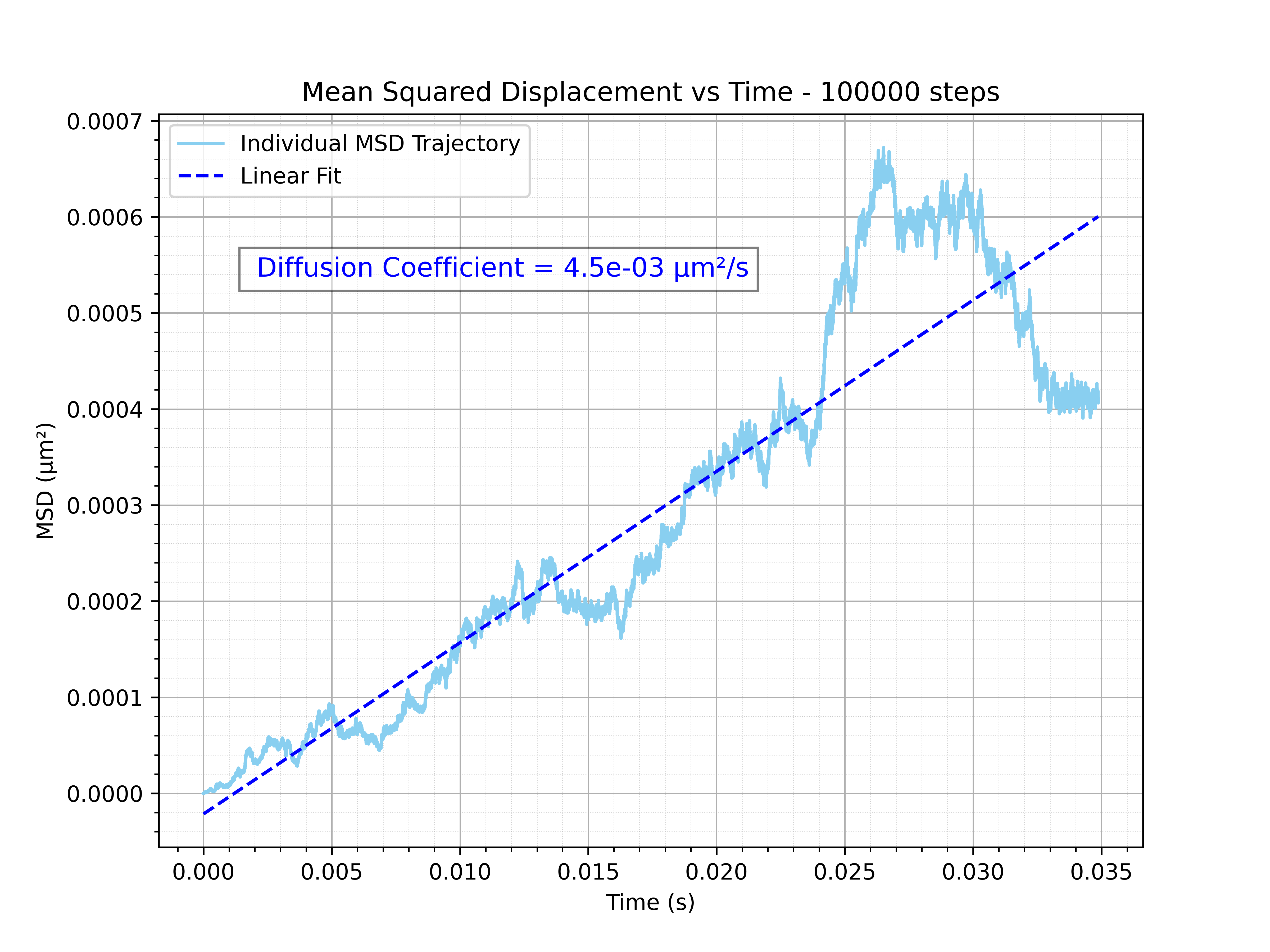
Single-Trajectory MSD vs Time
KMC.msdplot()
Demo (msdplot)
Ag monomer diffusion on stoichiometric anatase-TiO2(101)
Multi Run (Diffusion Coefficient Calculation)
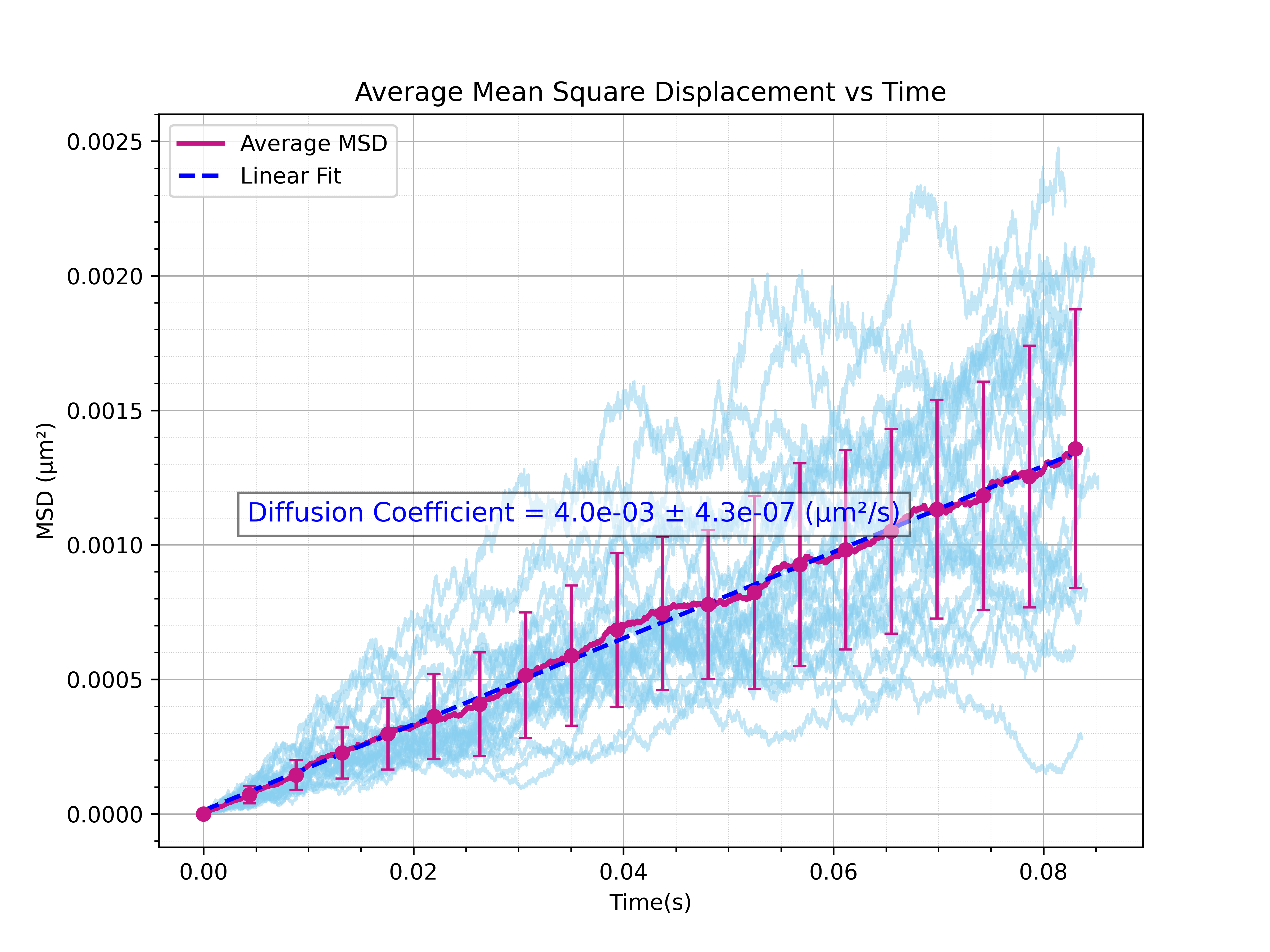
The example below shows how to run multiple independent KMC trajectories on a lattice, average the MSD, and extract the diffusion coefficient.
Step 1: Import and setup output directories
from kmclab import hexa_kmc         # hexagonal lattice
#from kmclab import square_kmc      # square lattice
import numpy as np
from pathlib import Path
import shutil

rs_p = Path("random_seeds")

if rs_p.exists():
    shutil.rmtree(rs_p)

(rs_p / "time").mkdir(parents=True)
(rs_p / "msd").mkdir(parents=True)
Step 2: Define simulation parameters
The parameters set for hexagonal lattice:
hexa_params = {
    # System composition
    'n_atoms': 5,                # Number of mobile adatoms
    'n_defects': 5,              # Number of surface defects
    'n_adsorbates': 5,           # Number of surface adsorbates

    # Lattice and simulation control
    'lattice_size': 10,          # Linear size of the lattice
    'T': 300,                    # Temperature (K)
    'seed': 1,                   # Random number seed

    'len_vertical' : 0.38e-3,    # Vertical lattice hop distances (µm)
    'len_horizontal' : 0.51e-3,  # Horizontal lattice hop distances (µm)
    'adsorbates_freq' : -1,      # Adsorbate redistribution frequency (required only if n_adsorbates > 0) (-1 disables)

    # Defect behavior
    'defect_type': 1,            # 1 = trapping defects, 2 = blocking defects (required only if n_defects > 0 )

    # Kinetic prefactor
    'k_0': 1,

    # Diffusion energy barriers on stoichiometric sites along defferent directions (eV)
    'energy_barrier_north': 0.46,
    'energy_barrier_south': 0.46,
    'energy_barrier_northeast': 0.65,
    'energy_barrier_northwest': 0.65,
    'energy_barrier_southeast': 0.65,
    'energy_barrier_southwest': 0.65,

    # Trapping defect energy barriers (required only if n_defects > 0 and defect_type == 1)
    'energy_barrier_trapping_defect_north': 1.2,
    'energy_barrier_trapping_defect_south': 1.2,
    'energy_barrier_trapping_defect_east': 1.1,
    'energy_barrier_trapping_defect_west': 1.1,
    'energy_barrier_trapping_defect_northeast': 1.1,
    'energy_barrier_trapping_defect_northwest': 1.1,
    'energy_barrier_trapping_defect_southeast': 1.1,
    'energy_barrier_trapping_defect_southwest': 1.1,

    # Blocking defect energy barriers (required only if n_defects > 0 and defect_type == 2)
    'energy_barrier_blocking_defect_north': 1.2,
    'energy_barrier_blocking_defect_south': 1.2,
    'energy_barrier_blocking_defect_northeast': 1.2,
    'energy_barrier_blocking_defect_northwest': 1.2,
    'energy_barrier_blocking_defect_southeast': 1.2,
    'energy_barrier_blocking_defect_southwest': 1.2,

    # Adsorbate-related diffusion barriers (required only if n_adsorbates > 0)
    'energy_barrier_adsorbate_north': 0.72,
    'energy_barrier_adsorbate_south': 0.72,
    'energy_barrier_adsorbate_northeast': 0.72,
    'energy_barrier_adsorbate_northwest': 0.72,
    'energy_barrier_adsorbate_southeast': 0.72,
    'energy_barrier_adsorbate_southwest': 0.72
}
The parameters set for square lattice:
square_params = {

    # System composition
    'n_atoms': 5,                 # Number of mobile adatoms
    'n_defects': 5,               # Number of surface defects
    'n_adsorbates': 5,            # Number of surface adsorbates

    # Lattice and simulation control
    'lattice_size': 10,           # Linear size of the lattice
    'T': 300,                     # Temperature (K)
    'seed': 1,                    # Random number seed

    'len_vertical' : 0.297e-3,    # Vertical lattice hop distances (µm)
    'len_horizontal' : 0.660e-3,  # Horizontal lattice hop distances (µm)
    'adsorbates_freq' : 3,        # Adsorbate redistribution frequency (required only if n_adsorbates > 0) (-1 disables)

    # Defect behavior
    'defect_type': 1,             # 1 = trapping defects, 2 = blocking defects (required only if n_defects > 0 )

    # Kinetic prefactor
    'k_0': 1,

    # Diffusion energy barriers on stoichiometric sites along defferent directions (eV)
    'energy_barrier_north' : 0.26,
    'energy_barrier_south' : 0.26,
    'energy_barrier_east' : 0.91,
    'energy_barrier_west' : 0.91,
    'energy_barrier_northeast' : 0.91,
    'energy_barrier_northwest' : 0.91,
    'energy_barrier_southeast' : 0.91,
    'energy_barrier_southwest' : 0.91,

    # Trapping defect energy barriers (required only if n_defects > 0 and defect_type == 1)
    'energy_barrier_trapping_defect_north' : 0.99,
    'energy_barrier_trapping_defect_south' : 0.99,
    'energy_barrier_trapping_defect_northeast' : 0.99,
    'energy_barrier_trapping_defect_northwest' : 0.99,
    'energy_barrier_trapping_defect_southeast' : 0.99,
    'energy_barrier_trapping_defect_southwest' : 0.99,

    # Blocking defect energy barriers (required only if n_defects > 0 and defect_type == 2)
    'energy_barrier_blocking_defect_north' : 0.99,
    'energy_barrier_blocking_defect_south' : 0.99,
    'energy_barrier_blocking_defect_east' : 0.99,
    'energy_barrier_blocking_defect_west' :0.99,
    'energy_barrier_blocking_defect_northeast' : 0.99,
    'energy_barrier_blocking_defect_northwest' : 0.99,
    'energy_barrier_blocking_defect_southeast' : 0.99,
    'energy_barrier_blocking_defect_southwest' : 0.99,

    # Adsorbate-related diffusion barriers (required only if n_adsorbates > 0)
    'energy_barrier_adsorbate_north' : 0.72,
    'energy_barrier_adsorbate_south' : 0.72,
    'energy_barrier_adsorbate_east' : 0.72,
    'energy_barrier_adsorbate_west' : 0.72,
    'energy_barrier_adsorbate_northeast' : 0.72,
    'energy_barrier_adsorbate_northwest' : 0.72,
    'energy_barrier_adsorbate_southeast' : 0.72,
    'energy_barrier_adsorbate_southwest' : 0.72}
Step 3: Run multiple KMC trajectories
n_seeds = 25                     # Number of trials
for i in range(n_seeds):

    hexa_params['seed'] = i                  # hexagonal lattice
    print(f'current random_seed = {i}')      # hexagonal lattice
    KMC = hexa_kmc(**hexa_params)            # hexagonal lattice

    #square_params['seed'] = i               # square lattice
    #print(f'current random_seed = {i}')     # square lattice
    #KMC = square_kmc(**square_params)       # square lattice

    time, msd = KMC.run(n_steps = 2500)

    msd_path = f'random_seeds/msd/rs_{i}'
    time_path = f'random_seeds/time/rs_{i}'
    np.save(msd_path, msd)
    np.save(time_path, time)

KMC.msd_histogram(n_seeds = n_seeds)
Demo
Ag monomer diffusion on stoichiometric anatase-TiO2(101)
License
MIT License

Copyright (c) 2026 Shirin Asadi

Permission is hereby granted, free of charge, to any person obtaining a copy of this software and associated documentation files (the "Software"), to deal in the Software without restriction, including without limitation the rights to use, copy, modify, merge, publish, distribute, sublicense, and/or sell copies of the Software, and to permit persons to whom the Software is furnished to do so, subject to the following conditions:
The above copyright notice and this permission notice shall be included in all copies or substantial portions of the Software.

THE SOFTWARE IS PROVIDED "AS IS", WITHOUT WARRANTY OF ANY KIND, EXPRESS OR IMPLIED, INCLUDING BUT NOT LIMITED TO THE WARRANTIES OF MERCHANTABILITY,
FITNESS FOR A PARTICULAR PURPOSE AND NONINFRINGEMENT. IN NO EVENT SHALL THE AUTHORS OR COPYRIGHT HOLDERS BE LIABLE FOR ANY CLAIM, DAMAGES OR OTHER
LIABILITY, WHETHER IN AN ACTION OF CONTRACT, TORT OR OTHERWISE, ARISING FROM, OUT OF OR IN CONNECTION WITH THE SOFTWARE OR THE USE OR OTHER DEALINGS IN THE SOFTWARE.
Release history Release notifications | RSS feed


Download files
Download the file for your platform. If you're not sure which to choose, learn more about installing packages.
Source Distribution
Built Distribution
Filter files by name, interpreter, ABI, and platform.
If you're not sure about the file name format, learn more about wheel file names.
Copy a direct link to the current filters
File details
Details for the file kmclab-0.1.12.tar.gz.
File metadata
- Download URL: kmclab-0.1.12.tar.gz
- Upload date:
- Size: 27.0 kB
- Tags: Source
- Uploaded using Trusted Publishing? Yes
- Uploaded via: twine/6.1.0 CPython/3.13.7
File hashes
| Algorithm | Hash digest | |
|---|---|---|
| SHA256 |
8cd02e3a8a23d6c47ff56d42ee4e898162b7d50ec224eb68064098bca9d84ac4
|
|
| MD5 |
164bcb9d56d96c8daa8fe2cb6fce2025
|
|
| BLAKE2b-256 |
7295a3ee961bb50b5e8a6668b7e45760615c7461ddfa33371fb63747809557b4
|
Provenance
The following attestation bundles were made for kmclab-0.1.12.tar.gz:
Publisher:
publish.yml on shirinasadix/kmclab
-
Statement:
-
Statement type:
https://in-toto.io/Statement/v1 -
Predicate type:
https://docs.pypi.org/attestations/publish/v1 -
Subject name:
kmclab-0.1.12.tar.gz -
Subject digest:
8cd02e3a8a23d6c47ff56d42ee4e898162b7d50ec224eb68064098bca9d84ac4 - Sigstore transparency entry: 942367241
- Sigstore integration time:
-
Permalink:
shirinasadix/kmclab@ddb5f16b0c8191ce4c3422c0a04f177e1ae496b1 -
Branch / Tag:
refs/tags/v0.1.12 - Owner: https://github.com/shirinasadix
-
Access:
public
-
Token Issuer:
https://token.actions.githubusercontent.com -
Runner Environment:
github-hosted -
Publication workflow:
publish.yml@ddb5f16b0c8191ce4c3422c0a04f177e1ae496b1 -
Trigger Event:
release
-
Statement type:
File details
Details for the file kmclab-0.1.12-py3-none-any.whl.
File metadata
- Download URL: kmclab-0.1.12-py3-none-any.whl
- Upload date:
- Size: 23.4 kB
- Tags: Python 3
- Uploaded using Trusted Publishing? Yes
- Uploaded via: twine/6.1.0 CPython/3.13.7
File hashes
| Algorithm | Hash digest | |
|---|---|---|
| SHA256 |
7fdf9d483198bb5107044dcc89043d81526d3b06786b4ab7b22454c694643186
|
|
| MD5 |
0c05aa744938a216b9d340b62ffbfc1e
|
|
| BLAKE2b-256 |
9e365954fe9c13033f649b4e790574da7ea432014897cdadd7eef3f25251db94
|
Provenance
The following attestation bundles were made for kmclab-0.1.12-py3-none-any.whl:
Publisher:
publish.yml on shirinasadix/kmclab
-
Statement:
-
Statement type:
https://in-toto.io/Statement/v1 -
Predicate type:
https://docs.pypi.org/attestations/publish/v1 -
Subject name:
kmclab-0.1.12-py3-none-any.whl -
Subject digest:
7fdf9d483198bb5107044dcc89043d81526d3b06786b4ab7b22454c694643186 - Sigstore transparency entry: 942367251
- Sigstore integration time:
-
Permalink:
shirinasadix/kmclab@ddb5f16b0c8191ce4c3422c0a04f177e1ae496b1 -
Branch / Tag:
refs/tags/v0.1.12 - Owner: https://github.com/shirinasadix
-
Access:
public
-
Token Issuer:
https://token.actions.githubusercontent.com -
Runner Environment:
github-hosted -
Publication workflow:
publish.yml@ddb5f16b0c8191ce4c3422c0a04f177e1ae496b1 -
Trigger Event:
release
-
Statement type:






