
KMNet: Discrete-Time Survival Analysis with Deep Learning
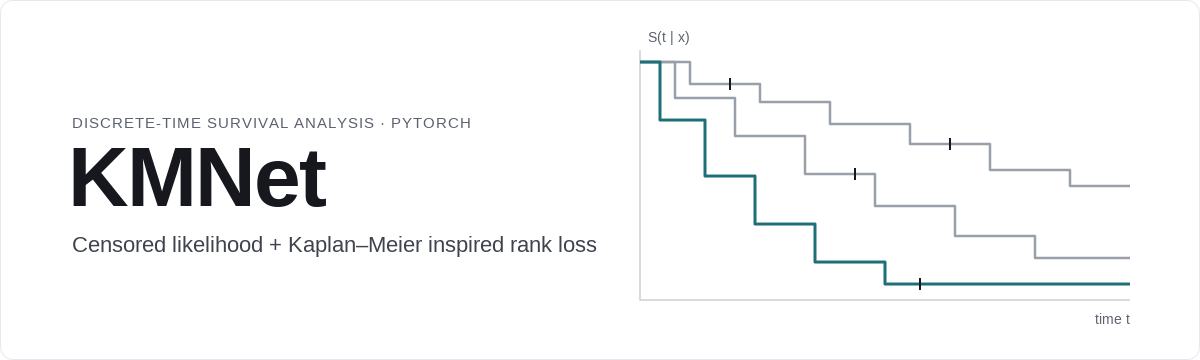
⚡ State-of-the-art survival analysis with deep learning and ranking losses ⚡
Documentation • Features • Installation • Quick Start • Demo Notebook • Citation





🎯 Use Cases & Applications
KMNet combines the power of deep neural networks with Kaplan-Meier inspired ranking losses to deliver state-of-the-art performance in discrete-time survival analysis. Perfect for clinical research, reliability engineering, and time-to-event prediction.
It extends standard neural survival models by incorporating a novel Kaplan-Meier inspired rank loss, allowing the model to learn not just from local hazard rates but also from global ranking constraints inherent in survival data.
This library provides a high-performance implementation using PyTorch JIT to speed up custom loss calculations, making it suitable for large-scale survival datasets.
🚀 Key Features
📊 Why KMNet?
| Feature | Traditional Methods | DeepSurv/Cox-PH | KMNet |
|---|---|---|---|
| Handles Non-Linear Effects | ❌ | ✅ | ✅ |
| Captures Ranking Information | ⚠️ Partial | ❌ | ✅ |
| Discrete Time Bins | ❌ | ❌ | ✅ |
| GPU Acceleration | ❌ | ✅ | ✅ |
| Flexible Loss Functions | ❌ | ⚠️ Limited | ✅ |
| JIT-Optimized | N/A | ❌ | ✅ |
📦 Installation
pip install kmnet
Or install the latest development version from source:
git clone https://github.com/yuvrajiro/KMNet.git
cd KMNet
pip install -e ".[dev]"
Requirements
- Python >= 3.8
- PyTorch >= 1.7.0
- NumPy, Pandas
- torchtuples
- pycox
- numba
⚡ Quick Start
Here is a complete example of how to use KMNet on a synthetic dataset. You can also check out the interactive demo notebook and the full documentation.
1. Data Preparation
KMNet requires the target variable (time and event) to be discretized. We use label_transforms from pycox for this.
import numpy as np
import pandas as pd
from kmnet.model import KMNet

# Generate synthetic data
def make_data(n=1000):
    X = np.random.randn(n, 5).astype('float32')
    T = np.random.exponential(1 / (0.1 * np.exp(0.5 * X[:, 0])))
    C = np.random.exponential(1 / 0.05, size=n)
    time = np.minimum(T, C)
    event = (T <= C).astype('float32')
    return X, time, event

X, time, event = make_data()

# Discretize time into 20 bins
num_durations = 20
labtrans = KMNet.label_transform(num_durations)
get_target = lambda df: (df['duration'].values, df['event'].values)

df = pd.DataFrame({'duration': time, 'event': event})
y = labtrans.fit_transform(*get_target(df))
2. Define the Neural Network
You can use any PyTorch network architecture. The output dimension must match the number of time bins.
import torch.nn as nn

in_features = X.shape[1]
out_features = labtrans.out_features

net = nn.Sequential(
    nn.Linear(in_features, 32),
    nn.ReLU(),
    nn.Linear(32, 32),
    nn.ReLU(),
    nn.Linear(32, out_features)
)
3. Train the Model
Initialize KMNet and fit it to the data.
# Initialize model with the discretized time grid
model = KMNet(net, duration_index=labtrans.cuts)

# Train
batch_size = 64
epochs = 10
model.fit(X, y, batch_size, epochs, verbose=True)
4. Prediction and Visualization
Predict survival functions and plot them.
import matplotlib.pyplot as plt

# Predict survival probabilities for the first 5 samples
surv_df = model.predict_surv_df(X[:5])

# Plot
plt.figure(figsize=(10, 6))
for col in surv_df.columns:
    plt.step(surv_df.index, surv_df[col], where="post")
plt.ylabel("Survival Probability")
plt.xlabel("Time")
plt.title("Predicted Survival Curves")
plt.show()
🔬 Mathematical Background
KMNet models the discrete conditional survival $p(t | x)$. The survival function is given by:
$$ \boxed{S(t | x) = \prod_{k=0}^{t} p(k | x)} $$
The loss function $\mathcal{L}$ is a weighted sum of two components:
$$ \boxed{\mathcal{L} = \alpha \mathcal{L}{bce} + (1 - \alpha)\lambda \mathcal{L}{Rank}} $$
📖 Click to expand detailed explanation
Loss Components
-
$\mathcal{L}_{bce}$ (Censored likelihood, masked BCE):
- Standard survival loss for discrete time
- Ensures the model fits the observed event times
- Handles censored data correctly
-
$\mathcal{L}_{Rank}$ (Rank Loss):
- Enforces correct ordering: $S(T_i | x_i) < S(T_i | x_j)$ if $T_i < T_j$
- Inspired by the Kaplan-Meier estimator
- Maintains global structure of survival curves
- Differentiable approximation using softplus/exponential penalties
📊 Performance & Optimization
⚡ Speed Benchmarks
The KMNet class leverages TorchScript (JIT) to compile the custom loss functions, eliminating Python interpreter overhead.
|
Benchmark Setup:
Results: |
Scalability:
Tested on Intel i7, 16GB RAM |
🛠️ Advanced Configuration
You can customize the loss function parameters when initializing the model:
alpha(default 0.9): weight on the likelihood;1 - alphagoes to the rank lossrank_weight(default 0.25) andsigma(default'auto'): strength and softness of the ranking penaltyrank_penalty: 'softplus' or 'exp' for the ranking loss formulation
from kmnet.model import KMLoss

loss = KMLoss(
    alpha=0.9,              # Weight for likelihood vs rank loss
    sigma='auto',           # Softness of the ranking penalty
    rank_weight=0.25,       # Extra weight on the rank loss
    rank_penalty='softplus' # 'softplus' or 'exp'
)

model = KMNet(net, loss=loss, duration_index=labtrans.cuts)
💬 Getting Help
- 📖 Documentation: kmnet.statml.in (quickstart, method, API reference)
- 💡 Issues: Found a bug? Open an issue
- 💬 Discussions: Have questions? Start a discussion
- 📧 Email: For collaboration inquiries: rahul@statml.in
🤝 Contributing
We welcome contributions! KMNet is an open-source research project.
How to contribute
- Fork the repository
- Create your feature branch (
git checkout -b feature/AmazingFeature) - Commit your changes (
git commit -m 'Add some AmazingFeature') - Push to the branch (
git push origin feature/AmazingFeature) - Open a Pull Request
Areas we'd love help with:
- 📝 Documentation improvements
- 🧪 Additional benchmarks and examples
- 🐛 Bug fixes and testing
- ✨ New features (e.g., competing risks, time-varying covariates)
📄 License
Distributed under the MIT License. See LICENSE for more information.
📚 Citation
KMNet accompanies a paper under review at TMLR (OpenReview). If you use KMNet in your research, please cite:
@article{anonymous2026deep,
  title   = {Deep Discrete-Time Survival Analysis with Guaranteed Monotonicity},
  author  = {Anonymous},
  journal = {Submitted to Transactions on Machine Learning Research},
  year    = {2026},
  url     = {https://openreview.net/forum?id=VXIk9iY10Q},
  note    = {Under review}
}
🏆 Acknowledgments
KMNet builds upon excellent work from:
- PyCox for survival analysis utilities
- TorchTuples for training infrastructure
- The PyTorch team for JIT compilation capabilities
Built with ❤️ for the survival analysis community
⭐ Star us on GitHub if KMNet helps your research!
1 maintainer

Metadata
1 maintainer
Release files for kmnet 0.3.1
For a detailed explanation of source distributions (sdists) and built distributions (wheels), please see the package formats documentation.
Source distribution (sdist)
| File | Size | Uploaded | Provenance | Actions |
|---|---|---|---|---|
| kmnet-0.3.1.tar.gz | 74.0 kB | Without provenance | Details for kmnet-0.3.1.tar.gz |
Built distribution (wheel)
| File | Interpreter | ABI | Platform | Actions Reset |
|---|---|---|---|---|
| kmnet-0.3.1-py3-none-any.whl | Python 3 | none | any | Details for kmnet-0.3.1-py3-none-any.whl |
Total release size: 86.0 kB
Release files / kmnet-0.3.1.tar.gz
| Download URL | kmnet-0.3.1.tar.gz |
|---|---|
| Size | 74.0 kB |
| Tags | Source |
|
SHA-256 checksum How to use checksums |
21924bdfbd7424ca8821dbe5b020f274b75ac70fe0d9d8e04a0ce43162925955
|
|
BLAKE2b-256 checksum How to use checksums |
cb05ecde3906b67fb91db974fde9cbdb43d4ddabcfb3546bc512aa53bd1a52bc
|
| Upload date | |
|
Uploaded using Trusted Publishing? What is trusted publishing? |
No |
| Uploaded via |
twine/7.0.0 CPython/3.13.14
|
Release files / kmnet-0.3.1-py3-none-any.whl
| Download URL | kmnet-0.3.1-py3-none-any.whl |
|---|---|
| Size | 12.0 kB |
| Tags | Python 3 |
|
SHA-256 checksum How to use checksums |
14e9fe0f062df0d96fdc82d6699ffef17c092ad41c434685481b96873f5409dd
|
|
BLAKE2b-256 checksum How to use checksums |
8c108c29ffb3d7f9bf9c80a114ff03d3ee972b1e2d744567dce1f2b5dbf9527d
|
| Upload date | |
|
Uploaded using Trusted Publishing? What is trusted publishing? |
No |
| Uploaded via |
twine/7.0.0 CPython/3.13.14
|
Security for kmnet 0.3.1
Provenance
Provenance describes where a file came from. On PyPI, provenance is shared via attestations, which provide a verifiable record of the build or publishing details. View details, limitations and caveats.
No provenance found
None of the files in this release were uploaded with provenance metadata.
A note on package security
PyPI is a repository for distributing packages, not a service for auditing them. While third-party security researchers and our staff do their best to detect and remove malicious packages, PyPI cannot guarantee the quality, security or suitability of any given package.
To learn more about protecting yourself from malicious actors, visit our package security documentation.













