
A CLI text-to-speech tool using the Kokoro model, supporting multiple languages, voices (with advanced multi-voice blending), and various input formats including EPUB books and PDF documents.

Project description
Kokoro Desktop
A CLI text-to-speech tool using the Kokoro model, supporting multiple languages, voices (with advanced multi-voice blending), and various input formats including EPUB books and PDF documents.
Features
- Multiple language and voice support
- Advanced multi-voice blending with customizable weights (3+ voices)
- EPUB, PDF and TXT file input support
- Standard input (stdin) and
|piping from other programs - Streaming audio playback
- Split output into chapters
- Adjustable speech speed
- WAV and MP3 output formats
- Chapter merging capability
- Detailed debug output option
- GPU Support
- Graphical User Interface (GUI) for easy access
- Web-based GUI with modern interface
Demo
Kokoro Desktop is an open-source CLI tool that delivers high-quality text-to-speech right from your terminal. Think of it as your personal voice studio, capable of transforming any text into natural-sounding speech with minimal effort.
https://github.com/user-attachments/assets/8413e640-59e9-490e-861d-49187e967526
Demo Audio (MP3) | Demo Audio (WAV)
TODO
- Add GPU support
- Add PDF support
- Add multi-voice blending (3+ voices)
- Add GUI
Prerequisites
- Python 3.9-3.12 (Python 3.13+ is not currently supported)
Installation
Method 1: Install from PyPI (Recommended)
The easiest way to install Kokoro Desktop is from PyPI:
# Using uv (recommended)
uv tool install kokoro-desktop

# Using pip
pip install kokoro-desktop
After installation, you can run:
- Command line:
kokoro-desktop --help - Desktop GUI:
kokoro-desktop-gui - Web GUI:
kokoro-web
Method 2: Install from Git
Install directly from the repository:
# Using uv (recommended)
uv tool install git+https://github.com/gondaliyashreyan1/Kokoro-Desktop

# Using pip
pip install git+https://github.com/gondaliyashreyan1/Kokoro-Desktop
Method 3: Clone and Install Locally
- Clone the repository:
git clone https://github.com/gondaliyashreyan1/Kokoro-Desktop.git
cd Kokoro-Desktop
- Install the package:
With uv (recommended):
uv venv
uv pip install -e .
With pip:
python -m venv .venv
source .venv/bin/activate  # On Windows: .venv\Scripts\activate
pip install -e .
- Run the tool:
# If using uv
uv run kokoro-desktop --help

# If using pip with activated venv
kokoro-desktop --help
Method 4: Run Without Installation
If you prefer to run without installing:
- Clone the repository:
git clone https://github.com/gondaliyashreyan1/Kokoro-Desktop.git
cd Kokoro-Desktop
- Install dependencies only:
With uv:
uv venv
uv sync
With pip:
python -m venv .venv
source .venv/bin/activate  # On Windows: .venv\Scripts\activate
pip install -r requirements.txt
- Run directly:
# With uv
uv run -m kokoro_tts --help

# With pip (venv activated)
python -m kokoro_tts --help
Download Model Files
After installation, download the required model files to your working directory:
# Download voice data (bin format is preferred)
wget https://github.com/nazdridoy/kokoro-tts/releases/download/v1.0.0/voices-v1.0.bin

# Download the model
wget https://github.com/nazdridoy/kokoro-tts/releases/download/v1.0.0/kokoro-v1.0.onnx
The script requires
voices-v1.0.binandkokoro-v1.0.onnxto be present in the same directory where you run thekokoro-desktopcommand.
Supported voices:
| Category | Voices | Language Code |
|---|---|---|
| 🇺🇸 👩 | af_alloy, af_aoede, af_bella, af_heart, af_jessica, af_kore, af_nicole, af_nova, af_river, af_sarah, af_sky | en-us |
| 🇺🇸 👨 | am_adam, am_echo, am_eric, am_fenrir, am_liam, am_michael, am_onyx, am_puck | en-us |
| 🇬🇧 | bf_alice, bf_emma, bf_isabella, bf_lily, bm_daniel, bm_fable, bm_george, bm_lewis | en-gb |
| 🇫🇷 | ff_siwis | fr-fr |
| 🇮🇹 | if_sara, im_nicola | it |
| 🇯🇵 | jf_alpha, jf_gongitsune, jf_nezumi, jf_tebukuro, jm_kumo | ja |
| 🇨🇳 | zf_xiaobei, zf_xiaoni, zf_xiaoxiao, zf_xiaoyi, zm_yunjian, zm_yunxi, zm_yunxia, zm_yunyang | cmn |
Usage
Basic Usage
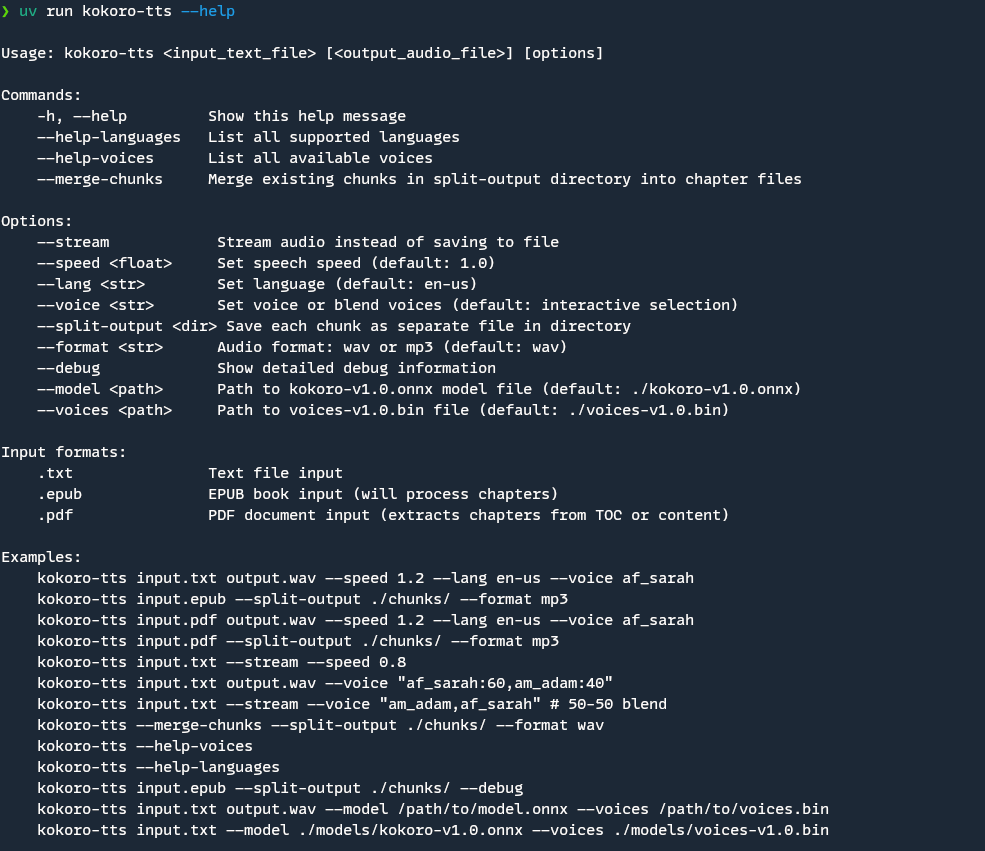
kokoro-desktop <input_text_file> [<output_audio_file>] [options]
[!NOTE]
- If you installed via Method 1 (PyPI) or Method 2 (git install), use
kokoro-desktopdirectly- If you installed via Method 3 (local install), use
uv run kokoro-desktopor activate your virtual environment first- If you're using Method 4 (no install), use
uv run -m kokoro_ttsorpython -m kokoro_ttswith activated venv
Commands
-h, --help: Show help message--help-languages: List supported languages--help-voices: List available voices--merge-chunks: Merge existing chunks into chapter files
Options
--stream: Stream audio instead of saving to file--speed <float>: Set speech speed (default: 1.0)--lang <str>: Set language (default: en-us)--voice <str>: Set voice or blend voices (default: interactive selection)- Single voice: Use voice name (e.g., "af_sarah")
- Blended voices: Use "voice1:weight,voice2:weight" format for 2-way blend
- Multi-way blended voices: Use "voice1:weight,voice2:weight,voice3:weight,..." format for 3+ way blends
--split-output <dir>: Save each chunk as separate file in directory--format <str>: Audio format: wav or mp3 (default: wav)--debug: Show detailed debug information during processing
Input Formats
.txt: Text file input.epub: EPUB book input (will process chapters).pdf: PDF document input (extracts chapters from TOC or content)-or/dev/stdin(Linux/macOS) orCONIN$(Windows): Standard input (stdin)
Examples
# Basic usage with output file
kokoro-desktop input.txt output.wav --speed 1.2 --lang en-us --voice af_sarah

# Read from standard input (stdin)
echo "Hello World" | kokoro-desktop - --stream
cat input.txt | kokoro-desktop - output.wav

# Cross-platform stdin support:
# Linux/macOS: echo "text" | kokoro-desktop - --stream
# Windows: echo "text" | kokoro-desktop - --stream
# All platforms also support: kokoro-desktop /dev/stdin --stream (Linux/macOS) or kokoro-desktop CONIN$ --stream (Windows)

# Use voice blending (60-40 mix)
kokoro-desktop input.txt output.wav --voice "af_sarah:60,am_adam:40"

# Use equal voice blend (50-50)
kokoro-desktop input.txt --stream --voice "am_adam,af_sarah"

# Use multi-way voice blend (40-35-25 mix of three voices)
kokoro-desktop input.txt --stream --voice "am_adam:40,af_sarah:35,bf_emma:25"

# Use 4-way voice blend (30-25-25-20 mix of four voices)
kokoro-desktop input.txt --stream --voice "am_adam:30,af_sarah:25,bf_emma:25,zf_xiaoxiao:20"

# Launch Desktop GUI
kokoro-desktop-gui

# Launch Web GUI
kokoro-web
[!TIP] If you're using Method 3, replace
kokoro-desktopwithuv run kokoro-desktopin the examples above. If you're using Method 4, replacekokoro-desktopwithuv run -m kokoro_ttsorpython -m kokoro_ttsin the examples above.
Features in Detail
EPUB Processing
- Automatically extracts chapters from EPUB files
- Preserves chapter titles and structure
- Creates organized output for each chapter
- Detailed debug output available for troubleshooting
Audio Processing
- Chunks long text into manageable segments
- Supports streaming for immediate playback
- Voice blending with customizable mix ratios (now supports 3+ voices)
- Progress indicators for long processes
- Handles interruptions gracefully
Output Options
- Single file output
- Split output with chapter organization
- Chunk merging capability
- Multiple audio format support
Debug Mode
- Shows detailed information about file processing
- Displays NCX parsing details for EPUB files
- Lists all found chapters and their metadata
- Helps troubleshoot processing issues
Input Options
- Text file input (.txt)
- EPUB book input (.epub)
- PDF document input (.pdf)
- Standard input (stdin)
- Supports piping from other programs
Contributing
This is a personal project. But if you want to contribute, please feel free to submit a Pull Request.
License
This project is licensed under the MIT License. See the LICENSE file for details.
Acknowledgments
Changelog
Version 2.4.0
- Added support for multi-voice blending (3+ voices)
- Enhanced voice blending algorithm to support unlimited voice combinations
- Updated documentation to reflect new multi-voice capabilities
- Rebranded from Kokoro TTS to Kokoro Desktop
Version 2.4.1
- Added desktop GUI for easy access
- Added web-based GUI with modern interface
- Fixed voice processing for multi-voice blending
- Implemented automatic weight normalization
Version 2.4.4
- Added ASCII art logo with rich formatting
- Added version variable for easier updates
- Included rich as dependency for enhanced visuals
Version 2.4.5
- Added API endpoints for custom emotions and audio effects
- Added support for registering custom emotion profiles
- Added support for registering custom audio effects
- Added comprehensive preset management system
- Added advanced speaker detection and voice assignment
- Added model parameter access API
- Added comprehensive testing suite
Version 2.4.6
- Added emotion controls to the web GUI
- Added audio effect controls to the web GUI
- Enhanced web interface with emotion and effect selectors
- Improved user experience with visual feedback for emotion/effect settings
Version 2.4.7
- Replaced emotion controls with speed multiplier controls (since the model only supports speed changes)
- Added comprehensive web application with full-featured dashboard
- Enhanced UI with tabbed interface and professional layout
- Added real-time model status monitoring
- Improved voice blending controls with dynamic addition/removal
- Added command: kokoro-app for the enhanced web application
Release history Release notifications | RSS feed

Download files
Download the file for your platform. If you're not sure which to choose, learn more about installing packages.
Source Distribution
Built Distribution
Filter files by name, interpreter, ABI, and platform.
If you're not sure about the file name format, learn more about wheel file names.
Copy a direct link to the current filters
File details
Details for the file kokoro_desktop-2.4.7.tar.gz.
File metadata
- Download URL: kokoro_desktop-2.4.7.tar.gz
- Upload date:
- Size: 1.2 MB
- Tags: Source
- Uploaded using Trusted Publishing? No
- Uploaded via: twine/6.2.0 CPython/3.12.3
File hashes
| Algorithm | Hash digest | |
|---|---|---|
| SHA256 |
faa641acfe2a71a45a704716d2165592c8e8cc0c105ec297f094442bc997d9af
|
|
| MD5 |
4c84476463c4f50752fe51429bae6c9c
|
|
| BLAKE2b-256 |
7de397a4275570d9c5fa839d8f9f84345a3e16e326e2fdb5977c5ac7fe3e5194
|
File details
Details for the file kokoro_desktop-2.4.7-py3-none-any.whl.
File metadata
- Download URL: kokoro_desktop-2.4.7-py3-none-any.whl
- Upload date:
- Size: 41.6 kB
- Tags: Python 3
- Uploaded using Trusted Publishing? No
- Uploaded via: twine/6.2.0 CPython/3.12.3
File hashes
| Algorithm | Hash digest | |
|---|---|---|
| SHA256 |
dadc958f521c4ed6af69d5bc2b0dd7ff5ee7400b7c238ed33da4f0e0a190f5fe
|
|
| MD5 |
7220c5d8a4f2fad6e4e28b172906bb8d
|
|
| BLAKE2b-256 |
071af2e377e1c52679ad779e476c00f7136739e098b35ed1bf605720343f5e76
|






