
Medical-imaging workflows, executable end to end
From images on disk to reproducible experiments, production inference, and reusable clinical applications.





Quickstart · See it on real data · Large images · Bring PyTorch or MONAI · Ship an App · Automate with MCP · KonfAI Studio
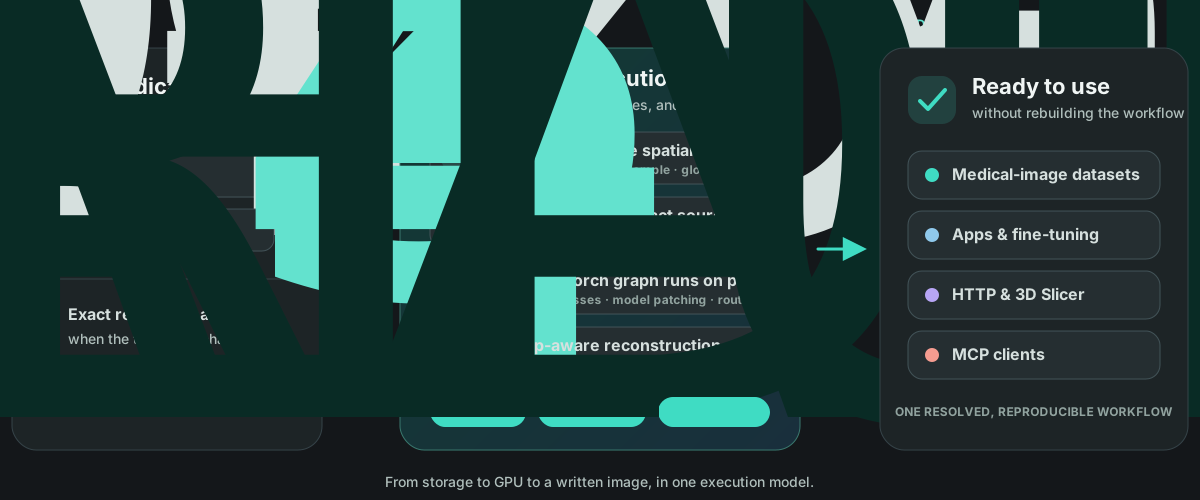
KonfAI is a declarative medical-imaging execution engine. It turns a reproducible research workflow into patch-native training, complete medical-image inference, and a reusable application, without giving up the PyTorch and MONAI components you already trust.
One configuration model connects storage, transforms, model graphs, losses, training, prediction, evaluation, and output geometry. The resolved YAML is the experiment record: inspectable, diffable, and runnable by a researcher or a program.
Trainer:
  Model:
    classpath: UNet.yml          # a model, referenced by name
  Dataset:
    groups_src: { CT: {...}, SEG: {...} }   # channel-first, lazy, patch-based
  epochs: 100                             # the shipped example ships 5, sized for a first run
konfai TRAIN -c Config.yml --gpu 0 # then PREDICTION, then EVALUATION
KonfAI has powered top-ranking MICCAI-challenge results across segmentation, registration, and synthesis: SynthRAD2025 T1 · SynthRAD2025 T2 · CURVAS PDACVI · TrackRAD2025 · Panther · CURVAS
📄 Paper: KonfAI: A Modular and Fully Configurable Framework for Deep Learning in Medical Imaging (Boussot & Dillenseger, 2025)
🤖 MCP tools. KonfAI ships an MCP server so an MCP client can drive the entire experiment loop (inspect a dataset, author & validate YAML, launch train / predict / evaluate / transform, monitor jobs, compare runs), always grounded in the same reproducible configs a human would run. → MCP workflows
Where to start
- Evaluating KonfAI? → the App benchmark table below, then the docs landing.
- Running a published model? → the one-command App install (Real workloads).
- Adapting an experiment? → the Quickstart (train → predict → evaluate).
- Building an App? →
konfai-apps. - Contributing? →
AGENTS.md.
Why KonfAI?
- Scale. Dataset patches can be read regionally from ITK, HDF5, DICOM, and OME-Zarr when preprocessing is stream-compatible; a bounded buffer preserves correctness when it is not. Prediction owns batching, TTA, ensembles, reductions, overlap reconstruction, geometry, and output writing.
- Reproduce. Training, prediction, and evaluation share named datasets and inspectable model graphs. Defaults are materialised into the YAML and configs travel with run artifacts.
- Ship and automate. Package the stable workflow as a local, Hugging Face, or remote App, use it from 3D Slicer, or let an MCP client operate the same validated builders and workspaces.
Already use another stack? Keep it. KonfAI can instantiate regular PyTorch and MONAI components, and its catalog includes documented compatibility paths for selected MONAI, nnU-Net, torchvision, and segmentation-models-pytorch models. See when to use KonfAI, or another tool.
One engine owns the complete medical workflow
| Layer | What KonfAI makes executable |
|---|---|
| Storage and data | Cases, modality groups, geometry, regional reads, transforms, cache/buffer policy, dataset patches |
| Learning | Named model graph, intermediate supervision, losses, metrics, optimizer, schedules, dataset- and model-level patching |
| Inference | Checkpoints, patch batches, TTA, ensembles, reductions, overlap blending, inverse transforms, medical-image outputs |
| Evidence | Resolved configs, checkpoints, statistics, predictions, per-case and aggregate evaluation JSON |
| Delivery | Local/Hugging Face Apps, HTTP jobs, external 3D Slicer client, uncertainty, evaluation, fine-tuning |
| Automation | Dataset inspection, config validation, smoke tests, jobs, metrics, run comparison through MCP |
That vertical integration is the product. YAML is its durable, inspectable interface, not the value proposition by itself.
Real workloads, one App contract
The same App interface already ships full segmentation, synthesis and registration systems, not reduced demonstration networks:
| App | Workload | Medium case (249 × 246 × 246), RTX PRO 5000 |
|---|---|---|
| TotalSegmentator-KonfAI | CT: 117 labels / 5 models · MRI: 50 labels / 2 models | CT total: 17.7 s / 5.2 GB RAM / 15.4 GB VRAM: 1.8–3.9× faster, 2.7–4.8× less host RAM than the original |
| MRSegmentator-KonfAI | MRI: 40 labels, 5-fold ensemble | 21 s / 5.3 GB RAM / 16.3 GB VRAM: 1.1–1.7× faster, 1.4–5.4× less host RAM than the original |
| ImpactSynth | three MR/CBCT→sCT variants, 2.5D UNet++, 5 models each | MR: 24.6 s / 2.7 GB RAM / 12.8 GB VRAM |
| ImpactSeg | one model segments 11 structures from CT, MRI, or CBCT | 3.3 s / 1.7 GB RAM / 3.9 GB VRAM |
| IMPACT-Reg | 13 multimodal presets across elastix+IMPACT, ConvexAdam, and FireANTs | FireANTs_SyN: 108 s / 6.3 GB RAM / 16.0 GB VRAM |
Every figure is the medium case of the bundle's own small/medium/large table
(see the bundle READMEs under
apps/), measured with
benchmarks/perf/bench_apps.py on 2026-09-09; the ratios against the original
tools span the three cases. They are evidence of executable scale, not a
cross-task leaderboard. The shared measurement protocol and the runnable harness
are in benchmarks/.
The bundles share the same App contract across local directories,
Hugging Face and HTTP, with SlicerKonfAI for general Apps and SlicerImpactReg
for dedicated registration.
Consuming a published workflow does not require authoring YAML. Install its
task-specific CLI and run one command, or address the same bundle through
konfai-apps; the complete configuration remains available when you need to
inspect, evaluate, fine-tune, or automate it.
pip install impact_synth_konfai
impact-synth-konfai synthesize MR -i input_mr.nii.gz -o output/

# The same packaged workflow through the generic App runtime
konfai-apps infer VBoussot/ImpactSynth:MR -i input_mr.nii.gz -o output/
Install
pip install "konfai[imaging]"     # core + all imaging backends (recommended)
pip install konfai                # core only (bring your own data reader)
[imaging] pulls SimpleITK / h5py / pydicom / zarr, needed to read .mha,
.nii.gz, DICOM, and OME-Zarr. For the full extras matrix (smp, lpips,
export, cluster, …) and a reproducible Pixi setup, see the
installation guide.
Four workflows, four configs
KonfAI is command-driven; each CLI state maps to one YAML file:
| Command | Config | Does |
|---|---|---|
konfai TRAIN / RESUME |
Config.yml (Trainer:) |
fit a model |
konfai PREDICTION |
Prediction.yml (Predictor:) |
patch/TTA/ensemble inference → datasets |
konfai EVALUATION |
Evaluation.yml (Evaluator:) |
metrics on saved predictions |
konfai TRANSFORM |
Transform.yml (Transformer:) |
dataset preparation: a transform chain → datasets (1→1, N→1, 1→N) |
Full CLI reference (flags, konfai-cluster, konfai-apps):
docs/reference/cli. The words with
two meanings (group, fold, worker, workspace, bundle):
docs/reference/glossary.
The same four workflows are Python callables, with structured results and the config tree as a dict, which is the idiom for a sweep or a notebook:
import konfai
from konfai.data.transform import Reduce, Resample, Write

result = konfai.transform("template", "./Cohorte:mha",
    {"CT": {"CT": [Resample(reference="atlas_000", reference_group="CT"),
                   Reduce(operator="Median", output="template", grid="strict"),
                   Write(dataset="./Template:mha")]}})
result.outputs   # where each deliverable landed
konfai.plan_transform returns the plan without running it; konfai.train,
konfai.predict and konfai.evaluate take a config path or the same tree as a
dict. → Python workflows.
Quickstart (first smoke run)
Train, predict and evaluate a two-class segmentation on four tiny synthetic CT volumes: one CPU, no dataset to download, and a final check of the files the run writes.
git clone https://github.com/fideus-labs/KonfAI.git
python -m venv .venv && . .venv/bin/activate
python -m pip install "./KonfAI[itk]"
cp -r KonfAI/examples/Segmentation/TwoClasses konfai-first-run && cd konfai-first-run

export OMP_NUM_THREADS=1
python quickstart.py prepare
konfai TRAIN -y --cpu 1 --config Config.yml
python quickstart.py checkpoint
konfai PREDICTION -y --cpu 1 --config Prediction.yml --models "$(python quickstart.py checkpoint)"
konfai EVALUATION -y --cpu 1 --config Evaluation.yml
python quickstart.py verify
💡 After a run,
Config.ymlwill contain the resolved defaults KonfAI materialised. That's expected, and it's what makes runs reproducible.
verify fails unless the four predictions carry the geometry of their CT and
the Dice values in Metric_TRAIN.json match the written files. The
Quickstart says
what each file is and how to adapt the three configs to your own CT.
The next step trains 41 classes on real pelvis CT, a GPU recommended: run every
cell of
examples/Segmentation/Segmentation_demo.ipynb,
which downloads the demo data, trains, predicts, evaluates and plots the result.
Its epochs: 5 walks the whole path without producing a useful model; raise it
to 100+ for a real run.
Bring your model (no YAML)
A model you already have goes through the same engine in two calls, the patching, the overlap blending, the streamed writes and the run record included:
pip install "konfai[itk,monai]" # .mha through SimpleITK, and the MONAI UNet below
import konfai
from monai.networks.nets import UNet
from konfai.data.transform import Argmax, TensorCast
from konfai.metric.measure import CrossEntropyLoss

if __name__ == "__main__":
    model = UNet(spatial_dims=2, in_channels=1, out_channels=41, channels=(32, 64, 128, 256), strides=(2, 2, 2))
    checkpoints = konfai.train_model(model, "./Dataset:mha", inputs="CT", targets="SEG", loss=CrossEntropyLoss(),
                                     patch=[1, 256, 256], epochs=20, batch_size=8,
                                     transforms={"SEG": [TensorCast(dtype="int64")]})
    konfai.predict_model(model, "./Dataset:mha", inputs="CT", patch=[1, 256, 256], output="./Pred:mha",
                         checkpoints=sorted(checkpoints.glob("[0-9]*.pt"))[-1],
                         final_transforms=[Argmax(), TensorCast(dtype="uint8")])
examples/BringYourModel/BringYourModel_demo.ipynb
runs it on the demo data; a MONAI Bundle imports the same way
(konfai.import_bundle), see Adopt from PyTorch/MONAI.
🩻 How volumes are read
Volumes are read as patches. Whether the volume is also held in RAM depends on
the workflow's loading regime (training caches, and memory_budget makes that
adaptive; prediction, evaluation and transform read each case once and never
cache) and on whether your preprocessing chain can be streamed. KonfAI derives
streamability from the transforms you declared:
| Regime | When | Memory held |
|---|---|---|
| Cache | training default | every case, resident for the whole run |
| Stream | predict/eval default or budget exceeded; transform default; chain streamable | one patch, or a budget-sized slab under TRANSFORM |
| Buffer | predict/eval, or training over its budget; chain not streamable | predict/eval: two cases, the one being finished and the next; training: a FIFO of max(batch_size + 1, shuffle_window) cases |
| Whole-volume | transform, chain not streamable | one case plus one in-flight copy |
A chain streams when every step declares the region it needs: the exact patch
(OneHot), a halo (Dilate), a remap (Flip), a resample (Resample),
or a whole-volume statistic read once from disk (Normalize). Under
TRANSFORM, peak host memory follows the declared memory_budget, not the
volume: python benchmarks/bench_streaming.py --gib 16 --budget 1 runs a
TRANSFORM chain over a 16 GiB volume under a 1 GiB budget and reports the peak
resident set of the whole process tree (protocol:
Reproducing the numbers).
konfai TRANSFORM decides that per case before it writes a byte: STREAM or
LOAD, WHOLE-VOLUME naming the stage that refused to stream, REDUCE or REFUSED
for a reduction, SKIP when the output already exists. The console gets a
one-line summary; the run's log opens with the plan in full.
--plan prints that full report and stops without transforming.
→ Patch streaming: what streams, what does not, and why.
What's in the box
Everything below is referenceable by name in YAML. See the built-in component catalogue for classpaths and constructor arguments.
| Kind | Examples | Catalogue |
|---|---|---|
| Models | UNet, NestedUNet, ResNet, VAE, VoxelMorph, GAN/diffusion families |
models |
| Losses & metrics | Dice, MAE, PSNR, SSIM, LPIPS, FID, CrossEntropyLoss, TRE, IMPACTReg, IMPACTSynth |
losses-metrics |
| Transforms | Standardize, Normalize, Clip, Resample*, OneHot, Crop (~40) |
transforms |
| Augmentations | Flip, Rotate, Elastix, Noise, CutOUT (~15) |
augmentations |
| Schedulers | weight (Constant, CosineAnnealing) + LR (PolyLRScheduler, Warmup, any torch) |
schedulers |
| Storage backends | ITK, HDF5, DICOM series, OME-Zarr | storage-backends |
Not limited to these: any importable class (monai.losses:DiceLoss,
torch:nn:L1Loss, or a local Model:MyNet) works via the module:Class form.
🤖 Automate workflows through MCP
KonfAI is built to serve as a deterministic backend for LLM-driven experimentation. Through the KonfAI-MCP server, a client can:
- 🔎 inspect datasets and infer their structure
- 📝 generate and validate YAML configurations
- 🚀 launch training / prediction / evaluation / transform runs
- 📈 read live metrics, compare runs, and iterate
Every execution stays reproducible, structured, and grounded in the same YAML workflows a human would run, bridging LLM reasoning and real experimental execution. See the ecosystem map for the current status.
💬 KonfAI Studio
KonfAI Studio is
a single chatbot web UI over the MCP server. Point it at your own dataset and,
from the conversation alone, inspect the data, author or reuse a model, train,
predict, evaluate, compare runs, and view the volumes in a built-in NiiVue
viewer. Every step is a konfai-mcp tool call, the compute staying on your
machine. It is a product surface over konfai-mcp, not a new engine, and it
ships no API key: you bring your own LLM, your Claude Code subscription by
default, the Claude API with your key, or a fully local OpenAI-compatible server
such as Ollama or vLLM.
pip install konfai-studio
konfai-studio            # -> http://127.0.0.1:8730
Ecosystem
| Package | What it is |
|---|---|
konfai |
the core framework (this repo) |
konfai-apps |
package a workflow as an app: CLI, HTTP server, Python API |
App bundles (apps/) |
ready-to-run: impact-synth, impact-seg, mrsegmentator, totalsegmentator, impact-reg |
| SlicerKonfAI | run segmentation, synthesis, evaluation, and uncertainty Apps from 3D Slicer |
| SlicerImpactReg | run IMPACT-Reg presets and inspect registration results in 3D Slicer |
| KonfAI-MCP | expose KonfAI to MCP clients: inspect data, author configs, launch and monitor runs |
| KonfAI Studio | a chat web UI over konfai-mcp: inspect data, train, predict, evaluate, and compare from one conversation |
See the ecosystem map for what is shipped vs. in-progress.
Documentation
📚 Full docs: https://konfai.readthedocs.io/en/latest/
- Quickstart: first end-to-end run
- Core concepts: how YAML becomes Python objects
- Large images: regional reads, fallback, and tuning
- Adopt from PyTorch/MONAI: reuse and tool choice
- Component catalogue: everything you can configure
- Examples: runnable Segmentation, Synthesis & Registration workflows, a model of your own in ten lines, a public 2.4 GB OME-Zarr read where it lives, plus five published-app demos
🐳 Docker: vboussot/konfai,
guide.
Development & contributing
git clone https://github.com/fideus-labs/KonfAI.git && cd KonfAI
pixi install
pixi run test      # run the test suite
pixi run check     # lint + format-check + test (run before pushing)
Contributions are welcome: improve examples, clarify docs, add tests, or extend models / transforms / apps. See the developer guide.
Contributors: start with AGENTS.md, the canonical
reference for conventions, commands, and repository rules. The docs site also
publishes llms.txt and
llms-full.txt: the
quickstart, config guides and component catalog in one plain-text file.
Citation
@article{boussot2025konfai,
  title   = {KonfAI: A Modular and Fully Configurable Framework for Deep Learning in Medical Imaging},
  author  = {Boussot, Valentin and Dillenseger, Jean-Louis},
  journal = {arXiv preprint arXiv:2508.09823},
  year    = {2025}
}
Licensed under Apache-2.0.
1 maintainer

Metadata
1 maintainer
Release files for konfai 1.8.7
For a detailed explanation of source distributions (sdists) and built distributions (wheels), please see the package formats documentation.
Source distribution (sdist)
| File | Size | Uploaded | |
|---|---|---|---|
| konfai-1.8.7.tar.gz | 720.6 kB | Details |
Built distribution (wheel)
| File | Interpreter | ABI | Platform | Reset |
|---|---|---|---|---|
| konfai-1.8.7-py3-none-any.whl | Python 3 | none | any | Details |
Total release size: 1.5 MB
Release files / konfai-1.8.7.tar.gz
| Download URL | konfai-1.8.7.tar.gz |
|---|---|
| Size | 720.6 kB |
| Tags | Source |
|
SHA-256 checksum How to use checksums |
ba7e4b42c745a8ea017d4942b83f4827f54fc9005320adb594f1c1e0accfa861
|
|
BLAKE2b-256 checksum How to use checksums |
36fb268089abb26cb5ae2eb32120ab421499ebd3711c26abfe28842cbd0eeff8
|
| Upload date | |
|
Uploaded using Trusted Publishing? What is trusted publishing? |
Yes |
| Uploaded via |
twine/7.0.0 CPython/3.13.14
|
Provenance
Provenance describes where a file came from. On PyPI, provenance is shared via attestations, which provide a verifiable record of the build or publishing details. View details, limitations and caveats.


PyPI Publish Attestation
PyPI verified that this artifact, at this checksum, originated from the publisher listed below.
Signed by GitHub Actions, verified by PyPI on Oct 5, 2026.
Transparency logRelease files / konfai-1.8.7-py3-none-any.whl
| Download URL | konfai-1.8.7-py3-none-any.whl |
|---|---|
| Size | 790.0 kB |
| Tags | Python 3 |
|
SHA-256 checksum How to use checksums |
c58c2e7567712f9bc934377ef52824779635fe694f5c6084c0c2685187dae39e
|
|
BLAKE2b-256 checksum How to use checksums |
2570463af7a2d7981f0875bdb28aea5e3f15d898a63b3f7e66bd3aa536ac6a6a
|
| Upload date | |
|
Uploaded using Trusted Publishing? What is trusted publishing? |
Yes |
| Uploaded via |
twine/7.0.0 CPython/3.13.14
|
Provenance
Provenance describes where a file came from. On PyPI, provenance is shared via attestations, which provide a verifiable record of the build or publishing details. View details, limitations and caveats.
PyPI Publish Attestation
PyPI verified that this artifact, at this checksum, originated from the publisher listed below.
Signed by GitHub Actions, verified by PyPI on Oct 5, 2026.
Transparency log













