
kube-llm-lint
English | 한국어
Offline linter that cross-checks the arguments of an LLM serving engine (vLLM, SGLang, TGI) against the Kubernetes pod spec around it. It finds the mistakes that only show up after you have waited for a GPU node: wrong GPU count, a 64 MiB /dev/shm, a probe that kills the pod while the model loads, a cache that vanishes on restart, a plaintext Hugging Face token.
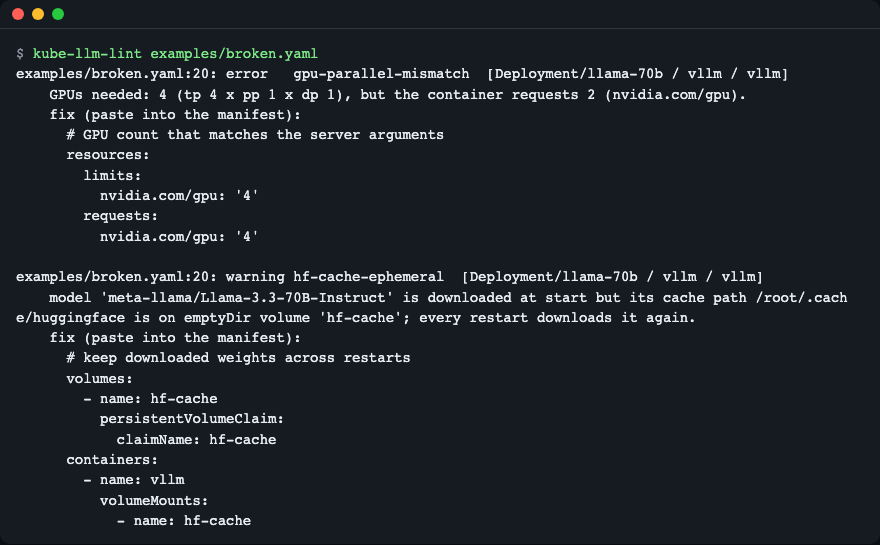
kube-llm-lint on examples/broken.yaml: each finding has a file line, a rule id, the reason, and a YAML snippet to paste.
Who it is for
- You deploy vLLM, SGLang or TGI to Kubernetes with hand-written YAML, Helm or kustomize and want to know about mistakes before
kubectl apply. - You run a platform team and want a CI step that rejects manifests where the server arguments and the pod spec disagree.
- You got
KeyboardInterrupt: terminatedrestart loops, NCCL hangs with tensor parallelism, or a 70B model re-downloaded after every restart, and want a checklist that is executable.
Install
# prerequisite: uv (https://docs.astral.sh/uv/)  ->  curl -LsSf https://astral.sh/uv/install.sh | sh
uv tool install git+https://github.com/LeeGyeongPil/kube-llm-lint
Requires Python 3.10 or newer (uv fetches one if needed). The only runtime dependency is ruamel.yaml. No cluster, GPU or network is needed to run it.
Quick start
git clone https://github.com/LeeGyeongPil/kube-llm-lint && cd kube-llm-lint
kube-llm-lint examples/broken.yaml
examples/broken.yaml holds three deliberately broken serving containers (vLLM, SGLang, TGI). The last lines are:

Reading one finding:
examples/broken.yaml:20: error   gpu-parallel-mismatch  [Deployment/llama-70b / vllm / vllm]
    GPUs needed: 4 (tp 4 x pp 1 x dp 1), but the container requests 2 (nvidia.com/gpu).
examples/broken.yaml:20is the file and the line of the container.erroris the severity,gpu-parallel-mismatchthe rule id, the bracket iskind/name / container / server.- The next line says what is wrong, then a
fix (paste into the manifest)block follows.
The fixed version passes:

examples/good.yaml is the same three servers with the problems fixed: no findings, exit code 0.
Usage
| Command / option | What it does | Example |
|---|---|---|
PATH ... |
Files, directories (searched recursively for *.yaml/*.yml) or - for stdin |
kube-llm-lint deploy/ |
--format text|json|sarif |
Human-readable report (default), JSON or SARIF 2.1.0 | --format sarif |
--fail-on error|warning|info|none |
Lowest severity that makes the exit code 1 (default error) |
--fail-on warning |
--startup-budget SECONDS |
Time a container may take to become healthy (default 600) | --startup-budget 1200 |
--disable RULES |
Comma-separated rule ids to turn off | --disable shm-missing,gpu-missing |
--list-rules |
Print every rule with severity, source URL and the date it was checked | kube-llm-lint --list-rules |
--lang en|ko |
Output language | --lang ko |
--version |
Print the version | kube-llm-lint --version |
Exit codes: 0 clean, 1 findings at or above --fail-on, 2 usage or input error (missing file, YAML syntax error).
Check a Helm chart
helm template my-release ./chart | kube-llm-lint - --fail-on warning
Rendered output is read from stdin (-), so the check sees what the cluster will see. The screenshot below pipes a hand-rendered copy of the vLLM example chart's default values (a test fixture) in place of real helm template output: cat tests/fixtures/upstream/vllm-chart-helm-rendered.yaml | kube-llm-lint -.
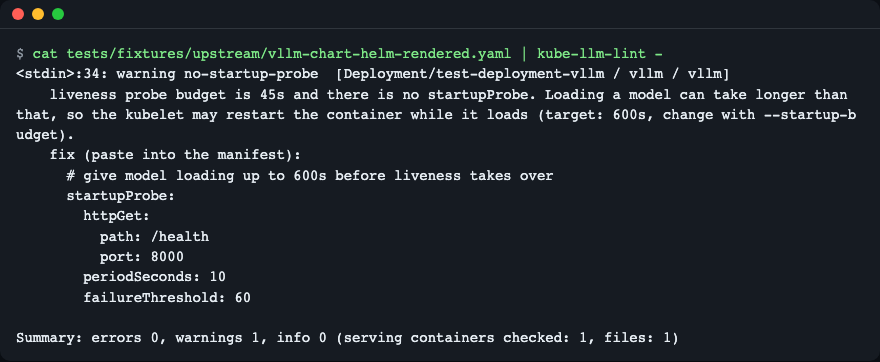
startupProbe: one warning, with a probe snippet that allows 600 s.
Use it in CI
- run: uv tool install git+https://github.com/LeeGyeongPil/kube-llm-lint
- run: kube-llm-lint manifests/ --fail-on warning
Machine-readable output
kube-llm-lint examples/broken.yaml --format json --fail-on warning
Prints {"findings": [...], "summary": {"errors": 6, "warnings": 2, "info": 0, "containers": 3, "files": 1}}; each finding has file, line, kind, name, namespace, container, server, rule, severity, message and fix.
Upload to code scanning (SARIF)
kube-llm-lint manifests/ --format sarif --fail-on none > kube-llm-lint.sarif
Then upload kube-llm-lint.sarif with GitHub's github/codeql-action/upload-sarif step to see findings as line annotations.
A complete workflow, for example .github/workflows/kube-llm-lint.yml (change manifests/ to your folder):
name: kube-llm-lint
on: [push, pull_request]
jobs:
  lint:
    runs-on: ubuntu-latest
    permissions:
      contents: read
      security-events: write   # required by upload-sarif
    steps:
      - uses: actions/checkout@v4
      - uses: astral-sh/setup-uv@v10.3.3
      - run: uv tool install git+https://github.com/LeeGyeongPil/kube-llm-lint
      # --fail-on none keeps the exit code 0, so the upload step still runs when there are findings
      - run: kube-llm-lint manifests/ --format sarif --fail-on none > kube-llm-lint.sarif
      - uses: github/codeql-action/upload-sarif@v4
        with:
          sarif_file: kube-llm-lint.sarif
Findings appear under the repository's Security tab and as annotations on pull requests. Public repositories need nothing else; private repositories need code scanning enabled (GitHub Code Security).
Silence one rule on one workload
metadata:
  name: mistral-7b
  annotations:
    kube-llm-lint/ignore: no-startup-probe   # comma-separated rule ids
The rules
kube-llm-lint --list-rules prints all 13 with their sources.
| Rule | Severity | Catches |
|---|---|---|
gpu-parallel-mismatch |
error | GPUs implied by tensor x pipeline x data parallel size differ from the GPUs requested |
gpu-missing |
warning | A serving container with no GPU resource |
gpu-mig-unchecked |
info | MIG resources are not compared with parallel sizes |
shm-missing |
error | More than one GPU but nothing mounted at /dev/shm (64 MiB default) |
shm-not-memory |
warning | /dev/shm volume is not emptyDir with medium: Memory |
shm-too-small |
warning | /dev/shm volume under 1Gi |
no-startup-probe |
warning | A liveness probe without startupProbe, shorter than the startup budget |
probe-budget-short |
warning | startupProbe budget shorter than the startup budget |
hf-cache-ephemeral |
warning | Model downloaded at start, cache on emptyDir or no mount |
hf-token-plaintext |
error | HF_TOKEN set as a literal value instead of secretKeyRef |
mem-fraction-range |
error | GPU memory fraction outside (0, 1] |
config-file-unchecked |
info | Values inside a vLLM --config file are not read |
arg-unresolved |
info | A variable could not be resolved, dependent checks skipped |
Workloads read: Pod, Deployment, StatefulSet, DaemonSet, ReplicaSet, Job, CronJob, LeaderWorkerSet.
Configuration
There is no config file. Everything is a command-line option or an annotation (see above).
Output language, first match wins: --lang, then KUBE_LLM_LINT_LANG, then LC_ALL, LC_MESSAGES, LANG; English unless the value starts with ko.
KUBE_LLM_LINT_LANG=ko kube-llm-lint examples/good.yaml
# 요약: 오류 0건, 경고 0건, 정보 0건 (파일 1개에서 서빙 컨테이너 3개 검사)
How it works
flowchart LR
  A[YAML files or stdin] --> B[Load with line numbers]
  B --> C[Find pod spec]
  C --> D[Read server arguments]
  C --> E[Read resources, volumes, probes, env]
  D --> F[Rule checks]
  E --> F
  F --> G[Findings with paste-ready fixes]
- The loader keeps line numbers so a finding points at the container, not just the file.
- It finds the pod spec inside each workload kind.
- For each container it recognises the server (
vllm serve,sglang.launch_server,text-generation-launcher, or the image name), then reads its arguments fromcommandandargs, includingsh -cstrings and$(VAR)or$VARtaken from literalenvvalues. - Rules compare those arguments with the pod spec. The probe budget is
initialDelaySeconds + periodSeconds x failureThreshold. A YAMLnullor valueless probe field (key with no value) uses the Kubernetes default (0, 10, 3); an empty string""or a non-numeric value is reported asarg-unresolved. - Values that cannot be resolved (for example from a ConfigMap) produce an
arg-unresolvedinfo and the checks that need them are skipped rather than guessed. - The report never prints a token value, only
hf_****.
Worked probe budget: the Kubernetes docs example startupProbe with failureThreshold: 3, periodSeconds: 10 and initialDelaySeconds: 60 gives 60 + 10 x 3 = 90 s. If the model needs longer to load, the kubelet restarts the container; the linter warns when this budget is below --startup-budget (600 s by default).
Why a separate linter
General-purpose linters do not know what the server arguments mean. On 2026-11-16 we ran kube-linter v0.8.3 against a manifest containing eight LLM-serving mistakes (GPU count vs tensor parallel size, missing or tiny /dev/shm, no startupProbe budget, ephemeral model cache, plaintext HF_TOKEN, and similar):
kube-linter lint bad.yaml                      # default checks: 0 of the 8 found
kube-linter lint --add-all-built-in bad.yaml   # all 63 built-in checks: still 0 of the 8
Even env-var-secret did not flag the plaintext HF_TOKEN, because it matches secret/password-style names. kube-llm-lint reads the arguments (--tensor-parallel-size, --shm-size, ...) and compares them with the pod spec, which a generic check cannot do. It complements kube-linter, Polaris and kubeconform; it does not replace them.
When to use it
- Good fit: you want a fast, offline check of the relationships between vLLM, SGLang or TGI arguments and the pod spec, locally or in CI.
- It does not replace general linters. For generic security and best-practice checks use kube-linter or Polaris; for schema validation use kubeconform. They can run alongside this tool.
- It only reads manifests. It does not talk to a cluster, so it cannot know the real GPU type, node memory or model size.
Limitations
- Static analysis only: it never contacts a cluster, so real GPU type, node memory and model size are unknown.
- It does not read the contents of a vLLM
--configfile, values that come from ConfigMaps, or custom start scripts. When a container'scommandruns something other than a known server, the GPU and shm checks are skipped rather than guessed. - The 600 s default startup budget is a starting point. Real load time depends on the model, disk and network; tune it with
--startup-budget. - Scope is single-pod specs. Multi-node setups (LeaderWorkerSet, operator CRDs) are read per container, not as a whole.
- Server flag names and defaults change between versions. The flag tables were checked on 2026-11-16 (see
--list-rules).
Roadmap
Ideas, not promises: a ready-made GitHub Action, a pre-commit hook, KServe InferenceService support.
Troubleshooting
| Symptom | Cause | Fix |
|---|---|---|
error: cannot read ...: no such file or directory (exit 2) |
Wrong path | Check the path; directories are searched for *.yaml and *.yml only |
error: ...: YAML parse error (exit 2) |
Invalid YAML, often unrendered Helm templates | Run helm template first and pipe it in with - |
arg-unresolved info and a GPU or shm check is missing |
The value comes from a variable that has no literal value in env |
Write the value inline, or accept that this check is skipped |
| Exit code 0 although a warning is printed | --fail-on defaults to error |
Use --fail-on warning in CI |
no-startup-probe for a model that loads in seconds |
Default budget is 600 s | Pass --startup-budget 60 or add the ignore annotation |
| Output is Korean on a Korean system | The language follows LANG |
Pass --lang en or set KUBE_LLM_LINT_LANG=en |
Development
uv sync
uv run pytest -q
The tests run offline in about a second. Bug reports and ideas are welcome as issues. Changes are listed in CHANGELOG.md.
License
MIT. Test fixtures under tests/fixtures/upstream/ are derived from the vLLM project (Apache License 2.0), see NOTICE.
Sources
Rule sources (checked 2026-11-16): vLLM Kubernetes deployment, vLLM engine arguments, vLLM issue 17386, TGI note on shared memory, Kubernetes probes, SGLang.
1 maintainer

Metadata
1 maintainer
Release files for kube-llm-lint 0.2.0
For a detailed explanation of source distributions (sdists) and built distributions (wheels), please see the package formats documentation.
Source distribution (sdist)
| File | Size | Uploaded | Provenance | Actions |
|---|---|---|---|---|
| kube_llm_lint-0.2.0.tar.gz | 402.8 kB | Without provenance | Details for kube_llm_lint-0.2.0.tar.gz |
Built distribution (wheel)
| File | Interpreter | ABI | Platform | Actions Reset |
|---|---|---|---|---|
| kube_llm_lint-0.2.0-py3-none-any.whl | Python 3 | none | any | Details for kube_llm_lint-0.2.0-py3-none-any.whl |
Total release size: 438.1 kB
Release files / kube_llm_lint-0.2.0.tar.gz
| Download URL | kube_llm_lint-0.2.0.tar.gz |
|---|---|
| Size | 402.8 kB |
| Tags | Source |
|
SHA-256 checksum How to use checksums |
09cba65512d87b4b27c5835e817b0b38b7f19b9f734f86a683a146fecf0fcf80
|
|
BLAKE2b-256 checksum How to use checksums |
b7e902f0c7d3bb4bc8e7c403749b10d4f3fc7665f5a79925d431401fb88fbe9a
|
| Upload date | |
|
Uploaded using Trusted Publishing? What is trusted publishing? |
No |
| Uploaded via |
uv/0.13.6 {"installer":{"name":"uv","version":"0.13.6","subcommand":["publish"]},"python":null,"implementation":{"name":null,"version":null},"distro":{"name":"macOS","version":null,"id":null,"libc":null},"system":{"name":null,"release":null},"cpu":null,"openssl_version":null,"setuptools_version":null,"rustc_version":null,"ci":null}
|
Release files / kube_llm_lint-0.2.0-py3-none-any.whl
| Download URL | kube_llm_lint-0.2.0-py3-none-any.whl |
|---|---|
| Size | 35.4 kB |
| Tags | Python 3 |
|
SHA-256 checksum How to use checksums |
5144f2251291ed400e90fe23650acf712bfec16d501c2428ad550de4a8b1bee7
|
|
BLAKE2b-256 checksum How to use checksums |
582660e2a2c9dd990eea04c5a63f8fd845c4450938fa28469a87d92f6ab92866
|
| Upload date | |
|
Uploaded using Trusted Publishing? What is trusted publishing? |
No |
| Uploaded via |
uv/0.13.6 {"installer":{"name":"uv","version":"0.13.6","subcommand":["publish"]},"python":null,"implementation":{"name":null,"version":null},"distro":{"name":"macOS","version":null,"id":null,"libc":null},"system":{"name":null,"release":null},"cpu":null,"openssl_version":null,"setuptools_version":null,"rustc_version":null,"ci":null}
|
Security for kube-llm-lint 0.2.0
Provenance
Provenance describes where a file came from. On PyPI, provenance is shared via attestations, which provide a verifiable record of the build or publishing details. View details, limitations and caveats.
No provenance found
None of the files in this release were uploaded with provenance metadata.
A note on package security
PyPI is a repository for distributing packages, not a service for auditing them. While third-party security researchers and our staff do their best to detect and remove malicious packages, PyPI cannot guarantee the quality, security or suitability of any given package.
To learn more about protecting yourself from malicious actors, visit our package security documentation.













