
Python dataclasses for all Kubernetes built-in resources (v1.23+)

Project description






kubesdk
kubesdk is a modern, async-first Kubernetes client and API model generator for Python.
- Developer-friendly, with fully typed APIs so IDE auto-complete works reliably across built-in resources and your custom resources.
- Made for large multi-cluster workloads.
- Minimal external dependencies (client itself depends on
aiohttpandPyYAMLonly).
The project is split into three packages:
kubesdk
The core client library, which you install and use in your project.
kube-models
Pre-generated Python models for all upstream Kubernetes APIs, for every Kubernetes version 1.23+. All Kubernetes APIs are bundled under a single kube-models package version, so you don’t end up in model-versioning hell.
Separate models package gives you ability to use latest client version with legacy Kubernetes APIs and vice versa.
You can find the latest generated models here. They are automatically uploaded to an external repository to avoid increasing the size of the main kubesdk repo.
kubesdk-cli
CLI that generates models from a live cluster or OpenAPI spec, including your own CRDs.
Comparison with other Python clients
| Feature / Library | kubesdk | kubernetes-asyncio | Official client (kubernetes) |
kr8s | lightkube |
|---|---|---|---|---|---|
| Async client | ✅ | ✅ | ✗ | ✅ | ✅ |
| IDE-friendly client methods typing | ✅ Full | ◑ Partial | ◑ Partial | ◑ Partial | ✅ Good |
| Typed models for all built-in APIs | ✅ | ✅ | ✅ | ◑ Partial | ✅ |
| Built-in multi-cluster ergonomics | ✅ | ◑ Manual | ◑ Manual | ◑ Manual | ◑ Manual |
| Easy API model generation (CLI) | ✅ | ✗ | ✗ | ◑ | ◑ |
| High-level JSON Patch helpers (typed) | ✅ | ✗ | ✗ | ✗ | ✗ |
| One API surface for core + CRDs | ✅ | ✗ | ✗ | ◑ | ✅ |
| Separated API models package | ✅ | ✗ | ✗ | ✗ | ✅ |
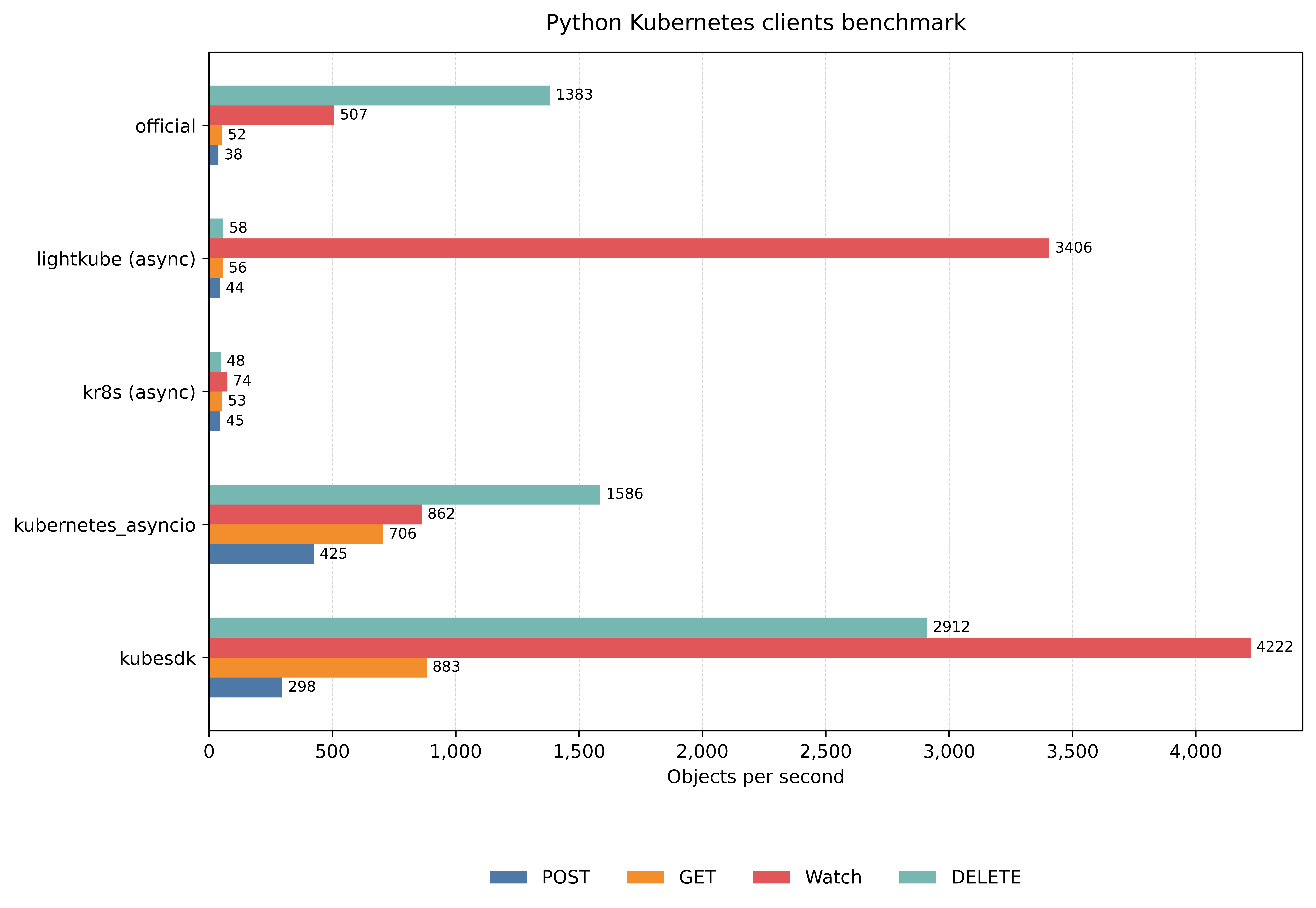
| Performance on large-scale workloads | ✅ >1000 RPS | ✅ >1000 RPS | <100 RPS | <100 RPS | <100 RPS |
Benchmark
Benchmark results were collected against kind (Kubernetes in Docker), which provides a fast, consistent local environment for comparing client overhead under the same cluster conditions.
Installation
pip install kubesdk[cli]
Quick examples
Create and read resource
import asyncio

from kube_models.apis_apps_v1.io.k8s.api.apps.v1 import (
    Deployment,
    DeploymentSpec,
    LabelSelector,
)
from kube_models.api_v1.io.k8s.api.core.v1 import (
    PodTemplateSpec,
    PodSpec,
    Container,
)
from kube_models.api_v1.io.k8s.apimachinery.pkg.apis.meta.v1 import ObjectMeta

from kubesdk import login, create_k8s_resource, get_k8s_resource


async def main() -> None:
    # Load available cluster config and establish cluster connection process-wide
    await login()

    deployment = Deployment(
        metadata=ObjectMeta(name="example-nginx", namespace="default"),
        spec=DeploymentSpec(
            replicas=2,
            selector=LabelSelector(matchLabels={"app": "example-nginx"}),
            template=PodTemplateSpec(
                metadata=ObjectMeta(labels={"app": "example-nginx"}),
                spec=PodSpec(
                    containers=[
                        Container(
                            name="nginx",
                            image="nginx:stable",
                        )
                    ]
                ),
            ),
        ),
    )

    # Create the Deployment
    await create_k8s_resource(deployment)

    # Read it back
    created = await get_k8s_resource(Deployment, "example-nginx", "default")

    # IDE autocomplete works here
    print("Container name:", created.spec.template.spec.containers[0].name)


if __name__ == "__main__":
    asyncio.run(main())
Watch resources
import asyncio

from kube_models.apis_apps_v1.io.k8s.api.apps.v1 import Deployment
from kubesdk import login, watch_k8s_resources


async def main() -> None:
    await login()

    async for event in watch_k8s_resources(Deployment, namespace="default"):
        deploy = event.object
        print(event.type, deploy.metadata.name)


if __name__ == "__main__":
    asyncio.run(main())
Delete resources
import asyncio

from kube_models.apis_apps_v1.io.k8s.api.apps.v1 import Deployment
from kubesdk import login, delete_k8s_resource


async def main() -> None:
    await login()
    await delete_k8s_resource(Deployment, "example-nginx", "default")


if __name__ == "__main__":
    asyncio.run(main())
Patch resource
from dataclasses import replace

from kube_models.api_v1.io.k8s.api.core.v1 import LimitRange, LimitRangeSpec, LimitRangeItem
from kube_models.api_v1.io.k8s.apimachinery.pkg.apis.meta.v1 import OwnerReference, ObjectMeta

from kubesdk import create_k8s_resource, update_k8s_resource, from_root_, path_, replace_


async def patch_limit_range() -> None:
    """
    Example: bump PVC min storage and add an OwnerReference in a single,
    server-side patch. kubesdk will compute the diff between `latest` and
    `updated` and pick the best patch type (strategic/merge) automatically.
    """
    # Create the initial LimitRange object.
    namespace = "default"
    initial_range = LimitRange(
        metadata=ObjectMeta(
            name="example-limit-range",
            namespace=namespace,
        ),
        spec=LimitRangeSpec(
            limits=[
                LimitRangeItem(
                    type="PersistentVolumeClaim",
                    min={"storage": "1Gi"},
                )
            ]
        ),
    )

    # The client returns the latest version from the API server.
    latest: LimitRange = await create_k8s_resource(initial_range)

    #
    # We want to make a few modifications, will do them one by one.
    # First, append a new OwnerReference.
    #
    # IDE autocomplete works here
    owner_ref_path = path_(from_root_(LimitRange).metadata.ownerReferences)
    updated_range = replace_(
        latest,

        # IDE autocomplete works here
        path=owner_ref_path,

        # Typecheck works here
        new_value=latest.metadata.ownerReferences + [
            OwnerReference(
                uid="9153e39d-87d1-46b2-b251-5f6636c30610",
                apiVersion="v1",
                kind="Secret",
                name="test-secret-1",
            ),
        ]
    )

    #
    # Then, set a new list of limits with updated PVC min storage.
    #
    # IDE autocomplete works here
    limits_path = path_(from_root_(LimitRange).spec.limits)
    updated_range = replace_(
        updated_range,

        # IDE autocomplete works here
        path=limits_path,

        # Typecheck works here
        new_value=[
            replace(lim, min={"storage": "3Gi"})
            if lim.type == "PersistentVolumeClaim" else lim
            for lim in latest.spec.limits
        ]
    )

    update_all_changed_fields = True
    # Let kubesdk compute the diff and patch everything that changed
    if update_all_changed_fields:
        await update_k8s_resource(updated_range, built_from_latest=latest)

    # Or, restrict the patch to specific paths only (optional)
    else:
        await update_k8s_resource(
            updated_range,
            built_from_latest=latest,
            paths=[owner_ref_path, limits_path],
        )
Working with multiple clusters
import asyncio
from dataclasses import replace

from kubesdk import login, KubeConfig, ServerInfo, watch_k8s_resources, create_or_update_k8s_resource, \
    delete_k8s_resource, WatchEventType
from kube_models.api_v1.io.k8s.api.core.v1 import Secret


async def sync_secrets_between_clusters(src_cluster: ServerInfo, dst_cluster: ServerInfo):
    src_ns, dst_ns = "default", "test-kubesdk"
    async for event in watch_k8s_resources(Secret, namespace=src_ns, server=src_cluster.server):
        if event.type == WatchEventType.ERROR:
            status = event.object
            raise Exception(f"Failed to watch Secrets: {status.data}")

        # Optional
        if event.type == WatchEventType.BOOKMARK:
            continue

        # Sync Secret on any other event
        src_secret = event.object
        if event.type == WatchEventType.DELETED:
            # Try to delete, skip if not found
            await delete_k8s_resource(
                Secret, src_secret.metadata.name, dst_ns, server=dst_cluster.server, return_api_exceptions=[404])
            continue

        dst_secret = replace(
            src_secret,
            metadata=replace(src_secret.metadata, namespace=dst_ns,
                # Drop all k8s runtime fields
                uid=None,
                resourceVersion=None,
                managedFields=None))

        # If the Secret exists, a patch is applied; if it doesn't, it will be created.
        await create_or_update_k8s_resource(dst_secret, server=dst_cluster.server)
        print(f"Secret {dst_secret.metadata.name} has been synced "
              f"from `{src_ns}` ns in {src_cluster.server} to `{dst_ns}` ns in {dst_cluster.server}")


async def main():
    default = await login()
    eu_finland_1 = await login(kubeconfig=KubeConfig(context_name="eu-finland-1.clusters.puzl.cloud"))

    # Endless syncing loop
    while True:
        try:
            await sync_secrets_between_clusters(default, eu_finland_1)
        except Exception as e:
            print(e)
            await asyncio.sleep(5)


if __name__ == "__main__":
    asyncio.run(main())
Custom Resource Definitions
You can generate your custom resource models from your Kubernetes cluster API directly using CLI. Another option is to define them manually. Below is the example of a FeatureFlag CR.
Operator
A FeatureFlag CR is a simple k8s resource that drives a progressive rollout by updating Nginx Ingress canary annotations (assumed you are using Nginx).
- Operator watches
FeatureFlagobjects and setsnginx.ingress.kubernetes.io/canary=trueandnginx.ingress.kubernetes.io/canary-weight=<0..100>on the referencedspec.canary_ingress. - When the flag is disabled or resource is deleted, the operator forces the canary weight to
0(no canary traffic).
from __future__ import annotations

import asyncio
from dataclasses import dataclass

from kubesdk import login, watch_k8s_resources, update_k8s_resource, WatchEventType, path_, from_root_, replace_, \
    K8sAPIRequestLoggingConfig
from kube_models import K8sResource, Loadable
from kube_models.api_v1.io.k8s.apimachinery.pkg.apis.meta import ObjectMeta
from kube_models.apis_networking_k8s_io_v1.io.k8s.api.networking.v1 import Ingress


@dataclass(kw_only=True, frozen=True, slots=True)
class FeatureFlagSpec(Loadable):
    enabled: bool = False
    rollout_percent: int = 0  # 0..100

    # Name of the canary Ingress (points to canary Service)
    canary_ingress: str


@dataclass(kw_only=True, frozen=True, slots=True)
class FeatureFlag(K8sResource):
    is_namespaced_ = True
    group_ = "my-beautiful-saas.com"
    plural_ = "featureflags"

    apiVersion = f"{group_}/v1alpha1"
    kind = "FeatureFlag"

    spec: FeatureFlagSpec


async def operator():
    finalizer_name = FeatureFlag.group_
    await login()

    async for event in watch_k8s_resources(FeatureFlag):
        if event.type == WatchEventType.BOOKMARK:
            continue

        flag, meta = event.object, event.object.metadata
        deleting = meta.deletionTimestamp is not None
        actually_enabled = False if deleting or event.type == WatchEventType.DELETED else flag.spec.enabled
        weight = int(flag.spec.rollout_percent or 0) if actually_enabled else 0

        # Add finalizer on create/normal updates (so we clean up on delete safely)
        fin_path = path_(from_root_(FeatureFlag).metadata.finalizers)
        if not deleting and event.type != WatchEventType.DELETED and finalizer_name not in meta.finalizers:
            new_finalizers = meta.finalizers + [finalizer_name]
            updated_flag = replace_(flag, fin_path, new_finalizers)
            await update_k8s_resource(updated_flag, paths=[fin_path])  # patch finalizers only

        new_annotations = {
            "nginx.ingress.kubernetes.io/canary": "true",
            "nginx.ingress.kubernetes.io/canary-weight": str(weight)
        }
        desired_ingress = Ingress(metadata=ObjectMeta(
            name=flag.spec.canary_ingress,
            namespace=meta.namespace,
            annotations=new_annotations
        ))

        annotations_path = path_(from_root_(Ingress).metadata.annotations)  # patch annotations only
        await update_k8s_resource(desired_ingress, paths=[annotations_path])

        # On delete: remove finalizer so the CR can be deleted
        if deleting and finalizer_name in meta.finalizers:
            new_finalizers = [f for f in meta.finalizers if f != finalizer_name]
            updated_flag = replace_(flag, fin_path, new_finalizers)
            do_not_log_404 = K8sAPIRequestLoggingConfig(not_error_statuses=[404])
            await update_k8s_resource(updated_flag, paths=[fin_path], return_api_exceptions=[404], log=do_not_log_404)


if __name__ == "__main__":
    asyncio.run(operator())
CRD
This example assumes you have installed the CRD below in your Kubernetes cluster (automatic generation of the CRD yaml from your dataclasses is coming in the near future versions of kubesdk).
apiVersion: apiextensions.k8s.io/v1
kind: CustomResourceDefinition
metadata:
  name: featureflags.my-beautiful-saas.com
spec:
  group: my-beautiful-saas.com
  scope: Namespaced
  names:
    plural: featureflags
    singular: featureflag
    kind: FeatureFlag
    shortNames:
      - ff
  versions:
    - name: v1alpha1
      served: true
      storage: true
      schema:
        openAPIV3Schema:
          type: object
          required: ["spec"]
          properties:
            spec:
              type: object
              required: ["canary_ingress"]
              properties:
                enabled:
                  type: boolean
                  default: false
                rollout_percent:
                  type: integer
                  minimum: 0
                  maximum: 100
                  default: 0
                canary_ingress:
                  type: string
                  minLength: 1
      additionalPrinterColumns:
        - name: Enabled
          type: boolean
          jsonPath: .spec.enabled
        - name: Weight
          type: integer
          jsonPath: .spec.rollout_percent
        - name: CanaryIngress
          type: string
          jsonPath: .spec.canary_ingress
kubectl apply -f my-feature-flag-crd.yaml
Run and test the operator
- Create demo
Ingressresource
apiVersion: networking.k8s.io/v1
kind: Ingress
metadata:
  name: checkout-canary
  namespace: default
spec:
  ingressClassName: nginx
  rules:
    - host: checkout-canary.local
      http:
        paths:
          - path: /
            pathType: Prefix
            backend:
              service:
                name: dummy-service
                port:
                  number: 80
kubectl apply -f checkout-canary-ingress.yaml
- Apply your
FeatureFlagcustom resource spec into cluster
apiVersion: my-beautiful-saas.com/v1alpha1
kind: FeatureFlag
metadata:
  name: checkout-canary  # the same as Ingress metadata.name
  namespace: default  # in the same namespace
spec:
  enabled: true
  rollout_percent: 20
  canary_ingress: checkout-canary
kubectl apply -f checkout-canary-feature-flag.yaml
- Check both annotations' values
kubectl get ingress checkout-canary -n default -o jsonpath="{.metadata.annotations.nginx\.ingress\.kubernetes\.io/canary}{'\n'}{.metadata.annotations.nginx\.ingress\.kubernetes\.io/canary-weight}{'\n'}"
The command must return
true
20
CLI
Generate models directly from a live cluster OpenAPI:
kubesdk \
  --url https://my-cluster.example.com:6443 \
  --output ./kube_models \
  --module-name kube_models \
  --http-headers "Authorization: Bearer $(cat /path/to/token)" \
  --skip-tls
Near-term roadmap
- Publish client benchmark suite and results
- Add contributor guide and contribution workflow
- Ship detailed API and usage documentation
- CRD YAML generator from your dataclasses
Release history Release notifications | RSS feed


Download files
Download the file for your platform. If you're not sure which to choose, learn more about installing packages.
Source Distribution
Built Distribution
Filter files by name, interpreter, ABI, and platform.
If you're not sure about the file name format, learn more about wheel file names.
Copy a direct link to the current filters
File details
Details for the file kube_models-0.2.0.tar.gz.
File metadata
- Download URL: kube_models-0.2.0.tar.gz
- Upload date:
- Size: 110.2 kB
- Tags: Source
- Uploaded using Trusted Publishing? Yes
- Uploaded via: uv/0.9.12 {"installer":{"name":"uv","version":"0.9.12"},"python":null,"implementation":{"name":null,"version":null},"distro":{"name":"Ubuntu","version":"24.04","id":"noble","libc":null},"system":{"name":null,"release":null},"cpu":null,"openssl_version":null,"setuptools_version":null,"rustc_version":null,"ci":true}
File hashes
| Algorithm | Hash digest | |
|---|---|---|
| SHA256 |
b8c6f1a90dede8b528da49c3cfad08ca2823f4faa1c94e2c82dd3c98f2c28085
|
|
| MD5 |
1377294515b0240efb77c3e5a07cd321
|
|
| BLAKE2b-256 |
be5b2319b42f78fa579bea05ed70bc73b486494957b02141da49b24cbb147941
|
File details
Details for the file kube_models-0.2.0-py3-none-any.whl.
File metadata
- Download URL: kube_models-0.2.0-py3-none-any.whl
- Upload date:
- Size: 487.8 kB
- Tags: Python 3
- Uploaded using Trusted Publishing? Yes
- Uploaded via: uv/0.9.12 {"installer":{"name":"uv","version":"0.9.12"},"python":null,"implementation":{"name":null,"version":null},"distro":{"name":"Ubuntu","version":"24.04","id":"noble","libc":null},"system":{"name":null,"release":null},"cpu":null,"openssl_version":null,"setuptools_version":null,"rustc_version":null,"ci":true}
File hashes
| Algorithm | Hash digest | |
|---|---|---|
| SHA256 |
780c62ee869d24aff7ea56db12ba0d97be9f17dfdf79ef016af2b78ec8022060
|
|
| MD5 |
718e8d059ab7796ba4d010d62869b658
|
|
| BLAKE2b-256 |
f27fbd03f79ee89ce2fa849b5588bfa1575d0df57bdec5a5358945aca10b8aa6
|






