
KudioEnhance
English | 繁體中文





Train and run learned speech-enhancement (denoising) models, built on the
kudio audio toolkit.
Three stages, one config file:
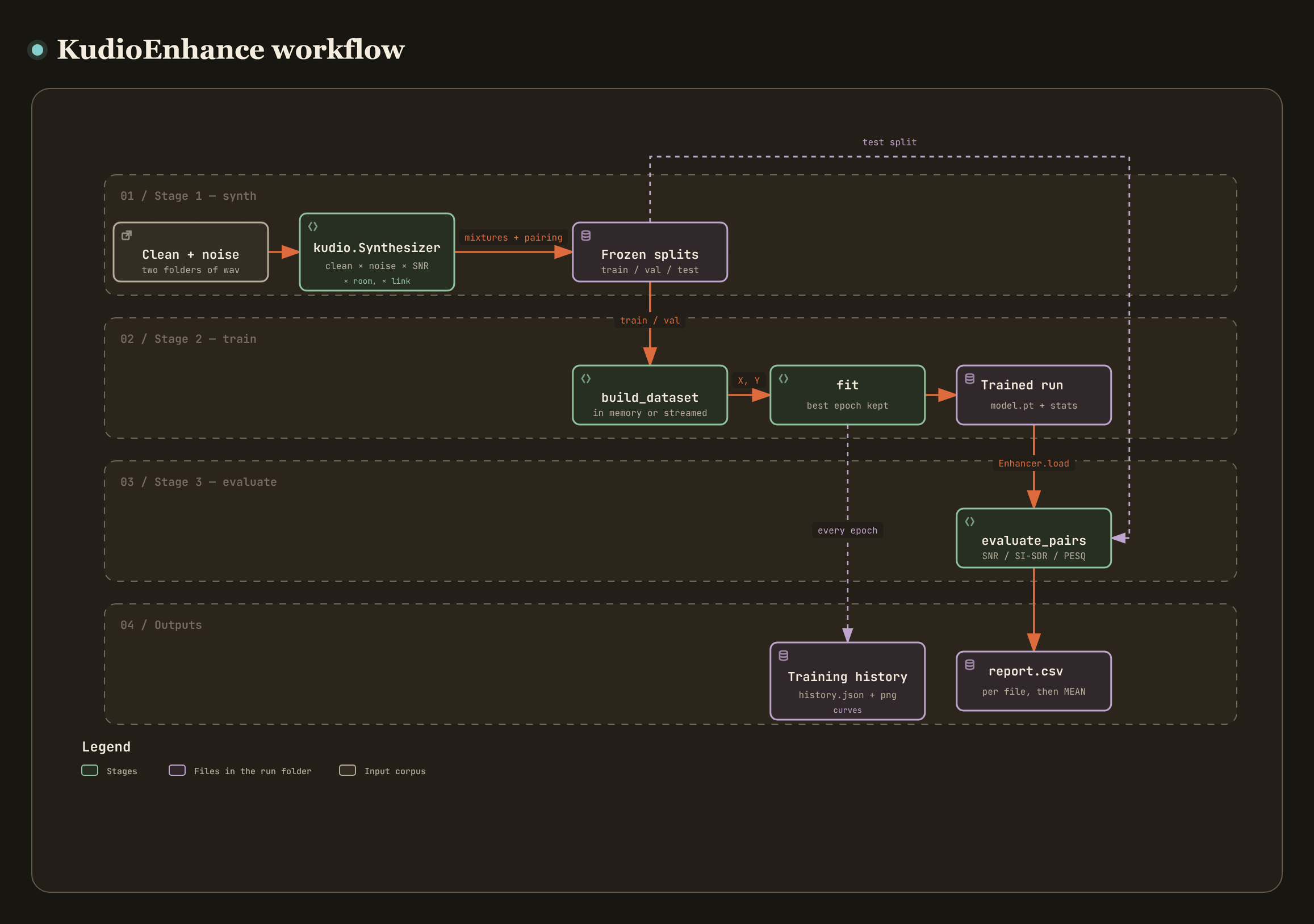
The figure is a link to an interactive version — open it online, or open docs/workflow.html from a checkout. You can zoom, search for a node, or trace the path between two of them, and most boxes carry a link to the lines of source they were drawn from, at the commit they were checked against.
Each stage reads what the one before it wrote, so you can re-train without
re-mixing and re-evaluate without re-training. run does all three in order.
Models work in the log-power spectrogram domain and reuse the noisy phase —
the standard magnitude-only enhancement setup. Feature extraction and
reconstruction both go through kudio, so what the model sees is exactly what
any other kudio-based tool produces.
Install
pip install kudioenhance
The command is kudioenhance and the package import kudioenhance.
Needs Python 3.9+ and PyTorch ≥ 2.4.1. The models are plain
torch.nn modules, trained by a loop in this package — no Keras, no
Lightning. Older torch wheels, and 2.4.0's on Windows, were built against
NumPy 1, which nothing stops pip from installing beside NumPy 2, and there
they fail at the first torch.from_numpy.
On Linux the default torch wheel bundles CUDA and runs to several
gigabytes. Without an NVIDIA GPU, install the CPU-only build first and pip
will keep it when it installs this package:
pip install torch --index-url https://download.pytorch.org/whl/cpu
pip install kudioenhance
The Windows and macOS wheels on PyPI carry no CUDA, so they stay small.
Training takes an NVIDIA GPU whenever torch can see one (device: auto in the
train section), so the same config works on both kinds of machine. Apple's
GPUs are not used: torch can drive them through mps, but this package does
not ask it to, and on a Mac training runs on the CPU.
STOI and SDR are optional: pip install "kudioenhance[eval]". PESQ is a
separate extra, pip install "kudio[pesq]", because it builds from source
— a C compiler, and the MSVC Build Tools on Windows — so it is deliberately
left out of [eval] and [all], which would otherwise stop installing.
PESQ comes on two scales. evaluate reports MOS-LQO by default; pass
--pesq-scale raw for the narrowband P.862 score most enhancement papers
quote. They are different scales, not different roundings: raw 2.03 is about
1.65 MOS-LQO.
Quick start
kudioenhance init config.yaml        # starter config
kudioenhance run -c config.yaml -n exp1
That mixes the dataset, trains, and prints the before/after scores:
si_sdr      -4.812 ->    6.933  (+11.745)
snr         -4.998 ->    5.221  (+10.219)
seg_snr     -6.114 ->    1.870  (+7.984)
report -> runs/exp1/report.csv
Then denoise anything with the trained run:
kudioenhance denoise runs/exp1 noisy.wav enhanced.wav
kudioenhance denoise runs/exp1 noisy/ clean/ --recursive --report
The folder form loads the model once for the whole tree, mirrors the input's
directory structure, and with --report says how far the noise floor moved.
And afterwards, whether it actually learned anything:
kudioenhance curves -c config.yaml -n exp1
3 epoch(s), monitoring val_loss
  best   0.12172 at epoch 3
  first  0.28104   last 0.12172
A training loop hands back its curves and almost every script drops them,
which makes "did it converge, or stop early because validation was already
climbing?" unanswerable the moment the terminal closes. They are written to
runs/exp1/history.json (and history.png when matplotlib is around). If the
best epoch was the first one the command says so and exits non-zero — that is
what "this did not learn" looks like.
Stage by stage
kudioenhance synth    -c config.yaml -n exp1   # mix + freeze the splits
kudioenhance train    -c config.yaml -n exp1   # fit (--epochs 1 to smoke-test)
kudioenhance evaluate -c config.yaml -n exp1   # score (--full adds PESQ/STOI)
Each stage reads what the previous one wrote, so you can re-train without re-mixing, or re-evaluate without re-training.
Configuration
audio:                      # STFT geometry, shared by features and reconstruction
  sr: 16000
  n_fft: 512
  hop_length: 256
  win_length: 512

data:
  clean_dir: data/clean
  noise_dir: data/noise
  mixed_dir: runs/mixed
  snr_db: [-5, 0, 5]
  rt60: []                  # reverberation times in seconds; [] = no rooms
  drr_db: 0.0               # how close the microphone is, in dB
  reverberant_target: false # train to remove the noise and leave the room
  channel: null             # telephone / voip / mu_law / a_law, or null
  mode: regular             # 'regular' = one mix per clean file; 'inc' = every combination
  seed: 17                  # makes the mixture and the splits reproducible
  val_split: 0.1
  test_split: 0.1

model:
  name: ddae                # ddae | blstm | conv_ae | crn | unet
  target: spectrum          # spectrum | irm  -- see "What the network is asked to produce"
  context: 2                # frame-wise models: ±frames stacked into the input
  n_frames: 64              # sequence models: frames per training window
  units: null               # layer widths; null = the architecture's default
  dropout: 0.1

train:
  epochs: 50
  batch_size: 256           # ddae needs 2 or more; the sequence models train on 1
  learning_rate: 0.001
  patience: 8
  out_dir: runs
  device: auto              # auto | cpu | cuda | cuda:1
  seed: null                # weights, dropout and batch order; null = data.seed
  streaming: false          # true: read the features from disk every epoch
  shuffle_buffer: 0         # streaming only: examples held back for mixing
Every key is a typed dataclass field. A typo fails at load time and names the offending key — it does not silently fall back to a default three stages later.
Models
kudioenhance models
blstm       stacked bidirectional LSTM                       units: [1024, 1024, 1024]
conv_ae     dilated Conv1D autoencoder, residual             units: [1024, 1024, 1024]
crn         causal conv-recurrent network (Tan & Wang 2018)  units: [16, 32, 64, 64, 64]
ddae        dense denoising autoencoder, frame-wise          units: [1024, 1024, 1024]
unet        2-D U-Net over time and frequency, non-causal    units: [16, 32, 64, 128]
| Name | Input layout | Causal | What it is, and when to choose it |
|---|---|---|---|
ddae |
(N, bins × (2·context+1)) |
no — sees ±context frames |
Dense denoising autoencoder. Frame-wise, fast, a solid baseline. |
blstm |
(N, n_frames, bins) |
no | Stacked bidirectional LSTM. Temporal context in both directions. |
conv_ae |
(N, n_frames, bins) |
no | Dilated Conv1D autoencoder with a residual connection — starts from "pass the signal through" rather than from noise. |
crn |
(N, n_frames, bins) |
yes | Convolutional recurrent network after Tan & Wang, A convolutional recurrent neural network for real-time speech enhancement (Interspeech 2018): a strided 2-D convolutional encoder over time and frequency, an LSTM over time, and a mirrored decoder that takes each encoder layer's output back in. Choose it when the output must not wait for what comes next. |
unet |
(N, n_frames, bins) |
no — about 50 frames ahead | 2-D U-Net over time and frequency: convolution blocks, halving both axes on the way down, skip connections on the way back up. Choose it for offline enhancement of whole files; at about half a million parameters it is also the smallest model here at the default widths. |
Sequence models are trained on fixed-length windows, but nothing in them
fixes the length of the time axis, so the same weights enhance a whole
utterance in one pass. The two 2-D models also take any n_fft: they pad
time and frequency internally as far as their halvings need, and crop back.
Causal means the output for a frame depends on that frame and earlier
ones only — the convolutions in crn are padded on the past side, its LSTM
runs forwards, and a test holds it to that. It is what a real-time port
needs, but this package does not stream: Enhancer still enhances a whole
file at once, and the STFT adds a window of latency of its own.
model.units is the list of layer widths: a dense layer's units, an
LSTM's, a convolution's filters or channels. Left as null it takes the
architecture's default, listed above. A width of 1024 is sensible for a
dense layer and absurd for a 2-D convolution, each of whose channels is a
whole time-frequency map, so the default belongs to the architecture. Set it
to a list to choose the widths yourself. Training writes the widths it
actually built into the run's config.yaml, so a run keeps loading even if a
later release changes a default.
crn's LSTM reads every channel at every bin left after halving the bins
once per layer, so its size grows with n_fft: about 1.8M parameters at
n_fft: 256, 5.5M at 512 and 19M at 1024. For a large n_fft, add a layer
to halve once more — units: [16, 32, 64, 64, 64, 64] brings 1024 back to
5.6M. Nothing in unet depends on the number of bins.
Adding an architecture is a builder function plus one REGISTRY entry —
there is no if/elif chain to extend in three places. The entry's
default_units is what units: null builds; leave it out and the
architecture gets the 1024-wide stack the first three share.
What the network is asked to produce
model.target is a separate choice from model.name, and every architecture
supports both:
| Target | The network outputs | |
|---|---|---|
spectrum |
the clean log-power spectrogram, directly | unbounded output; it has to learn the level as well as the shape |
irm |
an ideal ratio mask in [0, 1] |
bounded, so a sigmoid cannot produce an impossible answer, and the level comes from the input |
model:
  name: ddae
  target: irm
The mask is sqrt(|S|² / (|S|² + |N|²)) — how much of each time-frequency bin
is speech — and applying it is an addition in the log domain, so the network
only ever decides how much to keep.
Measured on this repo's own smoke corpus, three epochs of a small ddae:
| target | SI-SDR |
|---|---|
spectrum |
+0.05 → −7.59 dB |
irm |
+0.05 → +2.61 dB |
| an oracle mask | −3.02 → +14.16 dB |
An undertrained spectrum model has not learned the level yet, so it outputs something loud and wrong; an undertrained mask model is already useful, because the worst it can do is keep or drop what was already there. The oracle row is the ceiling this target aims at.
That is a tiny model on a tiny corpus, not a benchmark — but it is the reason mask targets are the usual choice, made visible in about twenty seconds.
Rooms
Noise is additive and a room is convolutive, and a real recording has both.
data.rt60 puts the speech through a room before the noise is mixed in:
data:
  snr_db: [-5, 0, 5]
  rt60: [0.3, 0.6, 0.9]     # a fourth axis -- in `inc` mode, x3 the files
  drr_db: 0.0               # +10 is a close mic, 0 is a metre or two
The SNR is then measured against the reverberant speech, because that is what is competing with the noise at the microphone.
By default the clean file stays the target. A model trained on that is asked to undo the room as well as the noise, which is a standard setup and a choice worth making on purpose rather than discovering.
reverberant_target: true changes it. kudio.Synthesizer then writes the
reverberant-but-clean signal to TARGETS/ beside each mixture — the same
speech with the room left on — and training asks the model to remove the
noise and leave the room, which is a different and easier problem, and
the honest one when the deployment keeps its room.
It also makes the irm target correct. The mask is built from
noisy - reference, and with a room on the speech the dry clean file is not
what was mixed, so that subtraction hands the reverberation to the noise
and the mask asks the model to strip the room's own tail as if it were noise.
Against the reverberant target the subtraction is the noise again.
Each mixture records the room it was built in — Pair.rt60, and the file name
carries it too (speech_white_0dB_rt600ms.wav), so a manifest says what every
example was asked to survive.
The channel
The third kind of degradation, and the one that is neither additive nor convolutive: a codec quantises, a link drops packets, a converter throws bits away.
data:
  channel: telephone        # 300-3400 Hz at 8 kHz through G.711
telephone, telephone_a, voip (G.711 with 5% of packets lost in runs of
four, held), mu_law, a_law. It is applied to the mixture, noise and
all, because a wire carries whatever reached the microphone.
It is not an axis. Unlike snr_db and rt60 it is constant for the
dataset and does not appear in the file names: a corpus is recorded over a
phone line or it is not. Pair.channel records which link, and the target
does not go down it — asking a model to reproduce G.711 is not denoising.
Datasets
Point clean_dir and noise_dir at any two folders. Public sets that work
well out of the box:
- VoiceBank-DEMAND — the standard speech-enhancement benchmark (comes pre-mixed; use its clean/noisy folders directly and skip the synth stage).
- LibriSpeech + DEMAND or MUSAN — mix them yourself at the SNRs you care about.
- ESC-50 — environmental noise, handy for non-speech targets.
Set a seed and the mixture is reproducible: the same noise offsets, the same
pairings, the same splits.
Training data: in memory or streamed
By default training holds its features in memory: they are computed once, and every epoch is a full shuffle of the whole set. That is the right choice for the tens of hours these models are normally trained on.
A frame-wise model (ddae) sees every frame with its ±context neighbours,
and stacking those for the whole set up front used to multiply the memory by
2·context + 1 — eleven times over at context: 5. The training set now
keeps each frame once, in a kudio.ContextFrames, and stacks the neighbours
of the rows a batch draws as it draws them. The rows are the same, and so is
the run: a test holds the set to the stacked matrix row for row, and fitting
on either gives the same weights to the last bit. Sequence models' windows
were never larger than their features.
What is left is the features themselves, input and target: at 16 kHz with the default STFT, about 0.46 GB per hour of training audio. When that does not fit, stream:
train:
  streaming: true
  shuffle_buffer: 25000     # a hundred 4-second files of ddae frames
Nothing is held then. Every epoch reads the training files again, in a fresh order, and computes each one's examples as it goes — the same examples, row for row, as the in-memory set. The price is that pass over the audio, every epoch: reading, resampling and the STFT, done by the training process between batches.
- The normalisation is fitted by one extra pass before the first epoch, a
file at a time. It is kudio's formula — the mean, the population standard
deviation and the same
1e-8added to it — summed in float64, and an in-memory run fits it the same way, a file's spectrogram at a time, so the two modes normalise with the same statistics to the bit. (kudio's ownStandardizer.fitsums in float32, and on an hour of frames drifts from the true statistics by a few parts in 10⁵; this stays within a part in 10⁷.) - Validation is streamed too, in manifest order, and its batches fall exactly where the in-memory set's would, so it scores what the in-memory set would score.
- The shuffle buffer. Each file's examples join a pool, and every batch is
drawn at random from everything in it, for as long as at least
shuffle_bufferexamples would be left waiting; when the files run out the rest goes out in random order. An example is a frame forddaeand ann_frameswindow for the sequence models. To mix well, let the buffer span a hundred files or so: a hundred times the frames in a typical file, or the windows in one. It costs that many inputs and targets of memory: 6 KB an example forddaeat 257 bins andcontext: 2, 132 KB for a 64-frame window. shuffle_buffer: 0holds nothing back. The files still come in a fresh order and each file's examples are shuffled, but every batch is drawn from the file being read and what earlier draws left over, less than a batch — neighbouring frames of one recording, which trains worse. Training warns when it is asked for. In memory the setting is not used.- It repeats. The order of the files and every draw from the pool come
from
train.seed, so a streamed run repeats to the last digit on the CPU, as an in-memory one does. It is a different run from the in-memory one, though: the same examples, in a different order.
kudioenhance.data.build_dataset is what both modes go through, and
train.fit takes what it returns in place of arrays:
from kudioenhance.data import build_dataset
from kudioenhance.train import fit

train_set, std = build_dataset(train_pairs, cfg, sequence=False, fit=True)
history = fit(model, train_set, None, cfg, "runs/exp1/ddae.pt")
build_arrays still returns the plain stacked matrices, for code that wants
them.
Python API
from kudioenhance import Config, Enhancer, pipeline

cfg = Config.from_yaml("config.yaml")
summary = pipeline.run(cfg, "exp1")          # synth + train + evaluate

enh = Enhancer.load("runs/exp1")             # model + stats + config together
clean = enh.enhance_file("noisy.wav", "enhanced.wav")
result = enh.enhance_folder("noisy/", "clean/", report=True)
print(result, result.mean_reduction_db())
The model is loaded once for the whole tree, and the result is a
kudio.EnhanceFolderResult — the same shape kudio.convert_folder returns, so
"I processed a folder" has one answer whatever did the processing.
A trained run also drops straight into kudio's comparison table, beside the statistical methods:
import kudio
kudio.compare_enhancers(y, sr, ['logmmse', ('exp1', enh.enhance)],
                        reference=clean)
Enhancer.load reads the model, its normalisation statistics and the STFT
geometry that produced them from the same run directory, so inference can never
silently disagree with training.
What a run directory holds
runs/exp1/
├── config.yaml      # the experiment, as it was trained
├── ddae.pt          # the weights: <model.name>.pt
├── stats.npz        # the Standardizer the features went through
├── history.json     # the curves (and history.png with matplotlib)
├── train.json  val.json  test.json  manifest.json
└── report.csv       # after evaluate
The .pt file is a plain dictionary — a format tag, the architecture and
target it was trained as, and a state_dict — read back with
torch.load(..., weights_only=True). Nothing in it is a pickled class, so
opening a run somebody sent you cannot run their code, and Enhancer.load
rebuilds the network from config.yaml before pouring the weights in. It is
also the best epoch, always: training checkpoints whenever the monitored loss
improves and puts those weights back into the model when it stops.
Set train.seed (or just data.seed) and the initial weights, the dropout
masks and the order of the batches all come from it, so on the CPU a run
repeats to the last digit. Some GPU kernels are not deterministic, so there
it repeats closely rather than exactly.
Layout
docs/
├── images/workflow.png  # the README figure
└── workflow.html        # the same diagram, interactive
src/kudioenhance/
├── config.py        # typed dataclasses, YAML in/out, run paths
├── data.py          # mixing, manifests, splits, training sets
├── datasets.py      # the training set as torch sees it: held or streamed
├── features.py      # spectrogram / context stacking / windows / Standardizer
├── models/
│   ├── registry.py      # name -> builder + data layout
│   ├── dense.py         # ddae
│   ├── recurrent.py     # blstm
│   ├── convolutional.py # conv_ae
│   ├── crn.py           # crn
│   └── unet.py          # unet
├── train.py         # the training loop: Adam, checkpoints, early stopping
├── checkpoint.py    # the .pt format
├── inference.py     # Enhancer
├── evaluate.py      # per-file scoring + CSV report
├── pipeline.py      # the three stages
└── cli.py           # kudioenhance
Model builders return plain torch.nn.Modules; train.py owns the
optimiser, the loss and the loop. That keeps architectures inspectable without
committing to an optimisation setup.
Tests
From a checkout, with the development extras:
git clone https://github.com/recklight/KudioEnhance.git
cd KudioEnhance
pip install -e ".[dev]"
pytest -q
229 tests. The suite builds a tiny synthetic corpus in a temp directory and runs the whole pipeline — mix, train one epoch, enhance, score — in seconds. Tests that need PyTorch ask for it by name and skip cleanly when it is not installed; the other 105 still run.
The mask tests check the formula, not just that it runs: all-speech gives 1,
all-noise gives 0, equal power gives 1/√2, and an oracle mask has to actually
improve SI-SDR. Those hold or the target is wrong, whatever the loss curve
says. The architecture tests work the same way: change any frame after t
and crn's output up to t has to stay the same bit for bit, while
unet's has to move, because its description says it is non-causal. And the
training sets: the in-memory one has to hand back the stacked matrix's rows
bit for bit, so does a streamed pass in manifest order, and a shuffled epoch
has to be every example exactly once, in the same order again from the same
seed. The two modes have to normalise with the same statistics, to the bit.
Known limits
- A streamed epoch reads and transforms its files in the training process, one at a time, between batches. There are no loader worker processes, so a GPU can end up waiting on the CPU; an in-memory run pays that cost once.
- Magnitude-only enhancement: the phase is the noisy input's. Phase-aware or time-domain models are a different architecture family.
- Sequence models enhance a whole file in one pass. For
crnandunetthat means a feature map per channel per bin for every frame: about half a gigabyte per minute of 16 kHz audio at the default widths, so split long recordings before enhancing them. - The
irmtarget needs the noise, and takes it asnoisy - referencein the time domain. That is exact for anythingkudio.Synthesizermixed, and wrong for a corpus whose noisy and clean files are separate recordings rather than a sum. In a reverberant dataset the reference has to be the reverberant target, or the room's tail is handed to the noise -- seereverberant_targetabove.
Since 0.2.0
The models are native PyTorch; 0.1 was TensorFlow and Keras 3. The configs
are unchanged — train.device and train.seed are new and optional — and so
are the architectures, down to Keras's initialisation, BatchNorm momentum and
LSTM forget-gate bias, so a config tuned on 0.1 keeps its meaning on 0.2 —
though not its exact numbers, since the two frameworks' kernels differ.
The weights are not. A run directory trained by 0.1 holds ddae.keras and no
ddae.pt, and Enhancer.load says so and asks for a retrain rather than
reporting a missing file. The config and the frozen splits in it can be
reused as they are:
kudioenhance train -c runs/exp1/config.yaml -n exp1
fit returns the curves as a plain dict instead of a Keras History, and
compile_model is a deprecated no-op kept so 0.1-era scripts that call
fit(compile_model(...)) still run. build_callbacks is gone, and importing
it fails: fit does the checkpointing, the early stopping and the
learning-rate halving itself, so code that built Keras callbacks for
model.fit calls kudioenhance.train.fit instead.
train.batch_size has to be 2 or more for ddae, and training says so before
it reads any audio; a ddae training set of a single frame is refused too.
Its BatchNorm takes a variance over the batch, and one example has none. 0.1
accepted a batch size of 1, but Keras normalised each unit to a constant
there, so nothing below the last BatchNorm ever trained. The sequence models
still train on a batch of one window.
The normalisation statistics are now summed in float64 in memory as well as
streamed, so the same training set gives a stats.npz a little different
from 0.1's: a few parts in 10⁵ on an hour of audio, less on a smaller set.
Training goes through build_dataset instead of build_arrays, so a
frame-wise model's context is no longer stacked for the whole set in memory;
the run is the same to the last digit. fit takes the dataset in place of
x with y=None, and still takes arrays. train.streaming is new, and
train.shuffle_buffer, which was in the config but read by nothing, now
sizes the streamed shuffle — and only that.
Two architectures are new, crn and unet, and model.units now defaults
to null, meaning the architecture's own widths. A config that sets units
builds what it did, and so does one that left it out: ddae, blstm and
conv_ae still default to [1024, 1024, 1024]. Code that reads
cfg.model.units directly can now find None there;
kudioenhance.models.resolve_units(cfg) returns a copy with the widths
spelled out.
Since 3.5.0
Pair, save_manifest, load_manifest and split_pairs now come from
kudio — nothing in them was specific to denoising. The JSON on disk is
unchanged and the names are still importable from kudioenhance.data, but
kudio's split_pairs is stricter: val_split + test_split >= 1.0 raises
instead of quietly handing everything to training.
Related
- kudio — the audio toolkit underneath.
- KudioStudio — desktop workbench
for the same toolkit. With this package installed alongside it
(
pip install "kudiostudio[enhance]"), its Enhance panel loads the run directories produced here, so you can listen to a model's output and score it interactively instead of only reading the CSV.
Licence
MIT — see LICENSE.txt.
1 maintainer

Metadata
1 maintainer
Release files for kudioenhance 1.0
For a detailed explanation of source distributions (sdists) and built distributions (wheels), please see the package formats documentation.
Source distribution (sdist)
| File | Size | Uploaded | Provenance | |
|---|---|---|---|---|
| kudioenhance-1.0.tar.gz | 92.2 kB | With provenance | Details |
Built distribution (wheel)
| File | Interpreter | ABI | Platform | Reset |
|---|---|---|---|---|
| kudioenhance-1.0-py3-none-any.whl | Python 3 | none | any | Details |
Total release size: 157.8 kB
Release files / kudioenhance-1.0.tar.gz
| Download URL | kudioenhance-1.0.tar.gz |
|---|---|
| Size | 92.2 kB |
| Tags | Source |
|
SHA-256 checksum How to use checksums |
858299f029b1efa81ca0ceae68fef5dc14752feced1dffa42e22e938a9f787a0
|
|
BLAKE2b-256 checksum How to use checksums |
eb8c622ae4e55841780387c487064eed4baeabbe9ab0bd6608b678d5bebc2e3f
|
| Upload date | |
|
Uploaded using Trusted Publishing? What is trusted publishing? |
Yes |
| Uploaded via |
twine/7.0.0 CPython/3.13.16
|
Provenance
Provenance describes where a file came from. On PyPI, provenance is shared via attestations, which provide a verifiable record of the build or publishing details. View details, limitations and caveats.


PyPI Publish Attestation
PyPI verified that this artifact, at this checksum, originated from the publisher listed below.
Signed by GitHub Actions, verified by PyPI on Oct 23, 2026.
Transparency logRelease files / kudioenhance-1.0-py3-none-any.whl
| Download URL | kudioenhance-1.0-py3-none-any.whl |
|---|---|
| Size | 65.7 kB |
| Tags | Python 3 |
|
SHA-256 checksum How to use checksums |
7249a79eb8f4cb3600198347b6bbce762a61ae81a486ed70252138bd6857a1b9
|
|
BLAKE2b-256 checksum How to use checksums |
e8c08833d7738802875ad1efb18483715852f27b97a56fc0993175cbe245a348
|
| Upload date | |
|
Uploaded using Trusted Publishing? What is trusted publishing? |
Yes |
| Uploaded via |
twine/7.0.0 CPython/3.13.16
|
Provenance
Provenance describes where a file came from. On PyPI, provenance is shared via attestations, which provide a verifiable record of the build or publishing details. View details, limitations and caveats.
PyPI Publish Attestation
PyPI verified that this artifact, at this checksum, originated from the publisher listed below.
Signed by GitHub Actions, verified by PyPI on Oct 23, 2026.
Transparency logSecurity for kudioenhance 1.0
Provenance
Provenance describes where a file came from. On PyPI, provenance is shared via attestations, which provide a verifiable record of the build or publishing details. View details, limitations and caveats.
Full provenance
All 2 files in this release have been uploaded with provenance metadata.
Attestation for kudioenhance-1.0.tar.gz
PyPI Publish Attestation
PyPI verified that this artifact, at this checksum, originated from the publisher listed below.
Signed by GitHub Actions, verified by PyPI on Oct 23, 2026.
Transparency logA note on package security
PyPI is a repository for distributing packages, not a service for auditing them. While third-party security researchers and our staff do their best to detect and remove malicious packages, PyPI cannot guarantee the quality, security or suitability of any given package.
To learn more about protecting yourself from malicious actors, visit our package security documentation.













